zenpundit.com » national security

Archive for the ‘national security’ Category

Google Ideas SAVE conference

Friday, July 8th, 2011

[ by Charles Cameron — cross-posted with brief intro from Alix Levine‘s blog — topic: Google’s Summit Against Violent Extremism ]

.

Google Ideas — the Google “think/do tank” — recently co-hosted (with the CFR and Tribeca Film festival) a conference on countering radical extremism in Dublin, with a mix of “former extremists, activists, academics, survivors, executives and public sector officials” in attendance.  Blog-friend Matt Armstrong was there, live-tweeting with enthusiasm. Dr William McCants of Jihadica and CNA wasn’t terribly impressed with the outcome, and posted at Foreign Policy:

I am not ready to give up on the enterprise of countering violent extremism just yet, but I am less sanguine about its chances of success than I was before I started working on the problem. Google Ideas’ summit has not increased my optimism, but its resources and potential do.

Alix Levine of Cronus Global attended the event, and reported back on her blog. I’ve commented briefly on McCants’ piece on FP, but wrote a longer piece as a comment on Alix’ blog, and am cross-posting it here in the hope that it will stir further discussion…

*
I’m comparing Will McCants‘ response to the Google Ideas conference on FP with yours, and I’m glad you wrote as you did.

McCants – whose work I generally admire — opens his comments by quoting Jared Cohen to the effect that the purpose of the conference was to “initiate a global conversation”. McCants then more or less dismisses the conference itself a couple paragraphs later with the words “If these are indeed the conclusions of the conference, Google Ideas needs more thinking and less doing in its approach”.

Conclusions? How does he get so quickly from “initiate” to “conclusions”?

Okay, we all know that a conference can lead to a volume of proceedings read mostly by the authors themselves and a few aspiring students eager to follow-my-leader and dead end there – but this conference was very clearly intended to be the start of something, not the wrap-up.

So your comment, Alix, “Instead of critiquing Google’s effort, it will be more productive and valuable to work in unison with Google on their mission to ‘initiate a global conversation'” seemed to me to bring us back to the actual intent Google had announced for the conference, and you reinforce that when you write, “I hope that more people will join in on the conversation in a meaningful and (gasp) positive way.”

My questions are: how and where do we do this?

There will have been contacts made at the conference that will lead to an exchange of emails, no doubt – but that’s not a global conversation.

Here are some of the problems I foresee:

(a) siloing: the conversation limiting itself to a few constituencies, each of which talks mainly among its own members, leading to

(b) group think: in which the widely assumed gets even more firmly entrenched as “wisdom”, with

(c) secrecy: meaning that potentially relevant information is unavailable to some or all participants, all of which add up to

(d) blind spots: topics and approaches that still don’t get the attention and exploration they deserve.

The solutions would need to include:

(a) networked diversity: by which I mean a structured means of getting the unpopular or minority opinion front and center (compare business brainstorming in which a facilitator ensures even the “quiet ones” get heard, and that even poor ideas are expressed without critique until a later, evaluative stage),

(b) contrariety: meaning that whatever ideas are “easily dismissed” get special attention, with

(c) transparency: meaning that whatever could be redacted and made partially available is made available, not (as in US Govt “open source” material, closely held), so that

(d) oddballs and outriders get to participate…

Jami Miscik who was Deputy Director for Intelligence at the time, caught my attention when she said in 2004, “Embrace the maverick”. Oddballs aka mavericks make the best contrarians, because they start from different premises / different assumption bases. Miscik accordingly invited science fiction and film writers to interact with her analysts at CIA, and found that when they did, they produced 80% already known ideas, 10% chaff, and 10% new and “valid” scenarios. But even then, “science fiction and screen writers” is a box…

Cross-fertilization, questioning of assumptions, passion, reverie, visualization, scenario planning, play – the number of strategies that could be employed to improve the chances of a successful new insight emerging are many and various – unkempt artists probably know some of them better than suits with high IQs and clearances, and Google clearly knows this, too…

But where?

I mean, what Google+ circles do any of us join, to join this global conversation? What twitter hashtag brings us together under one roof? When’s the follow up in my neck of the woods, or yours?

What’s the method for getting the conversation widespread, well-informed – and scaleable, so the best of the grass roots and local ideas can find their way to the influential and informed, and the best insights of the influential and informed can percolate through to the grass roots and local?

Lastly, I’d like to thank Google for getting a dialog going between those with a range of subjective experiences of radicalization, and those whose job it is to understand and thus be able to interdict it. Demonization never got the situation in Northern Ireland anywhere near peace – listening did.

And thank you too, Alix, for your own contribution. Let’s move the conversation onwards.

The Tip of a Shadowy Spear

Wednesday, July 6th, 2011

300.jpg

Fight in Afghanistan to turn east: Petraeus

The outgoing commander of US and NATO forces in Afghanistan says the focus of the war will shift in coming months from Taliban strongholds in the south to the eastern border with Pakistan where insurgents closest to al-Qaeda and other militants hold sway.

With a new job pending as the CIA director, General David Petraeus said on Monday that by the northern autumn, more special forces, intelligence, surveillance, air power will be concentrated in areas along Afghanistan’s rugged eastern border with Pakistan….

Commander: Special operations forces under stress

….Senators pressed McRaven on the impact that the planned U.S. troop withdrawal from Afghanistan would have on special operations troops, asking whether Afghan elite forces would be able to step in.

McRaven said that right now U.S. forces need to continue to monitor and guide many of the Afghan special forces, but some units are highly trained and are increasingly taking on a larger role.

While the number of special operations forces has doubled to about 61,000 over the past nine years, the total of those deployed overseas has quadrupled. There are at least 7,000 special operators in Afghanistan and about 3,000 in Iraq. Those numbers can vary as units move in and out of the war zone, and often the totals don’t include the most elite of the commandos – special mission units such as Army Delta Force and Navy SEALs that may go in and out more quietly and quickly.

….In Afghanistan, special operations forces serve a number of roles. Not only do they mount an aggressive counterterrorism campaign across the country, but they also form teams to train or mentor Afghan forces. In one example, McRaven said that over the past 12 months, the task force he commanded conducted about 2,000 operations, roughly 88 percent of which were at night….

Supply and demand is an economic principle with universal application.

The demands of war have outstripped our supply of tax dollars, so elite units of speed, stealth and striking power are being substituted, in synergy with airpower, paramilitaries and on the spot analysts of the CIA, for whole divisions. In the drawdown from Afghanistan, FID will replace COIN , covert ops will replace surging, class will replace mass.

Mass in an AVF is very, very expensive (so is, incidentally, choosing grandiose political objectives to be achieved by military means). The shift that is happening in Afghanistan, partly by fiscal necessity, is going to become our default defense paradigm for at least the 2010’s. Highly mobile, extremely fast, networked, partially covert, backed by lethal high-tech firepower.

Rumsfeld’s revenge. And Wild Bill Donovan’s. And Art Cebrowski’s.

As a rule, I think recreating a modernized OSS-like community in all but name is a good idea that will pay dividends in terms of tactical and strategic flexibility. I fully expect the bureaucratic gravitational pull and sheer utility in fighting the murky, mutable, Islamist enemy to eventually draw in cyber elements of various agencies, elite law enforcement, DOJ, DARPA, Treasury and State Department personnel in to the mix, albeit sparingly. Such an interdependent and collaborative military and intelligence community is optimized as a striking force against our most immediate or proximate security threats – though definitely not all of our security threats (those who wish to disband all our armored units or unilaterally give up nuclear weapons can stop fantasizing now).

However, there are some caveats that need to be considered, in my view.

First, supply and demand applies here as well.  There’s a high practical barrier to growing the size of our special forces, which are presently badly overstressed. The commonly cited figure for growth is 3-5 % annually, if we want something better in our special forces than the highly conditioned thugs that the Soviets used to roll out in large numbers in their SPETSNAZ divisions. That’s not much and it represents the max that is probably possible without returning to conscription, which theoretically would give the US military the pick of the litter of entire age cohorts, but in reality much less. You have to be highly motivated to become a Navy SEAL or want to jump out of a perfectly good Army helicopter. Unwilling conscripts won’t fit the bill. Right now we are “stretching” our special forces by mixing them with high quality regulars; a hidden cost to this practice is that most of these folk are essentially “officer material” and drawing out the most capable personnel systemically weakens the regular units of their natural leaders.  The tip of this shadowy spear is always going to be small and difficult to replace and not something suited for waging total war (shades of Byzantium).

Secondly, normal use of this kind of force requires a political climate that keeps the antiwar and anti-American factions of the Left marginalized because many operations in the blurry realm between war, terrorism, crime and covert ops will legally require presidential findings to be reported to Congressional oversight committees. If the US Congress had the political composition of the 1980’s, with Vietnam era anti-war types being extremely vocal, especially in the House, much of what we are doing and have done in Afghanistan, Pakistan or Yemen would not be politically possible, including the raid that killed Osama bin Laden. It would require a considerable electoral turn, but friction in the form of modern day Boland amendments, special prosecutors, ChurchPike hearings and gratuitous leaks will make use of these forces impractical and highly risky for any president. Or for the military and intelligence personnel themselves who might face ex post facto prosecution due to the agitation of zealous leftist partisans in Congress and the media.

Thirdly, an emphasis on a special forces dominant force structure may have the unintended consequence of causing the executive branch civilian officials to move even further away from strategic thinking and incline them more toward reactive, tactical, retaliation. Misuse of special forces is the American historical norm.  Special forces are so well suited for “emergency use” that they are frequently employed for every “priority” mission except those that are intended to have a strategic effect, even when a regular military unit of combat infantry is more than adequate for the task at hand (Or for that matter, using non-military options!) The mental focus and threat awareness starts to unconsciously migrate to those problems such a force structure is well-suited to solve and away from those that they are not. Unfortunately, those other security threats might ultimately be a lot more important in the long run to American interests.

America is headed into the Light Footprint Era, ready or not.

The East Rising

Sunday, July 3rd, 2011

Gifts from a generous Meatball:


Hardcovers too. Nice.

The Party: The Secret World of China’s Communist Rulers by Richard McGregor

Monsoon: The Indian Ocean and the Future of American Power by Robert D. Kaplan

I have already dived a few chapters into the McGregor book and it is very good. What makes it good is that is running counter to the message of the herd in terms of popular Sinology, which is to emphasize that China is a) uniquely Chinese with deeply introspective Confucian civilizational traditions (that’s modern PC-speak for “inscrutable”) and b) the brave new world of liberal, globalized, capitalism with a benign technocratic face.

Now there’s important truths in both of the popular mass messages on China, incompatible as they can be with one another. The economic rise of China in a globalized economy is the most important story of the last quarter of the 20th century and the first quarter of the 21st ( collapse of the USSR is second; the Soviets were beaten before they imploded and imploded largely because they knew they were beaten). China is also not like America, not even when they imported stock options, blue jeans, McDonald’s and the American jobs that used to create all those things. China’s civilization is truly of a dizzying depth, complexity and scale that is best compared to Europe rather than a specific country. That in itself, is important because it points to how ignorant the average American policy maker is, never mind the average American, about what makes their Chinese counterpart tick.

[ Sidebar: Perhaps the Obama administration assembling a new senior “China/East Asia” diplomatic and national security team that does not include a single official with any professional knowledge of China was unwise? How is that better than the Bush II administration shunning Arabists during the run up to and occupation of Iraq? It is not that these diplomats and officers are poor, they are smart and experienced, but none of them are China specialists. Or Japan specialists, for that matter and only one has expertise in Korean affairs. These are the region’s great powers! This is like turning EU/NATO policy over to diplomats who speak Hindi and Swahili ]

What McGregor is doing in The Party that is important is reminding Westerners that the Soviet experience, particularly the Leninist Party model, is still deeply embedded in China’s political DNA. Not in an ideologically Marxist, Khrushchevian, shoe-pounding sense but in a functional sense. In a structural sense. In an instrumental governance sense. In a networking theory sense. And all these characteristics, which are largely innately hostile or indifferent to the values of liberal democracy, continue to shape Chinese policy, leadership succession, national security, defense strategy and geopolitical outlook to this day.

That doesn’t mean China is itching for a war with the United States, but it means they are playing a longitudinal strategic game where the first goal is to stay in power forever and the next is to advance one’s position relative to others.

We are the other.

China is not an enemy but she is no friend or ally of the United States either, yet it is the most important relationship the US has to manage for the next thirty years – and that relationship in a strategic context with rising India, Japan, South Korea and Australia.

It might help if America brought a team to the table that included people who could tell Han Fei Tzu from Mencius or spoke Chinese.

Follow-Up on the “Astrategic” Discussion

Wednesday, June 22nd, 2011

The real value was in the comment thread. Original post here.

That caused Joseph Fouche to post Overgrown Comment, Short Post from which I will excerpt relevant comments from JF, Dave Schuler and Seydlitz89:

Dave Schuler comments:

I think that the Obama Administration’s actions are less an instance of only an indirect relationship between means and ends than a disagreement with you on ends, Mark. Just as one example, the primary objective of the Obama Administration (as in all administrations) is a second term. Consider the actions through that lens.

Also, isn’t it possible that the Administration is really sincere about the “international support” trope that marked the Libyan intervention? International support will never be forthcoming for intervention against the Syrian regime. I don’t think that either the Russians or Chinese would stand for it. The Russian relationship with Syria at least is much cozier than that between Russia and Libya.

Noted Clausewitzian seydlitz89 comments:

Zen-

Good thought-provoking post, you actually got me out of my hiatus from blogs/blogging, just don’t tell anyone over at milpub ;-)>

While I agree with Joseph’s comment, I would add a few other points to consider:

First, “strategy”, is a specific concept in terms of strategic theory which can be linked to “strategic effect”, but not necessarily so.  Force and personality alone (which are not “strategy” the way I define it -see http://milpubblog.blogspot.com/2010/11/when-strategy-is-not-strategy.html) can achieve strategic effect.  So we need to be clear how we  are using this particular adjective, which need not be linked to a specific strategy at all.  Also the strategy in question might be bad, even self-defeating, as Joseph points out and still be a strategy.

Second, when has our Middle Eastern policy ever been consistent, in terms of treating all countries the same?  Perhaps under Bush I during 1990-91, but we have always treated the different Arab countries differently in line with our different interests involved.  Bahrain gets a pass, whereas Libya gets NATO intervention, and Syria gets referred to the ICC .  .  . In each case the US interest is seen as different so the response is different.

Third, the real root cause of the problem is imo our dysfunctional political system which is unable to implement policies which are in the best interests of the country as a political community.  The Iraq war was essentially a collapse of US strategic thought and rather was based on narrow and corrupt interests, deceptive politics and notions of unlimited US power (force) and exceptionalism (personality)  which triggered a still ongoing strategic disaster for US interests in the region, but not limited to it.

We have a long way to go and I don’t see us getting there any time soon, unfortunately.

The Committee comments posts:

Scottish historian Niall Ferguson, just before transmogrifying into Scottish celebrity historian Niall Ferguson, proposed an approach that serious credentialed historians could use if venturing to write the generally silly and uncredentialed genre of counter-factual history:

To produce serious counter-factual history that is not utter bollocks, your point of departure from our factual timeline has to be a documented and real credible alternative raised by a documented and real credible person at a documented and real point in time prior to the moment when factual and the proposed counterfactual timelines diverge.

As Dave Schuler alludes, how Zen, I, or seydlitz interpret what is strategic, what is astrategic, and what is antistrategic is often determined by what we individually interpret as political, apolitical, or antipolitical. We put events in boxes and eventually there is a box beyond which we do not stray because we don’t know this outer box is there. We can perhaps use Ferguson’s approach to separate which of the Administration’s factual alignment of ends to means are impossible and which are merely improbable and which of our various counterfactual alternative alignments of ends to means are impossible or merely improbable.

….I’ll close my observations on this post and its comment thread with two points:

  • Whatever framework you use to analyze human actions, especially those actions your framework categorizes as war or conflict, it should be equally capable of shedding light (and defining) “good” or “successful” actions and “bad” or “failed” actions. Categorizing one lump of actions as Actions while excluding another lump of actions as less than actions does not a good framework make. For those frameworks that aspire to pass as “strategic theory”, this means that they should be just as capable of analyzing Hitler’s strategy of dividing Germany into bloodied, burned out, and thoroughly wrecked fragments occupied by foreigners as they are of analyzing Bismarck’s strategy of creating a unified and independent Germany. A proposed strategic analytic framework that accepts some strategic phenomena into the garden of strategy while consigning others to the outer darkness of non-strategy does serve a useful purpose. Strategic effect rains on both righteous and wicked alike. Neither can be barred from opening an umbrella to shield themselves from strategic fallout because an observer runs up and commands them to stop because theory forbids it. One of the fundamental principles of strategic theory is that theory cannot absolutely forbid umbrella opening: the umbrella opener will inevitably seek to subvert any theory that seeks to unnaturally restrict their freedom to open umbrellas.

That was very interesting and thought provoking. I have, in fact, thought about these comments for several days and I do not have a neat, plausible rejoinder so much as some thoughts in regard to epistemology, which is the level where this discussion really is taking place.

Dave, I think, is correct that are a jumble of motivations in play within the Obama administration, not least of which is the overriding focus of domestic politics in an administration where the national security and foreign policy apparat is heavy with politicos. There is an internationalist faction in the administration too, though they are hardly dominant. They win some and lose some.  Incidentally, most administrations, from transcripts and memoirs I have read operate in a state of crisis management much of the time – tightly focused sessions like ExComm during the Cuban Missile Crisis are exceptions. Oval Office convos and meetings as a rule, ramble like meetings do everywhere except when the POTUS (like Eisenhower) demands otherwise.

So, is it proper to categorize this behavior as something other than strategy? Yes – at least when you want to discern conscious strategic thinking about geopolitics and military operations, or absence thereof, you’d refer to what the administration is doing currently as “politics” insofar as their eye seemed to be primarily concerned with domestic political effects rather than strategic effects in the international arena. Strategy requires conscious effort because it is pro-active and often, what passes for strategy is brilliantly intuitive tactical reactions coupled with a fair piece of luck that generated fortunate outcomes that were strategic in their effect, if not intent.

I am pretty much in agreement with Seydlitz89 that the root of our inability to think and act in a strategic fashion is our dysfunction as a political community and his caution regarding strategic effects. There’s a number of reasons for this dysfunction but even if that was instantly remedied by the Good Civics Fairy, we would have to make a conscious effort to build a rational strategic culture.

Regarding Joseph Fouche’s comment on frameworks, he has a logical point regarding strategic theory that works….in theory. By that I mean that I don’t disagree, he’s right in the abstract sense that such a comprehensive and consistent structure would be preferable. My impression though – and I think this is in line with what he is arguing above – is that strategic theory as a field itself may not be quite up to the high standard to which Fouche aspires.  Strategic theory in practice, rarely demonstrates the concise  elegance of Newtonian physics. In terms of explanatory power, strategic theory used by practitioners or created by modern day theorists rarely rises beyond being situationally “good enough” for the problem at hand. An intellectual tool, like a sharp rock or a pointy stick in the fist of a paleolithic hunter-gatherer. For that matter, if strategic theory proves to be situationally accurate and useful, that is often a cause for celebration!

Going beyond “good enough” to “universally” or “generally” applicable strategic theory is an intellectual feat of the first order. That kind of system -building is usually the result of a life’s work and cannot be called into being on a moment’s notice. Aside from the fact that most people are not capable of rising to becoming a Clausewitz or Sun Tzu, the time constraints make it impossible for state decision makers to think and act within such a framework unless they have arrived into office with one already inculcated as part of their worldview (and even then, it is of great help if they spent years out of office thinking through real and hypothetical problems using that framework, internalizing the principles without losing the ability to observe and think critically).  This is why in matters of strategy, our decision makers are usually wielding the intellectual equivalent of stone tools – the statesman with the cognitive flintlock musket or strategic steam engine is few and far between.

So, we are often left with a fractured mess, analytically speaking. Entrails to root through, looking for signs from the gods.

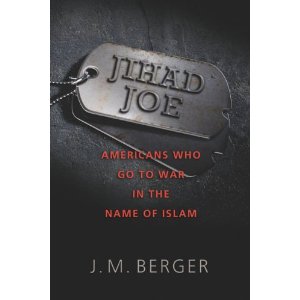
Book Review: JM Berger’s Jihad Joe

Monday, June 20th, 2011

[ by Charles Cameron — “homegrown” jihad ]

.
41nibyw1jbl_sl500_aa300_.jpg

Jihad Joe: Americans who go to war in the name of Islam

by JM Berger

Potomac Books, Inc, 2011, hard back, $29.95

*

The title by itself is striking — Jihad Joe – and captures nicely the somewhat surreal blend of the normal and the utterly strange that we encounter when we think about “Americans who go to war in the name of Islam” – the subtitle and topic of JM Berger‘s book. And think about them, know a bit about them, we should.

The big question, of course, is Why?

Berger writes early on of young men who gather “to focus their rage through a religious filter” and while noting that jihadists comes from varied backgrounds and travel for varied reasons, correctly zeroes in on the sense of obligation that a jihadist interpretation of Islam imposes:

While all major religions have rules that limit or justify war, a small but significant minority of Muslims believe that under the correct circumstances, war is a fundamental obligation for everyone who shares the religion of Islam. When war is carried out according to the rules, it is called military jihad or simply jihad. [emphasis mine]

The rage may spring from many sources, social, economic, political, but when religion is used to focus it, as Berger nicely puts it, that obligation is what provides divine legitimacy — and the promise of miracles, martydom and a paradisal afterlife – and the sense of serving a higher purpose, to otherwise quieter lives.

*

Berger starts at the beginning. After a brief mention of the presence of many Muslims under slavery, two early and distinctly American expressions of Islam (the Moorish Science Temple and the Nation of Islam), and the beginnings of Muslim Brotherhood activity as Egyptian and other Muslim immigrants brought more orthodox strands of Islam to the States, Berger alerts us to the idea that Americans leaving to fight jihad may have deeper roots than we think.

Bin Laden‘s mentor Abdullah Azzam, for instance, was in the US in the 1980s appealing for Americans to help the mujahideen in their resistance to the Soviet occupation of Afghanistan – a cause supported by President Reagan, who took tea with muj leaders for discussion and photo op, and by the wily Charlie Wilson of Charlie Wilson’s War. Azzam’s calls for volunteers were successful:

No one kept track of how many Americans answered the call, and no one in or out of the U.S. Government would venture a guess on the record. More than 30 documented cases were examined for this book. Based on court records and intelligence documents, a conservative estimate might be that a minimum of 150 American citizens and legal residents went to fight the Soviets.

Implications for today: this has been happening for a long time, it’s not something Anwar al-Awlaki invented just yesterday — and there have been times when the US was no too displeased at such activities.

Azzam’s appeal was precisely to the sense of a general, compulsory obligation for Muslims – fard ayn in Arabic – buttressed by tales of the miraculous and promises of paradise. I emphasize these points because their appeal is real. The day Al-Qaida was founded, an American was present, Mohammed Loay Bayazid, aka Abu Rida al Suri, and it was his reading of Azzam’s account of miracles among the jihadists in Afghanistan – apparent supernatural protection from and/or paralysis of superior forces, the “odor of sanctity” on martyrs’ bodies – that turned him from a not very pious Muslim into a volunteer jihadist. You can read the stories yourself — Azzam’s book is now available for download, in English, on the web.

I’m focusing in on the religious element because that’s my area, others will comment better than I on the military or historical aspects that Berger deals with. But Berger makes it clear that from its inception, Al-Qaida numbered Americans among its higher echelons, and bin Laden was “strangely enamored of Americans and people who had spent time in the United States” – if only for the very practical reason that their passports allowed them access most anywhere.

*

The first act of violence on American soil generally attributed to AQ, Berger tells us, was the 1990 killing of Rashad Khalifa in Tucson, AZ. Khalifa was the numerologically inclined leader of a Tucson mosque and translator of the Qur’an whose apocalyptic date-setting (2280 CE) I mentioned in my Zenpundit post Apocalypse Not Yet? a week ago.

Khalifa’s story leads into that of Al Fuqra, a group that Berger describes in some detail, writing of their “rural compounds and small private villages” and their “covert paramilitary training grounds” and noting that while they have been implicated in “at least thirty-four incidents … from bombings to kidnappings to murder … the government has never moved against the group in an organized manner.”

Berger turns next to the blind Sheikh Omar Abdel Rahman and his followers, soon joined by the AQ-trained bomb-maker Ramzi Yousef, and the 1993 bombing of the World Trade Center – which failed to topple the towers — leaving the task for Mohammed Atta to complete in 2001 under bin Laden’s command

1992 sees several thousand US troops in Arabia given briefings on Saudi culture – largely a matter of Wahhabist Islam – and four-day passes to visit Mecca at Saudi expense were available for converts. As the Bosnian crisis began to unfold, ex-military Muslims converted by these means formed a natural pool for recruitment as jihadists to defend their Muslim brothers against ethnic cleansing and genocide at the hands of their Serb neighbors.

With the combination of the first WTC bombing and the Bosnian jihad, the “far enemy / near enemy” combo was in place: jihad could draw on both local and global events to fuel its global plans, and find both local and targets to take down…

By the beginning of the 1990s, America was in AQ’s sights, though AQ was barely known to a handful of Americans. The 1993 Black Hawk Down incident in Mogadishu featured AQ-trained forces, and the Nairobi and Dar es Salaam embassy attacks were soon in the planning stages. In 1996, bin Laden publishes his declaration of war on America, and the CIA put together a first plan to kidnap him…

*

Anwar al-Awlaki enters the picture around this time, a complex man Berger calls “a study in contradictions” – “a gifted speaker who was capable of moving men to action”.

If the power of religion to focus rage, and the concept of jihad as a compulsory obligation, fard ayn, are two of our first take-aways from Berger’s book, here is a third: rhetoric is the tool that transforms the curious (pious or not so much) into the committed. Anwar al-Awlaki had “a powerful cocktail of skills” but they boil down to this: the ability to talks Islam casually, in the American manner, to American kids — in American English, in a way that appears pious and scholarly, presents jihad as both obligation and adventure, and moves them to action…

Three of the 9-11 hijackers were al-Awlaki contacts… Nidal Hasan, the army psychiatrist who massacred his fellow soldiers at Fort Hood… Umar Farouk Abdulmutallab, the suspected “underwear bomber”… Faizal Shazad, the Times Square bomber… the list of those who have known and been influenced by al-Awlaki goes on…

The history of AQ by now is well known, covered in such books as Lawrence Wright‘s The Looming Tower and Peter Bergen‘s The Longest War, so Berger can concentrate on the “home grown” side of things, featuring — alongside al-Awlaki — his clumsier precursor the AQ propagandist Adam Gadahn, and paying considerable attention to another less-than-widely reported aspect of the jihad – the Pakistani Lashkar-e-Taiba group and its ISI-assisted 2008 attack on Mumbai, India, for which the intelligence scouting was done by the Pakistani-American sometime DEA agent David Headley, and the subsequent planning of an attack in Denmark…Berger turns next to Somalia and al-Shabab – but you get the drift, he is offering us a thoroughgoing, fully researched tour of the various Americans and groups joined by Americans across the world, involved in waging jihad, against scattered local enemies, or against the “far enemy” – the United States.

*

Berger’s work is detail-packed and focused, and a useful resource for that reason alone. But it is also and specifically the work of someone who has read and talked with and listened to the people he is writing about, and his work carries their voices embedded in his own commentary. It thus joins such works as Jessica Stern‘s Terror in the Name of God: Why Religious Militants Kill and Mark Juergensmeyer‘s similarly named and similarly excellent Terror in the Mind of God: The Global Rise of Religious Violence.

Bringing us up to date, Berger offers an overview of jihadist use of the internet, paying special attention to English-language sites – Islamic Awakening, Revolution Muslim — emphasizing the peripheral nature of “forum” activities, but also crediting them as an active doorway to recruitment. Zach Chesser, Samir Khan, Jihad Recollections and Inspire magazine, they’re all here. Read Berger’s recent blog post on “gamification” after this chapter, follow him at @intelwire, and you’ll be ongoingly up to date on his thought…

Berger closes with a look at future prospects. The opening of this chapter – an overview of the history so far covered – speaks volumes:

The journey of the American jihadist spans continents and decades. Americans of every race and cultural background have made the decision to take up arms in the name of Islam and strike a blow for what they believed to be justice.

Many who embarked on this journey took their first steps for the noblest of reasons – to lay their lives on the line in defense of people who seemed defenseless. But some chose to act for baser reasons – anger, hatred of the “other,” desire for power, or an urge towards violence.

In the early days of the movement, it was possible to be a jihadist and still be a “good” American…

Berger neither condemns nor excuses: he sees, he asks, he researches, he reports. His observations of the current situation can thus be trusted to be driven by insight rather than ideology – not the most common of stances, but one we very much need.

He pinpoints as the first element that almost all American jihadists have in common as “an urgent feeling that Muslims are under attack”. Foreign policy implications? Yes indeed – but Berger is also looking to the Muslim community to take an approach less focused on what he terms a “litany of grievances” – valid though some of them may be – which in effect helps perpetuate a “counterproductive narrative” of how the US views and treats Muslims.

Once a narrative that America is at war with Islam is established, the argument for jihad as fard ayn can be made – and all manner of shame, frustrations, rage, violent tendencies, alienation and idealism can be unleashed under the jihadist banner.

Berger’s conclusion:

We must preserve the constitutional rights and basic human respect due to American Muslims while changing the playing field to create conditions in which extremism cannot thrive. These goals are not mutually exclusive – they are independent.

If principle and pragmatism are not enough reason to change the tone of the conversation, there isx one more thing to consider. It would be not only dangerous but shameful to prove that our enemies were right about us all along.

Berger’s is a book to read, certainly — and more significantly perhaps, a book to admire.


Switch to our mobile site

