zenpundit.com » military

Archive for the ‘military’ Category

Hand grenades: a two way street

Thursday, August 13th, 2015

[ by Charles Cameron — toys as weapons, weapons as toys, appearances, can be deceptive, ethnicities too ]
.

Before there were the realities we now know as “virtual reality” and “real life” there were the two known as “real” and “pretend” or “make-believe”.

Confusing pretend for real can be harrowing enough, as we saw this morning:

but the reverse has even more dire potential:

**

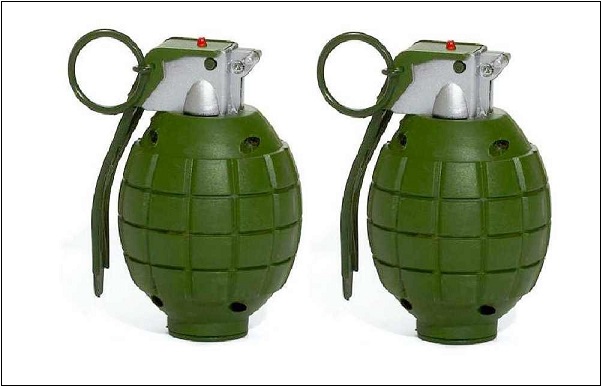
For the record, toy grenades are a a regular feature of the news these days, see for instance:

  • 26 June 2015, Bomb disposal team called to toy grenade in Coatbridge
  • 19 Octpober 2014, Toy grenade puts Newport News neighborhood on alert<
  • Get your Toy Grenades Battery Operated for Pretend Play on Amazon:

    Toy Grenades

  • Pull the grenade pin, press bar and throw!
  • Estimated Delivery Date: Aug. 14 – 19 when you choose Expedited at checkout
  • **

    Watch out, Staten Island:

    But then again..

    when is an assault rifle not an assault rifle?

    and come to that,

    when is a paintball more than a paintball — when is it a weapon?

    and when is the reason not just a paintball, but a scarf?

    — and if that’s not enough, is skin color a difference that makes a difference?

    Ah yes.

    Target and Walmart — another nice pairing that gives that last tweet just a touch of extra impact!

    Pete Turner on “Collecting Instability”

    Friday, June 12th, 2015

    [by Mark Safranski, a.k.a. “zen“]

    Collection Center Collects Instability

    Pete Turner of The Break it Down Show had a powerful post that encapsulated what is wrong with the American approach to intervention in foreign societies, both in terms of our aid and development programs as well as COIN and military assistance of various kinds.

    Collection Center Collects Instability 

    ….A good example of what we did involves things called Collection Centers, which our government built to afford Afghan farmers a place to showcase products to vendors. The Center is supposed to create greater revenue for farmers. Despite the best of intent, and a lot of hard work, the program was and remains an utter disaster.

    Why has the program been such a flop?

    We, the US, came in and established these centers without ever considering how the existing system worked. We never bothered to determine how changing the system might be accepted or rejected, or cause harm to those we intended to help. We didn’t consider if the Afghans even had a system (which, of course, they did).

    Instead of defining the existing system and assessing whether or how our tool might address a need, we just came in and started changing things It didn’t work, and we barely cared that it didn’t; and we reported the opposite.-

    An aside–the if you read the report, look for mentions of Afghan involvement in the process. You won’t find it.  

    I spoke with an Army Major in charge of the program and asked him about the existing local market chain from grower to consumer. He admitted that he didn’t know about it. When I asked why he was trying to change it, I was met with silence.

    We also never considered if we were creating a harmful situation for farmers, and that ignorance caused unexpected and undesirable outcomes. At the most basic level, Taliban fighters notice “western” influence. A farmer who uses (though they never actually did) the collection center is exposing his allegiance with the US and therefore putting his family and himself in jeopardy. Further, the farmer buyer relationship is established relationship. Changing the nature of their transaction is reckless in such a conservative, Taliban influenced place. What we can’t do is create a situation that is perceived to increase uncertainty for farmers.

    We built these centers throughout Afghanistan. At every instance, covering multiple units, I observed the same poor US decision-making. We never bothered to involve our Afghan partners in the decisions and never allowed them to guide us on how to work within their system. We forced these centers upon the people of Afghanistan, and wasted more than money and resources in the process. We wasted opportunities to actually improve the lot of the farmer, which makes de-legitimizing the Taliban fighters more challenging.

    Read the whole post here.

    Turner wore many different hats in Iraq and Afghanistan but in one extended tour in Zabul, Pete worked closely with political science Professor Richard Ledet, who in addition to his scholarly expertise, was uncannily good at donning local attire and blending in with Afghan villagers.

    Dr. Richard Ledet

    Turner and his partner Jon, interviewed Ledet recently on their program:

    What happens when an institution attempts to make changes intending to improve the lot of others? What if they ignore culture and fail to communicate with the people designed to receive a benefit from the change? We address these questions in ourepisode with Dr. Richard Ledet.

    We are fans of Rich. He’s a warrior, professor, surfer, hunter, all-around brilliant, rugged dude. His current gig is working as a Poli Sci professor at Troy University in Troy Alabama. Rich and I worked together in Afghanistan studying how effective or “affective” our work was as US assets helping Afghans. It’s not common for Poli Sci professors to get so close to the ground truth, and then to be able to test our policy and strategic programs as they implemented at the lowest level. This experience, we believe, is fascinating and applies directly to the real world.

    Listen to the interview here on The Break it Down Show.

    How shall “in the box” people think “outside the box”?

    Tuesday, June 2nd, 2015

    [ by Charles Cameron — a gadfly question ]
    .

    We have seen various conversations online in which its is plausibly suggested that YESness leads to upward mobility across an array of silos and disciplines, specifically including the intelligence community and the military — the end result being risk-averse group-think that is pretty much “inside the box” by definition.

    Similarly, we have noted that serious and nuanced issues are frequently debated in the media by those who are known for their general-purpose punditry or seniority, rather than by those with specific knowledge of and insight into the particular issues of concern.

    Question: How shall we get outside the box thinking from inside the box thinkers?

    WARLORDS, INC BOOK LAUNCH!!!

    Saturday, May 9th, 2015

    [by Mark Safranski, a.k.a. “zen“]

    This important and terrifying book should be read by everyone who cares about the future of human civilization.” Anatol Lieven

    Warlords, inc. ; Black Markets, Broken States and the Rise of the Warlord Entrepreneur, Edited by Noah Raford and Andrew Trabulsi

    Warlords, inc. a book to which I have contributed a chapter, is being launched today at The Long Now Foundation in San Francisco. Published by Penguin-Random House, Warlords, inc. was the brainchild of Dr. Noah Raford, who recruited an impressive group of experts, journalists, scholars and futurists to analyze and anticipate emergent security trends and irregular warfare among non-state actors, including terrorists, hackers, insurgents, sectarians and corporations.  With a foreword by Dr. Robert J. Bunker, the list of authors include:

    William Barnes
    Daniel Biro
    James Bosworth
    Nils Gilman
    Jesse Goldhammer
    Daniel S. Gressang
    Vinay Gupta
    Paul Hilder
    Graham Leicester
    Sam Logan
    Noah Raford
    Tuesday Reitano
    Mark Safranski
    John P. Sullivan
    Peter Taylor
    Hardin Tibbs
    Andrew Trabulsi
    Shlok Vaidya
    Steven Weber

    As editor, Andrew Trabulsi did a heroic job herding cats in editing this substantial volume and keeping all of the authors and project on track and on time. Warlords, inc. is available May 12 on Amazon and will be at Barnes & Noble and Target as well. Excited and proud to be part of this endeavor!

    New Article: There Are No Tea Leaves to Read About the Mosul Plan

    Friday, March 13th, 2015

    [by Mark Safranski, a.k.a. “zen”]

    There Are No Tea Leaves to Read About the “Mosul Plan”

    I have a new piece up at War on the Rocks ( which, by the way, is doing an important Indiegogo fundraising drive):

    THERE ARE NO TEA LEAVES TO READ ABOUT THE “MOSUL PLAN” 

    A mostly forgotten Arab adversary of American influence in the Mideast, the late Egyptian dictator Gamal Abdel Nasser, once said “The genius of you Americans is that you make no clear-cut stupid moves, only complicated stupid moves which make us wonder at the possibility that there may be something to them we are missing.”

    The Obama administration appears determined to live up to Nasser’s estimation of our strategic acumen.

    The latest evidence for this proposition would be the ill-fated affair of the administration’s former battle plan to retake the Iraqi city of Mosul from the butchers of the Islamic State in Iraq and the Levant (ISIL). Problems began at the inception when the anonymous but official Central Command (CENTCOM) briefer revealed a plethora of sensitive operational details to reporters, a move described by journalists in their stories as “odd,” “very unusual,” “rare.” The stories provoked a firestorm of criticism from members of Congress, the Iraqis, and within the Pentagon itself which predictably led the administration’s numerous admirers in the media to mobilize andtake up a defensive crouch, speculating as to the clever hidden motives for releasing the plan. [….]

    Read the rest here.

    The dust-up over the Mosul Plan is, in my view, symptomatic of dysfunctional organizational problems, especially with the senior White Hose staff and NSC.  The latter of which is now of enormous size, estimated 400-500 people, depending how you count various civil service employees and military personnel on “loan” from their agencies and departments ( a “mini-State Department”, in the words of one member of the natsec community).

    By contrast, Brent Scowcroft helped the collapse of the USSR to a soft landing and managed the Gulf War with an NSC of about 50.


    Switch to our mobile site