zenpundit.com » cultural intelligence

Archive for the ‘cultural intelligence’ Category

Debating the Mexican Cartel Wars at SWJ Blog

Monday, February 14th, 2011

Only Some Dare Call it “Insurgency”

A “must read” article by Dr. Robert J. Bunker at SWJ Blog:

The Mexican Cartel Debate: As Viewed Through Five Divergent Fields of Security Studies

….What is clear is that complex post-modern threats-such as those posed by the Mexican cartels and, for that matter, Al Qaeda and its affiliate network- do not fit into neat categories and well-defined security fields. What is needed is for a U.S. governmental „honest broker? or supra-security organization to come into the Mexican cartel debate and leverage the five fields of security studies highlighted in this essay into a broader networked effort. This effort must further be tied into issues pertaining to the trans-operational environments involving U.S. engagement with Mexican cartels and their affiliates. We can no longer afford the luxury of watching numerous fields of study and security response organizations-each with their own form of „extreme specialization?- independently going about their activities in a totally uncoordinated manner. Instead, attention should be directed at creating a hemispheric strategy for the Americas, possibly even global in scale, to directly challenge the rise of the Mexican cartels and their mercenary and gang affiliates along the entire threat continuum highlighted in this essay.

That the narco-cartels originally had illicit economic motivations and lack Maoist ambitions is apparently a very large obstacle for some orthodox counterinsurgency experts to wrap their heads around – despite the fact that if a group with a political identity were beheading rivals, assassinating police chiefs, kidnapping mayors, using propaganda of word and deed, setting off car bombs and fighting the Army, they’d call it “insurgency”.

While the USG is not supposed to call the narco-cartel war an “insurgency“, we appear to be starting to treat it as one.
 

The colors of hope

Thursday, February 10th, 2011

[ by Charles Cameron — cross-posted from Brainstormers on the Web ]

You know, we talk a lot about Facebook and Twitter as technologies for change, but how about painted fingers?

Sources: Iraq — and she was too young to vote! — Iran

Egypt: the Muslim Brotherhood as Rorschach test

Wednesday, February 9th, 2011

[ by Charles Cameron ]

quoikhwan.gif

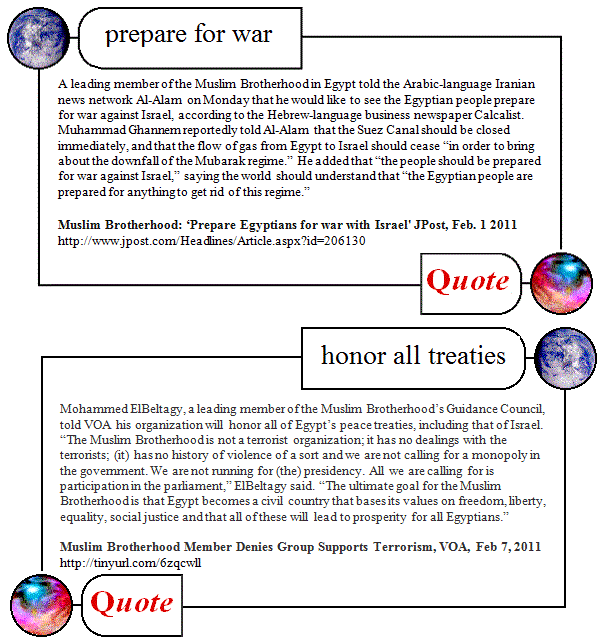
As far as I can tell from a quick search on Google, ElBeltagy is a Muslim Brotherhood MP, while Muhammad Ghanem is the Muslim Brotherhood’s representative in London.

Some will see in this DoubleQuote, further evidence of “taqiyya” — I think that’s quite a stretch. Some will see evidence of a struggle in which two opinions use media access as part of the process of jockeying for position — that seems a lot more plausible. Or it may be as simple as the left hand not knowing what the right hand is doing.

Here’s one analytic overview that came highly recommended by my more expert friends:

Hossam Tammam, Islamists and the Egyptian revolution

Of Anwar al-Awlaki and Bold Christian Clothing

Monday, January 24th, 2011

[ by Charles Cameron ]

I am, admittedly, very interested in religion, and Christianity has been the mother-lode for me of the imagery, gestures and profound words that can move heart, soul, mind and imagination into a greater depth.

Advertising, on the other hand… well, let’s just say that the best of it plays on imagination, too, but it is generally more of an intrusion upon – via billboards on landscapes, via commercials in movies, or via irritating jingles and catch phrases that subvert my best attempts at quieting the mind – than an experience of the kind of depth that religion at its best can offer.

But if you are interested in religion, and click online in enough of the right places, advertising that has “religious” content will be targeted to you.

*

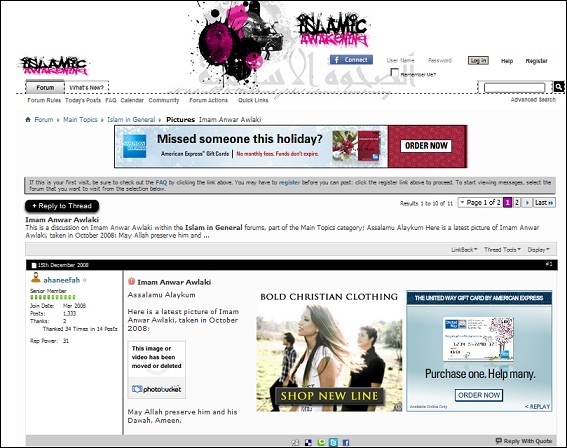
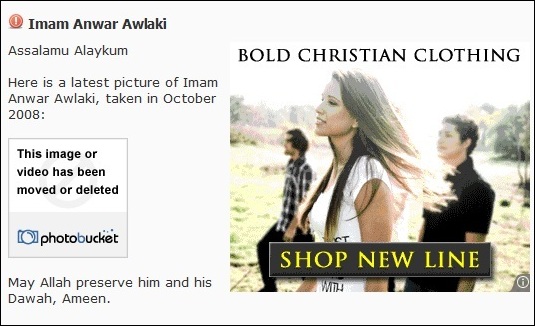
And so it is that I went online this morning to check out something about al-Awlaki on Islamic Awakening, an American jihadist forum, and found myself invited to consider, instead, wearing some “bold Christian clothing”.

This was while I was researching al-Awlaki, right? the Muslim jihadist preacher?

at:

a site with its own curious graphics…

And looking closer at that logo, isn’t that some sort of triumphalist armored vehicle I see?

*

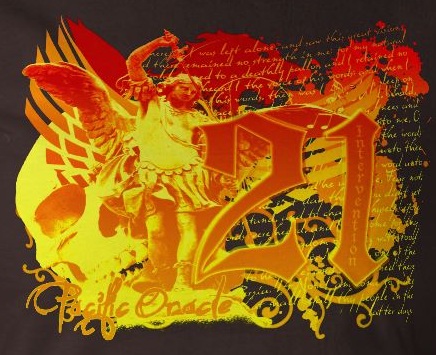
Well, never averse to a pretty girl, and noticing the one in the Bold Christian ad, I thought I’d taker a look at Bold Christian Clothing to find out what sort of fashion sense was popular among the younger Christian set just now, and found I could obtain t-shirts with such comforting images as these…

— this one’s symbolic of our relatively new century, I guess…

or this:

which I am praeternaturally fond of since my online moniker is hipbone, with its veiled reference to the Valley of the Dry Bones in that very same chapter 37 of Ezekiel…

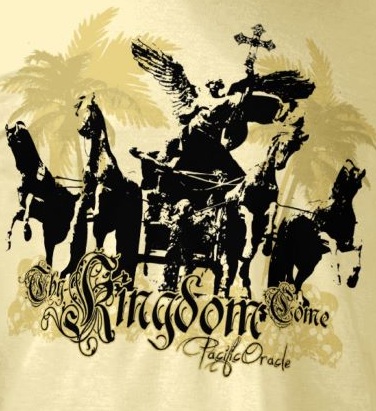
and then there’s this masterfully supremacist rendering of a part of the Lord’s Prayer:

which I must admit isn’t the image of Thy Kingdom Come that springs to mind when I personally hope and pray for heaven on earth.

What exactly is it, you may ask? According to the manufacturer, it’s

The Lord’s Prayer — “Thy Kingdom Come” with an Angel holding the cross, Horses, skulls under the horses, and palm trees (with Shield and Pacific Oracle cross logo added)

It’s also “the softest, smoothest shirt we sell” … “made from combed cotton for your added comfort” and gives “a flattering and stylish fit to virtually any body type”.

I on the other hand think it looks more like a photoshopped variant of the Quadringa statue in London that celebrates Wellington’s victory over Napoleon at Waterloo:

*

In light of all this, I do believe I’ll just wear white – although even that could be misinterpreted, I guess.

Cameron Guest Posts at Jihadology

Monday, January 24th, 2011

Charles Cameron ventures forth to conquer new blogworlds:

GUEST POST: Hitting the Blind-Spot- A Review of Jean-Pierre Filiu’s “Apocalypse in Islam”

Jean-Pierre Filiu’s book, Apocalypse in Islam (University of California Press, 2011) makes a crucially important contribution to our understanding of current events – it illuminates not just one but a cluster of closely-related blind-spots in our current thinking, and it does so with scholarship and verve.

Al-Qaida’s interest in acquiring nuclear weapons – and Iran’s – and the safety of Pakistan’s nuclear materiel – and the situation in Jerusalem – depending how you count ‘em, there are a half dozen or so glaring world problems where one spark in the Mahdist underbrush might transform a critical situation. And yet as Ali Allawi put it in his talk to the Jamestown Foundation on Mahdism in Iraq a few years back, Mahdists ferments still tend to be “below our radar”.

People are always talking about unintended consequences: might I suggest that blind-spots are where unintended consequences come from – and offer some background on apocalyptic, before proceeding to discuss Filiu’s contribution?

We already have a tendency to dismiss religious drivers in considering current events, having concluded in many cases that religion is passé for the serious-minded types who populate diplomatic, military and governmental bureaucracies world-wide – and we are even more reluctant to focus on anyone who talks about the Last Days and Final Judgment, despite the presence of both in the faith statements and scriptures of both Islam and Christianity. We think vaguely of cartoons of bearded and bedraggled men with sandwich boards declaring The End is Nigh, and move along to something more easily understood, something conveniently quantitative like the number of centrifuges unaffected by Stuxnet in Iran, or purely hypothetical, like the association of Taliban and Al Qaida in Afghanistan.


Switch to our mobile site