zenpundit.com » brain

Archive for the ‘brain’ Category

A Baghdad DoubleTake and other matters

Friday, December 31st, 2010

[ by Charles Cameron ]

Zen recently posted a video of a terrific hour-plus-long speech by Doug Hofstadter – one of the best videos I’ve ever taken the time to watch – in which Hofstadter, the guy who brought us Godel Escher Bach and much more, talked about analogy and suggested that it’s at the very core of human cognition.

I posted a poem and some comments in response — they got a bit mangled in terms of formatting, which may be fixed by the time you read this – and Zen then posed a question:

Charles – there’s a large portion of visual imagery in the passage you cite: do you think the incorporation of imagery (thus activating a powerful region of the brain) enhances or distorts the underlying conceptual connection in an analogical construction?

That’s what set me off this time…

*

I think of a poem as a braiding of three strands: a strand of sound or music, a strand of image, and a strand of meaning. For convenience, I’ll usually include a fourth – wit – but it’s actually more like a pearl that can be threaded on the strand of meaning.

From my POV, the poem is thus essentially a screenplay for the mind’s eye – and if a poem begins with strong music, at the very least I’d like it to end with strong music, if it starts with wit or wordplay, I’d like it to end with that too, and if it has imagery, I’d like the images to unspool in a way not unlike the images in a movie…

When I’m reading poems by others, and particularly if I’m teaching a poetry class, I’ll sometimes notice a sudden disjunction in one of the three strands. If it’s clearly for effect, all’s well and good – but if it’s unconscious, unintended, it will always reveal an aspect of the poem that hasn’t been worked through yet, and applying conscious attention to it will result in the emergence of new material from the unconscious store that enriches the final product. Sometimes, that kind of attention reaches something that was psychologically difficult, a disjunction in soul if you like – and the result of moving through it to the finished poem can be very much like a breakthrough insight in therapy.

But “poetry is not a hospital” – if Apollinaire didn’t say that, and I used to think he did, I shall.

*

From my POV, therefore, there are analogies of sound, analogies of meaning, and analogies of image. There’s an analogy of sound between tomb and womb – we call it rhyme. There’s certainly an analogy of meaning – whence we come at birth, whither we go at death. And if you like, there’s an analogy of image – when I think of the “twinning” of those two words, I see life itself as running across a brief stretch of grass between two caves…

When as here, the analogy runs across all three braids, you have a very powerful “conceit” or poetic device.

The graphic match, together with sonic rhyme, between the visuals of a hotel room fan and the rotors of a helicopter at the beginning of Apocalypse Now parallels the sense of explosive heat and frustrated inaction of Captain Willard trapped in Saigon with the sense of freedom and clarity he feels when sent on mission up-river – again, an analogy in three strands.

*

But analogy can also cut across the senses in a different way. Here’s Hermann Hesse‘s view of the Glass Bead Game:

Throughout its history the Game was closely allied with music, and usually proceeded according to musical or mathematical rules. One theme, two themes, or three themes were stated, elaborated, varied, and underwent a development quite similar to that of the theme in a Bach fugue or a concerto movement . A Game, for example, might start from a given astronomical configuration, or from the actual theme of a Bach fugue, or from a sentence out of Leibniz or the Upanishads, and from this theme, depending on the intentions and talents of the player, it could either further explore and elaborate the initial motif or else enrich its expressiveness by allusions to kindred concepts.

Beginners learned how to establish parallels, by means of the Game’s symbols, between a piece of classical music and the formula for some law of nature. Experts and Masters of the Game freely wove the initial theme into unlimited combination.

That’s analogy cutting across disciplines, and across sensory modalities too.

There was a period of about a dozen years when I almost completely stopped writing poetry, and concentrated on devising a variant on Hesse’s game that would be playable on a napkin in a café – conceiving of it as an art that would combine tight form (think: sonnet, sonata) with the entire spectrum or palette of human thought, visual, verbal, numerical, aural.

Hesse again:

The Glass Bead Game is thus a mode of playing with the total contents and values of our culture; it plays with them as, say, in the great age of the arts a painter might have played with the colors on his palette. All the insights, noble thoughts, and works of art that the human race has produced in its creative eras, all that subsequent periods of scholarly study have reduced to concepts and converted into intellectual values the Glass Bead Game player plays like the organist on an organ. And this organ has attained an almost unimaginable perfection; its manuals and pedals range over the entire intellectual cosmos; its stops are almost beyond number. Theoretically this instrument is capable of reproducing in the Game the entire intellectual content of the universe.

And that was written before the world wide web allowed us to mingle visual, verbal, numerical and aural elements so directly in a single presentation.

You can imagine how delighted I was, therefore, to stumble upon Sven Birkerts‘ writing:

There are tremendous opportunities, and we are probably on the brink of the birth of whole new genres of art which will work through electronic systems. These genres will likely be multi-media in ways we can’t imagine. Digitalization, the idea that the same string of digits can bring image, music, or text, is a huge revolution in and of itself. When artists begin to grasp the creative possibilities of works that are neither literary, visual, or musical, but exist using all three forms in a synthetic collage fashion, an enormous artistic boom will occur.

That’s what the HipBone Games were all about…

*

That’s what I was reaching for, back in the days before I even called my games the HipBone Games — when they were still TenStones Games played on a board whose geometry I borrowed from the Sephirotic Tree – when I played TS Eliot‘s poem, The dove descending, in juxtaposition to Vaughan Williams‘ piece for violin and orchestra, The lark ascending

…matching music with poem, descent with ascent, dove with lark, and the natural world of the English countryside with the “wrought” world of Eliot’s London in the pentecostal Blitz.

I don’t think Stephen or I had web browsers at the time – we played that game using AOL’s early texting function, so the music was entirely in the mind…

And I still think of that game as one of the loveliest expressions of the “hipbone” art.

Hesse’s game really is, for me, the continuation of poetry by other means…

*

But then it turns out that analogy is an incredibly powerful aspect of human thought – and one that, IMO, we haven’t explored very deeply, perhaps precisely because it jumps silos and disciplinary boundaries, and creates fresh insight

…which is pretty much as Doug Hofstadter was suggesting in that video Zen posted.

And so this fundamentally analogical frame of mind — which I had developed in a poetic and aesthetic context and applied to the symbolism so dear to the poets, cultural anthropologists, analytical psychologists, and comparative theologians and the like — turned out to be highly applicable and seen as highly creative when applied to real world issues, when I got a job for a couple of years at a small think-tank just outside DC.

Because if linear causality is the warp of the weave of the world, acausal patterning is its woof (or weft) – and frankly, our current techno-civilization is hopelessly warped in the direction of warp, and has very little understanding of woof, of weft, of pattern — of what can only be learned from analogy.

*

Not that there doesn’t have to be enormous care taken to avoid over-reading parallels. But consider the immediacy of the impact of this DoubleQuote, which I composed in 2003:
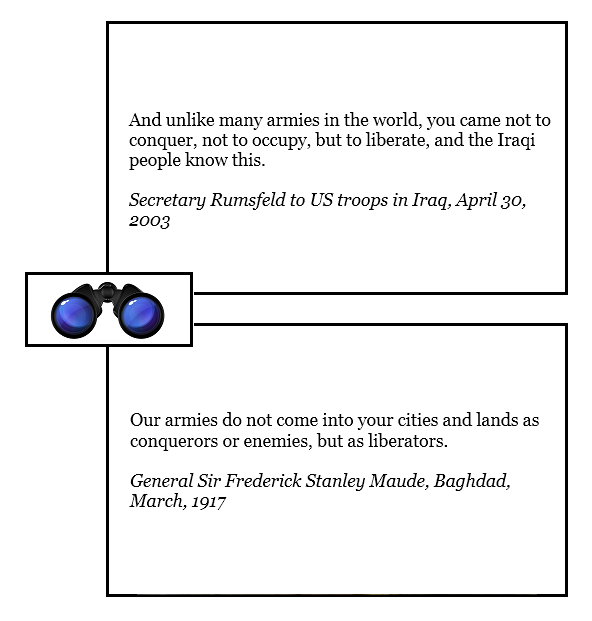
Eh, Zen?

Santayana echoes Marx refracts Hegel:

Hegel remarks somewhere that all great world-historic facts and personages appear, so to speak, twice. He forgot to add: the first time as tragedy, the second time as farce.

Those who cannot remember the past are condemned to repeat it

Seen from another angle: history has rhymes to match its reasons

Simplification for Strategic Leverage

Sunday, December 5th, 2010

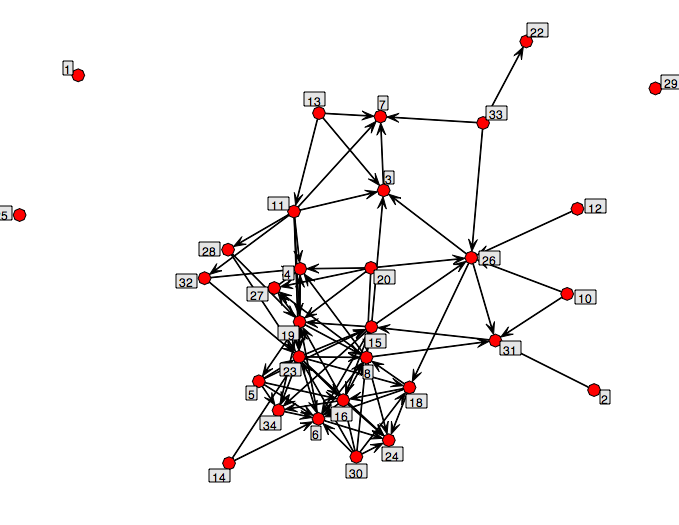
Remember this much ridiculed visual monstrosity?:

Excessively complex representations, much less the bureaucratic systems in practice, are poor vehicles for efficient communication of strategic conceptualizations to the uninformed – such as those downstream who must labor to execute such designs. Or those targeted by them for help or harm.  In addition to the difficulty in ascertaining prioritization, the unnaturally rigid complexity of the bureaucracy generally prevents an efficient focus of the system’s resources and latent power. The system gets in it’s own way while eating ever growing amounts of resources to produce less and less, leading to paralysis and collapse.

Does it have to?

Here’s an interesting, very brief take on analytical simplification from a natural scientist and network theorist Dr. Eric Berlow on how to cull simplification – and thus an advantage – out of complex systems by applying an ecological paradigm.

Cognitive simplification will be a critical strategic tool in the 21st century.

Metaphors as Catalyst and Scaffold

Friday, November 19th, 2010

Via John Hagel, a particularly interesting NYT article on the neroscience of metaphors. I have always considered metaphors and analogies to be a “spark” or a “catalyst” to insight but they appear to be potentially structural organizers or “signal switches” of information processing:

This Is Your Brain on Metaphors

….Symbols, metaphors, analogies, parables, synecdoche, figures of speech: we understand them. We understand that a captain wants more than just hands when he orders all of them on deck. We understand that Kafka’s “Metamorphosis” isn’t really about a cockroach. If we are of a certain theological ilk, we see bread and wine intertwined with body and blood. We grasp that the right piece of cloth can represent a nation and its values, and that setting fire to such a flag is a highly charged act. We can learn that a certain combination of sounds put together by Tchaikovsky represents Napoleon getting his butt kicked just outside Moscow. And that the name “Napoleon,” in this case, represents thousands and thousands of soldiers dying cold and hungry, far from home.

And we even understand that June isn’t literally busting out all over. It would seem that doing this would be hard enough to cause a brainstorm. So where did this facility with symbolism come from? It strikes me that the human brain has evolved a necessary shortcut for doing so, and with some major implications.

….This potential to manipulate behavior by exploiting the brain’s literal-metaphorical confusions about hygiene and health is also shown in a study by Mark Landau and Daniel Sullivan of the University of Kansas and Jeff Greenberg of the University of Arizona. Subjects either did or didn’t read an article about the health risks of airborne bacteria. All then read a history article that used imagery of a nation as a living organism with statements like, “Following the Civil War, the United States underwent a growth spurt.” Those who read about scary bacteria before thinking about the U.S. as an organism were then more likely to express negative views about immigration.

Another example of how the brain links the literal and the metaphorical comes from a study by Lawrence Williams of the University of Colorado and John Bargh of Yale. Volunteers would meet one of the experimenters, believing that they would be starting the experiment shortly. In reality, the experiment began when the experimenter, seemingly struggling with an armful of folders, asks the volunteer to briefly hold their coffee. As the key experimental manipulation, the coffee was either hot or iced. Subjects then read a description of some individual, and those who had held the warmer cup tended to rate the individual as having a warmer personality, with no change in ratings of other attributes.

From this simple associative effect are the conditions from which a “eureka” moment of insight can crystallize, as it did for Archimedes in his bath:

Effect—-> Association —-> Orientation ——> Insight ——> Extrapolation/Generalization

ADDENDUM:

Curtis has commented and expanded the discussion, though his comments seem to go into my akismet spam folder. Should be fixed now:

WOODA = C(OODA) + A(OODA) / 4GW & 5GW

There is the potential not only for insight but also for deception, whether the deceivers are others in our milieu or we ourselves (and our brains) may be deceivers….

True. Metaphors and analogies can crystallize insughts but they can also become powerfully attractive distorions of reality – sort of “anti-models” or  “false models”.

….As a model of what might be called metaphorization, these similarities make sense.  The OODA in all its forms, including the WOODA which includes World, represents a dynamic process of cycling (although perhaps not always uniform and unidirectional cycling) of information.  The focal point of the A-OODA, Observe above, is the abstract locus of observation:  New information received from without comes into contact (abstractly speaking!) with previously built understandings, or Mental Constructs, and relatively newer insights, or Conditional Constructs.  These diverse abstract observations have, to some extent, already prepared the mind for interpretation of new information and, these observations taken as whole create an opportunity for triangulation (of a sort.)  Using Mark Safranski’s terminology, after the information is Associated, it is Oriented through analysis and synthesis, Insights may form the basis of new hypotheses which may either be conditional (re-looped into further observation w/ outside information and previous understandings) or may be accepted as finalized understandings about what one has observed (Extrapolation/Generalization).

Hmmmm…. I have read that “insight” as a neurocognitive event tends to occur in two brain regions, the lateral inferior prefrontal cortex and the anterior cingulate cortex. The associative work of insight correlates with the former region but the “combinatory play” cited by Einstein and referenced , if I recall, by Charles and leading to new hypothesis correlates with the latter.  I am not a neuroscientist, so I am now wondering if insight is a distributed, parallel processing, brain function or if we are really talking about two separate cognitive effects – an “Insight 1” and “Insight 2”?

Anyone who cares to weigh in here, feel free…..

A Superb Exposition on the Power of Metaphor

Saturday, November 6th, 2010

A work colleague, of great height and formidible baldness, pointed me to a new, dynamic slideware app called Prezi.

While Prezi is interesting in itself for those of you condemned to give briefings and presentations, I was intrigued by one of their showcase demos on metaphors. A first rate, concise, presentation on metaphorical thinking  by Adam Somlai-Fischer; a strong cognitive bent, but very reachable for a general audience.

By the way, you should watch this presentation on “Autoplay” while listening to this:

Guest Post:A Hipbone Approach to Analysis III.

Saturday, October 30th, 2010


Charles Cameron is the regular guest-blogger at Zenpundit, and has also posted at Small Wars Journal, All Things Counterterrorism, for the Chicago Boyz Afghanistan 2050 roundtable and elsewhere.  Charles read Theology at Christ Church, Oxford, under AE Harvey, and was at one time a Principal Researcher with Boston University’s Center for Millennial Studies and the Senior Analyst with the Arlington Institute:

A Hipbone Approach to Analysis III.

by Charles Cameron

I’ve been slowly prepping this series of pieces about my analytic approach — and the mysterious business of “connecting the dots” — for a while, but.. Jeff Jonas, whose work I only recently ran across, has given me “another piece of the puzzle” and a slew of new dots to connect, so here’s a quick impression of some new (for me) terrain that connects with other areas I have long been familiar with.

1

What it comes down to in my post today is this: I would like to reconcile “connecting the dots” with “putting together the pieces of the puzzle”.

Both metaphors have to do with “seeing the big picture”, and one of them (“connecting the dots”) has to do directly with nodes and edges, i.e. with those systems we call graphs and networks, while the other suggests a far subtler set of connections.

Consider this: n+1 is the next dot in the series of integers after n, with “+1” being the only link necessary — you can represent that on a graph with two nodes and an edge. But if you had the sky of the northern hemisphere in one hand (hey, this is a thought experiment) and five square miles of landscape around Winchester Cathedral in the other, finding just where to fit the cathedral (and the surrounding, branching, leafy trees nearby) snugly into the sky would be a far trickier business, and the links between air and leaf and stone molecules would be very many — we should be grateful for the ease with which the sky accommodates itself in reality to the cathedral and the trees (and the cathedral and the trees to the sky) — and for the ease with which a painter like Turner can capture the effect…


Two puzzle pieces, I mean, may have to fit along many aspects of their intersection, while dots can be connected by a single common thread.

2

I’ve only recently “met” the mind of Jeff Jonas, but he has some remarkable things to say about puzzles — for one thing, he writes about the levels of, well, computation involved in solving a jigsaw puzzle:

The first piece you take out of the box and place on the work surface requires very little computational effort. The second and third pieces require almost equally insignificant mental effort. Then as the number of pieces on the table grows the effort to determine where the next piece goes increases as well. But there is a tipping point where the effort to determine where to place the next piece gets easier and easier … despite the fact the number of puzzle pieces on the table continues to grow.

That in itself is a fascinating thought to dwell on, in fact it’s the sort of piece of the puzzle that gives me an epiphany — Jonas talks about puzzle pieces that provoke epiphanies, too:

Some pieces produce remarkable epiphanies. You grab the next piece, which appears to be just some chunk of grass – obviously no big deal. But wait … you discover this innocuous piece connects the windmill scene to the alligator scene! This innocent little new piece turned out to be the glue.

I’m processing this as a theologian / philosopher / poet, and Jonas has just given me a new angle on the theme of the intersection of frames of reference that Arthur Koestler in The Act of Creation takes to be the fundamental element in insights ranging all the way from casual jokes about rabbis to — let me give you a more powerful example — the Taniyama-Shimura Conjecture which, if I’ve understood the layman’s version correctly, began as a hunch that the otherwise entirely distinct mathematical zones known as “elliptic curves” and “modular forms” could be mapped onto each other – and wound up once proven, successfully bridging algebra with analysis.

Now, I am no no no no mathematician — but I am a student of conceptual bridges, so if I’ve phrased myself poorly here, please bear with me. The point is to think freshly about how one idea connects with another.

Koestler’s insight at the intersection between two fields (for this is essentially a matter of multiple-frame, and thus cross-disciplinary, thinking) is, I’d suggest, Jonas’ epiphanic piece of the puzzle.

Awesome.

3

But as we are trying to figure out the puzzle pieces — and this applies to “what is the meaning of life?” as much as to “what threat should be uppermost in our concern?” — Jonas has more to throw at us:

There may be more than one puzzle in the box, some puzzles having nothing to do with others. There may be duplicate pieces, pieces that disagree with each other, and missing pieces. Some pieces may have been shredded and are now unusable. Other pieces are mislabeled and/or are exceptionally well crafted lies.

I would like to add that puzzles may not be the only thing in the (universal) box. There’s a quote that originates somewhere in Heidegger, to the effect that “A puzzle is the unknown, to be solved, while a mystery is the unknowable, to be entered into and dwelt within.” As I say, I’ve only just run into Jonas’ thoughts, but I’d like to integrate that piece of the puzzle in with the ideas he’s providing – why not have a go at the mystery too while we’re about it?

4

So what happens with ideas? How do they connect?

Hermann Hesse, the Nobel laureate in literature who gave us Siddhartha and Steppenwolf and The Journey to the East, won his Nobel for his most ambitious novel, The Glass Bead Game (Das Glasperlenspiel, also known in English as Magister Ludi). It is an amazing piece of work that inspired at least one other book by another Nobel laureate — Manfred Eigen’s Laws of the Game: How the Principles of Nature Govern Chance — gave John Holland (he of genetic algorithms) the ruling metaphor for his life’s work, was an early and profound influence on Christopher Alexander’s thinking about pattern languages, and in general serves as a catalyst for grand scale creativity among a disparate crowd of very bright minds.

It is about a game — a game on the order of the complete works of JS Bach. And the essence of the game is the juxtaposition of thoughts.

It is about “connecting the dots” and “putting together the pieces of the puzzle” on the grand scale, to create not a single link between ideas, not a small “bigger picture” deploying a half-dozen or so insights, but a vast architecture of ideas that encompasses all “deep” human thought and connects all “beautiful” cognizable patterns. Hesse uses the image of an organist playing an organ to describe the play of ideas that composes his Game, writing:

All the insights, noble thoughts, and works of art that the human race has produced in its creative eras, all that subsequent periods of scholarly study have reduced to concepts and converted into intellectual values the Glass Bead Game player plays like the organist on an organ. And this organ has attained an almost unimaginable perfection; its manuals and pedals range over the entire intellectual cosmos; its stops are almost beyond number.

And in Hesse’s central, musical metaphor, the myriad thoughts that comprise what he terms the “hundred-gated cathedral of Mind” are linked one with another by likeness — by identity, isomorphism, homology, symmetry, parallelism, opposition, analogy, metaphor…

5

I’ll have to move us deep into the territory of the arts and humanities here, because Hesse himself was supremely versed in those areas, but in doing so I would remind you that John Holland wrote of his life’s work, “If I could get at all close to producing something like the glass bead game I can’t think of anything that would delight me more.”

Here’s Hesse on the analogical / isomorphic nature of the moves that connect ideas — “only connect!” said EM Forster — in his great Game:

Throughout its history the Game was closely allied with music, and usually proceeded according to musical or mathematical rules. One theme, two themes, or three themes were stated, elaborated, varied, and underwent a development quite similar to that of the theme in a Bach fugue or a concerto movement. A Game, for example, might start from a given astronomical configuration, or from the actual theme of a Bach fugue, or from a sentence out of Leibniz or the Upanishads, and from this theme, depending on the intentions and talents of the player, it could either further explore and elaborate the initial motif or else enrich its expressiveness by allusions to kindred concepts. Beginners learned how to establish parallels, by means of the Game’s symbols, between a piece of classical music and the formula for some law of nature. Experts and Masters of the Game freely wove the initial theme into unlimited combinations. For a long time one school of players favored the technique of stating side by side, developing in counterpoint, and finally harmoniously combining two hostile themes or ideas, such as law and freedom, individual and community. In such a Game the goal was to develop both themes or theses with complete equality and impartiality, to evolve out of thesis and antithesis the purest possible synthesis.

It is Bach, it is Hegel, it is the very essence of creativity, it is the associative, metaphoric nature of mind and brain (and I won’t get more than toe-deep in the “deep problem” of consciousness here).

6

And it does involve combining the understanding of both puzzle and mystery, to return to that distinction from Heidegger:

I suddenly realized that in the language, or at any rate in the spirit of the Glass Bead Game, everything actually was all-meaningful, that every symbol and combination of symbols led not hither and yon, not to single examples, experiments, and proofs, but into the center, the mystery and innermost heart of the world, into primal knowledge. Every transition from major to minor in a sonata, every transformation of a myth or a religious cult, every classical or artistic formulation was, I realized in that flashing moment, if seen with a truly meditative mind, nothing but a direct route into the interior of the cosmic mystery, where in the alternation between inhaling and exhaling, between heaven and earth, between Yin and Yang, holiness is forever being created.

Hesse is proposing his intuition that the world of ideas is a mandala-form array of symmetries with a “vanishing point” in the center.

Well, I have leapt far from my original topic, Jeff Jonas’ comments on piecing together a puzzle, but I hope the bungee-cord I’ve been depending on has held your attention, and now as always, at the far end of the extension there’s a bouncing-back.

7

The human mind “connects the dots” and “pieces together the puzzle” by recognizing likenesses — pattern recognition, if you like.

But just how human analogical thinking functions is not exactly an easy question…


Switch to our mobile site