zenpundit.com » islamic world

Archive for the ‘islamic world’ Category

The Post-COIN Era is Here

Monday, January 25th, 2010

Learning to Eat Soup with a Spoon Again……

There has been, for years, an ongoing debate in the defense and national security community over the proper place of COIN doctrine in the repertoire of the United States military and in our national strategy. While a sizable number of serious scholars, strategists, journalists and officers have been deeply involved, the bitter discussion characterized as “COINdinista vs. Big War crowd” debate  is epitomized by the exchanges between two antagonists, both lieutenant colonels with PhD’s, John Nagl, a leading figure behind the U.S. Army/Marine Corps Counterinsurgency Field Manual and now president of the powerhouse think tank CNAS , and Gian Gentile, professor of history at West Point and COIN’s most infamous arch-critic.

In terms of policy and influence, the COINdinistas ultimately carried the day. COIN advocates moved from a marginalized mafia of military intellectuals who in 2004 were just trying to get a hearing from an  indifferent Rumsfeld Pentagon, to policy conquerors as the public’s perceptions of the “Surge” in Iraq (masterminded by General David Petraeus, Dr. Frederick Kagan, General Jack Keane and a small number of collaborators) allowed the evolution of a COIN-centric, operationally oriented, “Kilcullen Doctrine” to emerge across two very different administrations.

Critics like Colonel Gentile and Andrew Bacevich began to warn, along with dovish liberal pundits – and with some exaggeration – that COIN theory was acheiving a “cult” status that was usurping the time, money, talent and attention that the military should be devoting to traditional near peer rival threats. And furthermore, ominously, COIN fixation was threatening to cause the U.S. political class (especially Democrats) to be inclined to embark upon a host of half-baked, interventionist “crusades“in Third world quagmires.

Informed readers who follow defense community issues knew that many COIN expert-advocates such as Nagl, Col. David Kilcullen, Andrew Exum and others had painstakingly framed the future application of COIN by the United States in both minimalist and “population-centric” terms, averse to all but the most restrictive uses of “hard” counterterrorism tactics like the use of predator drones for the “targeted assassinations” of al Qaida figures hiding in Pakistan.

Unfortunately for the COINdinistas, as George Kennan discovered to his dismay, to father a doctrine does not mean that you can control how others interpret and make use of it. As the new Obama administration and its new commander in Afghanistan, General Stanley McChrystal conducted its internally contentious review of “AfPak” policy in 2009 on what seemed a geological time scale, the administration’s most restless foreign policy bigwig, the Talleyrand of Dayton, proposed using COIN as nation-building on steroids to re-create Hamid Karzai’s Afghanistan as the secure, centralized, state that it has never been.  Public reaction to this trial balloon was poor and the administration ultimately pared down General McChrystal’s troop request to 30,000 men, hedging a COIN based strategy toward policy suggestions made by Vice-President Biden.

So, COIN still reigns supreme, albeit with trimmed sails?

No.

We are forgetting something important about the ascendancy of COIN. It was not accepted by a reluctant Pentagon and the Bush administration because COIN is a very effective operational tool in the right strategic context – although that is certainly true. Nor was it because the advocates of COIN were brilliant policy architects and advocates – though most of them are. COIN became the order of the day for three reasons:

1) The  “Big Army, fire the artillery, fly B-52’s and Search & Destroy=counterinsurgency” approach proved to be tactically and strategically bankrupt in Iraq. It failed in Mesopotamia as it failed in the Mekong Delta under Westmoreland – except worse and faster. Period.

2) The loudest other alternative to COIN at the time, the antiwar demand, mostly from Leftwing extremists, of immediately bugging-out of Iraq, damn the consequences, was not politically palatable even for moderately liberal Democrats, to say nothing of Republicans.

3) The 2006 election results were a political earthquake that forced the Bush administration to change policy in Iraq for its’ own sheer political survival. COIN was accepted only because it represented a life preserver for the Bush administration.

We have just had another such political earthquake. The administration is now but one more electoral debacle away from having the president be chased in Benny Hill fashion all over the White House lawn by enraged Democratic officeholders scared out of their wits of losing their seats next November.

Republican Scott Brown, the winner in a stunning upset in Massachusett’s special election for Senator, certainly had no intention of undermining President Obama’s commitment to Afghanistan. To the contrary, he is for it in a far more muscular manner than was his hapless Democratic opponent. But that’s irrelevant. What matters is that in all the recent elections, Democrats have been clobbered by a “Revolt of the Moderates” – socially liberal, fiscally conservative, independent voters who came out in 2008 for Obama and are now shifting radically away from him. For the next year, politicians of both parties will be  competing hard for this bloc which means “deficit hawks” will soar higher than defense hawks.

America’s nine year drunken sailor spending spree is officially over.

Defense experts have long known that the post-9/11, record DoD budget expenditures were not going to be politically sustainable forever and that either a drawdown of combat operations or cancellation of very big, very complicated and supremely expensive weapons platforms or some combination of both would eventually be needed. That eventuality is here and will increase in intensity over the next five years, barring an unexpected economic boom. Spending $60 billion annually on Afghanistan, a nation with a GDP of roughly $ 20 billion, for the next 7 years, is not going to be in the cards. Not at a time of 10 % unemployment, when the Congress will be forced to cut Medicare, education, veteran’s benefits, eliminate COLA’s on Social Security or raise the retirement age and income taxes. Who is going to want to “own” an ambitious “nation-building” program at election time?

There is a silver lining here. Really.

COIN is an excellent operational tool, brought back by John Nagl & co. from the dark oblivion that Big Army partisans consigned it to cover up their own strategic failures in Vietnam. As good as COIN is though, it is not something akin to magic with which to work policy miracles or to substitute for America not having a cohesive and realistic grand strategy. Remaking Afghanistan into France or Japan on the Hindu Kush is beyond the scope of what COIN can accomplish. Or any policy. Or any president. Never mind Obama, Superman, Winston Churchill and Abe Lincoln rolled into one could not make that happen.

Association with grandiosely maximalist goals would only serve to politically discredit COIN when the benchmarks to paradise ultimately proved unreachable. Austerity will scale them back to the bounds of reality and perhaps a more modest, decentralized, emphasis. COIN will then become a normal component of military capabilities and training instead of alternating between pariah and rock star status inside the DoD.

Austerity may also force – finally – the USG to get serious about thinking in terms of comprehensive and coherent DIME-integrated national strategy (Ok – this is more of a hope on my part). Instead of having every agency and service going off in its own direction with strategic nuclear arms reductions being proposed out of context from our conventional military obligations and urgent security threats we might stop and look at how the two fit together. And how these should be in sync with our fiscal and monetary policies and our need to deeply invest in and improve our unsteady economic position in a very competitive, globalized world. The latter is of much greater strategic importance to national security than Afghanistan or whether or not Israel and Hezbollah fight another mini-war.

We are all COINdinistas now. Instead of being controversial, COIN having a secure place in our operational arsenal of ideas has become the new “conventional” wisdom; it is past time to look at some of the other serious challenges America has ahead.

ADDENDUM I:

First, I wanted to thank everyone for their lively responses, both comments as well as email. The critiques are very helpful, as are the large number of PDFs and links to related material. I am trying to catch up on my replies but first, I wanted to feature a link to Andrew Exum ‘s related but inside baseball article up at Boston Review:

The Conflict in Central Asia will likely mark the end of the current era of Counterinsurgency 

 ….Whether or not the United States and its allies are successful in Afghanistan, the conflict in Central Asia will likely mark the end of the Third Counterinsurgency Era. Counterinsurgency warfare has its roots in the colonial experiences of France and the United Kingdom as well as the pseudo-colonial experiences of the United States in the Philippines and Latin America. In the First Counterinsurgency Era, nineteenth-century French colonial military commanders such as Hubert Lyautey, Thomas-Robert Bugeaud, and Joseph Gallieni devised rudimentary “hearts and minds” campaigns that were—though often just as brutal as the conventional warfare of the time—at odds with then-contemporary thought on the employment of military force. 

….Michael Semple —with two decades experience working in Afghanistan and Pakistan—believes that it is, and that the Taliban and its allies cannot win. The balance of power, he argues, has shifted toward the Taliban’s natural enemies, and the Taliban hides this reality by dressing their civil war in the clothes of an insurgency being fought against Western powers. If this assessment is right, there may yet be hope for U.S. and allied efforts in Afghanistan. Because President Obama has pledged to begin a withdrawal from Afghanistan in eighteen months, time may be too short to execute a comprehensive counterinsurgency campaign. But there may be sufficient time to build up key Afghan institutions and allow Afghans to fight a civil war that will no doubt continue after the United States and its allies begin to withdraw.

ADDENDUM II – LINKS To This Post:

Most of these bloggers have extended the discussion into new dimensions or aspects. I will put a short, explanatory tag next to each where warranted.

RBO (Pundita)The cavalry has arrived: Mark Safranski takes on COIN; Pundita takes on Pakistan  Extensive examination of Pakistan

In Harmonium (Dr. Marc Tyrell)Is the post-COIN era here?  The conceptual-perceptual-cognitive implications of this debate

Shlok VaidyaZen is right  Constraints and innovation….and a great post title!

Newshoggers (Dave Anderson)COIN’s coins; political constraints on COIN  COIN = Clausewitzian disconnect

Wings Over IraqLink of the morning is here…  And the bonus Nagl/Gentile mash-up graphic!

SWJ BlogThe Post-COIN Era is Here  Comments on link excerpt have begun……

Guest Post: Charles Cameron on Khorasan – A Muslim Once and Future Kingdom

Tuesday, January 19th, 2010

 Charles Cameron, my regular guest blogger, is the former Senior Analyst with The Arlington Instituteand Principal Researcher with the Center for Millennial Studies at Boston University. He specializes in forensic theology, with a deep interest in millennial, eschatological and apocalyptic religious sects of all stripes.

Khorasan: A Muslim Once and Future Kingdom

by Charles Cameron

The title of an interview in a Taliban sponsored magazine with Hammam Khalil al-Balawi — the Jordanian jihadist physician and double-agent / informant who signed himself Abu Dujana al-Khorasani on jihadist forums, and carried out the recent CIA bombing in Khost — is intriguing in a self-referential, “Doug Hofstadter might like this” sort of way:

Interview with Brother Abu Dujanah al-Khorasani, a Well-Known Blogger in Jihadi Forums, and a Newcomer to the Land of Khorasan.

In his appearances on the web, al-Balawi / Abu Dujana had given himself the geographic cognomen “al-Khorasani” meaning “from Khorasan” — yet he was a Jordanian by birth, and the interview title calls him a “newcomer” to Khorasan, while the interviewer himself remarks, “Abu Dujanah al-Khurasani (sic) is actually now inside Khorasan, and the decision to travel to the lands of jihad is a divine blessing and a magnificent grace.”

The Khorasan that Abu Dujana “is actually now inside” is presumably Afghanistan on the literal, geographical level — but what of the Khorasan of the mind and heart to which, as his choice of handle indicates, Abu Dujana must have long aspired?

What is the significance of “Khorasan”?

It’s a bit like “Jerusalem” — only yesterday I was reading that Grand Rapids, Michigan is referred to as “Jerusalem” by some folk of Dutch extraction in the Pacific Northwest. I think we’ll get the sense of the idea if we call it of “Khorasan of sacred memory and present hope”.  As the UCLA scholar Jean Rosenfeld puts it (personal communication):

In any event, Khorasan refers to much more than a former region of the Islamic empires.  It has a mythical meaning that is being taken seriously as a “once and future kingdom” in the millennial mindset of al-Qaida.

The territory once called Khorasan — and the borders covered by that name shifted a great deal over the centuries — covered parts of what we now know as Iran (which still has a province named Khorasan), Turkmenistan, Uzbekistan, Afghanistan and NW Pakistan.  I’m finding references that suggest the name originally meant “the place where the sun rises” — the East, the Orient.

Rosenfeld suggests that Khorasan “is code in al-Qaida for the warrior sect itself” — “the army of the (future) caliphate in the mind of the International jihad” and thus, Al-Qaida in Fawaz Gerges’ broad sense.  My own reading ties it in with the ahadith about the “black banners of Khorasan” and the army which will sweep down from Khorasan to Jerusalem…

As I’ve noted before   there are many variant ahadith describing the army of the Mahdi.  Here is one commonly cited version:

If you see the black flags coming from Khurasan, join that army, even if you have to crawl over ice, for this is the army of the Caliph, the Mahdi and no one can stop that army until it reaches Jerusalem.”

Quite how we should align that with actual jihadist entities such as AQ core and or its subsidiaries or the various bodies called Taliban, however, I’m not sure. The clearest implication I can see is to the place of origin of the Mahdi’s army.

It is at least as much an eschatological as a geographic claim.

Since the imagery of Khorasan is closely tied to that of black flags, I would like to take a slight detour here.  We have seen that the black flags signify the army of the Mahdi, but what are its origins, and how widely is it used?

The Islamic Imagery Project at West Point Combating Terrorism Center lists “Black Flag” under the heading “Warfare Motifs“, saying:

The Black Flag (al-raya) traces its roots to the very beginning of Islam.  It was the battle (jihad) flag of the Prophet Muhammad, carried into battle by many of his companions, including his nephew ‘Ali ibn Abi Talib.  The flag regained prominence in the 8th century with its use by the leader of the Abbasid revolution, Abu Muslim, who led a revolt against the Umayyad clan and its Caliphate.  The Umayyads, the ruling establishment of the Islamic world at the time, were seen as greedy, gluttonous, and religiously wayward leaders.  The Abbasid revolution, then, was aimed at installing a new, more properly Islamic ruling house that would keep orthodox Islam at the center of its regime. Since then, the image of the black flag has been used as a symbol of religious revolt and battle (i.e. jihad).  In Shiite belief, the black flag also evokes expectations about the afterlife.  In the contemporary Islamist movement, the black flag is used to symbolize both offensive jihad and the proponents of reestablishing the Islamic Caliphate.

The flag is frequently identified with specific jihadist groups — thus Bill Roggio, writing in Long War Journal, refers to “the al rayah, the black flag of al Qaeda” in his 2007 article, “Musa Qala and the NATO offensive”.

Likewise, the Somalian president Abdullahi Yusuf Ahmed in 2006 is reported to have spoken in 2006 of “the ‘black flag’ of Al-Qaeda and the Taliban” — and as recently as this month, Al-Shabaab “vowed to replace the Somali flag with its (al-Shabaab’s) black flag”.

So the Black Flags or banners represent the Prophet as warrior at one end of Islamic history and the Mahdi’s army from Khorasan at the other — and have been adopted as symbols of jihad by different groups from the Abbasids to al-Shabaab. They are indeed indicative of jihad, but it is their association with Khorasan that gives them a specifically Mahdist reference.

The defeat of the Umayyads and establishment of the Abbasid caliphate, and hence also the golden age of Islamic culture, was strongly supported by forces raised in Khorasan, and David Cook in his Contemporary Muslim Apocalyptic Literature suggests that “the Abbasids sought to present their movement as the fulfillment of messianic expectations, and so they produced a great quantity of materials given in the form of hadith traditions to indicate that the Mahdi would come from this region.”

The tale lives on. As I’ve mentioned before, Cook notes that bin Laden’s mentor, Abdullah Azzam, made fresh use of this line of messianic tradition and “popularized the position of Afghanistan as the messianic precursor to the future liberation of Palestine” in his book, From Kabul to Jerusalem, while bin Laden refers to finding “a safe base in Khurasan, high in the peaks of the Hindu Kush” in his 1996 Declaration of Jihad.

The spiritual geography, then, is clear: Khorasan is that place in the east, somewhere in the general region including eastern Iran and northern Afghanistan, from which the Mahdi’s army will come — and it is very plausibly also a place the jihadist might need to “crawl over ice” to reach.

I think Rosenfeld is right in suggesting that al-Balawi’s geographic cognomen is a significant one, as is “Abu Dujana” — the name of a particularly valiant companion of the Prophet, as I discussed in a previous post.

But which of the various jihadist forces currently deployed in Afghanistan and nearby might be the nucleus of the Mahdi’s forces? The army with black flags from Khorasan has been identified with the Abbasids, with the Iranian revolutionaries, and with the Taliban. Bin Laden would presumably wish for it to be with al-Qaida, and Cook also says, this time in Understanding Jihad:

Since Afghanistan, as Khurasan, has powerful resonance with many Muslims because of the messianic expectations focused on that region, this gave the globalist radical Muslims associated with al-Qa’ida under the leadership of Bin Ladin additional moral authority to proclaim jihad and call for the purification of the present Muslim governments and elites.

In Jordan via the jihadist web forums, al-Balawi signaled his identification with the victorious army of the coming Mahdi and with jihadists in Afghanistan by his choice of the cognomen “al-Khorasani” — but the name alone does not tell us which particular jihadist group he might have been thinking of, and that may not even have been an question he felt the need to resolve at that time.

  Once in Khorasan itself, al-Khorasani left us two “media” items, a magazine interview and a video, and we might hope that they would add to our understanding of the more literal, geographical meaning his name carried, for they clearly indicate his associations.

According to Flashpoint-Intel, who provided the version of the interview I’ve seen, al-Khorasani’s interview was given to “Vanguards of Khorasan” which they describe as “a well-known Taliban propaganda magazine” and released by the Al-Fajr Media Center, which they term “the official online logistical arm of Al-Qaida”. SITE refers to “Vanguards” as “the … magazine of al-Qaeda in Afghanistan”. Others more familiar with the logistics may want to clarify the point.

The video, then, seems to give the clearest indication. Al-Khorasani was taped sitting next to Hakimullah Mehsud, the head of the Terik- i-Taliban Pakistan or TPP (whose death in a drone strike is reported but unconfirmed at the time of writing), and indicated his allegiance with the words, “We will never forget the blood of our emir Baitullah Mehsud” — referring to Hakimullah’s predecessor.

In general, “Khorasan” doesn’t appear to function as code for a particular jihadist organization, but as a more general symbol for victorious jihad — coming from the East, faithful to the truth, unstoppable, ushering in the Caliphate, serving the cause of the Mahdi, and thus heralding the End of Days.

I’m intrigued to note that the Australian analyst / scholar Leah Farrall at All Things Counter Terrorism blogged on Abu Dujana today  (after I’d “completed” this post) and closed her post with an aside. I’ll quote the whole paragraph for context, but it’s the last point that ties in here:

Another point of interest is Khorasani’s  internet history circa 2001- 2003. Despite what Khorasani said in his interview in the Taliban magazine ( I think it was the Taliban mag if memory serves), one does not get to be a forum administrator overnight. I watched another person rise through the ranks this way and he had direct contact with  a mid-level AQ commander. It still took him 18 months or so. This brings me back to my question about Khorsani’s early internet history and possible real world history. As an aside, back then, in the early days you didn’t write Khorasani, Kandahari etc unless you had been there. It was used as an identifier. This has changed in recent years but I do wonder about this with him too.

Leah’s curiosity on this point reminds me that along with the general symbolism of Khorasan, which I have tried to explore here, there are intriguing aspects to the particular use Abu Dujana made of the name.

I look forward to any further thoughts she may have.

Grateful thanks to Jean Rosenfeld for our very helpful conversations around this and related topics, and for the comment that gave me its title.

Five Questions: An Interview with Chief Ajmal Khan Zazai

Thursday, December 24th, 2009

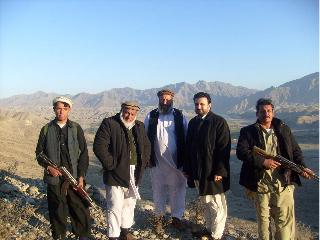
Those of you who also regularly read Steven Pressfield’s site, It’s the Tribes, Stupid have come across his interview series with Ajmal Khan Zazai, elected paramount tribal chief of his home district in the Zazi valley of Paktia province in Afghanistan ( near Tora Bora and bordering Pakistani Waziristan). Chief Zazai fought in the Soviet War and at one time, was imprisoned by Pakistan’s ISI. On March 15, 2000, the Taliban assassinated Chief Zazai’s father, Chief Raiss Afzal Khan Zazai in his family house in Peshawar, Pakistan.

As paramount chief, Chief Zazai raised a Tribal Police Force that is presently working with the U.S. Army’s 10th Mountain Division to secure the Zazi valley. Chief Zazai’s force has come under attack, as insurgents have fought to stop his efforts.  His commander, Amir Muhammad, has personally survived several assassination attempts in the last several months. On two occasions in 2008, warlord-financed hit men attempted to assassinate Chief Zazai. One attack nearly succeeded, leaving several wounded and one man deadzazai.jpg

Steve cordially arranged for me to ask Chief Zazai a few questions via email regarding his perspective on the historical background of the war against the Taliban and the current situation in Afghanistan. My questions are in bold type and Chief Zazai’s answers are in normal text:

FIVE QUESTIONS: AN INTERVIEW WITH CHIEF AJMAL KHAN ZAZAI:

1.  Some American academics have argued that the day of “the tribe” is long past in Afghanistan, having been battered by governmental intrusion and war since at least 1978, and that a better understanding of Afghan identity for Americans is to look at the “Qaum” and other very local loyalties. How accurate is that description?:

“Qaum” means “Tribe” in Pashtu and also in the Dari Language. 

The 1978 coup was not the first bloody revolution Afghanistan saw, as I have said on many occasions, Afghanistan has gone through many turmoils and turbulences throughout its history and has survived as a nation and country. For one to get convinced that after the 1978 Red revolution that the tribal structure was gone for good, then one would also have to argue how this tribal structure survived till 1978 when Ghengis Khan burned almost half of Afghanistan?  What about Hulagu Khan, Tamerlane, the Persian empire, the Mughals and prior to all that Alexander the Great? [The tribes ] having seen all these bloody empires and survive untill 1978 is amazing, isn’t it?

To justify the argument simply by referring to the 1978 bloody Red revolution and claim the tribal structure was gone, is dead and has vanished in Afghanistan, would simply be ignorance and a lack of understanding of the rich Afghan culture and Afghan way of life.

The Bonn Agreement appointed Hamid Karzai for 6 months as an interim President of Afghanistan back in 2002. When 6 months passed, did the UN or US call for election? No, of course not. Who then who appointed Mr. Karzai as a President for 2nd time to be the President of the transitional government? It was the “Loya Jirga” and not through the election process. A Loya Jirga is a pure Afghan Tribal process and procedure of making things happen!

Let’s take a look at how the current Afghan Constitution was approved  and came into an effect:

The constitution of Afghanistan was not approved by the Afghan Parliament and Senate as the Parliament and Senate did not exist at the time. In fact the constitution was approved by the “Loya Jirga”; although there was a large presence of the Warlords and criminals in both those Loya Jirgas, nevertheless they served their purpose.

Now, why would one argue that the tribal structure does not exist in Afghanistan or it’s a thing of the past? Closing our eyes from the truth does not mean the truth would vanish. We have a phrase in Pashto which means “One can not hide the sun with just two fingers”.

If one believes they need to find local loyalties in Afghanistan, the locals are the tribes. Why would some go around in [semantic] circles and confuse themselves? 

2.  In your interviews with Steve Pressfield, you discussed the presence of warlords in the Afghan government of Hamid Karzai, men with very bad records.  There have also been reports in the media, from time to time, of Ex-Khalqi Communists serving the regime. Are these men a similar problem to the warlords in your view?

When the Russians withdrew their forces in 1989 and left behind the Communist regime of Dr Najibullah, many thought that the regime would collapse in just days or in weeks, but Najibullah’s government survived for five long years despite the daily rains of rocket attacks on Kabul and only collapsed in 1992. Then the so-called Mujahideen took charge of Kabul and Afghanistan, but soon we saw that these power hungry men started fighting each other over the Throne of Kabul. Their bloody civil war of lasted from 1992 untill 1996 and turned Afghanistan into a pile of rubble.

 Many Afghans were turned against these so-called Mujahideen because these leaders and their commanders became involved in killing innocent men, women and children, looted people’s livelihoods and literally turned all of Afghanistan into a war zone. We witnessed that in just five years these “Mujahideen” warlords destroyed Kabul and all other major cities in Afghanistan. People started to hate them more than they hated the old Communists, so in a way, the crimes which were initially committed by the Communists were covered up when the Afghan people witnessed the subsequent brutality of these so-called Mujahideen leaders and commanders.

I strongly believe the Afghan civil war was also orchestrated by the  KGB/FSB in order to engage these Freedom fighters in Afghanistan and prevent them from crossing over to infiltrate the [formerly Soviet] Central Asian States, and also to cover the atrocities committed by the Red Army against the Afghans in Afghanistan. The KGB/FSB calculated shrewdly that if these “Mujahideen” leaders accomplished a united Islamic government in Afghanistan, it would spill over into the entire Central Asian countries. Although many believed in the West at the time that Russia was almost finished and gone, that was a mistake Westerners made in trying to understand the Russian mind set. 

I strongly believe that the Afghan Communists are responsible for the destruction of Afghanistan. They still have the Marxist-Leninist theory in their heads and we recently have witnessed that many of these Afghan ex-Communists are keeping close ties to Moscow. I believe these Khalqis and Parchamis are now part of the problem as they are now receiving support from Russia.   

3.  Afghanis, especially Pushtuns, have a well-deserved historical reputation as fierce fighters.  Yet there is more to life than war, even in a warrior society. What does a young Afghan man in his late teens or twenties hope for?  What would he see as “progress” or better times?

Much is been said about the Afghans, Pashtuns in the media and honestly I disagree with much of it because no nation, no tribe no people wish for a war as war only brings devastation, destruction and miseries.

Yes, the Afghans are great fighters, but that does not mean they wish for a war all their life. We needed to fight against the Russian invasion and I still strongly believe we have done the right thing defending our country and nation against Communism; as I said earlier, things went wrong when these so-called Mujahideen or Freedom fighters leaders started fighting one another. I believe every Afghan wishes for peace and stability in Afghanistan. Yes there are some who will continue fighting, but we all know they are small in numbers and are not significant. The reason many young men are part of the Taliban and other insurgents is the lack of employment , lack of better life conditions and of course lack of any positive attention from their government in Kabul. At this moment if you ask me, why are these young men are turning to Taliban and are fighting the US, NATO and the Afghan government? You will hear a simple answer from me and that is lack of employment opportunity for these youth who are mostly uneducated.

I will tell you my own experience: I was only 16 when I used to go to Afghanistan from Pakistan from time to time to fight against the Russians. I knew the consequences of being killed, but I was not going to Afghanistan in order to be killed, I was going to Afghanistan to fight the Russians. Now things are opposite, many young men are brainwashed by evil men and these young men wish to die, that’s why there are many suicide attacks now. I remember very well in my days when we were busy fighting the Russians, that we never had suicide bombers. This is very new to us and it has been brought form outside Afghanistan.

I believe the Afghan government and the US/NATO should provide training programmes to all those young Afghan men at around age of 16 and above who have lost the chance to go to school and get education. By learning skilled trades, I believe they will be in a position to earn a loaf of bread for themselves and their family and in this way we will prevent many young men from falling in the trap of believing being a suicide bomber means a life in the hereafter with the 72 virgins which will await them at the corridor of heaven.

4.  You have spoken at length with Steve Pressfield about the 10th Mountain Division and your positive relationship with them.  How successful have American and NATO units been in making connections elsewhere with Afghan tribal leaders compared to the 10th Mountain Division?

I do not have any information to the regard that if the US Army has any close contacts with other Tribal leaders. In my case, I have pushed hard for this partnership, regardless of any obstacles that were created for us to even have a decent understanding, but now it seems to be working. In the entire Afghanistan, I am the first Tribal Leader who denounced the Taliban and Al Qaeda openly and more practically, by forming TPF (Tribal Police Force) from my Tribesmen to fight these evil men without any financial assistance from the US Army, US Government, NATO or the Afghan Government. My TPF programme is by the people and for the people – I think it is on the same lines of your democracy “By the people and for the people”!

5). A friend of mine, the strategist Thomas PM Barnett, has been advocating a much greater international presence in Afghanistan, including not just NATO but China, Russia and India, with direct business investment as well as providing military and civilian aid workers. Would this development be a welcome one?

I believe this is a positive step in bringing a broader coalition and the entire International community to help and be involved in Afghanistan; but although this approach might be purely for business purposes, it could pose a future problem as most of these nations are not very sure of the US and NATO policy in the long term and present intentions. Afghanistan has always maintained very good and close relations with India, and throughout this friendship, India had no political ambitions and that what made India look good until the 90’s when India supported the Northern alliance. [As a result] I believe India has lost that status of being a neutral friend of Afghanistan. Also, the growing presence of Indians in Afghanistan is sending some disturbing alarms to our immediate neighbor (Pakistan).

Things needs to be balanced and Afghanistan needs a better understanding [of FDI] and not just bringing in anyone which could only lead to disruption and anxiety in long term. As an example, the large copper mines in Logar Province were won in a biding by a Chinese company – later it was revealed that the Chinese paid large kick backs to the minister of mines. In my opinion, involving more Chinese and Russian corporations would mean more corruption in Afghanistan.

Russian firms are already involved in Afghanistan. Most of them are involved in espionage and there are Chinese corporations and I believe they are doing the same. It would be more fruitful [for Afghans] for your friend to encourage Western corporations and companies to invest in Afghanistan.

Thank you, Chief Zazai.

None Dare Call it a Rogue State

Wednesday, December 9th, 2009


Reader Isaac, points to an excellent analytical overview of Pakistan’s national nervous breakdown at Dawn.com, by Nadeem F. Paracha. It is a lengthy but stupendous post with some 200 + comments:

Little monsters

There is nothing new anymore about the suggestion that over a span of about 30 odd years, the Pakistani military and its establishmentarian allies in the intelligence agencies, the politicised clergy, conservative political parties and the media have, in the name of Islam and patriotism, given birth to a number of unrestrained demons which have now become full-fledged monsters threatening the very core of the state and society in Pakistan.

A widespread consensus across various academic and intellectual circles (both within and outside Pakistan), now states that violent entities such as the Taliban and assorted Islamist organisations involved in scores of anti-state, sectarian and related violence in the country are the pitfalls of policies and propaganda undertaken by the Pakistani state and its various intelligence agencies to supposedly safeguard Pakistan’s ‘strategic interests’ in the region and more superficially, Pakistan’s own ideological interest.

….The 1980s and the so-called anti-Soviet Afghan jihad is colored with deep nostalgic strokes by the Islamists and the military in Pakistan. Forgetting that the Afghans would have remained being nothing more than a defeated group of rag-tag militants without the millions of dollars worth of aid and weapons that the Americans provided, and Zia could not have survived even the first MRD movement in 1981 had it not been due to the unflinching support that he received from America and Saudi Arabia, Pakistani intelligence agencies and its Afghan and Arab militant allies were convinced that it was them alone who toppled the Soviet Union.

The above belief began looking more and more like a grave delusion by the time the Afghan mujahideen factions went to war against one another in the early 1990s and Pakistan was engulfed with serious sectarian and ethnic strife. But the post-1971 narrative that had now started to seep into the press and in many people’s minds, desperately attempted to drown out conflicting points of views about the Afghan war by once again blaming the usual suspects: democracy, secularism and India.

Many years and follies later, and in the midst of unprecedented violence being perpetrated in the name of Islam, Pakistanis today stand more confused and flabbergasted than ever before.

The seeds of the ideological schizophrenia that the 1956 proclamation of Pakistan being an ‘Islamic Republic’ sowed, have now grown into a chaotic and bloody tree that only bares delusions and denials as fruit.

Read the rest here.

There has been an ocean of ink spilled about the Obama administration’s Hamlet-like deliberation over a war strategy for Afghanistan and on the implications of agreeing to 30,000 rather than the 40,000 new troops for the “Afghan Surge”, as Gen. McChrystal had originally requested. The 10,000 difference in boots is not the salient strategic point, though it is the one that excites political partisans on the Right, Left and anti-war Far Left. It also distracts us from debating our fundamental strategic challenge.

The horns of our dilemma is that our long time “ally” whom we have hitched ourselves to in a grand war effort against revolutionary Islamist terrorism is not our ally at all, but a co-belligerent with our enemy. By every policy measure that matters that causes the United States – justifiably in my view – to take a tough stance against North Korea and Iran, applies in spades to Islamabad. Yet none dare call Pakistan a rogue state.

It is the elephant in our strategy room – if the elephant was a rabid and schizophrenic trained mastodon, still willing to perform simple tricks for a neverending stream of treats, even as it eyes its trainer and audience with a murderous kind of hatred. That Pakistan’s deeply corrupt elite can be “rented” to defer their ambitions, or to work at cross-purposes with Pakistan’s perceived  “interests”, is not a game-changing event. Instead, it sustains and ramps up the dysfunctional dynamic we find ourselves swimming against.

We play a bizarre game, our leaders being more concerned about Pakistan’s “stability” than Pakistan’s own generals and politicians who egg on, fund and train the very militant Islamist groups spreading death and chaos inside Pakistan and beyond its borders. Why can we not find Osama bin Laden or Mullah Omar ? Because they are high value clients of the ISI which is no more likely to give them up than the KGB was to hand over Kim Philby.  

Until America’s bipartisan foreign policy elite grapple with the fact – and it is an easily verifiable, empirical, fact – that Pakistan’s government is in chronic pursuit of policies that destabilize Central Asia, menace all of Pakistan’s neighbors, generate legions of terrorists and risk nuclear war with India, no solutions will present themselves.

A strategy will only have a chance of success when it is grounded in reality.

Metz on the Afghan Surge

Friday, December 4th, 2009

Nothing like dueling Steves (see previous post).

Dr. Steve Metz of SSI compares the surges of Obama and Bush and finds them to be cut from the same cloth. Hat tip to SWJ Blog.

How Obama”s Surge is Like Bush’s

….Ultimately, though, the Obama strategy in Afghanistan and the Bush strategy in Iraq are more alike than different–variations on a theme rather than stark alternatives. Both were attempts to give a beleaguered ally an opportunity to reverse its slide into disaster. And both were gambles. In Iraq, President Bush bet that the Maliki government would rein in sectarian violence, and that the Iraqi Security Forces were nearly ready to assume responsibility for their nation’s security. This panned out. Now President Obama is making the same bet. His strategy is contingent on the Afghan security forces, bolstered by increased assistance from the U.S. military, being able to conduct counterinsurgency on its own by 2011. Even more importantly, Obama’s plan is contingent on the Karzai government’s reining in its crushing corruption and addressing the myriad problems that the Afghan people face. If the Afghan security forces or the Karzai government are not up to the task, nothing the United States can do will matter. A surge of 20,000, 30,000, or 100,000 would be equally irrelevant. Unfortunately, only President Karzai and the Afghan security forces can determine whether the Obama strategy works. Our fate is in their hands.

Read the rest here

Steve has spotted a poor contingency for the administration to rely upon. Putting the war strategy on Karzai’s performance is akin to building a house on quicksand. It might look a little like wet cement but it is not going to harden into a foundation no matter how much time passes. We need to work within the parameters of our own capacities and with realistic and not utopian options.

We’d garner more goodwill giving every Afghan child a pony than by waiting for villagers to see honest officials from Kabul appear. It’d be cheaper too.


Switch to our mobile site