zenpundit.com » Perception

Archive for the ‘Perception’ Category

Social and Individual Components of Creativity

Thursday, April 14th, 2011

This is very good. And it is fast.

I have enjoyed several of Steven Johnson’s previous books, Emergence and Mind Wide Open and his latest one, Where Good Ideas Come From looks to be a must read, though I think those of you who have read Wikinomics or works like Flow by Mihaly Csikszentmihalyi will find some of Johnson’s points in the video to be familiar as will those long time readers who have seen my views on horizontal thinking   and  insight.

My students watched this and reacted by defining themselves as those who were creative mostly through social collaboration but a decided minority required solitude and an environmental filter to think clearly and creatively – not a catalyst of a series of  social-intellectual stimuli. For them, the cognitive load generated by the environment amounted to an overload, a distracting white noise that short-circuited the emergence of good ideas.

This suggests to me that there are multiple and very different neuronal pathways to creativity in the brain and a person’s predisposition in their executive function, say for example the classic “ADHD” kid at the back of the class, may have different requirements to be creative than a peer without that characteristic. It also means that creativity may be subject to improvement if we can cultivate proficiency in several “styles” of creative thinking.

Martyrologies and the Undead

Saturday, April 9th, 2011

[ by Charles Cameron ]

*

How things stay the same, and change!

quo-martyrologies.jpg

The first book cover is that of Abdullah Azzam‘s account of miraculous events associated with shahids / martyrs among the mujahideen in Afghanistan during the fight against the Soviets, while the second is a Dar al-Murabiteen Publications compilation of stories of jihadist martyrdom. In effect, they are both devotional propaganda items, using the deaths of the fallen to inspire the actions of the living:

And call not those who are slain in the way of Allah “dead.” Nay, they are living, only ye perceive not.

Qur’an, 2. 154.

Two shifts are worth noting between the two of them:

First, the Dar al-Murabiteen cover design betrays an awareness of the pop-cultural ubiquity of the undead meme – whether it’s applied in books, games or films, to vampires or zombies… as exemplified here:

undead-warrior-model.jpg

Second, the shift from a classic Islamic to a pop cultural title is accompanied by a shift from a local to a lunar graphic background and from a contemporary armored vehicle silhouette to a silhouette of a mythic horseman-warrior…

The Dar al-Murabiteen effort is thus both more contemporary and more archaic — hip and contemporary to catch the attention of western youth, archaic and mythic to give resonance to the idea that the glorious past, the past of Saladdin, the past of Ali, is lived again in present reality.

That’s master narrative in the form of imagery.

Of Quantity and Quality I: weighing man against book

Tuesday, April 5th, 2011

[ by Charles Cameron ]

*

It may be that the hardest thing for a human to wrestle with is the correlation of quality with quantity.

.
One:

I’m writing this post by way of a response to the comments of J Scott Shipman and Fred Zimmerman on my earlier post, Burning scriptures and human lives — but as I said in a comment of my own there, not in a point by point fashion, more in the manner of a meditation. Our conversation grew out of a discussion of the killing of humans and the burning of Qur’ans, and perhaps I should say at the outset that in my view, the burning of sacred books is in general a pretty offensive business, the taking of human lives in general even more so.

.
Two:

If, however, we wish to know our enemies, as Sun Tzu advises, let alone to love them, as Christ suggests, we might reflect that what is happening these days in Afghanistan in many ways resembles what was happening in Europe a few short centuries back:

A little later, after the definition of the dogma of transubstantiation by the Fourth Lateran Council in 1215, a new libel surfaced, known as host desecration. According to this calumny, the Jews obtained a consecrated host from the mass, with the assistance of a Christian who retained it from the administration of communion, took it to their synagogue or homes and subjected it to every indignity, including trampling on it and sticking pins into it. … The accusation was made for the first time at Belitz, near Berlin; all the Jews of the town were burned. One hundred instances of the charge have been recorded, in many cases leading to massacres.

William Nichols, Christian Antisemitism: A History of Hate, pp 239-40

William Gibson is frequently quoted as saying, “The future is already here — it’s just not very evenly distributed” – and by the same token, the past is still with us, and no more evenly distributed.

For myself, I don’t see how I can condone or judge those whose values are as radically different from my own as those Christians, these Afghans – or the “religious but unstable” woman in Spartanburg County, Tennessee, who chained up and burned her nephew’s dog because it had chewed her Bible and was clearly a “devil dog”. Thankfully, it is neither mine to condemn nor to forgive.

.
Three:

I value human life way more than I value any physical book – and I revere those insights, not infrequently found in scriptures, which encourage love, wonder, compassion, insight, wisdom, peace, generosity, gratitude and praise…

I revere them enough that I can understand Sir Thomas More preferring to surrender his own life rather than to go against that which his own traditions, scriptures, and sacraments had taught him to venerate. Likewise, I can find no fault in the Zen of the monk who famously burned a wooden statue of the Buddha when the firewood ran out… a tale that is worth repeating:

In a famous zen story, a travelling monk was resting in a monastery during a cold night. He took down a wooden Buddha statue and used it as fire wood.When the resident monks saw what he did, they became very angry and demanded to know why he did that.

He replied “I am looking for sarrira (holy relics).

The monks then laugh and exclaimed: “How can one find sarrira in a wooden statue?”

In reply, the travelling monk then said “Well then, can you pass me that other wooden statues also?

.
Four:

I once climbed the many stairs and stood on the small platform atop the head of the great 6th century Buddha of Bamiyan, which just ten years ago was demolished by the Taliban, and I remember that day with great affection.

Historically speaking it is a tragedy for the world and the Afghan people that the Buddhas were destroyed.

What Buddha taught, remains, however. What the Beatitudes taught, remains., despite what dogs may chew. What the Qur’an teaches remains, beyond the pastor’s fire. What the host at the Eucharist embodies, remains…

It is in the sense of what I have written above that I wrote, “The value of one human life is the value of the world. The Qur’an is indestructible. It is deeply inadvisable to threaten, attempt or facilitate the destruction of man, world, or book…”

.
Five:

Mind you, I am not suggesting that others should share my view – my own life experiences just don’t encourage me to use scriptures or credal statements against others until I have first “removed the beam from my own eye”. In the meanwhile, I take my inspiration where I can find it.

.
Six:

And find it I do in this comment on my previous post, from Jimpa:

Books are paper and ink and can be republished. A human life is a miracle of creation (regardless of whose theory is used to explain it.) There is only one of each of us there are no copies of anyone, even cloning can not create a replacement.

To me, this gets to the spirit and clarity of the matter.

.
Seven:

But there’s also its soul, its blues if you like, its duende – and I find that quality – another voice in the music of inspiration, perhaps, in this impassioned post by Abu Muqawama, aka Andrew Exum:

The crime was horrific, and the mob outside the jail was angry. They had gathered before and demanded the death of the man inside, but a conservative cleric, who ran a religious school for boys, had appeared and told them all to go home and repent before God. Because the men in the mob were all religious and obeyed this particular cleric, they went home as he had ordered. When the crowd returned a few days later, though, while that cleric was away preaching elsewhere, they fought their way past the guards and found the man for whom they were looking. The man was from a minority group in the area, and though he was actually innocent of the crime of which he had been accused, that did not stop the violent mob from beating him horribly, tying a rope around his neck and throwing him off a bridge while hundreds cheered.

The year was 1906, and the place was my hometown of Chattanooga, Tennessee. The name of the man killed was Ed Johnsen, a black man who had been accused of the brutal rape of a white woman, Nevada Taylor. (The conservative cleric? Well, that madrasa he founded has produced several U.S. senators, governors, businessmen and one dyspeptic defense policy blogger.) …

The reason I mention the story, though, is because it popped into my head when I read my friends Dion and Maria’s account of what had happened in Mazar-e Sharif a few days ago when several innocent United Nations workers were brutally murdered because some fundamentalist crank in Florida thought it would be a hot idea to videotape himself burning a Quran. It was not that long ago, we should remind ourselves going into a discussion of what happened in northern Afghanistan and why, when the ugly kinds of mob scenes we saw in Mazar might have also happened in the United States. (The last lynching of an innocent black man of which I am aware took place in the American South in 1981.)

I see those two posts as working together like head and heart — the “soul” and richness of feeling in Abu Muqawama’s post adds depth to the “spirit” and clarity of thought in Jimpa’s. To have a high standard of measurement is fine — to forget one’s own human frailty, not wise at all.

[ to be continued in Of Quantity and Quality II: weighing man against world ]

Of the Mahdi and the Matrix

Saturday, April 2nd, 2011

[ by Charles Cameron ]

*

There’s a book by Douglas Harding that I very much doubt Samir Khan has read, which may still be relevant to the ad in Inspire #4 that Jarret Brachman pointed to in this piece on Cronus Global — in which he notes the parallel between Inspire‘s ad featuring the choice between paradise and hell, and the choice featured in The Matrix between the blue and red pills…

jarret.jpg

That image, with its headless figure, put me in mind of another image that greatly interests me — a portrayal of the Imam Mahdi by Mahmud Farshchian — so I rescued it from my files to see if it was a good enough match with the ad for me to suggest a possible second graphic influence to Jarret:

16_imam-zaman2.jpg

Not surprisingly perhaps — considering that Samir Khan’s work is, putting it crudely, an advertising graphic, whereas Farshchian’s is a work of devotional art, and that furthermore Inspire is a Salafi-jihadist journal while Farshchian is a pious Shi’ite — the match isn’t close enough for me to argue influence…

But it did set me thinking.

*

The title of the Harding book to which I referred above is On Having no Head, and although it now carries the subtitle Zen and the Rediscovery of the Obvious it actually draws on Islamic traditions quite a bit, quoting Rumi:

Behead yourself! … Dissolve your whole body into Vision: become seeing, seeing, seeing!

and Attar:

Cover your breast with nothingness, and draw over your head the robe of non-existence.

and proposing — I’m putting this into my own words, now — the notion that the physical form of a human face is in some sense no more than a mask, veil or hijab over that light “which lighteth every man that cometh into the world” (John 1.9) — a light too profound for the conventional gaze.

And it is this profundity, attributed in Islam to the prophets in general and superlatively to Muhammad, which makes their literal portrayal a matter of some controversy…

*

Farshchian’s Imam Mahdi, like Khan’s Islamist Morpheus, is headless, I’m suggesting, because, to speak figuratively, radiance has taken the place of the face.

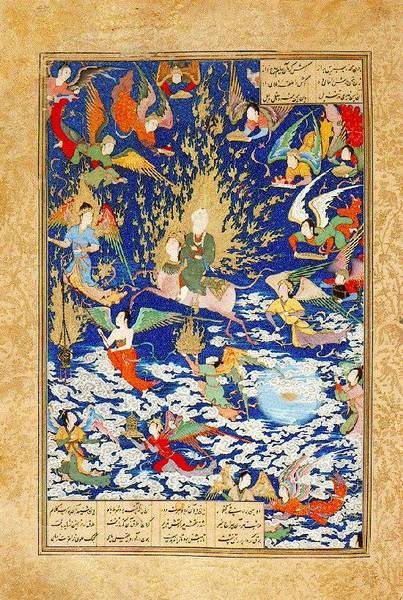
Which is also why, in this image of what must be for Muslims one of the holiest nights in the history of the world, the Night of the Mi’raj, the Prophet is portrayed without a face — or veiled — in this Persian miniature:

miraj_by_sultan_muhammad.jpg

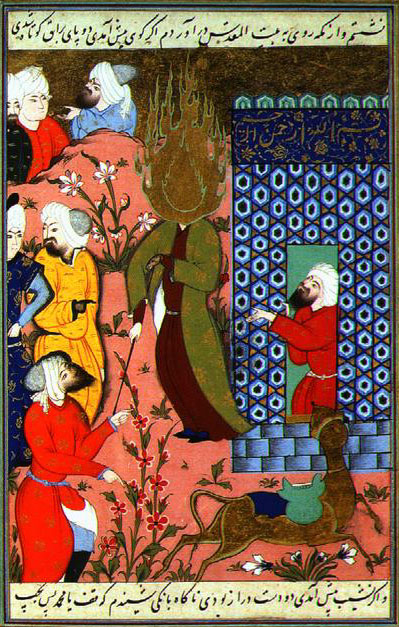
and transfigured by his own fiery “halo” of illumination in this one:

muhammad_miraj1.jpeg

Pity America the Un-Philosophical

Tuesday, March 29th, 2011


I attempted to leave a short amusing response at Foreign Policy.com but was thwarted by their comment system, so I am writing a pedantic post here instead.

Joshua Keating, bursting with admiration for Bernard-Henri Levy, laments the lack of enlightenment of American politicians compared to their much cooler French counterparts:

Libyan intervention: Brought to you by Bernard-Henri Levy?

….I was going to write some kind of quip along the lines of, “Can you imagine President Obama taking phone calls from [American philosopher] in the oval office while he debates whether to send U.S. troops to war,” but I can’t even think of a name for whom that joke would make sense. 

France and Germany have a tradition of publicly engaged philosophers that’s pretty much alien to the United States. The idea of an American BHL or even Jurgen Habermas seems pretty laughable. Economists like Paul Krugman are the go-to public intellectuals here while philosophy has become an increasingly specialized and technical discipline, even within academia. What effect the prominence of philosophers in public life has on a country’s political culture and policies is a pretty promising subject for further research.

Heh. 

Philosophers have never had much of an impact on American public life and the politics of their times except…. maybe…. for William James, Reinhold Neibhur, John Dewey, Leo Strauss, Walter Lippmann, Ayn Rand, Herbert Croly, Sydney Hook, Allan Bloom, James Burnham, John Rawls and Thomas Kuhn. That’s just off of the top of my head. If you want to include economists as philosophers who influenced contemporary American political life – and, frankly, we often should – add Adam Smith, Karl Marx, John Maynard Keynes, Friedrich von Hayek, Ludwig von Mises, John Galbraith and Milton Friedman to the list. It should not need to be said, but America was founded on the ideals of philosophers like John Locke, Baron de Montesquieu and Cicero by men deeply steeped in moral and political philosophy. Some of the founders would have qualified as philosophers themselves.

I don’t know much about Mr. Keating. Pretty sure he is a sharp guy, but I bet he is 35 or younger and was a journalism or polisci grad. Academic philosophy as a profession has been increasingly irrelevant to policy makers or the general public as described, Keating is spot on there, since the early mid-60’s, which is probably the entirety of his life. It was not always this way. Formerly, philosophers wrestled with problems of general interest and were active public intellectuals, the determined self-marginalization of today’s professional philosophers notwithstanding.

It is a symptom of intellectual decline but the problem Keating identifies is not in American society or even in American politicians but in the philosophers.


Switch to our mobile site