zenpundit.com » counterterrorism

Archive for the ‘counterterrorism’ Category

Further dangers lurking “in the kitchen of your mom”

Thursday, August 1st, 2013

[ by Charles Cameron — for our bizarre humor section, and featuring the word beer-goggled ]
.

These two headlines from today’s findings struck me as painting a dark picture of the dangers hidden in even the brightest of kitchens these days:

**

I’ll have to admit that I was torn, though — that penis and toaster headline cried out to be paired with another — illustrate illustrating between them the follies prevalent in my country of origin, and the necessity of parental guidance for its denizens:

**

Sources:

  • The Atlantic Wire, Google Pressure Cookers and Backpacks
  • The Guardian, Do try not to get your penis stuck
  • NBC News, Drunken Brits fall foul of a pigeon
  • **

    My own roots are Scottish, so I was particularly proud to see the paras in the Drunk Brits piece which read:

    The video showed a clip from security cameras at Scotland’s Edinburgh Waverley station in which two men dressed in kilts – possibly supporters of Scotland’s rugby or football teams – on a platform.

    One tries to kick out at a pigeon but misses and his momentum causes him to fall onto the tracks in front of a stationary train.

    “The pigeon will always win when you are beer-goggled,” the caption says, using a slang term for the altered perceptions of a drunk.

    I even learned a new hyphenated word in all this mad kerfuffle: will wonders never cease?

    “Optimizing the Potential of Special Forces”

    Sunday, July 14th, 2013

    [ by Mark Safranski – a.k.a “zen”]

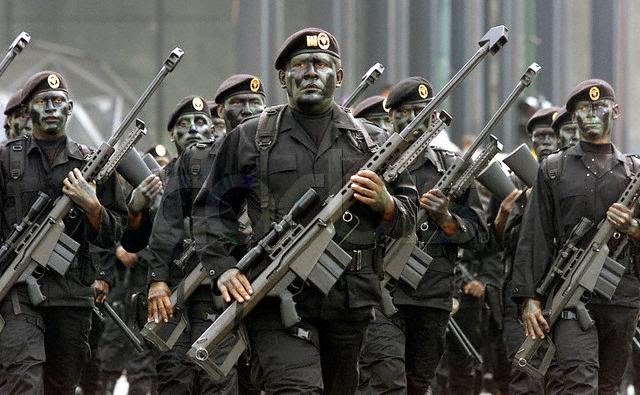
    A remarkably blunt article on SF/SOF (“special forces” is being used as an umbrella term for both) in the context of policy and strategy, from the perspective of an emerging great power by LTG Prakosh Katoch of the Indian Army. The American example of SOCOM in Afghanistan/Iraq/GWOT has obviously had an impact here, as has the negative example of Pakistani use of terrorists as proxy forces and ISI covert operatives for direct action in Indian territory and elsewhere. Quite aside from global conflicts and the bilateral rivalry with Pakistan, India also faces more than a dozen long term irregular conflicts with their own dynamics, such as the NaxaliteMaoist insurgency , which Katoch places in the context of Chinese strategic ambitions against India.

    A must read.

    Optimizing the Potential of Special Forces

    ….In India, the lack of strategic culture, more on account of keeping the military out from strategic military decision making, has led the hierarchy to believe that conventional forces coupled with nuclear clout can deter us from irregular threats. Nothing can be farther from the truth. Pakistan, though conventionally inferior, has been successfully playing her ‘thousand cuts policy’ knowing full well that India has failed to develop the required deterrent. It is our inability to find a cure to this Achilles’ heel, that has led China, which was hitherto using Pakistan as proxy to wage irregular war on India, now directly aids and supports insurgent and terrorist outfits inside India.

    ….Why the US has managed to secure its mainland post 9/11 is not only because of an efficient Homeland Security organisation but because the US Special Forces (USSF) are operating in 200 countries including India. Significantly, USSF have undeclared tasks such as conducting proactive, sustained ‘man-hunts’ and disrupt operations globally; building partner capacity in relevant ground, air and maritime capabilities in scores of countries on a steady – state basis; helping generate persistent ground, air and maritime surveillance and strike coverage over ‘under-governed’ areas and littoral zones and employing unconventional warfare against state-sponsored terrorism and trans-national terrorist groups globally. Before 26/11, Al-Qaeda had planned similar operations against New York but could not because the USSF had infiltrated Al-Qaeda. One cannot guard the house by simply barricading it. You must patrol the streets and the area outside.

    Growing inter-dependence and interlinking of terrorist groups regionally and internationally should be a matter of serious concern. It is not the US alone that has deployed its Special Forces abroad. This is the case with most advanced countries including UK, Russia, Israel, China and even Pakistan. Pakistan’s SSG was operating with the Taliban in Afghanistan and has been active in Jammu and Kashmir, Nepal and Bangladesh, primarily training anti-India forces. There is a strong possibility of their presence in the Maldives and Sri Lanka as well, aside from presence within India. The Chinese have been smarter. For all the development projects throughout the globe, including in Myanmar, Nepal, Pakistan-POK, Sri Lanka, Bangladesh and Seychelles, contracts underway by PLA-owned/affiliated companies employ serving and veteran PLA soldiers and disguised Special Forces with assigned tasks, including evacuation of Chinese citizens from that country in case of emergencies. 

    Read the rest here.

    News from the near blogosphere: I

    Wednesday, July 10th, 2013

    [ by Charles Cameron — listen up if you get the chance ]
    .

    It is possible that this post will reach some of you in time to tune in to this testimony:

    **

    I’m posting this here because I hope some of you will be able to watch this session live, but also because I think it’s indicative of a shift that is happening — and it’s a shift I’ve been hoping for and wanting to talk about here on Zenpundit. That shift has to do with the blogosphere, and to my mind it’s a very positive one.

    I’ll have more on that later — but first, I wanted to get the word out about this session. More, hopefully, a few hours from now.

    Manhunt: Radicalization, & comprehending the full impact of dreams

    Saturday, June 8th, 2013

    [ by Charles Cameron — how do you intercept messages that come via dreams? I’m thinking of al-Balawi ]
    .

    My little graphic (below) may be kidding — but what of reality?

    **

    In the bin Laden documentary, Manhunt, which I mentioned before seeing it here, and discussed briefly here, another passage (at 1.22.31) that is missing from the CNN transcript concerns the dream which radicalized Humam al-Balawi, the Khost bomber. Balawi speaks, the subtitles translate for us:

    God blessed me to have this dream. I dreamed I saw Zarqawi. He was in my house. His face was like a full moon. He was busy. Preparing an attack. I wishes I could fight with him. Be killed with him. I am your humble brother from Jordan. I am 32 years old and a medical doctor.

    I’m not suggesting there was no prior fertilization of Balawi’s mind and heart, nor that he was influenced by no other drivers: I just wonder what the impact of such a dream would be, given that intense smuggling goes on between our waking and dream lives, of a kind that no intercepts can capture for analysis.

    **

    How powerful can influence can a dream exert?

    Consider this example, taken from Marie-Lousie von Franz, On Dreams & Death: A Jungian Interpretation, p. 64:

    She sees a candle lit on the window sill of the hospital room and finds that the candle suddenly goes out. Fear and anxiety ensue as the darkness envelops her. Fear and anxiety ensue as the darkness envelops her. Then, the candle re-lights on the other side of the window and she awakens. She died the same day.

    **

    If I may borrow a bit from some unpublished writings of mine…

    Dreams as early indicators:

    The western secular paradigm considers dreams to be of little or no significance, and it is therefore entirely possible that intelligence gleaned from the recounting of dreams will seem of little interest to western analysts. In the Islamic view, however, certain dreams are of considered to be of real significance, their importance being indicated by the hadith reported by Bukhari:

    Narrated Ibn ‘Umar: Allah’s Apostle said, “The worst lie is that a person claims to have seen a dream which he has not seen.”

    — Sahih Bukhari, book 87: Interpretation of Dreams, #167.

    One early indicator of a Mahdist tendency in a given population, therefore, would be the presence of dreams about the Mahdi in a given discourse — in jihadist chat rooms, for instance — while the frequency of such mentions would be a useful heuristic measure of the development of such a movement. Thus Yaroslav Trofimov reports [Siege of Mecca, hb. p.50.] that in the run-up to the 1979 siege of the Grand Mosque and Ka’aba in Mecca, many followers of Juhayman al-Otaibi, the leader of the raid, dreamed dreams:

    Then, one after another, hundreds of Juhayman’s supporters experienced detailed, vivid dreams. Mohammed Abdullah’s sister appears to have been the first, quickly followed by others. In their sleep, they all had the same vision: Mohammed Abdullah standing by the sacred Kaaba in Mecca’s Grand Mosque, accepting allegiance as the blessed Mahdi amid multitudes of believers. Militants from as far away as Lebanon who never encountered Mohammed Abdullah in person claimed to have had the same dream.

    It is worth noting here that while, as Trofimov suggests, much of the dreaming “must have been caused by self-suggestion” this in no way invalidates their significance as indicators. Indeed, Reuven Paz writes of the mediaeval scholar Ibn Sirrin‘s still-popular Interpretation of Dreams that “high selling rates of this book can provide us an indicator for rising apocalyptic notions”. Paz also notes a “sizable number” of jihadis publishing their dreams and visions on Jihadist forums on the web [p.4..

    Dream narration of this sort certainly corresponds to hikayat as discussed by Michael Vlahos in his essay Terror’s Mask: Insurgency Within Islam — still one of the most necessary pieces I have read on al-Qaeda..

    **

    Closer to home, in one sense, than the siege of the Grand Mosque, is the 9/11 attack on the Twin Towers and Pentagon. This too had its dream precursors, as we can tell from the video transcript of bin Laden‘s taped meeting of mid-November 2001:

    UBL: He [Abu-Al-Hasan Al-Masri] told me a year ago: “I saw in a dream, we were playing a soccer game against the Americans. When our team showed up in the field, they were all pilots!” He said: “So I wondered if that was a soccer game or a pilot game? Our players were pilots.” He didn’t know anything about the operation until he heard it on the radio. He said the game went on and we defeated them. That was a good omen for us.

    Shaykh: May Allah be blessed.

    Unidentified Man: Abd Al Rahman Al-Ghamri said he saw a vision, before the operation, a plane crashed into a tall building. He knew nothing about it.

    Shaykh: May Allah be blessed!

    and notably:

    UBL: We were at a camp of one of the brother’s guards in Qandahar. This brother belonged to the majority of the group. He came close and told me that he saw, in a dream, a tall building in America, and in the same dream he saw Mukhtar teaching them how to play karate. At that point, I was worried that maybe the secret would be revealed if everyone starts seeing it in their dream. So I closed the subject. I told him if he sees another dream, not to tell anybody, because people will be upset with him.

    (Another person’s voice can be heard recounting his dream about two planes hitting a big building).

    For your in-depth reading pleasure, see Iain R. Edgar, The Inspirational Night Dream in the Motivation and Justification of Jihad if you can get past the paywall…

    **

    Vlahos quotes Albert Hourani, A History of the Arab Peoples, on this point — I’ll present my own version of that quote here, because it describes a mindset that, mutatis mutandis, many of our opponents share to this day:

    It was commonly held, in all cultures before the modern age, that dreams and visions could open a door into a world other than that of senses. They might bring messages from God; they might disclose a hidden dimension of a person’s own soul; they might come from jinns or devils. The desire to unravel the meaning of dreams must have been widespread, and was generally regarded as legitimate; dreams told us something which it was important to know.

    Dreams are “outside the box” of waking reality — and we need to learn to appreciate the force of dream logic, if we want to think outside our own western prejudices, and inside our adversaries’ heads…


    Is 4GW Dead?: Point-Counterpoint and Commentary

    Tuesday, May 28th, 2013

    4GW theory has always attracted overenthusiasts and  raging haters ever since the concept emerged way back in 1989, so debates about the merit of 4GW are nothing new; in fact, the arguments became so routine that they had largely gone sterile years ago.  After T.X. Hammes published his excellent  The Sling and the Stone and John Robb  went to the next level with Brave New War , it seemed that  little new was left to be said. In the late 2000’s, intellectual energies shifted to arguing the nuances and flaws of Pop-centric COINwhich proved in time to be even more bitter than those about 4GW.

    Generations of War Theory Visualized by Chet Richards

    What is different recently is that the person taking the affirmative on the question “Is 4GW dead?” was Dr. Chet Richards, who for years ran the premier but now defunct 4GW site, D-N-I.net, now archived here by the Project on Government Oversight.  Richards is no Clausewitzian true-believer or Big Army MBA with stars, but a former collaborator with John Boyd and a leading thinker of the 4GW school who had written several books with that strategic theme.

    Therefore, not a critic to be dismissed lightly. Here’s Chet:

    Is 4GW Dead? 

    ….The first thing to note is that 4GW is an evolution from 3GW, which they equate to maneuver warfare and the blitzkrieg as defined in MCDP 1 and Boyd’s Patterns of Conflict. These are styles of warfare conducted by state armies against other state armies, although the paper does invoke the notion of transnational terrorists near the end.

    At some point in the late 1990s, the theory bifurcated. Bill Lind and Martin van Creveld began to emphasize the decline of the state and focus on transnational guerrilla organizations like al-Qa’ida. Tom Barnett called this the “road warrior” model. T. X. Hammes, on the other hand, characterized 4GW as “evolved insurgency” and envisioned the techniques described in the paragraphs above as also useful for state-vs-state conflicts.

    ….The 9/11 attacks, by a transnational guerrilla movement, seemed to confirm 4GW in both of its forms. In the last few years, however, everything has gone quiet. Transnational insurgencies, “global guerrillas” as John Robb terms them, have not become a significant factor in geopolitics. “Continuing irritation” might best describe them, whose primary function seems to be upholding national security budgets in frightened western democracies. The state system has not noticeably weakened. So it might be fair at this point to conclude that although 4GW was a legitimate theory, well supported by logic and data, the world simply didn’t develop along the lines it proposed.

    A prominent critic of 4GW, Antulio J. Echevarria, may have been correct:

    What we are really seeing in the war on terror, and the campaign in Iraq and elsewhere, is that the increased “dispersion and democratization of technology, information, and finance” brought about by globalization has given terrorist groups greater mobility and access worldwide. At this point, globalization seems to aid the nonstate actor more than the state, but states still play a central role in the support or defeat of terrorist groups or insurgencies.

    Why? I’ll offer this hypothesis, that the primary reason warfare did not evolve a fourth generation is that it didn’t live long enough. The opening of Sir Rupert Smith’s 2005 treatise, The Utility of Force, states the case….

    Chet’s post spurred a sharp rebuttal from William Lind, “the Father of Fourth Generation Warfare”:

    4GW is Alive and Well 

    So “the world simply didn’t develop along the lines it (4GW) proposed”? How do you say that in Syriac?

    The basic error in Chet Richards’ piece of April 19, “Is 4GW dead?” is confusing the external and internal worlds. Internally, in the U.S. military and the larger defense and foreign policy establishment, 4GW is dead, as is maneuver warfare and increasingly any connection to the external world. The foreign policy types can only perceive a world of states, in which their job is to promote the Wilsonian nee Jacobin, follies of “democracy” and “universal human rights.” They are in fact, 4GW’s allies, in that their demand for “democracy” undermines states, opening the door for more 4GW.

    In most of the world, democracy is not an option. The only real options are tyranny or anarchy, and when you work against tyranny, you are working for anarchy. The ghost of bin Laden sends his heartfelt thanks.

    Third Generation doctrine has been abandoned, de facto, if not de jure, by the one service that embraced it, the U.S. Marine Corps. The others never gave it a glance. The U.S. military remains and will remain second generation until it disappears from sheer irrelevance coupled with high cost. That is coming much sooner than any of them think.

    ….In many of these cases, including Egypt and Pakistan, the only element strong enough to hold the state together is the army. But the “democracy” crowd in Washington immediately threatens aid cut-offs, sanctions, etc., if the army acts. Again, the children now running America’s foreign policy are 4GW’s best allies.

    Fourth generation war includes far more than just Islamic “terrorism,” and we see it gaining strength in areas far from the Middle East. Gangs have grown so powerful in Mexico, right on our border, that I predict the state will soon have to make deals with them, as the PRI has done in the past. Invasion by immigrants who do not acculturate is a powerful form of 4GW, more powerful than any terrorism, and that is occurring on a north-south basis (except Australia) literally around the world. Remember, most of the barbarians did not invade the Roman Empire to destroy it. They just wanted to move in. In fact, most were invited in. Sound familiar?

    What should concern us most is precisely the disconnect between the internal and external worlds. Externally, 4GW is flourishing, while internally, in the US government and military, it does not exist. This is the kind of chasm into which empires can disappear….

    Fabius Maximus – who is a both a pseudonymous blogger and a group blog, also responded:

    Update about one of the seldom-discussed trends shaping our world: 4GW 

    One of the interesting aspects of recent history is the coincidence of

    1. the collapse of discussion about 4GW in US military and geopolitical circles,
    2. victories by insurgents using 4GW methods over foreign armies in Iraq and Afghanistan, &
    3. most important, the perhaps history-making victory by Bin Laden’s al Qaeda.

    The second point is important to us, but the usual outcome since WW2 (after which 4GW became the dominate form of military conflict; see section C below).  The third point is the big one. Based on the available information, one of Bin Laden’s goals was to destabilize the US political regime. Massive increase in military spending (using borrowed funds). The bill of rights being shredded (note yesterday’s House vote to tear another strip from the 4th amendment). Our Courts holding show trials of terrorists — recruited, financed, supported by our security services. Torture and concentration camps.

    ….We — the Second American Republic — have engaged in a war with nationalistic, Islamic forces using 4GW.  So far we are losing.  For various reasons we are unable to even perceive the nature of the threat. In DoD the hot dot is again procurement of high-tech weapons — new ships, the F-35, the hypersonic cruise missile, etc.  All useless in the wars we’ve fought for the past 50 years, and probably in those of the next 50 years….. 

    A few comments.

    4GW has been heavily criticized – and accurately so – for making selective use of history, for unsupported maximal claims, for an excessively and ahistorically linear argument and for shifting or vaguely defined terms. Presented rigidly, it is relatively easy for critics to poke holes in it simply by playing “gotcha” (some of the criticism of 4GW did not get beyond ad hominem level garbage, but more intellectually serious detractors made very effective critiques of 4GW’s flaws).

    That said, there were a number of useful elements or insights in the body of 4GW writings that retain their utility and I think are worth recalling:

    • Whatever one thinks of 4GW as a whole, the school drew attention to the threat of non-state irregular warfare, failed states and the decline of state vs. state warfare and did so long before it was Pentagon conventional wisdom or trendy Beltway talking head spiels on Sunday morning news programs.
    • While the state is not in decline everywhere in an absolute sense, it sure is failing in some places and has utterly collapsed elsewhere. Failed, failing and hollowed out states are nexus points for geopolitical problems and feature corruption, black globalization, insurgency, tribalism, terrorism, transnational criminal organizations and zones of humanitarian crisis. Whether we call these situations “irregular”, “hybrid”, “decentralized and polycentric”, “LIC”, “4GW” or everyone’s favorite, “complex” matters less than using force to achieve political aims becomes increasingly difficult as the interested parties and observers multiply. Some of the advice offered by the 4GW school regarding “the moral level of war”, de-escalation and the perils of fighting the weak in such a conflict environment are all to the good for reducing friction.
    • The emphasis of the 4GW school on the perspective of the irregular fighter and their motivations not always fitting neatly within state-centric realpolitik, Galula-ish “Maoist Model” insurgency, Clausewitzian best strategic practice or the Western intellectual tradition, were likewise ahead of their time and contrary to S.O.P. Even today, the effort to see the world through the eyes of our enemies is at best, anemic. Red teams are feared more than they are loved. Or utilized.
    • The bitter criticism the 4GW school lodged of the American political elite being allergic to strategic thinking and ignorant of strategy in general was apt; that American strategy since the end of the Cold War has been exceedingly inept in thought and execution is one of the few points on which the most rabid 4GW advocate and diehard Clausewitzian can find themselves in full agreement.

    The lessons of 4GW will still be relevant wherever men fight in the rubble of broken societies, atomized communities and failed states.


    Switch to our mobile site