zenpundit.com » foreign policy

Archive for the ‘foreign policy’ Category

The Debate over the Influence and Extent of “Realism”

Tuesday, August 16th, 2011

 Kudos to Dan Trombly of Fear, Honor and Interest. Why?

First, for drawing attention to the debate between Dan Drezner and Anne-Marie Slaughter over, hmm, “Real-world Realism” in American foreign policy:

Dan DreznerMeet the new foreign policy frontier…. same as the old foreign policy frontier

….Well, this is… this is… I’m sorry, I got lost among the ridiculously tall strawmen populating these paragraphs.   I’ll go out on a limb and posit that not even Henry Kissinger thinks of the world the way Slaughter describes it.  Just a quick glance at, say, Hillary Clinton’s recent speech in Hong Kong suggests that actual great power foreign policies bear no resemblance whatsoever to that description of “traditional foreign policy.” 

Slaughter knows this very well, given that she was Clinton’s first director of policy planning.  She also knows this because much of her writing in international relations is about the ways in which traditional governments are becoming more networked and adaptive to emergent foreign policy concerns.  

Rebuttal time…..

Anne-Marie SlaughterThe Debate Is On! A Response to Dan Drezner

….I’ll take that bet. I think it’s exactly how Henry Kissinger still thinks of the world. Indeed, he has just published a book on China — of course, because from the traditional realist perspective China is by far the most important foreign policy issue in the 20th century, as it is the only possible military and economic competitor to the United States. Hence, as realists/traditionalists never tire of repeating, the U.S.-China relationship is the most important global relationship of the 21st century: what matters most is ensuring that as both nations pursue their power-based interests they do not collide catastrophically. Never mind that an avian flu virus that is both fatal and aerosol-borne arising anywhere in Asia could do far more damage to global security and the economy than China ever could — just see the forthcoming movie Contagion.

The second reason for giving Mr. Trombly props is that his excellent post in response to the above was a lot more interesting and substantive than their pleasantly jocular and Friedmanesque exchange:

Old School realism and the problem of society

….Waltz cares about states because states, in the time periods he examines, are the primary bearers of power. Power, not the state, is likely the more long-standing differentiation between the liberal/idealist and realist schools of international affairs. Realists generally care more about who has power, and particularly coercive power, because in the realist view, it is the power to control – not to collaborate, connect, or convince – which is the final arbiter and source of other forms of  socio-political-economic behavior.

For most of the history of thinkers identified with realism, the state did not exist, nor did the conception of the state as a unitary actor. Thucydides, long identified as one of the fathers of Western realism, was not a Waltzian structural realist in the slightest. As most early realists did, he cited the origins of political behavior in irrational and rational drives, which originate in the hearts and minds of men. There were no states in Thucydides’s day, but city-states, empires, and various other forms of political organization which did not survive to the present day. Thus one had to be quite conscious not just of particular parties and factions, but even individuals, who, in a polis such as Athens could completely upturn the designs of the Athenian state. In his description of the varying governments and systems of organization at play, Thuycdides actually shows a keen awareness of how regime types and the social composition can influence international politics, but only insofar as it involves the exercise of power. The exchange of goods, culture, and ideas matters far less to him. Slaughter does offhand mention that an Avian flu could kill far more than a war and be more likely. Interestingly enough, the plague of Athens does play an important role in Thucydides’s history

….This pessimism about the dangers of those lacking political virtue, or restraint of their passions, from acquiring power colors, in one way or another, much of the subsequent 2,500 years of realist thought. Ultimately, the interactions and aims of the various interest groups that Slaughter describes, and Drezner dismissed, are not necessarily prescriptively ignored but the subjects of active disdain, fear, and scorn

Much to like in this fairly lengthy post, which  I recommend you read in full.

Now for my two cents.

First, as a factual matter, it would not be hard to establish that Dr. Slaughter is correct and Dr. Drezner is not that Henry Kissinger does think like that. He most certainly did while he was in power, as is amply recorded in the National Archives, Kissinger’s memoirs and secondary works by historians and biographers who made Kissinger their subject. To all appearances, Brent Scowcroft, Kissinger’s protege thinks the same way, as did Kissinger’s master, Richard Nixon, whose private remarks regarding the unimportance of ephemeral actors to geopolitics were brutal. The UN, for example, Nixon dismissed as a place for “just gassing around” and Nixon was happy to use the UN (and George Bush the Elder) as unwitting props in his China Opening.

Policy makers do not think like IR academics do, even when they are IR academics like Dr. Slaughter or Dr. Kissinger. They don’t have the time or luxury of remove from events. The cool, detached, analytical, Harvard intellectual who wrote Nuclear Weapons and Foreign Policy became the emotive, egoistic, domineering, slightly hysterical, bureaucratic operator and diplomatic tactician as National Security Adviser. I suspect a six days a week, sixteen hour days of crisis management culture as Policy Planning Director at State likewise tempered Slaughter’s time for theorizing speculations.

That said, there is some room present for Dr. Drezner’s skepticism and Mr. Trombly’s “active disdain, fear and scorn”of non-state actors (which I think is a spot on gestalt of the Metternich-worshipping Henry the K).

The state as an organization of coercion and defense is unrivaled in human history by any other political form except the tribe. The state is fine-tuned to be a beast of prey and open challeges to the state, in all it’s panolpy of might, without a long preparatory period of eroding it’s legitimacy and attriting it’s will to power, seldom turn out well unless the challenger is another state. Non-state actors who challenge state authority tend to survive and thrive initially only by being elusive, deceptive, adaptive, faster and by inflicting moral defeats until they accumulate enough armed power to co-opt, thwart, deter or topple the state by force. This requires the challenger engaging the state in such a way that it habitually reacts with excessive restraint punctuated by poorly directed outbursts of morally discrediting excessive violence ( see Boyd’s OODA Loop)

When non-state actor challengers gain sufficient political momentum and break into a full-fledged armed insurgency, a dangerous tipping point has been reached because insurgencies are generally very difficult, expensive and bloody to put down, often representing a much larger pool of passive political discontent. The advantage begins to turn to the challenger because the mere existence of the insurgency is itself an indictment of the state’s competence, authority and legitimacy. Some states never manage to regain the initiative, slipping into state failure and co-existing with the insurgency for decades or being ignominously defeated.

We live in an era of state decline, or at least an era of erosion of the state’s willingness to use force in self-defense with the unconstrained savagery of a William Tecumseh Sherman or a Curtis LeMay. While overall, the zeitgeist favors the non-state actor, challenging the state a much harder trick when it is ruled by a charismatic sociopath, an authoritarian lunatic or when the machinery of security is organized on the basis of extreme and homicidal paranoia. Very little political “room” exists in such circumstances for non-state actors of any size to emerge because the state has used terror to atomize society and dissolve natural bonds of social trust; dissidents, if they are to be effective, often must rely upon external support and patronage.

This is not to say that the power Dr. Slaughter commends, to “collaborate and connect” is unimportant. Far from it, as it represents a very formidible long term threat to the omnipotence of states by permitting a highly networked and wealthy global civil society to self-organize to check their power. At the inception though, “collaboration and connection” is very fragile and vulnerable to state interdiction. Representing oneself as a political challenge to the state before power is acquired to any significant degree is unwise; if empowering civil society in tyrannies through “collaboration and connection” is the goal of the USG, it ought to be done under the radar with plausible pretexts and without an obvious affiliation to American sponsorship.

That would only be…..realistic.

Johnston, Gorka and the need for specialist knowledges

Wednesday, August 10th, 2011

[ by Charles Cameron — religious knowledge, foreign policy, military ]

.

Dr. Douglas M. Johnston just posted a piece titled Religion a crucial tool in U.S. foreign policy in the Washington Post’s On Faith blog, and in it he quoted Dr. Sebastian Gorka‘s recent testimony to the HASC Subcommittee on Emerging Threats and Capabilities:

It is very difficult, if not impossible, to provide the contextual knowledge we need to understand and defeat our enemy if we rely solely upon anthropologists and social scientists…. Today our multi-disciplinary analysis of the enemy and his doctrine just as much requires — if not more so — the expertise of the regional historian and theologian, the specialist who knows when and how Sunni Islam split from Shia Islam and what the difference is between the Meccan and Medinan verses of the Koran. We should ask ourselves honestly, how many national security practitioners know the answers to these questions, or at least have somewhere to turn to within government to provide them such essential expertise.

I do appreciate that this was written by Dr Gorka for an audience that needs to keep up to speed on many, many topics.  What dismays me here isn’t the idea that “national security practitioners” should know these things — they should indeed, and should certainly also know specialists who know a great deal more — but that the bar is set so low, “a specialist” being, for that audience, someone “who knows when and how Sunni Islam split from Shia Islam and what the difference is between the Meccan and Medinan verses of the Koran”.

Let’s back up a bit.  Here’s a report on the Senate hearing on the appointment of GEN. Dempsey as Chief of Staff of the U.S. Army.

Gen. Martin Dempsey, tapped by the White House to be the next top military officer, acknowledged Tuesday that he and other senior officers failed to grasp the power dynamics among Islamic-based groups in Iraq.

After the U.S. military toppled the Saddam Hussein-led regime there in 2003, a powder keg erupted that was driven, in large part, by centuries-old power struggles and distrust among Iraq’s various Islamic sects.

It took American civilian and military leaders years to adapt and understand these dynamics, which experts say played a major role in both the length and violent nature of the Iraq war.

Driving the lack of understanding was a tendency of the military to “take five minutes to understand” an issue while immediately spending the next “55 minutes trying to solve it,” Dempsey said during his confirmation hearing before the Senate Armed Services Committee.

Those “five minutes to understand” might get you the basic difference between the Meccan and Medinan suras — but a specialist knows a little more than that, as one can gather from comments Dr Timothy Furnish posted just the other day on his MahdiWatch blog, commenting on Dempsey’s remarks:

One might reasonably wonder whether the US military and intelligence community (not to mention the State Department) truly does, finally, realize the importance of sectarian differences in the Islamic world. For example, the Syrian case pitting the pseudo-Shi`i Alawi rulers against the country’s Sunni majority only recently came to Washington’s attention; neither Libya’s history of Sanusiyah Sufi jihad against occupation, nor Mua`amar al-Qadhafi’s heretical Islamic teachings and rule, has been fully considered or acknowledged by the American government; and there are still commanders deploying to and from Afghanistan who seem blissfully ignorant of the fact that that country is 19% Shi`i (and that a substantial subset of that is not Twelver but Sevener, or Isma’ili, Shi`i).

But that’s one paragraph from a single blog post, and Furnish has written a book — has written, as they say, “the book” on Mahdism.  And that’s just one book, you don’t suppose Furnish’s knowledge is limited to what he managed to compress into a few hundred pages, do you?

Furnish is a specialist — that’s why I read and correspond with him.  I’m a generalist with, I hope, some decent insights into what to watch for and who to read for background — but Furnish is a specialist.

And the solution isn’t to add “specialist” to a checklist, find one on LinkedIn and check it off — the solution is widespread, ongoing conversation among specialists, with the help of generalists, across all silos and disciplinary boundaries, of the sort we try to promote here from time to time… until there are enough people, with enough parts of the puzzle, that we don’t get blindsided by our ignorances.

Ignorances, plural.  Knowledges, plural.

*

This just in…  Dr Furnish’s second book — The Caliphate: Threat or Opportunity? — is now available for pre-order. I hope to review it at some point here on ZP.

Bing West on COIN and Afghanistan Strategy

Tuesday, August 2nd, 2011

From SWJ Blog:

Where we have been. According to US counterinsurgency doctrine, our soldiers and marines were expected to be “nation-builders.” Afghanistan, however, was the wrong war for that strategy of democratic nation building – for three reasons.

First, a foreign power cannot build a democratic nation, while having no control over that nation’s authoritarian leaders. In 2002, the US and the UN handed full sovereignty to Afghan leaders who proved to be venal and selfish. We conceded all leverage over Afghan leadership. That was a fatal mistake.

Second, a duplicitous Pakistan has maintained a 1500-mile long sanctuary. The recent decision to give Pakistan money only on a transactional basis – do this if you want to be paid – is commendable. It will influence behavior, because Pakistani officials cannot maintain their comfortable life styles without American money.

Third, our benign counterinsurgency strategy did not win the commitment of the people. In Iraq, the Sunni tribes did eventually reject the insurgency. In Afghanistan, the Pashtun tribes have not done so. Most Pashtun villagers survive by being chameleons; they expect the Taliban to return.

By giving away $18 billion over ten years, we created a culture of entitlement. Afghans from President Karzai down to village elders came to expect that we would fight for them and give them money. The US military alone undertook 16,000 economic projects, as if its mission was that of a giant Peace Corps. This money resulted in no change in the war; however, it did weaken the willingness of Afghans to rely upon themselves. When you give something for nothing, you receive nothing in return…

Read the rest here:

Booksbooksbooksbooks….

Monday, August 1st, 2011

Two more for the pile….


Another Bloody Century by Colin Gray

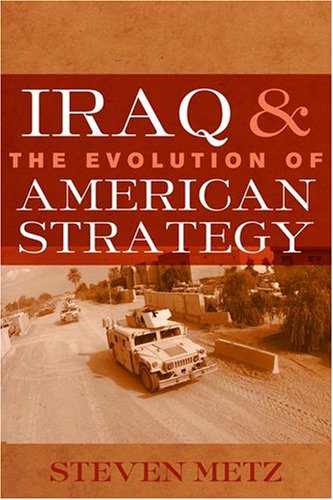
Iraq & the Evolution of American Strategy by Steven Metz

Comments or opinions?

Possible Shifts in AfPak

Tuesday, July 12th, 2011

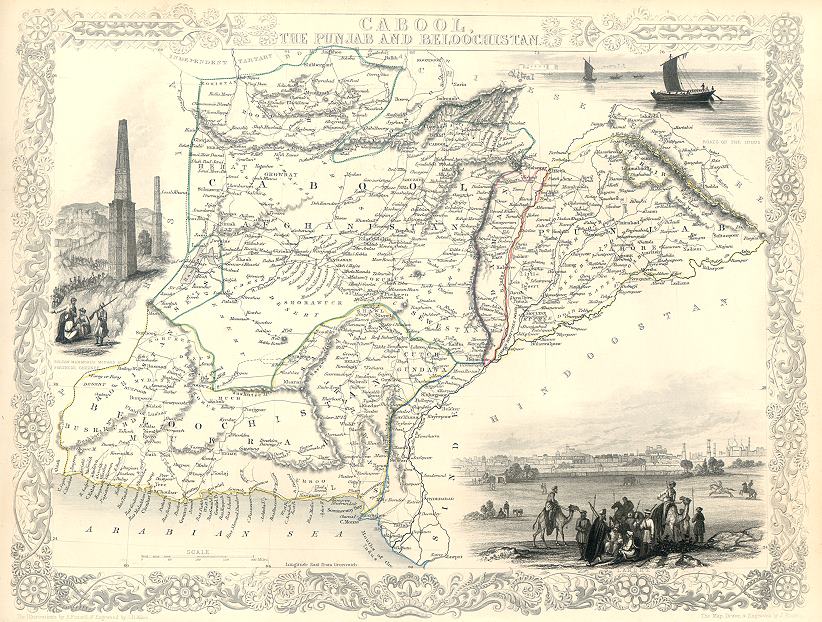
afpak.jpg

On Pakistan policy, credit where credit is due: the Obama administration has found the stones to respond to evidence of systemic and brazen bad faith on the part of our Pakistani “allies” and show their displeasure by witholding $ 800 million dollars in aid from Islamabad. There are already squeals of Pakistani unhappiness at this modest decrease of aid that all too frequently gets diverted to preparing to make war on India or, for that matter, on American soldiers and Marines. Former dictator General Pervez Musharraf, who cannot go back home to Rawalpindi for fear his brother officers will assassinate him, told a well appointed crowd in Houston that the aid cut “will be disastrous….if Pakistan is weakened, how will it fight terrorism?“.

Cynics might note that we could replace “fight” with “fund” in the former Pakistani ruler’s question and achieve greater historical accuracy.

On Afghanistan, it might be advisable for the new American commander, Lieutenant General John Allen, in carrying out his extremely difficult mission of “Afghanization” and “punitive raiding” the Taliban, to first ponder history and  “Remember Herat“.

In 1979, before the Soviet invasion of Afghanistan, the entire garrison of Soviet advisers in Herat was slaughtered, including the dependent women and children, by an angry mob that was aided by the local Afghan Communist Army units who, led by Ismail Khan, conveniently revolted and turned on their Russian allies. If British military history is more to Lt. General Allen’s taste, the Afghans massacred British garrisons in Kabul twice in the 19th century, Major Cavagnari’s in 1878 and that of Sir William McNaghten and Sir Alexander Burnes in 1841, though most of the British died to all but the last man on the retreat to Jalalabad in 1842.

The cape wearing, election-stealing, lotus-eater whom we thanklessly prop up, may be more incompetent than Nur Mohammed Taraki and less legitimate a client than Shah Shuja, but he has a demonstrated talent for inciting anti-western violence exceeded only by his enterprise in looting aid money. Is crazy Karzai above lighting a match to a tense situation the US military itself has already described as a “rapidly growing systemic threat“? Not in my view.

When the American drawdown begins in earnest, General Allen will need to watch the backs of his troops

ADDENDUM:

Ahmed Wali Karzai, the notorious fixer and feared enforcer of the Afghan regime and the brother of President Hamid Karzai was assassinated today. The Taliban claimed credit, but AWK has too many enemies to be certain yet.


Switch to our mobile site