zenpundit.com » 2012

Archive for 2012

An Afghan Buddha koan

Friday, October 5th, 2012

[ by Charles Cameron — for Madhu ]
.

Our friend Madhu has requested that I post poems here on occasion, and this particular poem made me think of her and her request, so here it is:

A copper and gold koan
.

The world happened, the world is drifting away,
the farther away the world floats the deeper into the mists.

In Mes Aynak, Afghanistan, the remains
of a buddhist monastery already eroded by time are adrift,
a sitting buddha is floating into the mist,
headless, gold paint still on his knees and robe,
the devotion has drifted, lifted its focus
to the one without a second, the buddha left
whatever he left in memory, lingering, to gather aromas
of other ideas, realms, dust, archaeology, oblivion,
there is change, ceaseless change,

and adults must decide: is the wealth implied by the copper
beneath the buddha worth more than a trace of halo,
as the moon moves once again across a brilliant night sky.

.
Koans are those brilliant paradoxes zen buddhism uses to pry the mind open, I think they’re important aids to handling complexity, and I have a post about them coming up shortly. Here, it’s enough to say that the issue of copper mining vs archaeology in Mes Aynak seems to me to be a living, breathing koan.

**

It’s awkward, when you write an “ekphrastic” poem, a poem about a painting or photo, to have the image right there when the poem is read, because it trammels the reader’s mind in much the same way that a film can trammel the mind of a reader into “seeing” only the film-maker’s Gandalf, no longer her or his own.

And I’m going on at some length about this, because next up is the image from which that particular poem was built, but I’d like the image to be, as they’d say in the newsprint world, “below the fold” as you read the poem.

So here it is, #4 in a fine series of photos in a Foreign Policy photo essay which I recommend, although I’ve taken this particular (smaller) version from a CNN page, since the subtitle in the lower right corner explains the basic situation handily:

You can hear the archaeologist Brent Huffman, who took the photo, talk about the situation here — local reactions pro and con, who the Taliban are shooting at, the likelihood that the Chinese operation will in fact benefit the locals and more:

The koan of balancing material with immaterial values remains, but in this circumstance the likelihood of local Afghans receiving litter or nothing from the mining project likely tips the scales.

You can petition Afghan President Hamid Karzai for preservation…

But then he’s another wild-card in the continuing Great Game, isn’t it?

Why do people cover their mouths?

Thursday, October 4th, 2012

[ by Charles Cameron — mostly amused, a little curious ]
.


.

The image is from Vanity Fair‘s Exclusive: President Obama Considered Putting Osama bin Laden on Trial if Taken Alive, teaser for a forthcoming article, which includes this intriguing Obama quote:

I mean, we had worked through a whole bunch of those scenarios. But, frankly, my belief was if we had captured him, that I would be in a pretty strong position, politically, here, to argue that displaying due process and rule of law would be our best weapon against al-Qaeda, in preventing him from appearing as a martyr.

That — the quote itself, the Vanity Fair piece I grabbed it from, their upcoming full article by Mark Bowden, and or Bowden’s own book The Finish, plus any and all ramifications and queries relating thereto — strikes me as the sort of thing we might like to discuss here.

Not that I personally have any competence in such matters.

**

What I want to know, just out of idle curiosity, is this: why do so many of the people in the photo want to keep their thoughts to themselves?

Of the importance of form in intelligence: I

Wednesday, October 3rd, 2012

[ by Charles Cameron — form as pattern recognition, the form of suicide / martyrdom ops, a format for analysts, first in a series on form in intelligence, and maybe the beginnings of an eccentric thinking manual for analysts ]
.

Bear with me for a paragraph or two, while I try to sort something out.

Form is to content as algebra is to arithmetic: does that work for you? Form is one degree more abstract than content: how about that? I don’t think either of these expressions quite captures what I want to say about form and content, but they may help us think about form. Here’s a form:

It’s pretty clearly a diagram of connections of some sort, but exactly what those connections are is unclear as long as the various boxes in the diagram remain empty.

I could fill it with the names of members of a hippie commune that practiced a flexxible approach to free love over a decade or two, from when the founder bought the farm (in the literal sense of real estate) to the point where the last surviving member bought the farm (metaphorically speaking — the farm in the sky).

Or with the names of elements in the human digestive and energetic system…

I mention the latter, because I came across this particular (empty) diagram on a blog post by a certain Jacques Chester about how people get fat, where it was preceded by the words:

A better diagram for bodyweight control will resemble a great big mess

I won’t tell you where I got the other idea from, if you want to know you’ll just have to fantasize, as I did.

**

At least in this case, form means pattern. The diagram above is a pattern, fill it with appropriate verbal or other content and you’ll give it meaning — which can then be disputed or accepted. But the form, the patterning, is somehow antecedent to any particular content.

Take the last words of each line of Shakespeare‘s Sonnet XCVII and you’ll get:

been, year, seen, everywhere, time, increase, prime, decease, me, fruit, thee, mute, cheer, near.

The rhyme scheme is pretty clear: ABAB CDCD EFEF GG.

That’s a form, and all of Shakespeare’s sonnets follow it. Petrarch‘s sonnets by contrast follow the rhyme scheme ABBA ABBA CDECDE.

**

In my practice of thinking, as a poet and as a practitioner of the open source analysis of scriptural sanctions for religious violence, I find the recognition of forms — pattern recognition — to be my central process.

I think what first really brought this home to me was the similarity of form between two reports of terrorist training activities — each in its own way illustrating the idea that the activity to be performed will begin quite naturally on earth, where training is required, but end quite supernaturally in paradise, where it isn’t:

That one’s pretty obvious, right? I mean, if you’ve seen the first instance you would be pretty likely to remember it if you ran across the second…

And what the form means is pretty clear too — martyrdom ops, suicide ops.

But what if you had a note-pad on your desk — or better, a game format on your computer — that gave you those two boxes, free of specific data, and any time you found a weird or anomalous data-point or image you could scribble it or drag-n-drop it into that form, give it a name for easy retrieval, and keep your eyes peeled for parallels, opposites, similars?

I call that format SPECS, by the way, because it allows you to see two similar ideas stereoscopically, so to speak, and thus gain an extra dimension — neat trick, eh?

What if collecting SPECS was part of your training as an analyst, and you practiced the form a few hundred times and kept 150 mind-blowing examples — as Shakespeare did with his ABAB CDCD EFEF GG sonnets?

**

Why, you’d be training yourself in pattern recognition — formal thinking — horizontal thinking — lateral thinking — analogy — thinking by leaps and bounds.

Inteligence happens in the Intelligence Community, and in the human population as well. I can’t speak to the ways in which animal and plant mimicry, or the artistry of birdsong, correspond to pattern recognition, although that would be a fascinating topic for another post.

What I can say is that analogical, horizontal, cross-disciplinary thinking is in its own away more powerful than logical, rational, vertical, silo-bound thinking.

**

In terms of Intelligence and intelligence, the strategies of linear / vertical thinking are like your fingers: it’s your skill at lateral / horizontal thinking that gives your mind an opposable thumb.

On Super Mario Brothers and mental parcours games

Wednesday, October 3rd, 2012

[ by Charles Cameron — cross-posted from Sembl, side-scrollers for the mind, light but deep ]
.

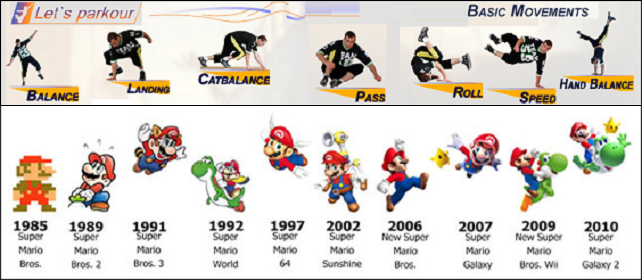
According to 25 Years of Super Mario Bros: A Look Back Through Mushroom Kingdom History, from which I grabbed the Mario Bros portion of the graphic at the foot of this page, “Since 1985’s release of the second-most selling console game of all-time, over 200 Nintendo titles have featured the eponymous Mario Bros” — on which I’ve played perhaps three or four levels of one or two early versions.

The Super Mario Bros side-scrollers (image above, left) are the work of the brilliant Shigeru Miyamoto, and part of what I find so fascinating about them is the way in which they resemble the mind-blowing practice known as Parcours (image, right), which apparently developed from the work of one David Belle, born in 1973 — who would have been 12 when the first Super Mario Bros game came out.

Let’s take a look at Super Mario Bros and Parcours, and then move on to the issue of parcours for the adventuring mind.

**

First, for those of you who don’t remember them, here’s what the early Mario Bros games were like…

I don’t think there’s much doubt that the Super Mario Bros games are essentially digital versions of Parcours, and you can see by comparing the video above with this next one:

Finally, this video from Jesse La Flair confirms the comnnection, at least in the mind of one top flight traceur:

**

My own question is: what would a mental parcours game look like?

I was thinking for a while last week about what a Mario-like side-scrolling game of mental parcours would be like. We already have the “creative leap” side pretty well covered with the various variants of Sembl we’ll be developing, so I thought about other types of mental agility, and what a game might look like if it incorporated a bunch of them — induction? deduction? causality? the sorts of pattern skills that go into IQ tests? — in a side-scroller with playful graphics…

Two things:

One: my friend Derek Robinson pretty quickly informed me that the actual build of such a game would be enormously complex — I resisted him, saying I wasn’t aiming to build the entire game, just to get the idea down on paper to see whether we could get the initial phases funded…

And two: I ran across Lumosity:

Let’s just say Lumosity seems to have a variety of cognitive skills well in hand, which leaves me free once again to concentrate on what Derek calls the mind’s opposable thumb.

**

That’s a brilliant concept, I think, and gets to the heart of what we’re working on with Sembl.

The various other conceptual skills that essentially add up to linear thinking — Zen calls it vertical thinking, see this helpful diagram — are important, and well-studied. They work best where what you are talking about is quantifiable and amenable to logic and cause and effect analysis, and is explored within fields, not across them.

But lo, that approach may help you quantify the trees and evaluate them as board feet of lumber, but consistently misses the forest, the greater context, the big picture –the combined systemic impact of many tiny details, insects, mosses, the tree as ecosystem within an ecosystem, and the ecosystems within that – the time scale, the slow growth, the root system, the transformation of mulch into nourishment, the sudden spurt of tiny leaves in spring, the photosynthesis — and the human wonder — the glory, dappled sunlight on fallen leaves, the shelter afforded to lovers by a weeping willow (I’m thinking of one willow in an Oxford college garden, but I’m time-traveling and I digress) – the poetry, of beech and birch, copper beech and silver birch, the trees, the words, the metals…

Context, quality, complexity, systems, dynamics, process, simplicity, value, passion, poetry – these are the things linear thinking has problems with. Poetry, passion, value, simplicity, process, dynamics, systems, complexity, quality, context – these are the things horizontal thinking does best.

**

That’s it.

Oh, and hey — just because I like the tiny antics they’re getting up to in the graphics:

On Eric Hobsbawm

Wednesday, October 3rd, 2012

I was going to comment on the death of the famed historian who was the Soviet Union’s most venerable and shameless apologist, but I was beaten to it in a brilliant piece by British blogger and fellow Chicago Boyz member, Helen Szamuely:

A great Communist crime denier dies

On my way to and from Manchester yesterday and today I read Anne Applebaum’s latest book Iron Curtain about the subjugation of Eastern Europe between 1944 and 1956. Ms Applebaum’s knowledge and understanding of the European Union is not quite what it ought to be, given that she usually appears in the guise of one of our leading political commentators but she does know the history of Communism and what it did to the countries and peoples who, for various reasons, found themselves under its rule. The first few chapters describe in some detail the brutality, violence, whole scale looting and widespread rapine that marked the Red Army’s route across Eastern and Central Europe, regardless of whether they were in enemy or friendly countries, with soldiers or civilians, men or women, adults or children, friend or foe. And then came the NKVD and the organized violence and looting. How many people know, for instance, that several of the Nazi camps, Auschwitz and Buchenwald included, were reopened by the Soviets for their own purposes? Not a few of the people they imprisoned there had been liberated only a few weeks previously.

As I was reading this horrible tale I got a text message from somebody who saw on the news that Professor Eric Hobsbawm, the best known apologist for Stalin and denier of Communist crimes, has died. We are entering a period of unrestrained mourning for this man who has on various occasions been described as the greatest living historian and one of the most influential ones. Sadly, the last part of it is true. He has been influential.

While Holocaust deniers are rightly excoriated Professor Hobsbawm has been treated in life and will be in death with the greatest adulation. Channel 4 lists some of the misguided souls who are pronouncing sorrowfully on the demise of this supposedly great man and asks rather disingenuously whether he was an apologist for tyranny.

Well, yes, as a matter of fact, he was….

Read the rest here.


Switch to our mobile site