zenpundit.com » military intelligence

Archive for the ‘military intelligence’ Category

Mackinlay’s Insurgent Archipelago & Other Books

Tuesday, March 9th, 2010

The Insurgent Archipelago by John Mackinlay

At the strong recommendation of Colonel Gian Gentile, I ordered The Insurgent Archipelago: From Mao to Bin Laden by Dr. John Mackinlay of King’s College, London and a hardcover copy just arrived this afternoon. Judging from the table of contents and the sources in Mackinlay’s endnotes, The Insurgent Archipelago will present a tightly written argument on the nature of COIN. For a well regarded  and informative review, see David Betz of Kings of War blog, brief excerpt below:

Review: The Insurgent Archipelago

….The book is sweeping, as the subtitle ‘From Mao to Bin Laden’ suggests; yet it is also admirably succinct at 292 pages including notes and index.[2] In design it is exceedingly clear, consisting of three parts-‘Maoism’, ‘Post-Maoism’, and ‘Responding to Post-Maoism’, which reflect the basic components of his argument. Insurgency’s classical form is the brainchild of the carnivorously ambitious strategic and political genius Mao Zedong who gave meaning to the now familiar bumper sticker that insurgency is ’80 per cent political and 20 per cent military’. Mao’s innovation was to figure out what to fill that 80 per cent with: industrial scale political subversion by which he was able to harness the latent power of an aggrieved population to the wagon of political change, to whit the victory of the Chinese Communist Party in the Chinese Civil War which ended with the proclamation of the People’s Republic of China in 1949

….The problem is that what we now face in the form of ‘global insurgency’ is not Maoism but Post-Maoism-a form of insurgency which differs significantly from that which preceded it.[6] We have, in essence, been searching for the right tool to defeat today’s most virulent insurgency in the wrong conceptual tool box. This is perhaps the most uncomfortable truth to be laid out in this book; another worrying one is that the security interests of Western Europe differ markedly from those of the United States-because the threat in the former emerges from their own undigested Muslim minorities which are alienated further by their involvement in expeditionary campaigns which, arguably at least, serve the needs of the latter well enough

Oddly, this will be the second book by a former British Gurkha officer that I’ve read in the last six months; the first being The Call of Nepal: My Life In the Himalayan Homeland of Britain’s Gurkha Soldiers by Colonel J.P. Cross, which I played a minor role in getting reissued here by Nimble Books, along with Lexington Green. After just thumbing through a few pages, Dr. Mackinlay already strikes me as a far less mystically inclined military author than does the esteemed but eccentric Colonel Cross.

I am way behind in my book reviews. Fortunately, Charles Cameron is stepping up with a new series of posts this week, which will give me some time to write reviews at least for Inside Cyber Warfare: Mapping the Cyber Underworld and Senator’s Son: An Iraq War Novel and then read Mackinlay. Ah, this designated guest blogger business is proving to be most convenient! 🙂

Guest Post: Speak the Languages, Know the Modes of Thought

Wednesday, November 4th, 2009

Charles Cameron, who has appeared here before, is the former Senior Analyst with The Arlington Institute and Principal Researcher with the Center for Millennial Studies at Boston University. He specializes in forensic theology, with a deep interest in millennial, eschatological and apocalyptic religious sects of all stripes.

Charles will be doing a new series of posts here at Zenpundit that will drill down into the important but often elusive religious-cultural connections that impact American national security and foreign policy issues.

Very pleased to have him aboard:

SPEAK THE LANGUAGES, KNOW THE MODES OF THOUGHT:

by Charles Cameron

SSgt. David Flaherty, currently deployed as the Zabul Provincial Reconstruction Team’s public information officer, is to be congratulated on speaking Pashto. But Wireds Danger Room comment, “The fact that this is considered newsworthy and exceptional — a U.S. military officer speaks one of the official languages of Afghanistan! — doesn’t reflect well on the national commitment to Afghanistan” is also to the point.

A couple of other recent items in the news about languages and translation at home and abroad should concern us.A report from the US Department of Justice on the FBI’s Translation Project was less than enthusiastic, not only finding that significant quantities of material collected in the Bureau’s highest-priority counter-terrorism and counter-intelligence collection categories were never evaluated, but that the number of translators inn the FBI pool had diminished since a 2005 audit, that in 2008 the FBI met its hiring goals for linguists in only 2 of its 14 critical languages, that security clearance and language proficiency training for a new linguist took 19 months before hiring could take place, and that 70 percent of the FBI’s own linguists in the field offices tested did not attend the FBIs required training course.

And retired and renowned Marine colonel Thomas X. Hammes was quoted in a recent piece on CBC News about allegations of “botched” translations in the Afghan theater leading NATO troops to faulty conclusions as saying, “We’re willing to spend hundreds of millions of dollars to make sure ice cream and steak is there, and I would trade all of that for my entire tour if I could have one decent translator. Many times I’d trade body armor for a translator.”I want to suggest, though, that there is another aspect to this business. I was reminded of it when reading the FBI complaint against Luqman Ameen Abdullah and others connected with the recent events in Detroit. The complaint includes the phrase, “Abdullah also said that thegovernment plots and plans against them so they need to plot and plan in return”. The complaint doesn’t mention it, but that’s an echo of the words of the Qur’an, 8.30:

 “And when those who disbelieve plot against thee (O Muhammad) to wound thee fatally, or to kill thee or to drive thee forth; they plot, but Allah (also) plotteth; and Allah is the best of plotters.”

What this suggests to me is that we need to be able to speak / read not only spoken or written languages of our sources, suspects, informants and opponents — but also the language or underlying logic of their thought. A close reading of the Detroit complaint’s text in association with that of the Qur’an gives us an understanding that Abdullah views his plotting as aligned with Allah’s. This in itself may not seems surprising, but it suggests a manner of reading that may prove fruitful in other occasions, and that’s the point I want to make.

Whatever the merits of the particular case of Luqman Abdullah — and I note that some respected analysts have their questions about that — it will be found to hold true in general that jihadist thought moves along Qur’anic pathways as surely as jihadist behavior parallels the behavior of Mohammed. A keen awareness of both will thus allow us to understand where the touching of familiar chords is most apt to stir the hearts of fellow believers, and hence strengthen the bonds of community and dedication between them.

When bin Laden retreated to the caves of Tora Bora, he was following in his Prophet’s footsteps, as Lawrence Wright masterfully showed in *The Looming Tower*. His spoken words often follow Qur’anic precedent in much the same way.Bin Laden’s address to the US just before the 2004 elections was a case in point for me. I read three translations (CNN, MEMRI, Al-Jazeera), none of which included the Qur’anic citation that headed the whole thing, and figured out what it must be from the repeated echoes in the text, notably “and just as you lay waste to our Nation, so shall we lay waste to yours”.

That put me very strongly in mind of Qur’an 2.194:

“For the prohibited month, and so for all things prohibited, there is the law of equality. If then any one transgresses the prohibition against you, transgress ye likewise against him. But fear Allah, and know that Allah is with those who restrain themselves.”

Okay, I could figure out that bin Laden had this passage in mind as I read the transcripts of his address — but it wasn’t until I saw ABC’s transcript that I could confirm that Bin laden did indeed reference that verse directly.

Which powerfully reinforces the idea that bin Laden views his jihad against the US in terms of measured reciprocity — a notion which should give us pause every time we take an action which we would not choose to have taken against us…

And how good are we at this kind of “reading in parallel” — both abroadand at home?

To return to the Detroit affair, as UCLA’s Jean Rosenfeld pointed out, the NYT report on the event contained the phrase “a faction of a group called the Ummah, meaning the Brotherhood” — a completely misleading
translation which might suggest ties with the Egyptian “Muslim Brotherhood” — when the plain meaning of “Ummah” is the transnational community of Muslims. The New York Times is our newspaper of record.

The Times, in turn, was likely paraphrasing the FBI’s own press release, which speaks of “part of a group which calls themselves Ummah (‘the brotherhood’)”. It’s notable, though, that there is no mention of the
“brotherhood” in the entire 45 pages of the actual FBI complaint,
written by those more closely involved with the investigation.

What the complaint itself does say is that the name “Ummah” was used as a cover for the movement’s real name, the “Dar-ul-Islam Movement“.

Okay, that’s a beginning…

And still our transcriptions of jihadist messages all too often omit religious content. Indeed, when the Joint Forces Command asked Jim Lacey to edit abu Musab al-Suri’s massive Call to Global Islamic Resistance for publication in English translation, he (rightly) produced a condensed version, but (wrongly, IMO) “also removed most of the repetitive theological justifications undergirding” al-Suri’s project.

[ Zen  ed.  Note: copy released to general public as A Terrorist’s Call to Global Jihad: Deciphering Abu Musab al-Suri’s Islamic Jihad Manifesto by Jim Lacey]

Lacey’s work is still a significant contribution, as I intend to detail in an upcoming review. But the omission of almost all trace of al-Suri’s significant messianic-Mahdist content, as you’d expect, leaves me wincing.

We need to be able to “read” jihad — this really shouldn’t need saying, eight years after 9/11, ten after Nairobi and Dar — against its Islamic background.

Always.

“Political Commissars in Camouflage”

Thursday, July 2nd, 2009

Dr. Tony Corn opens fire at the SWJ with a 33 page broadside against ….well….many targets… of the Defense Department/ military academia/civilian political status quo. I can’t say that I agree with every point in this brutal, turbocharged jeremiad, but some of Corn’s targets deserve the abuse he heaps on them, and he nails a few of my pet peeves, including the chronic neglect of strategy and grand strategy by the American elite (civilian appointees even more than flag officers, in my view).

You will agree and disagree with Corn as he has a high density of concepts and references here, often expressed in polemical terms. He also throws in a gratuitous dose of anti-Clausewitzianism to add salt to the wounds of some readers, if the political angle is not providing sufficient friction 🙂 :

From War Managers to Soldier Diplomats: The Coming Revolution in Civil Military Relations

….There was of course a price to be paid for the failure to distinguish between political partisanship and political literacy. The risk was to end up with an officer corps focused exclusively on tactical and operational matters, and so lacking in political literacy as to be unable to relate military means to political ends, i.e. to think strategically. It did not seem to matter much at the time for two reasons. In the nuclear age, strategic thinking was seen as being too important to be left to the military, and was therefore quickly taken over by civilians. In addition, those same civilians (including Huntington) tacitly shared the conviction famously expressed by Bernard Brodie in 1946: “Thus far the chief purpose of our military establishment has been to win wars. From now on its chief purpose must be to avert them. It can have no other useful purpose.” And indeed, if the main raison d’etre of the military is not to win, but to avert, war, why take the risk of having officers develop an “unhealthy” interest in politics by emphasizing the strategic level of war?

Read the whole thing here.

ADDENDUM:

My take, four years ago, on the emerging class of “soldier-statesmen” (I try to be so far ahead of each curve that it brings me no recognition whatsoever. LOL!)

Strangling OSINT, Weakening Defense, Censoring Criticism: The Pentagon

Wednesday, April 29th, 2009

banned.jpg

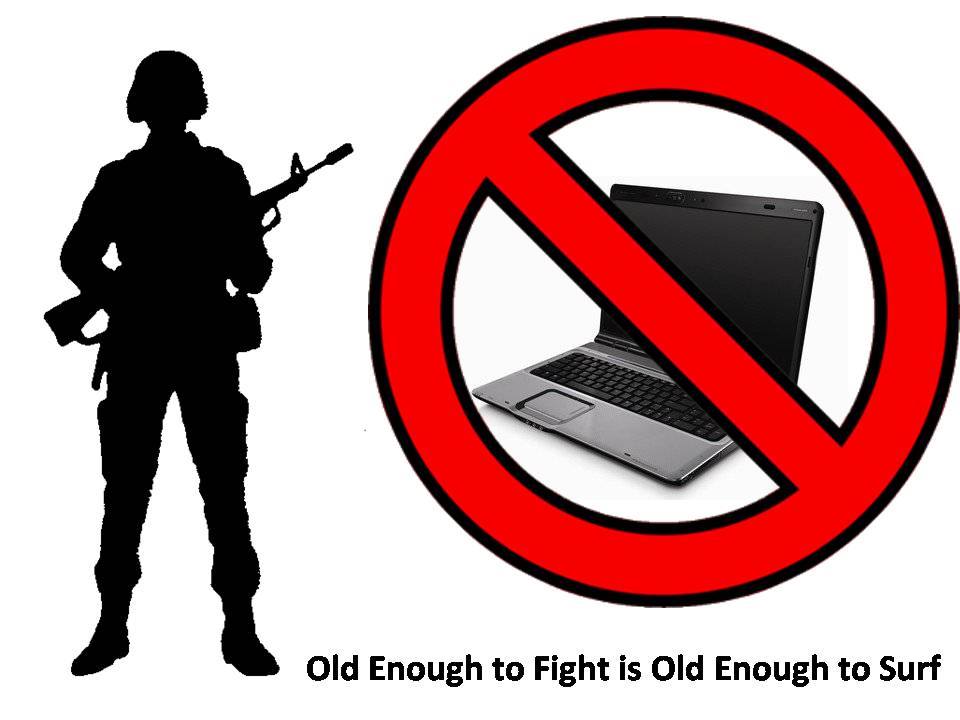
William Lind has a new post up at Defense and The National Interest that addresses the issue of the IT restrictions on the use of the internet by military personnel. This topic has been touched on previous by others such as at the SWC, SWJ Blog, Haft of the Spear, Hidden Unities and many milbloggers, intel and cyberwonks but previously, IT policy varied across services and from command to command. That appears to be changing – for the worse.

On War #302: Blinders

At the height of the Cold War, a U.S. army corps commander in Europe asked for information on his Soviet opposite, the commander of the corps facing him across the inter-German border. All the U.S. intelligence agencies, working with classified material, came up with very little. He then took his question to Chris Donnelly, who had a small Soviet military research institute at Sandhurst. That institute worked solely from open source, i.e. unclassified material. It sent the American general a stack of reports six inches high, with articles by his Soviet counterpart, articles about him, descriptions of exercises he had played in, etc.

What was true during the Cold War is even more true now, in the face of Fourth Generation war. As we have witnessed in the hunt for Osama, our satellite-photo-addicted intel shops can’t tell us much. But there is a vast amount of 4GW material available open-source: websites by and about our opponents, works by civilian academics, material from think-tanks, reports from businessmen who travel in areas we are interested in – the pile is almost bottomless. Every American soldier with access to a computer can find almost anything he needs. Much of it is both more accurate and more useful than what filters down through the military intelligence chain.

Or at least he could. In recent months, more and more American officers have told me that when they attempt to access the websites they need, they find access is blocked on DOD computers. Is al Qaeda doing this in a dastardly attempt to blind American combat units?
Sadly, no. DOD is doing it. Someone in DOD is putting blinders on American troops.

I do not know who is behind this particular bit of idiocy. It may be the security trolls. They always like to restrict access to information, because doing so increases their bureaucratic power. One argument points to them, namely an assertion that the other side may obtain useful information by seeing what we are looking for. That is like arguing that our troops should be given no ammunition lest muzzle flashes give away their positions in a fire-fight.

But the fact that websites of American organizations whose views differ from DOD’s are also blocked points elsewhere. It suggests political involvement. Why, for example, is access to the website of the Center for Defense Information blocked? CDI is located in Washington, not the Hindu Kush. Its work includes the new book on military reform America’s Defense Meltdown, which has garnered quite a bit of attention at Quantico.

The goal of the website blockers, it seems, is to cut American military men off from any views except those of DOD itself. In other words, the blockaders want to create a closed system. John Boyd had quite a bit to say about closed systems, and it wasn’t favorable.

Read the rest here

What is disturbing to me is that Lind indicates that the previous policy, which left IT restrictions up to commanders, seems to be coalescing behind one of systemic, tight, restrictions on access for all uniformed personnel to all kinds of blogs or websites that do not jeopardize information security. Or may even be useful to the conduct of their mission. The previous excuse by DoD bureaucrats was “conserving bandwidth” but it’s hard to see how esoteric sites like the Center for Defense Information or some university PDF on Islamist madrassas in Pakistan clog up a combatant command’s skinny pipes.

Intel and cyber experts in the readership are cordially invited to weigh in here.

ADDENDUM:

Professor Sam Liles offered up this manifesto on cyberthreats and cybersecurity.

ADDENDUM II:

Fabius Maximus, Ubi war and Wings Over Iraq took a similar view ( Wings though, added “Curse you Zenpundit!”).

ADDENDUM III THE COUNTERPOINT:

Galrahn says Bill Lind does not understand the legitimate cybersecurity aspect that causes blogs and websites to be blocked and then offers some practical advice to the blocked bloggers (such as myself):

….but I’d bet at least 5 shots of Canadian Whiskey (I’m a Crown Royal fan until summer gets here) that the problem that triggered his rant doesn’t originate in the DoD or any government entity, rather the private sector.

But I will say this. There are several legitimate reasons why websites, blogs, and other forms of social media sites on the web are blocked. If your website or blog is blocked, please understand you can do something about it besides whine.

Use Feedburner, or some other form of syndication software to distribute your content, including by email. Organizations including the military may block Blogger but typically they do not block syndication service sites because from an IT perspective, syndication services like Feedburner is a better way to manage bandwidth for larger enterprises. If an organization is blocking syndication sites too, then your organization has a very strict IT policy, BUT if your favorite websites are distributing content by email, problem solved

I used Feedburner previously with my old blogger site when Feedburner was in beta but when it was purchased or absorbed by Google, that account went dormant. I think I will ressurect it and then look into Galrahn’s other suggestions.

The World According to Meatballs

Tuesday, February 10th, 2009

I have been remiss in linking but the off-color psyops analysts at Swedish Meatballs Confidential are back to posting again.

Where o’ where are the Imperating Kents though ?


Switch to our mobile site