zenpundit.com » small wars journal

Archive for the ‘small wars journal’ Category

Few at SWJ on “Less is Often More?”

Wednesday, June 22nd, 2011

Major Michael Few had a short theoretical post that sparked an important discussion at SWJ Blog and other social networking sites. He’s wrestling with the military-tactical effects of diminishing returns. Well worth your time to read through:

Less is Often More?

This is a post that I never would have written while practicing the art in Iraq. On the ground level, every commander wants more forces. In fact, one of the unstated prerequisites for command is that you must conduct at least one daily bitching session where you emphatically describe how much more effective you could be if you were given another platoon, company, battalion, etc…

– More forces equal more villages and more neighborhoods you can clear and occupy.
– More forces equal more visible power and control.
– More resources equal more money to bribe your enemies.

But, sometimes more is actually less:

– More forces mean that you can act unilaterally and just ignore the impotent host nation security forces.
– More forces mean that you can coerce and bully the corrupt political leaders.
– More resources mean that you may waste money building elaborate schools and medical clinics and digging canals rather than repairing the existing suitable structures.

Sometimes with more, we merely attack the symptoms creating short-term visible gains rather than attacking the root problems. Doctrinally, we would call this creating maneuver space on the human and physical terrain.

Read the rest here.

It Takes a Big Man to Know the Value of a Small Wars Coin

Saturday, May 7th, 2011

coin2.jpg

I’ve got mine.

Get yours!

It is pretty weighty, moreso than a Liberty silver dollar. And it is a slick presentation.

Carl Prine will tell you how:

COINtribute!

….Maybe it’s my unnatural nocturnal fear of monster Jasminocereus talking, but this morning I plunked down my annual contribution to SWJ.

Yes, I routinely squabble with the peeps who run the joint, but it remains the world’s best clearinghouse of ideas about irregular wars, military strategy and other topics of interest to laymen and professionals alike.

The Small Wars Journal Foundation is a 501C3 nonprofit. The founders don’t seem to have made any moolah off of it and they mostly get by with slave labor from cranky Army majors.

Those unpaid editors bring us not only the best essays of the COINdinistas but also (and increasingly) the ripostes of dissenters who don’t drink the Kool-Aid.

They’ve been endorsed by Rolling Stone. Yeah, I know, but you should still help out SWJ before you take a long, slow pee on Rolling Stone.

If you’ve served in uniform, some REMF general from some dank cavern in the E-Ring bestowed on you a crappy command coin in lieu of actually learning your name during a visit you didn’t deserve to suffer.

You never got rid of it because it’s the size of a turkey platter, but you also don’t display it because the Pentagon shop’s command coin isn’t exactly akin to the green-monkey-screwing-a-skull medallion the hip SF guys flipped you after that one crazy mission outside the wire, right?

Well, SWJ is running a special: Give them $50 and they mail you their Challenge Coin. And it’s worth displaying, probably because it says “Small Wars Journal” so it makes everyone who sees it think you’re a lot smarter than you actually are.

I know that’s my excuse for flashing it.  That, and my wife won’t let me show anyone the monkey coin.

Good Things Come in Threes

Friday, April 29th, 2011

From our friends at Infinity Journal:

LTC Ron TiraThe Uncommitted Commitment: US Military Involvement in Libya

At the time of this writing the United States may or may not still consider itself engaged in a limited-means campaign in Libya, whose declared objective is to protect Libyan civilians and whose implicit objective is regime change. This military endeavor is, or has been, conducted in contravention of hard-learned American strategic doctrines; and it is an odd pick when contrasted with other more pressing and significant challenges to US vital interests in the Middle East.

As is the case with many lessons learned, the US has paid a high price for the insights embodied mostly in the Weinberger Doctrine and also in the Powell Doctrine. Yet, as is also often the case, it has offhandedly brushed aside that hard-earned strategic prudence.

….Yet the planners of the Libyan operation have preferred force economy and risk aversion over winning. First and foremost has been the demarcation of acceptable risks and consequently acceptable modes of military operation, while the gap between those tolerable ways and means on the one hand and the ends on the other hand remain knowingly unaddressed. The operation’s architects have only been willing to commit and risk limited assets applying standoff fire and possibly special operations, and whatever those can achieve – will be achieved. It is not the objectives and theater characteristics but economy and risk aversion that have driven the campaign’s design.   

Read the rest here ( free registration required).

From SWJ Blog where they are about to launch their subscription newsletter, where I debut as the Recommended Reading columnist with Crispin Burke of Wings Over Iraq:

SWJ Monthly E-News (Bumped – Updated)

Once a month, beginning on 1 May, we will be sending out an e-mail overview of the latest news, issues, events and more from SWJ and the broader Small Wars / Irregular Warfare community of interest and practice.

Have something you think should be included in future newsletters? Send it along to mailto:%20comment@smallwarsjournal.com. Care to advertise in future newsletters? Contact SWJ at mailto:%20advertise@smallwarsjournal.com for details.

Keep abreast of what’s happening in the far flung reaches of the SWJ Empire – sign up below for our newsletter today.

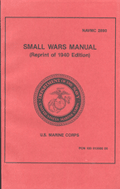
***Sign up now – One lucky SWJ E-News subscriber will win a copy of the 1987 reprint of the Small Wars Manual.*** smallwarsmanual.gif***This copy is in new condition – never been opened and has been priced as high as $101.00 on Amazon.com***The contents of SWJ E-News No. 1 will include:

* SWJ News – Journal articles and blog entries, Council debates and discussions, This Week at War and a sneak preview of our SWJ challenge coin,
*
Doctrine Man @ SWJ – DM’s exclusive for Small Wars Journal cartoon commentary,
* Professional Reading – Snapshots and links to articles of interest from a wide array of professional journals,
* SWJ Interviews – A recap with links covering our SWJ interview series,
*
Starbuck and Zenpundit – Recommended reading,
* Book Review – Bing West’s The Wrong War,
* Upcoming Events – Small Wars-related workshops, conferences, seminars and webcasts,
* More…

Signup for our Monthly E-News

* indicates required


Finally, Wikistrat has released the latest Core-Gap Bulletin:

CoreGap 11.11 Released – What to Do With Despots Who Fight to the Bitter End?

Wikistrat has released edition 11.11 of the CoreGap Bulletin.

This CoreGap edition features, among others:

  • Terra Incognita – What to Do With Despots Who Fight to the Bitter End?
  • Bahrain Repression Indicates Just How Scared of Iran the Saudis Truly Are
  • IMF and Standard & Poors Both Issue Warnings on Unprecedented US Debt
  • As Libyan Stalemate Looms, NATO Increases Involvement
  • South Africa Formally Joins BRIC Group, Signaling China’s Dominance

And much more…

The entire bulletin is available for subscribers. Over the upcoming week we will release analysis from the bulletin to our free Geopolitical Analysis section of the Wikistrat website, first being “Terra Incognita – What to Do With Despots Who Fight to the Bitter End?”

Read the full piece here

Corn’s Caliphates in Wonderland

Saturday, March 26th, 2011


They Just Don’t Make Caliphates Like They Used To….

SWJ Blog featured a lengthy (30 page) essay by Dr. Tony Corn on….well….many things. Corn begins with caliphates and then sort of takes off much like a blown up balloon abruptly released by a child prior to tying a knot in the end.

The Clash of the Caliphates: Understanding the Real War of Ideas by Dr. Tony Corn

….For one thing, within the global umma, there appears to be as many conceptions of the ideal Caliphate as there are Muslims. This grass-roots longing for a symbol of unity should be heard with the proverbial Freudian -third ear,?? and seen for what it really is, i.e., a symptom rather than a disease. For another, by agreeing to establish diplomatic relations with the 57-member Organization of the Islamic Conference (OIC), America and Europe have, in essence, already granted the OIC the status of a Quasi-Caliphate.

More important still, it is time for Western policy-makers to realize that the ideological rivalry between Saudi Arabia and Iran that has been going on since 1979 constitutes nothing less than a Clash of the Caliphates. Through a soft power strategy blurring the distinction between -public diplomacy?? and -political warfare,?? -humanitarian aid?? and -religious propaganda,?? the two states have been the main drivers of the re-Islamization process throughout the Muslim world. The one-upmanship dynamic generated by the rivalry between these two fundamentalist regimes is the main reason why, from the Balkans to Pakistan, the re-Islamization of the global umma has taken a radical, rather than moderate, dimension.

Ok, “caliphates” as a metaphor/analogy for geopolitical rivalry of Muslim states works but it is not really what Islamists or normal Muslims would mean by the term. It is a very odd usage. I’m not overly bothered by that because I tend to like analogies but Corn’s device here is apt to make the heads of area studies and Islamic history scholars explode. The whole essay is in this meandering, idiosyncratic, vein.

Now that is not to suggest that you should not read the piece. Dr. Corn held my attention all the way through and he has a number of excellent observations on many, loosely related, subjects. For example, after discussing the pernicious effects of Saudi donations and Edward Said’s agitprop theory of “Orientalism” on the intellectual objectivity of academia, Corn writes:

…The combined effect of the House of Saud and the House of Said is the first reason why the Ivory Tower has done such a poor job identifying the nature of Muslim Exceptionalism. A more indirect, yet more insidious, reason is that, unlike in the early days of the Cold War, American academics across the board today are trained in social sciences rather than educated in the humanities. For social scientists, Explanation (erklaren) and -theory-building?? take precedence over Understanding (verstehen) and -policy-making. The victory of the -numerates over the -literates in the 1970s has produced a generation of scholars who show a certain virtuosity when it comes to -research design, but display an amazing lack, not just of historical literacy, but of -historical empathy as well. Not to make too fine a point: the Long War is being waged by a generation of policy-makers who, however articulate, never learned anything about history in their college years

Corn is spot on here. Not only is it spot on, it is likely to get much worse. After a brief qualitative “bump” from Iraq-Afghan war  language trained vets, diplos, analysts and spooks peters out, we will have the Gen Y kids with K-12 educations scrubbed free of history, foreign languages and science graduating from college with communication and marketing degrees and entering government service. Hang on to your hat when that happens.

What Corn really requires to vault his essays to the next level are the services of an experienced editor because less would be more. The man is erudite and insightful. He writes forcefully and raises a number of points that are important and with which I agree. Corn, commendably, also makes more of an effort to connect the dots than most. But maybe, if you have an essay that references David Kilcullen, Trotsky, neo-Ottomanism, lawfare, Sam Huntington, neo-COIN, Nasser, Vatican II, the Comintern, the Hapsburgs, Ataturk, public diplomacy, al- Qaradawi, social media, Fascism, Marc Lynch, Youtube, network theory, the UN, hybrid wars and the Protestant Reformation, it might be time to up the Ritalin dosage a notch. Jesus, there’s either a book proposal or four different articles in that kitchen sink of an op-ed!

Read it and take what is useful.

Debating the Mexican Cartel Wars at SWJ Blog

Monday, February 14th, 2011

Only Some Dare Call it “Insurgency”

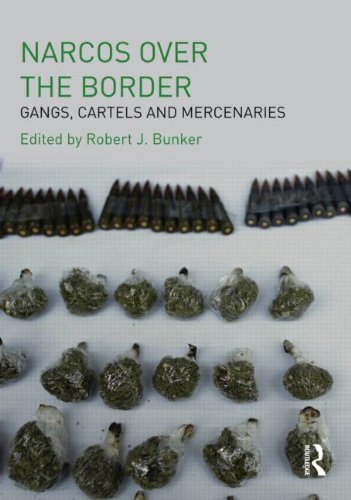
A “must read” article by Dr. Robert J. Bunker at SWJ Blog:

The Mexican Cartel Debate: As Viewed Through Five Divergent Fields of Security Studies

….What is clear is that complex post-modern threats-such as those posed by the Mexican cartels and, for that matter, Al Qaeda and its affiliate network- do not fit into neat categories and well-defined security fields. What is needed is for a U.S. governmental „honest broker? or supra-security organization to come into the Mexican cartel debate and leverage the five fields of security studies highlighted in this essay into a broader networked effort. This effort must further be tied into issues pertaining to the trans-operational environments involving U.S. engagement with Mexican cartels and their affiliates. We can no longer afford the luxury of watching numerous fields of study and security response organizations-each with their own form of „extreme specialization?- independently going about their activities in a totally uncoordinated manner. Instead, attention should be directed at creating a hemispheric strategy for the Americas, possibly even global in scale, to directly challenge the rise of the Mexican cartels and their mercenary and gang affiliates along the entire threat continuum highlighted in this essay.


That the narco-cartels originally had illicit economic motivations and lack Maoist ambitions is apparently a very large obstacle for some orthodox counterinsurgency experts to wrap their heads around – despite the fact that if a group with a political identity were beheading rivals, assassinating police chiefs, kidnapping mayors, using propaganda of word and deed, setting off car bombs and fighting the Army, they’d call it “insurgency”.

While the USG is not supposed to call the narco-cartel war an “insurgency“, we appear to be starting to treat it as one.


Switch to our mobile site