zenpundit.com » terrorism

Archive for the ‘terrorism’ Category

Lion of the Punjab

Tuesday, January 4th, 2011

[ by Charles Cameron, cross-posted from SmartMobs ]

I found this story strangely moving. The governor of the province of the Punjab in Pakistan, Salmaan Taseer, was killed by one of his own guards — according to this NY Times Lede blog story, because he was speaking out in favor of amending Pakistan’s blasphemy laws.

So here’s my DoubleQuote twitter-requiem for a courageous man:
.
quo-salman-taseer2

A DoubleQuote for InfoCult

Wednesday, December 29th, 2010

[ by Charles Cameron, cross-posted from Infocult ]

InfoCult is my friend Bryan Alexander‘s fine blog, with a house specialty of the gothic in everyday life and media.  I put this DoubleQuote together for Bryan as a sort of Addams Family greeting for Christmas:

two Christmas quotes about hell fire and vampires

The power of network visualization

Sunday, December 12th, 2010

[ by Charles Cameron ]

We’ve been having an intriguing discussion recently in the comments here on Zenpundit about mapping / modeling complex situations in a way that leaves us humans more liable to come to nuanced understandings and less liable to unintended consequences, and one point that keeps on cropping up is the need to pare down the number of nodes in our mapping without losing sight of the subtleties…

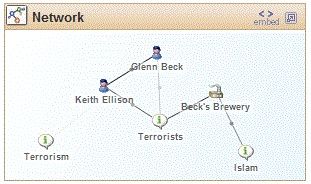
I was thus delighted to find, as I was doing my morning trawl of usual and unusual news sources, that Glenn Beck had come out with his estimate of how many Muslim terrorists there are in the world (10% of the global Muslim population, ie 157 million), Fareed Zakaria had refuted him — and there was even a helpful Silobreaker network diagram to show me how the relevant nodes under discussion fit together:

Beck Muslims and Brewery

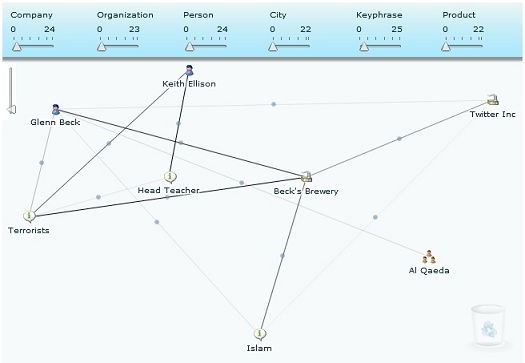
I was delighted to see that (Mormon) Glenn Beck is more closely associated with (Muslim) Rep. Keith Ellison than he is with terrorists, and sorry to note that Beck’s Brewery and Islam are somehow linked… But naturally, once I had seen this much I wanted to drill down even deeper — so I entered the appropriate keywords at Silobreaker and found this:

silobreaker beck islam

You’ll see that Beck’s link with Al Qaeda is, thankfully, a weak one. And I think you’ll agree with me that even shifting from a six node to an eight node graph considerably ups the sophistication of analysis required to fully comprehend the issues portrayed.

*

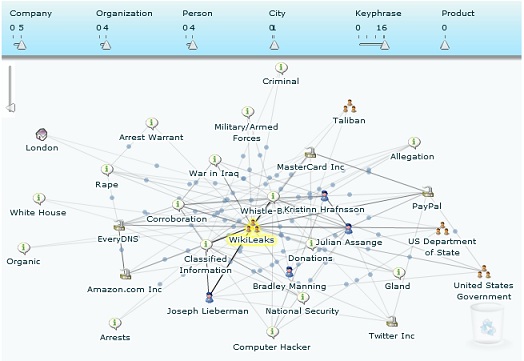
In any case, I thought it might be appropriate to post Silobuster’s more detailed map of the current situation with WikiLeaks here:

Wikileaks Silobreaker

All becomes clear, eh?

I particularly like the node labeled “Gland” (it’s almost hidden but not quite, you’ll find it lower right, between PayPal and Twitter)– that might be the one I’d zero in on to get a fuller appreciation of the complexities of the situation.

And for the record, this post is an example of British “humor” — or as we prefer to call it, “dry wit”.

What the Dickens? Symbolic details in Inspire issue 3

Sunday, November 21st, 2010

by Charles Cameron
.
It’s easily missed. It’s part of the “small print” that most small-format paperbacks carry on the copyright page:

The sale of this book without its cover is unauthorized. If you purchased this book without a cover, you should be aware that it was reported to the publisher as “unsold and destroyed.” Neither the author nor the publisher has received payment for the sale of this “stripped book.”

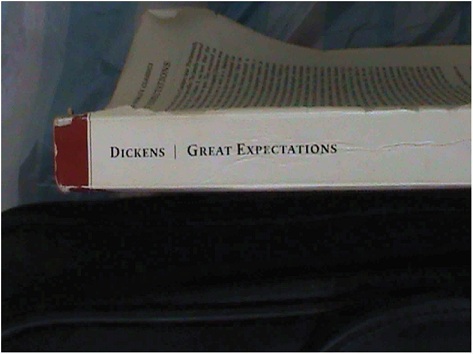
Here’s the picture that AQAP took of the copy of Dickens’ novel Great Expectations they inserted into one of their bombs recently – which they then published in issue 3 of their English language magazine Inspire:

Dickens

And here’s the explanation that accompanies that photo, in a piece titled “The Objectives if Operation Hemorrhage” by their “Head of the Foreign Operations Team”:

This current battle fought by the West is not an isolated battle but is a continuation of a long history of aggression by the West against the Muslim world. In order to revive and bring back this history we listed the names of Reynald Krak and Diego Diaz as the recipients of the packages. We got the former name from Reynald de Chatillon, the lord of Krak des Chevaliers who was one of the worst and most treacherous of the Crusade’s leaders. He fell into captivity and Salahuddeen personally beheaded him. The name we used for the second package was derived from that of Don Diego Deza, the Inquisitor General of the Spanish Inquisition after the fall of Granada who along with the Spanish monarchy supervised the extermination and expulsion of the Muslim presence on the Iberian Peninsula employing the most horrific methods of torture and done in the name of God and the Church. Today we are facing a coalition of Crusaders and Zionists and we in al Qaeda of the Arabian Peninsula will never forget Palestine. How can we forget it when our motto is: “Here we start and in al-Aqsa we meet”? So we listed the address of the “Congregation Or Chadash”, a Gay and Lesbian synagogue on our one of our packages. The second package was sent to “Congregation B’nai Zion”. Both synagogues are in Chicago, Obama’s city.
.
We were very optimistic about the outcome of this operation. That is why we dropped into one of the boxes a novel titled, Great Expectations.

They may not have read the book or seen the movie, as Ibn Siqilli comments at the link above, but they do have long memories and/or a taste for history, and they are indeed sending signals with small details like the fictitious names of their addressees.

*

This is in line with one of the basic premises of Islamic thought: that the world we inhabit is a world of ayat or symbols (the singular is ayah, and the word is also used to refer to the verses of the Qur’an, each of which is viewed as a symbolic utterance). Here, for instance, is a passage from Fazlun Khalid’s paper, Islam and the Environment, from the website of Jordan’s Royal Aal al-Bayt Institute for Islamic Thought:

The Qur’an refers to creation or the natural world as the signs (ayat) of Allah, the Creator, and this is also the name given to the verses contained in the Qur’an. Ayat means signs, symbols or proofs of the divine. As the Qur’an is proof of Allah so likewise is His creation. The Qur’an also speaks of signs within the self and as Nasr explains, “… when Muslim sages referred to the cosmic or ontological Qur’an … they saw upon the face of every creature letters and words from the cosmic Qur’an … they remained fully aware of the fact that the Qur’an refers to phenomena of nature and events within the soul of man as ayat … for them forms of nature were literally ayat Allah”. As the Qur’an says, “there are certainly signs (ayat) in the earth for people with certainty; and in yourselves. Do you not then see?” (Adh-Dhariat, 51:20, 21).

*

BTW, I don’t think Penguin (or, for that matter, Charles Dickens) got paid for that book… whatever their expectations may have been.

Blood and Rage by Burleigh

Tuesday, November 16th, 2010

After an extended hiatus, Summer Series 2010: Reviewing the Books! re-starts……

Blood and Rage: A Cultural History of Terrorism by Michael Burleigh

British historian Michael Burleigh brings the same kind of unsparingly brutal prose to the history of terrorism that he previously delivered on National Socialism in his acclaimed, The Third Reich: A New History. There is a wealth of detail about terrorists, their casual atrocities and the warped morality that terrorists habitually employ to rationalize their crimes; a nihilistic mentalite shared with their intellectual groupies in universities and political law firms that will shock and inform the reader. The scattered nature of the case studies that comprise modern terrorism though, makes Blood and Rage more of a kaleidescope than microscope.

Burleigh set out to chronicle a comprehensive examination of the evolution of terrorism in the last two centuries. There are Feinians and radicalized Russian Narodniks, murderous FLN Algerians and their pied noir OAS blood enemies, Irgun gunmen and Black September, ETA, IRA and Baader-Meinhoff gangsters consorting with Palestinian radicals and Herbert Marcuse. Burleigh dissects the psychopathology of ultraviolent degenerates like Hugh “Lenny” Murphy, Abu Musab al-Zarqawi and Andreas Baader. Terrorists, statistically speaking, are generally not madmen in a clinical sense, but Burleigh records a noteworthy exception regarding Germany’s Baader-Meinhoff Gang:

….With their numbers by now reduced to about a dozen people, the group was desperate for new recruits. Salvation came from an unlikely quarter. The mad. A radical psychiatrist at Heidelberg University, influenced by the anti-psychiatry of R.D. Laing and the anti-institutionalisation theories of Franco Basaglia, had formed a socialist collective among the mainly student clientele he was treating for various mental disturbances common to that age cohort including depression, paranoia and mild schizophrenia. In early 1971 Baader and Ensslin visited Heidelberg where they met some of the radicalized patients. In the following years, about twelve of the latter, including Gerhard Muller, Siegfried Hausner, Sieglinde Hofmann, Lutz Taufner and others became the second generation of RAF terrorists, initially under the slogan “Crazies to Arms”.

Blood and Rage makes for a grim read, with the recurring pattern of terrorism and counterterrorist response erupting to demoralize societies until the terrorists in question are either dead, imprisoned or mellowed by paunchy middle-age and political irrelevance as the times pass their maniacal political passions by. Only in a few instances, notably South Africa and Northern Ireland are political settlements a more feasible option than methodical police and intelligence work followed by tough-minded prosecution and a steely societal rejection of grandiose moral claims of terrorists and their fellow-travelling left-wing lawyer-advocates. Burleigh also makes clear his disdain for militarized CT and multiculturalist enablement alike.

The weakness of Blood and Rage, unlike some of Burleigh’s other works, is a lack of a strong analytical theme, focus or grand theory to explain and unite the relentless and gory march of geographically diverse case studies in terrorism, though an intelligent reader should be able to discern patterns present well enough for themselves. Given Burleigh’s stature as a scholar, one can envision him having taken the ball further down field for a deeper level of analysis of terrorism as a societal phenomena. Burleigh would probably reply that such is not the proper job of a historian, which while true enough, still leaves me wishing he had.

As a popular history, Blood and Rage makes a page turner out of rancorous destruction.


Switch to our mobile site