zenpundit.com » academia

Archive for the ‘academia’ Category

Book Review: A Terrorist’s Call to Global Jihad

Thursday, December 29th, 2011
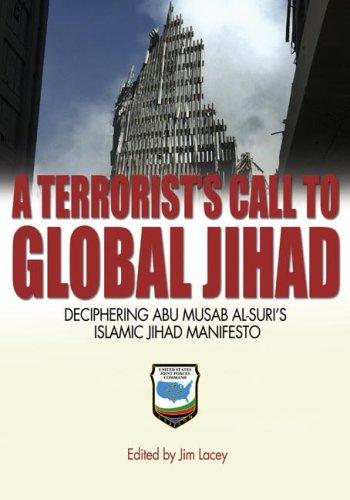
A Terrorist’s Call to Global Jihad: Deciphering Abu Musab al-Suri’s Islamic Jihad Manifesto by Jim Lacey (Ed.)

Previously, I read and reviewed Brynjar Lia’s Architect of Global Jihad, about Islamist terrorist and strategist Abu Musab al-Suri. A sometime collaborator with Osama bin Laden and the AQ inner circle, a trainer of terrorists in military tactics in Afghanistan and an advocate of jihadi IO, al-Suri was one of the few minds produced by the radical Islamist movement who thought and wrote about conflict with the West on a strategic level. Before falling into the hands of Pakistani security and eventually, Syria, where al-Suri was wanted by the Assad regime, al-Suri produced a massive 1600 page tome on conducting a terror insurgency,  The Global Islamic Resistance Call, which al-Suri released on to the jihadi darknet.

Jim Lacey has produced an English digest version of al-Suri’s influential magnum opus comprising approximately 10 % of the original  Arabic version, by focusing on the tactical and strategic subjects and excising the rhetorical/ritualistic redundancies common to Islamist discourse and the interminable theological disputation. There are advantages and disadvantages to this approach.

First, Lacey has produced a concise and readable book from a large mass of sometimes convoluted and repetitive theorizing that al-Suri strung together piecemeal, sometimes on the run or in hiding. For those interested in getting to the heart of al-Suri’s nizam la tanzim strategic philosophy, A Terrorist’s Call to Global Jihad is an invaluable resource for strategists, counter-terrorism specialists, tactical operators,  law enforcement and laymen. Secondly, it is also a useful reference for policy people to see through al-Suri’s eyes the internal political and philosophical divisions within the radical jihadi community. al-Suri himself writes very ambivalently about 9/11 as a great blow against America and yet a complete calamity in it’s effects for the “jihadi current” that destroyed everything the Islamist revolutionaries had so painstakingly built, including the Taliban Emirate. Thus a climate was created by the American counter-attack where old methods of struggle were no longer useful and jihadis must adopt radically decentralized operations ( what John Robb terms Open-Source Warfare; indeed it is clear to an informed reader that al-Suri, a wide-ranging intellectual rather than a narrow religious ideologue, was influenced by Western literature on asymmetric warfare, 4GW, Three Block War  and COIN).

The drawback to this approach is more for scholars looking at the deeper psychological and ideological drivers of jihadi policies, strategy and movement politics. The religious questions and obscure Quranic justifications cited by Islamist extremists that are so tedious and repetitive to the Western mind are to the jihadis themselves, of paramount importance in establishing both the credentials of the person making an argument but also the moral certainty of the course of action proposed. al-Suri himself had some exasperation with the degree to which primarily armchair ideologues, by virtue of clever religious rhetoric, could have more influence over the operational decisions of fighting jihadis than men with field experience like himself. By removing these citations, an important piece of the puzzle is missing.

The Musab al-Suri whose voice appears in A Terrorist’s Call to Global Jihad is consistent with the one seen in Lia’s book, dry, sardonic, coldly hateful toward the West and highly critical of the jihadis own mistakes, laden with overtones of pessimism and gloom. al-Suri did not envision a quick victory over the West and wrote his manifesto as a legacy for future generations of Islamist radicals because the current one was nearly spent after the American onslaught and poorly educated in comparison with predecessors like the generation of Sayid Qutb.

Strongly recommended.

Maxwell on North Korea

Tuesday, December 20th, 2011

Fatboy Kim II

(Photo hat tip to Robert Young Pelton)

Colonel Dave Maxwell, now retired from active duty and working at Georgetown University as Associate Director of the Center for Peace and Security Studies and the Security Studies Program in the School of Foreign Service, is an expert on the esoteric subject of North Korea ( which he habitually writes as “north Korea”) and the idiosyncratic dynastic Communist system he terms “the Kim Family regime”. In the past few years, I can say my knowledge of the DPRK has improved markedly largely from reading Dave’s posts on The Warlord Loop.

SWJ Blog has just published an analysis by Colonel Maxwell on what the demise of Kim Jong-il portends:

The Death of a Dictator: Danger, Opportunity or Best Timing Possible?

….There are two scenarios that are likely to play out within North Korea.  The first scenario depends on the strength and power of Jang Song-taek who, along with his wife and the late Kim Jong-il’s sister, is the de facto “regent” for the young Kim Jong-un.  Has he been able to help Kim Jong-un establish sufficient legitimacy within the Regime and will they be able to consolidate power?  It is very likely that if Kim has sufficient strength and control of the
security apparatus there are very likely arrests and purges taking place even as we try to figure out what is happening. 

The second scenario is that he has not been able to consolidate sufficient power and will be
faced with internal threats from other senior members of the regime who are unwilling to allow a 27 year old four star general rule the party and the military.  If there is a power struggle many scenarios can play out ranging from internal chaos, civil war, and “implosion” to an external “explosion” – e.g., spillover of the effects of chaos and civil war into China and the ROK or the worst case: the desperate execution of the regime’s campaign plan to reunify the peninsula as the only means left to ensure survival of the Kim Family Regime.  Finally, regime collapse will occur when there is the loss of the ability of the regime to centrally govern and the loss of control and support of the military and security apparatus.    We have seen cracks in the system like hairline cracks in a dam.  The recently reported alleged defection of eight armed guards is but one indication of such cracks with water slowly dripping from through the regime’s dam – the question is are those cracks repairable or will they cause the dam to crumble and collapse; unleashing such a torrent on the peninsula that will make 1950-53 look like a minor skirmish in terms of scale of potential conflict and devastation.

Either scenario will ensure the continued suffering of 23 million north Korean people and the second scenario will expand the tragedy to the Republic of Korea and its 46 million citizens and significantly affect the other countries in Northeast Asia as well as have global effects…..

Read the rest here.


Lex Talionis I: the matter of Subramaniam Swamy and Harvard

Friday, December 9th, 2011

[ by Charles Cameron — Harvard controversy, free speech vs hate speech, Hindutva, moral high ground & sanctions for and against violence ]

.

I am grateful to various members of the New Religious Movements list for pointing me to the recent events in Harvard, where a group of scholars led by the formidable Diana Eck (her book on Banaras is a masterpiece and greatly treasured) have persuaded the Faculty of Arts and Sciences to omit two courses in economics usually taught by Subramaniam Swamy from their Summer School offerings next year, on the ground that an op-ed he published in Daily News and Analysis titled “How to Wipe Out Islamic Terror” fell under the category of hate-speech (as opposed to free speech).

The article in question is no longer available on the DNA site, but can be found on Pamela Geller‘s Atlas Shrugged blog.  An account of the controversy can be found on Inside Higher Ed, and Harvard Faculty’s debate was reported in the Harvard Magazine.

Subramaniam Swamy is President of what remains of the once powerful Janata Party and former Union Cabinet Minister.

With that as background, I would like to address the issue of the varying principles and rule-sets invoked as offering a moral high ground – or a necessary safeguard – in various religious and other traditions.

*

I have read Dr Subramaniam Swamy’s article, and while the various quotes in it recommending specific actions — such as “Remove the masjid in Kashi Vishwanath temple complex, and 300 others in other sites as a tit-for-tat” and “Enact a national law prohibiting conversion from Hindu religion to any other religion” – give western readers a sense of Swamy’s overall mindset and intentions, it was another quote that held my attention:

This is Kaliyug, and hence there is no room for sattvic responses to evil people. Hindu religion has a concept of apat dharma and we should invoke it. This is the moment of truth for us.

I suspect the reason this quote has not been featured in the reports I’ve read of the debate have to do with the number of words in it that are unfamiliar to the western reader.

I’m acquainted with Kaliyug (the Age of Darkness) and with the concept of the sattvic (“Sattva is a state of mind in which the mind is steady, calm and peaceful” to quote the sacred Wiki), but had to dig a bit to discover that apat dharma is essentially “righteousness in emergencies”:

There are special Dharmas during critical and dangerous circumstances. They are called Apat-Dharma.

Swami Sivananda

Apat Dharma: They are duties that come to one under extraordinary circumstances, in crisis or in emergencies (apatmulakah). In such circumstances, even that which under normal circumstance is deemed wrong becomes dharma (tatra adharmo’pi dharmah). Here the righteous motives guide our actions (bhava-suddhimattvat). Normally a doctor gives anaesthesia before operating the patient but an emergency operation performed on the battlefield to save the life or limb of a soldier on the battlefield may be done without anaesthesia and with the instruments available, be they sterilized or not. When emergency is declared in the country, the elected parliament can be dismissed, the Constitution suspended and the ruler assumes extra-ordinary powers to deal with the situation. When peace prevails, the youth of a country should get education and work, but during war, the country may call upon its youth to sacrifice their education and fight in defence of the country, sometimes with hardly any training.

Sanjeev Nayyar

So that quote – “This is Kaliyug, and hence there is no room for sattvic responses to evil people. Hindu religion has a concept of apat dharma and we should invoke it. This is the moment of truth for us” – is essentially the abstract principle on which Swamy’s various proposals are based, and thus corresponds to the principles articulated by PM Netanyahu in his recent opening of the Knesset as underlying his government’s policies with regard to national security:

Our policy is guided by two main principles: the first is “if someone comes to kill you, rise up and kill him first,” and the second is “if anyone harms us, his blood is on his own hands.”

If you want a sense of how important that quote about apat dharma is to a Hindu (and a fortiori, a Hindutva) reader, see the way it is singled out and quoted with an illustration of Krishna driving Arjuna‘s chariot into battle by “Sanchithere (I’ve used the same illustration at the head of this post):

*

What am I after here?

It seems to me that we could use a brief yet definitive scholarly account of what the guiding principles of the various religions and secular worldviews allow their adherents, in terms of justice, forgiveness, pre-emption, retribution and retaliation.

This would need to include, compare and contrast such principles as:

  • The Judaic notions of pre-emptive killing (Netanyahu’s first principle, found in the Talmud and commonly quoted as ‘ha’Ba Lehorgecha, Hashkem Lehorgo, If someone tries to kill you, rise up and kill him first) and the injunction, in fighting the Amalekites, “Now go and smite Amalek, and utterly destroy all that they have, and spare them not; but slay both man and woman, infant and suckling, ox and sheep, camel and ass” (1 Samuel 15:3).
  • Christ’s “But I say unto you which hear, Love your enemies, do good to them which hate you.” (Luke 6.27)
  • Christian “just war” theology.
  • The western / UN “norm” that some actions are simply beyond the pale, unacceptable under any circumstances (essentially the basis for war crimes tribunals)
  • Game theory’s “tit for tat” strategy in an iterated Prisoners’ Dilemma as proposed by Anatol Rapaport and articulated by Robert Axelrod in his book, The Evolution of Cooperation.
  • The Islamic tradition’s notion of response in kind (Qur’an: 2.194, “and so for all things prohibited, — there is the Law of Equality. If then anyone transgresses the prohibition against you, transgress ye likewise against him but fear Allah, and know that Allah is with those who restrain themselves”) – which would appear to imply that actions that would not normally be acceptable may be appropriate in response to an enemy that has already “transgressed” in that specific manner
  • Gandhi’s ahimsa, together with his corollaries, “An eye for an eye makes the whole world blind” (attributed) and “It is better to be violent, if there is violence in our hearts, than to put on the cloak of nonviolence to cover impotence.”
  • Swamy’s own “This is Kaliyug, and hence there is no room for sattvic responses to evil people” and “the nation must retaliate — not by measured and ‘sober’ responses but by massive retaliation.”
  • Buddha’s “Victory breeds hatred. The defeated live in pain. Happily the peaceful live giving up victory and defeat” (Dhammapada15,5)…

… and so forth.

*

I am grateful for further pointers and comments you may care to offer.

I hope to follow this post up with another, Lex Talionis II, which will address the use of private rewards for revenge killings in the Israeli / Palestinian matter.

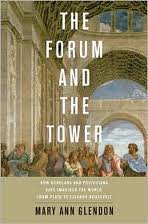
The Forum and The Tower, a review

Sunday, November 20th, 2011

[by J. Scott Shipman]

the-forum-and-the-tower.jpeg

The Forum and The Tower by Mary Ann Glendon

“The relationship between politics and the academy has been marked by mutual fascination and wariness since the time of Plato.”

The first sentence on the flap of the dust jacket of this very good and informative small book. Professor Glendon, who is the Learned Hand Professor of Law at Harvard Law school, set out to write a book for her students that would answer ageless questions such as:

“Is politics such a dirty business, or are conditions so unfavorable, that couldn’t make a difference? What kinds of compromises can one make for the sake of getting and keeping a position from which one might be able to have influence on the course of events? What kinds of compromises can one make for the sake of achieving a higher political goal? When does prudent accommodation become pandering? When should one speak truth to power no matter what the risk, and when is it acceptable, as Burke put it, to speak the truth with measure that one may speak it longer? When does one reach the point at which one concludes, as Plato finally did, that circumstances are so unfavorable that only the reasonable course of action is to “keep quiet and offer up prayers for one’s own welfare and for that of one’s country”?”

Professor Glendon answers these questions and more through brief examinations of the lives and works of some of history’s most important figures:

Plato

Cicero

Justinian, Tribonian, and Irnerius

Machiavelli

Thomas Hobbs and Edward Coke

John Locke

Jean-Jacques Rousseau

Edmund Burke

Tocqueville

Max Weber

Oliver Wendell Holmes

Eleanor Roosevelt and Charles Malik

All in all, I believe Professor Glendon has provided a uniquely valuable book to help her students and other readers to answers those questions. In short but focused chapters of about 20 pages each, she provides mini-biographies of the subjects above and how they answered the some of the questions both in their lives and in their philosophy. Some of her subjects were thinkers lacking the abilities for the public square, Plato, for instance, but were enormously influential just the same. Rare were those like Cicero and Burke who were equally comfortable in the political arena or the academy.

My favorite chapters were on Plato, Cicero, Machiavelli, and Burke—mostly because I’ve read a respectable amount of their work. That said, I have not read Plato’s The Laws—and Professor Glendon suggests it is much better than The Republic—which I have read and did not much enjoy. Not surprisingly, The Laws will be on my list for this winter.

The inclusion of Eleanor Roosevelt and Charles Malik was something of a surprise, but Professor Glendon is weaving a sub-story through each chapter and illustrating how Roosevelt and Malik’s work on the Universal Declaration of Human Rights was something of culmination and extension of over 2,000 years of thinking and political action—not in the context of human progress towards a utopia of sorts, which she wisely rejects,  but rather a reflection the common threads of political thought throughout history.

While this is not criticism, I would have liked to have seen a chapter on John Adams and Thomas Jefferson, and a chapter on Karl Marx, whom she frequently mentions.

This is a book that is approachable and readable, and in our tumultuous domestic and global political climate, important.

She closes with this illuminating sentence:

“If one message emerges from the stories collected here, it is that just because one does not see the results of one’s best efforts in one’s own lifetime does not mean those efforts were in vain.”

Professor Glendon is to be commended for a job “well done!”

The book comes with my highest recommendation and may be the best book I’ve read this calendar year. Add this book to your must read list.

.
Referenced works you may find of interest (some of these works are out of print and expensive—for simplicity I’ve used Amazon links): 

The Laws of Plato, translated by Thomas Pangle

Cicero: The Life and Times of Rome’s Greatest Politician, by Anthony Everitt

Cicero, A Portrait, by Elizabeth Rawson (Glendon praised this book.)

A Panorama of the World’s Legal Systems, John Henry Wigmore

The Life of Nicolo Machiavelli, Roberto Ridolfi

The Prince, translated by Harvy Mansfield

Machiavelli, by Quentin Skinner

The Lion and the Throne, Catherine Drinker Bowen

The Spirit of Modern Republicanism, by Thomas Pangle

Statesmanship and Party Government, by Harvy Mansfield

The Great Melody, A Thematic biography of Edmund Burke, by Conor Cruise O’Brien (I read this wonderful book in 1992 when it was released: highly recommended.)

Book

Sunday, November 20th, 2011

Thinking in Time by Richard Neustadt and Ernest May

Picked up this classic work on metacognition, history and strategic decision making for the astronomical price of…..$ 4. Including shipping.

The diminuition of the teaching of history in elite universities after the 1960’s, when the old undergraduate canon was chucked in deference to demands by student and faculty radicals for an a la carte system (to replace the old core with politicized race-gender-crit rubbish), has contributed to the decline in American strategic thinking.


Switch to our mobile site