zenpundit.com » philosophy

Archive for the ‘philosophy’ Category

Taliban: religiosity vs pragmatism

Wednesday, June 27th, 2012

[ by Charles Cameron — a question of priorities ]
.
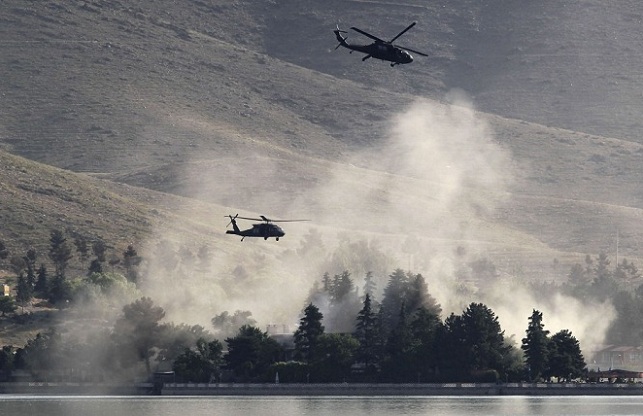

photo credit: Omar Sobhani/Reuters
.

The attack in Qargha was not about liberating one’s own people from an occupying power, but about imposing one’s religious morality on compatriots who do not share one’s enthusiasm. Or to put that another way: at times, war is the continuation of religiosity by other means.

Offered without further comment, from The attack in Kargha: Return of the Taleban Puritans? by Thomas Ruttig of Afghan Analysts Network:

For the first time in many months, the Taleban have attacked a target that is almost exclusively used by Afghan civilians, while statements by their leader Mulla Muhammad Omar and their code of conduct (the layha, see an AAN report about it here) suggested a desire to protect civilians as much as possible. In the past, when causing civilian casualties, Taleban spokesmen often argued that they had actually been attacking a military target (like a convoy, a checkpost or another military installation) and that they had not planned to harm civilians. This time, such an excuse would have sounded ridiculous. Instead, in a statement under the name of their spokesman Zabihullah Mujahed they called the hotel a ‘hub of obscenity and vulgarity frequented by the lusty foreign and local top-level military and officials to satisfy their impure lust especially on Thursday nights’ and where ‘anti-Islamic meeting are usually being held’ (sic).

Equally ridiculous was their claim that it was mainly foreigners who had been targeted at Kargha. In the statement already quoted they claimed that their fighters had killed and wounded ‘several dozens of the top-level foreign diplomats and military figures and high-ranking puppets’. But everyone in Kabul knows that many foreigners are not even allowed to go to most of the restaurants in the city centre, particularly ‘top-level diplomats’. Kargha, well outside the city, is off limits for all foreigners except those few who do not have strict security rules. Instead, Kargha, with its little restaurants (which Afghans tend to call ‘hotels’), ice cream parlours and even cottages furbished in Swedish style and a few pedalo boats to rent, is a typical weekend retreat for Kabulis from all walks of life, from the young and well-off to rather ordinary people who enjoy the only accessible lake in the vicinity of the capital. To target such an area is not only a clear deviation from recent stated Taleban policy, if not practice, it is also an outrage.

That the Taleban tried to justify their attack by claiming that it was a venue of ‘anti-Islamic’ behaviour also shows that the old puritan tendency in their movement is alive and kicking, to which all kind of temporal amusement are anathema, especially if men and women are attending without being strictly separated.


Tree series, II: Phototropic Simplexities

Monday, June 25th, 2012

[ by Charles Cameron — this one’s a prose poem: it begins with a statement so tight it needs to be unwound, and unwinds it ]
.

I wrote this urgently starting when it “woke” me at 4am one morning in the late 1990s or 2000, and as soon as it was out, I found myself writing #3 in the series, a game design. Together, the pair of them represent a stage in my games and education thinking intermediate between Myst-like Universities of 1996 and my vision today of games in education, which I hope to address in a further post addressed to Sebastian Thrun & with appreciation to Bryan Alexander and Lewis Shepherd. In this posting, I have added the words “figuratively speaking” for absolute clarity: otherwise, the piece remains as written all those years ago.

***


A copse. Photo credit: Ian Britton via FreePhoto.com under CC license. Note how the wind sweeps the trees into a group shape.

***

Trees: Phototropic Simplexities

Trees are phototropic simplexities, no wonder we like them they cowork so well too: copses, see.

*

Meaning:

Trees we know: I as writer can refer you, reader, safely to them, “trees”, in trust that the word I use will signal to you too — triggering for you, also — pretty much the assortment of branching organic thingies about which I’m hoping to communicate that they are complex entities whose complexity comes from a simplicity of rule — branching — repeated with variations, said variants doing their branching in thirst of light, each trunk rising, limb outpushing, branch diverging, twig evading other twig much as one who seeks in a crowd a clear view of a distant celebrity shifts and cranes and peers — branching, thus, by the finding of light in avoidance of nearby shadow and moving into it, into light as position, that light, that position, growing, and thus in the overall “unified yet various”, we, seekers of the various and unified love them, to see them in greens themselves various in their simplexity is to say “tree” with a quiet warmth; while they themselves also, by the necessity of their branching seeking, if clumped together seek in an avoidance of each other’s seeking, growing, thus space-sharing in ways which as the wind sweeps and conforms them to its own simplex flows, shapes them to a common curve we call aerodynamic, highlit against the sky huddled together as “copse” — this, in the mind’s eyes and in your wanderings, see…

*

Meaning:

Trees we can talk about. Simplexity is a useful term for forms — like trees — which are neither simple only nor complex only, but as varied as complexity suggests with a manner of variation as simple as simplicity implies.

Trees? Their simplexity is conveyed in principle by the word “branching”. Its necessity lies in the need of each “reaching end” of the organism to ascertain from its own position and within the bounds of its possible growing movement, some “available” light — this light-seeking having the name “phototropism”.

Simplexities — and thus by way of example, trees — we like, we call them beautiful.

Clustered together, too, and shaped by the winds’ patterns of flow, these individual simplexities combine on an English hilltop (or where you will) to form yet other beauties.

*

Thus:

Trees are phototropic simplexities, no wonder we like them they cowork so well too: copses, see.

*

Meaning:

I love trees. Want to talk about simplexities, beauty.

I wish to talk about beauty because it is beauty that I love, if I love it, that is beauty: love is kalotropic, a beauty-seeking. I am erotropic, love seeking — you can find in this my own simplexity, my own varieties of seeking, of the growths that are my growth, and clumping me with others under the winds, the pressures that form and conform us, you can find also the mutual shapes that we adopt, beautiful.

Simplexity, then, is a key to beauty, variety, self, character, cohabitation… Tropism, seeking, is the key to simplexity. Love is my tropism. Ours, I propose.

*

Meaning:

Beauty is one simplexity perceived by another: the eye of the beholder, with optic nerve, “brain”, branching neuron paths that other simplexity, “consciousness” the perceiving.

*

Meaning also:

That all is jostle, striving — a strife for life, in which the outcome overall is for each a “place in the sun” but not without skirmishes, shadows. The overall picture, therefore, beautiful — but this overall beauty hard to perceive when the specific shadow falls in the specific sought place of the moment, the “available” is not available, and the strife of the moment is paramount.

Branching being the order behind simplexity, differentiation…

Differentiation for maximal tropism at all levels — life seeking always the light, honey, beauty, is always and everywhere in conflict also with itself, competitive: and competition the necessary act of the avoidance of shadow, and the shadow creating act.

And beauty — the light, thing sought, implacably necessary food and drink, the honey — thus the drive that would make us kill for life.

I could kill for beauty.

I could kill for honey.

Figuratively speaking.

*

Implying:

Paradise and Fall, simultaneous, everywhere.

It is at this juncture, at this branching, that we are “expelled from the garden” — can no longer see the beauty that is and remains overall, that can allow us to say also, “we are never outside the garden” — for the dappling of light on and among the leaves has become to us, too closely jostled, shadow.

And shadow for shadow we jostle, and life is strife.

*

Thus:

The dappling of light on leaves, beautiful, is for each shadowed leaf, shadow, death-dealing, is for each lit leaf, light, life-giving: a chiaroscuro, beautiful, see.

Roots, too, have their mirror branchings.

Tree series, I: This is how nature thinks

Saturday, June 23rd, 2012

[ by Charles Cameron — this one’s a companion piece for One bead for a rosary and the first of three more or less contemplative / creative posts on trees. ]

.


.

This is how nature thinks: this is one of nature’s thoughts, and it’s the kind of thought that comes late, after much else has been worn away and only essence remains, the kind we find in our elders and call by the name wisdom.

We don’t think of trees as thoughts, but perhaps we should: our idea of mind might broaden.

*

And rivers.

We spend a great deal of our time thinking and speaking in straight lines. One of the straight lines I tent to think along and speak about is the idea that we might want to think differently, to braid our linear ideas perhaps, to listen to the voices of others and join ours to theirs, making somehow a thought that is many-voiced, a thought stream that reflects on itself, echoes itself, has eddies of questioning, rapids, calm stretches, still ponds… “pondering”, my friend Derek suggests.

There are certain people who, I trust you’ll agree, are deliciously frank and frankly strange: we call them by affectionate negative names – he or she’s “an ornery old cuss” we say, perhaps – I suppose I may be one myself, and my language old-fangled, but I trust again that you get my drift.

Gnarly.

Now there’s another word for them. It comes from the gnarls in wood, and the poet Hopkins applies it to the nails that tear the hands of Christ: With the gnarl of the nails in thee, niche of the lance…

A gnarly character has come to conclusions you probably don’t share, but you feel a grudging admiration for the forthrightness with which this character has pursued some intricate and personal logic to its unordinary conclusion.

I have presented various images for a kind of thinking that is many-braided, communal yet irrepressibly individualistic, including a railway marshaling yards after a bombing raid and the multiple complex paths of the Mississippi.

*

Please consider the tree above – seen in a photo by Rick Goldwasser of a Bristlecone Pine from the White Mountains in California – as exemplifying the gnarly, intensely personal, complexly braided thought of a Beethoven in the late quartets and sonatas, the Hammerklavier and Grosse Fuge – or the unfinished late masterworks of a Michelangelo.

A tree, a way of thinking – and appreciation for that which is bone-weary yet resolute, difficult yet rewarding, which swirls like water yet is almost as still as stone.

* * *

The Grosse Fuge, performed by the Takács Quartet:

The Hammerklavier, performed by Mitsuko Uchida:

These, also, are among nature’s thoughts.

Another magnificent example of which is GM Hopkins’ poem, The Wreck of the Deutschland, from which that line about “the gnarl of the nails in thee” is drawn…

One bead for a rosary

Friday, June 22nd, 2012

[ by Charles Cameron — one bead from NASA for the glass bead game as rosary ]
.


photo credit: Norman Kuring, NASA’s Goddard Space Flight Center
.

Consider her sacred, treat her with care.

Messy Wars, Navigating Wicked Problems, and the Soul of American Foreign Policy

Monday, June 18th, 2012

Michael Few is a retired military officer and former editor of the Small Wars Journal: we are honored to offer our readers this guest post by a good friend of this blog.
.

This fall, I’m hoping to begin teaching high school social studies as well as an elective on Global Issues or Wicked Problems (WPs). WPs are those messy, seemingly intractable problems that seem to evade solutions from conventional planning and decision making methods — terrorism, poverty, water rights, etc… These types of courses are already being taught in the school system where I live, and my hope is that I will be able to become a force multiplier given my experience and background.

Eventually, if this elective course takes off, then I would like the final project to be a collection of TEDx talks, where the students describe a problem, discuss past failed efforts to tame the problem, and offer coping strategies or new solutions.

As I am doing my initial reconnaissance of the student demographics, the first striking data point is their age. The incoming freshman class would have been born in 1998, and the senior class born in 1995. A second surprise that I received is the socio-ethnic backgrounds. Along with the expected mix of white, black and Hispanic children, my school district has a significant first generation Indian population, whose parents teach or work in the Research Triangle Park or surrounding universities. Moreover, there is a minority of Burmese refugees who have found a safe home after fleeing a repressive regime.

How do they see and understand the world?

The attacks of 9/11 were but a faint memory; the Cold War is ancient history. Their childhoods were formed with the Iraq and Afghanistan wars in the background, and their pop-culture heroes are Navy Seal Team Six and Call to Duty video games. Drone strikes and the intervention in Libya are normal for them.

It is the way things are. We fight terrorists in other countries in order to protect our way of life. But what is a terrorist or an insurgent? Is it simply someone that disagrees with you?

These students have much bigger problems to solve than simply pacifying villages in the remote areas of modernity. By 2040, when these students are in the prime of their lives, the world population is expected to be nearing nine billion with increased competition for basic resources as the world passes through peak oil and peak fresh water.

If the United States is to remain strong, then these children are our hope. They will be tasked with leading the nation, finding new solutions to coming crisis, and developing innovation in technology, science, governance, and medicine.

As I am developing my teaching philosophy, I am using the same process that served me well as a commander in the military. My purpose is to help develop, mentor, and coach: 1. leaders of character, 2.involved citizens in the nation who understand that rights must be complimented by responsibilities, and 3. the individual self-confidence to pursue a good life respecting themselves and others.

Initially, I want to challenge them to rethink what they’ve been taught or think they know. I want my students to think for themselves and determine what right should look like.

First, I began studying Reinhold Niebuhr. Now, I’m spending some time reading Saint Augustine’s “City of God” and rethinking Just War Theory. If we zoom up from just drone strikes and look at our continued military action across the globe, do we still have the moral high ground? I don’t know. As Saint Augustine wrote,

Whoever gives even moderate attention to human affairs and to our common nature, will recognize that if there is no man who does not wish to be joyful, neither is there anyone who does not wish to have peace. For even they who make war desire nothing but victory — desire, that is to say, to attain to peace with glory. For what else is victory than the conquest of those who resist us? And when this is done there is peace. It is therefore with the desire for peace that wars are waged, even by those who take pleasure in exercising their warlike nature in command and battle. And hence it is obvious that peace is the end sought for by war.

When I quoted Saint Augustine in a comment here, Mark Safranski, the Zen of Zen, replied,

The high ground is in the eye of the beholder. Some people cheered 9/11, including a few American radicals. With multiple-audiences watching 24/7, some will disapprove of our merely existing and bitterly resent and deny the legitimacy of our fighting back because they prefer us defeated and dead. Other audiences are more fair-minded and these are a good barometer – if we are winning them over, securing their admiration and isolating our opponents, our moral behavior in the big picture is apt to be reasonably on track. If we are repelling them, isolating ourselves, driving others to the side of our enemies, then chances are fairly good that we are going astray.

Zen’s point is well-taken, but I disagree. Following a moral life is not based on how others feel about you. It is through living a life that subscribes to your believed philosophy, spiritual norms, and values and beliefs particularly when you have to make an unpopular decision.

John Arquilla, in his most recent “Cool War,” said it best,

’It is well that war is so terrible,’ Confederate General Robert E. Lee once said, ‘lest we should grow too fond of it.’ For him, and generations of military leaders before and since, the carnage and other costs of war have driven a sense of reluctance to start a conflict, or even to join one already in progress.

Caution about going to war has formed a central aspect of the American public character. George Washington worried about being drawn into foreign wars through what Thomas Jefferson later called ‘entangling alliances.’ John Quincy Adams admonished Americans not to ‘go abroad in search of monsters to destroy.’ Their advice has generally been followed. Even when it came to helping thwart the adventurer-conquerors who started the twentieth century’s world wars, the United States stayed out of both from the outset, entering only when dragged into them.

Today, war has become too easy and not too terrible. With our global hegemony in military strength, we can force our will at any time and any place.

But, what is the right thing to do?

What is the moral high ground?

These are some of the questions that my students will eventually have to answer.


Switch to our mobile site