zenpundit.com » IC

Archive for the ‘IC’ Category

Viewdle is a Two-Edged App

Sunday, February 20th, 2011

Saw this on Shlok’s site:

Viewdle – Photo and Video Face Tagging from Viewdle on Vimeo.

This kind of app is a required step for making augmented reality devices part of the social media ecology. Therefore, this tech will become a standard for all mobile devices – merchants and advertisers want us as an army of data collectors on each other.

OTOH, automatic face-recognition and social media aggregation raises serious concerns about the potential dangers of living under a panopticon state if an app is aggregating and bundling all your online data in real time, while giving out your GPS and home address. A godsend to stalkers, oppo researchers, con men, disgruntled spouses or employees, autocratic governments and other creepy malefactors. Expect businesses, which are already attempting to illegally pry and spy into all areas of employee’s lives, to make surreptitious use of apps of this nature

Puts the protests to revolution in Egypt and Tunisia in perspective, doesn’t it?

If the FCC wanted to do something useful and promoting of liberty, they might consider regs to let individuals exercise greater control the use third parties would have to their collective online IDs – then you could be “out there” or not or to the degree you liked. Some people, do want to be “out there” professional or social reasons. While you cannot control pictures of yourself in a public space, I’m not sure the Supreme Court thought that your presence in public meant that random strangers and government officials should be able to run your credit history as you sit at a table in a restaurant or bar or take in a movie or ball game by taking your photo. A similar logic underlies state laws prohibiting wiretapping or making auditory recording individuals without their knowledge and consent (Illinois being one such state where Chicago aldermen and state legislators have acquired a healthy fear of recording devices).

Speaking of government, I have been told by an authoritative source that the USG rsearch is far advanced in this area. Probably a lot further along than is Viewdle, but perhaps not.

NSDD-32 as Ronald Reagan’s Grand Strategy

Wednesday, February 9th, 2011


[Cross-posted to the Ronald Reagan Roundtable at Chicago Boyz]

Big Peace blogger Sun Tzu has dug into the historical archives to post NSDD-32, the cornerstone document for coordinating the Reagan administration’s foreign, defense and intelligence policies ( Hat tip to Col. Dave).

“NSDD” stands for “National Security Decision Directive”. In essence, the document is an executive order issued through the National Security Council to executive branch agencies represented or under the supervision of the NSC. A NSDD (or “PDD” in Democratic administrations) carries the force of law and is often highly classified, frequently being used for presidential “findings” for approving covert operations, as well as to set national security policy.

NSDD-32: Ronald Reagan’s Secret Grand Strategy

CLASSIFIED:  TOP SECRETTHE WHITE HOUSE
WASHINGTON

May 20, 1982

National Security Decision
Directive Number 32

U.S. NATIONAL SECURITY STRATEGY

I have carefully reviewed the NSSD 1-82 study in its component parts, considered the final recommendations of the National Security Council, and direct that the study serve as guidance for U.S. National Security Strategy.

Our national security requires development and integration of a set of strategies, including diplomatic, informational economic/political, and military components.  NSSD 1-82 begins that process. Part I of the study provides basic U.S. national objectives, both global and regional, and shall serve as the starting point for all components of our national security strategy.

The national security policy of the United States shall be guided by the following global objectives:

  • To deter military attack by the USSR and its allies against the U.S., its allies, and other important countries across the spectrum of conflict; and to defeat such attack should deterrence fail.
  • To strengthen the influence of the U.S. throughout the world by strengthening existing alliances, by improving relations with other nations, by forming and supporting coalitions of states friendly to U.S. interests, and by a full range of diplomatic, political, economic, and information efforts.
  • To contain and reverse the expansion of Soviet control and military presence throughout the world, and to increase the costs of Soviet support and the use of proxy, terrorist, and subversive forces.
  • To neutralize the efforts of the USSR to increase its influence through its use of diplomacy, arms transfers, economic pressure, political action, propaganda, and disinformation.
  • To foster, if possible in concert with our allies, restraint in Soviet military spending, discourage Soviet adventurism, and weaken the Soviet alliance system by forcing the USSR to bear the brunt of its economic shortcomings, and to encourage long-term liberalizing and nationalist tendencies within the Soviet Union and allied countries.
  • To limit Soviet military capabilities by strengthening the U.S. military, by pursuing equitable and verifiable arms control agreements, and by preventing the flow of militarily significant technologies and resources to the Soviet Union.
  • To ensure the U.S. access to foreign markets, and to ensure the U.S. and its allies and friends access to foreign energy and mineral resources.
  • To ensure U.S. access to space and the oceans.
  • To discourage further proliferation of nuclear weapons.
  • To encourage and strongly support aid, trade, and investment programs that promote economic development and the growth of humane social and political orders in the Third World.
  • To promote a well-functioning international economic system with minimal distortions to trade and investment and broadly agreed and respected rules for managing and resolving differences.

In addition to the foregoing, U.S. national security policy will be guided by the operational objectives in specific regions as identified in Parts I and III of the study.

Read the rest here.

Normally, for important NSDD, there will be several preliminary meetings of principals (the statutory members of the NSC) or their key deputies, before the text of the NSDD is prepared by the NSC adviser or executive director (sort of the chief of staff of the NSC) and the White House Counsel before it is formally approved by the NSC and signed by the President. This however, is not set in stone. Presidents are free to determine the NSC procedures of their administrations or ignore them if it suits their purpose. It is hard to imagine Richard Nixon fully briefing his SECSTATE William Rogers on anything of importance, much less doing it through Kissinger’s NSC, or JFK permitting any kind of bureaucratic structure to constrain his prerogatives.

NSDD-32 was prepared under the auspices of Reagan’s second NSC Adviser, “Judge” William P. Clark, who succeeded the hapless William V. Allen. Clark was the most conservative of Reagan’s many NSC Advisers and, as a California political crony of the president, the only Washington outsider. As a result, Clark was in tune with DCI William Casey and UN Ambassador Jeanne Kirkpatrick, hostile toward the views of State Department Soviet experts and far more interventionist than the top officials at Cap Weinberger’s OSD (Office of the Secretary of Defense). Clark had previously served at State as Deputy Secretary under Al Haig, an experience that did not leave him with a good impression of the loyalty of senior State Department officials to the administration’s foreign policy goals.


The activist “we win, they lose” strategy laid out NSDD-32 reflects Clark’s alignment with William Casey and it is very hard to credit Reagan’s national security strategy looking like NSDD-32 if it had been concocted by Colin Powell, Frank Carlucci and George Schultz, making Clarks brief tenure of critical historical importance. Powell, Carlucci and Schultz are all fine public servants but were disinclined by temperment and institutional loyalty to have articulated a strategy that “went on offense”; though, in fairness to Schultz, as SECSTATE he made very effective diplomatic use of Reagan Doctrine programs that State consistently opposed ( Contra aid, covert aid to the Afghan Mujahedin, UNITA and RENAMO) to extract concessions from the Soviets at the bargaining table.

Targeted advertising / recruitment?

Monday, February 7th, 2011

[ by Charles Cameron – a Zenpundit exclusive! ]

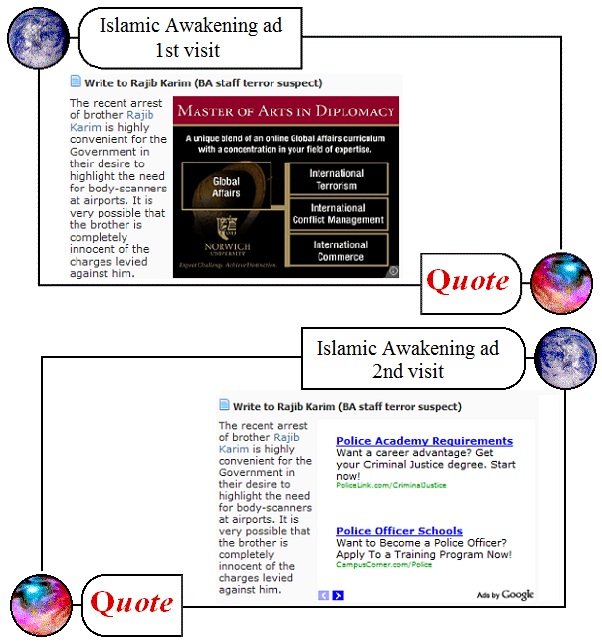
I was browsing the web looking for court papers from the case of Rajib Karim today, and one of the links I got took me to an Islamic Awakening page — which is to say, to an English-language, pro-jihadist forum founded by Yousef al-Khattab — where I found myself facing some unexpected advertising…

quotargeted-advertising.jpg

Let me get this straight. The pro-jihadist website Islamic Awakening is now receiving funds from a university that wants to train future diplomats and some schools for aspiring police officers?

If so, do these educational establishments imagine they’re recruiting from the pool of wannabe jihadists who supposedly frequent the site — or from folks already in the FBI and counter-terrorism business, who may by now be the site’s only remaining readers?

Either way, I’d say it’s a pretty subtle approach — and almost as much fun to stumble across as the Bold Christian clothing ad that I found on a previous visit to Islamic Awakening… do you remember that?

Living Intelligence System

Tuesday, February 1st, 2011

My twitteramigo @ckras has put your tax dollars to work attempting to shatter the stovepipes of analytical excellence in the IC.

And it is pretty cool…..notice how issues of lines of authority and reliability of information are facilitated and made infinitely more efficient with off the shelf Web 2.0.


The nice thing about this project of @ckras is that his model can be generalized to any large organization or system where bureaucratic complexity and the territoriality of guarding tiny empires is gumming up the timely flow of information into the right hands.

“Whoever took religion seriously?”

Saturday, January 8th, 2011

[ by Charles Cameron — cross-posted from the DIME/PMESII boards at LinkedIn ]

I’ve been hammering away at the importance of a nuanced understanding of religious drivers in successful modeling of our world, and today I ran across some paragraphs from a book by Gary Sick that explain, forcefully and briefly, just why this seems like a big deal to me.

1

Sick, who was the National Security Council’s point man on Iran at the time of the Ayatollah Khomeini‘s Iranian Revolution, recounts how totally unprepared we were for the sudden emergence of a theocracy in his book, All Fall Down:

Vision is influenced by expectations, and perceptions — especially in politics — are colored by the models and analogies all of us carry in our heads. Unfortunately, there were no relevant models in Western political tradition to explain what we were seeing in Iran during the revolution. This contradiction between expectation and reality was so profound and so persistent that it interfered fundamentally with the normal processes of observation and analysis on which all of us instinctively rely.

On one level, it helps to explain why the early-warning functions of all existing intelligence systems — from SAVAK to Mossad to the CIA — failed so utterly in the Iranian case. Certainly, US intelligence capability to track the shah’s domestic opposition had been allowed to deteriorate almost to the vanishing point. But even if it had not, it would probably have looked in the wrong place. Only in retrospect is it obvious that a good intelligence organization should have focused its attention on the religious schools, the mosques and the recorded sermons of an aged religious leader who had been living in exile for fourteen years. As one State Department official remarked in some exasperation after the revolution, “Whoever took religion seriously?”

Even after it became clear that the revolution was gaining momentum and that the movement was being organized through the mosques in the name of Khomeini, observers of all stripes assumed that the purely religious forces were merely a means to the end of ousting the shah and that their political role would be severely limited in the political environment following the shah’s departure, The mosque, it was believed, would serve as the transmission belt of the revolution, but its political importance would quickly wane once its initial objectives had been achieved.

2

The blissful ignorance didn’t end back there in 1979. Right at the end of 2006, reporter Jeff Stein asked Rep. Silvestre Reyes (Dem, TX), the incoming head of the House Intelligence Committee (which has oversight of the entire US Intelligence Community) whether Al-Qaida was Sunni or Shiite – noting in two asides, “Members of the Intelligence Committee, mind you, are paid $165,200 a year to know more than basic facts about our foes in the Middle East” and “To me, it’s like asking about Catholics and Protestants in Northern Ireland: Who’s on what side?”

Reyes guessed wrong – not good – and so did a lot of other senior people in the FBI, Congress and so forth. Understandable perhaps, but still, not good.

The popular media keep many of the rest of us confused, too. Glenn Beck has been misinformed by the Christian thriller writer Joel Rosenberg, and refers to the “Twelvers” when he means the “Anjoman-e Hojjatieh” -which, to extend Stein’s point, is the equivalent of saying “Catholic Church” when you mean “Legionnaires of Christ”.

3

Okay, we know that religion has something to do with all this Iran – and Afghanistan and Pakistan and Iraq, and Yemen, and Somalia, and Nigeria — and maybe even homegrown — mess. And I agree, other people’s religions really aren’t our business normally, and it’s not surprising if we don’t know much about them.

Except, I’d say, when religions take up the sword, or have significant power to influence decisions about the use of nuclear weapons — at which point it’s appropriate to get up to speed…


Switch to our mobile site