zenpundit.com » cognition

Archive for the ‘cognition’ Category

Two courtyards, two hundred camels

Sunday, March 6th, 2011

a light-hearted canon in two voices

[ by Charles Cameron ]

*

I’d been doing some research for a follow-up post on story-telling in Afghanistan to go with Scott‘s account of his day at DARPA’s recent STORyNET conference, and one of the interlocutors on the list we’re both on posted a question about the impact of drug use as a consideration in narrative.

Baudelaire and Cocteau both have writings on drug use — hashish and opium respectively — but it was Afghan or more generally Islamic story-telling that I was after, and it occurred to me that the four stories in Paul Bowles‘ collection, A Hundred Camels in the Courtyard, were easily accessible examples of the kind of story-telling that Moroccans are prone to under the influence of hashish.  Bowles describes their mental processes thus:

Moroccan kif-smokers like to speak of the “two worlds,” the one ruled by inexorable natural laws, and the other, the kif world, in which each person perceives “reality” according to the projections of his own essence, the state of consciousness in which the elements of the physical universe are automatically rearranged by cannabis to suit the requirements of the individual. These distorted variations in themselves generally are of scant interest to anyone but the subject at the time he is experiencing them. An intelligent smoker, nevertheless, can aid in directing the process of deformation in such a way that the results will have value to him in his daily life. If he has faith in the accuracy of his interpretations, he will accept them as decisive, and use them to determine a subsequent plan of action. Thus, for a dedicated smoker, the passage to the “other world” is often a pilgrimage undertaken for the express purpose of oracular consultation.

The title of Bowles’ little collection, by the way, comes from the Moroccan proverb which is gives me the first of my two quotes, two courtyards, two intoxicants and two hundred camels below…

I wasn’t entirely satisfied, though, which a Moroccan account of hash-flavored narrative when DARPA was looking for an understanding of narrative that would apply in Afghanistan, so I thought I’d look up some of Idries Shah‘s writings, and Kara Kush in particular, to see if perhaps I could find an Afghan equivalent of Bowles’ stories there…

I already had Bowles’ one courtyard and one hundred camels in mind, so you’ll understand how pleased I was to stumble upon another slightly obscure but interesting writer — Peter Lamborn Wilson, aka Hakim Bey, who gave use the concept of the TAZ or Temporary Autonomous Zone — writing about Afghanistan rather than Morocco, opium rather than hashish, and a second courtyard, with a second hundred camels:

quo-100-camels.jpg

Two terrific writers: Paul Bowles and Peter Lamborn Wilson.

Sources: BowlesWilson

Courtyards with a hundred camels in them are popping up all over.

Maybe Shallow, Poorly Supported, Arguments Make Us Stupid?

Thursday, March 3rd, 2011

Nick Carr’s new book gets smacked upside the head in LRB by Jim Holt ( hat tip to Scott Shipman).

Smarter, Happier, More Productive

…This is a seductive model, but the empirical support for Carr’s conclusion is both slim and equivocal. To begin with, there is evidence that web surfing can increase the capacity of working memory. And while some studies have indeed shown that ‘hypertexts’ impede retention – in a 2001 Canadian study, for instance, people who read a version of Elizabeth Bowen’s story ‘The Demon Lover’ festooned with clickable links took longer and reported more confusion about the plot than did those who read it in an old-fashioned ‘linear’ text – others have failed to substantiate this claim. No study has shown that internet use degrades the ability to learn from a book, though that doesn’t stop people feeling that this is so – one medical blogger quoted by Carr laments, ‘I can’t read War and Peace any more.’

….It’s not that the web is making us less intelligent; if anything, the evidence suggests it sharpens more cognitive skills than it dulls. It’s not that the web is making us less happy, although there are certainly those who, like Carr, feel enslaved by its rhythms and cheated by the quality of its pleasures. It’s that the web may be an enemy of creativity. Which is why Woody Allen might be wise in avoiding it altogether.

Meanwhile, futurist Jamais Cascio asks “Is the Alphabet Making Us Stupid?”

Guest Post: DARPA, STORyNet and the Fate of the War by J. Scott Shipman

Wednesday, March 2nd, 2011

J. Scott Shipman, the owner of a boutique consulting firm in the Metro DC area that is putting Col. John Boyd’s ideas into action, is a longtime friend of this blog and an occasional guest-poster. Scott has an important report regarding the “war of ideas” against the Islamist-Takfirist enemy in Afghanistan after attending a workshop hosted by DARPA.

DARPA, STORyNet and the Fate of the War

by J. Scott Shipman

 I had the opportunity to attend a DARPA workshop yesterday called STORyNet. The purpose was to survey narrative theories, to better understand the role of narrative in security contexts, and to survey the state of the art in narrative analysis and decomposition tools (see below): 

This STORyNET workshop has three goals:

1. To survey narrative theories.

These empirically informed theories should tell us something about the nature of stories: what is a story? What are its moving parts? Is there a list of necessary and sufficient conditions it takes for a stimulus to be considered a story instead of something else? Does the structure and function of stories vary considerably across cultural contexts or is there a universal theory of story?

2. To better understand the role of narrative in security contexts.

What role do stories play in influencing political violence and to what extent? What function do narratives serve in the process of political radicalization and how do theyinfluence a person or group’s choice of means (such as violence) to achieve political ends? How do stories influence bystanders’ response to conflict? Is it possible to measure how attitudes salient to security issues are shaped by stories?

3. To survey the state of the art in narrative analysis and decomposition tools.

How can we take stories and make them quantitatively analyzable in a rigorous, transparent and repeatable fashion? What analytic approaches or tools best establish a framework for the scientific study of the psychological and neurobiological impact of stories on people? Are particular approaches or tools better than others for understanding how stories propagate in a system so as to influence behavior?

I was alerted to the meeting by a member at one of my “groups” at LinkedIn and just barely made the registration cut-off. It was a good meeting, but not reassuring on our situation in Afghanistan—you’ll see why  below.

As a “hobby” I’ve been tinkering with the implications of patterns with respect to language and communications. Just about every presumption I have articulated over the last several months is being pursued in one way or another—which is good news for our guys. While the on-going research is good, I do believe there is room for better and more imaginative thinking, although I didn’t say anything during the meeting for once, I kept my mouth shut and just listened.

This is exceptionally brief and decidedly non-techincal.  Here are some observations of interest:

  • In Afghanistan, stories (those who tell them and those who believe) are central to our geopolitical strategy and policies.
  • There is underway, a “battle of the narratives,” where any “counter” narrative developed by the US must have credibility. This seems obvious, but the speaker observed the “story telling” was more important than the story. Given the high illiteracy rate, this makes sense.
  • We [DARPA] are reviewing chants (which are wildly popular), video, magazines, poetry, the Internet, and sermons as thematic vehicles for analysis.
  • The language of the Taliban is not secular, and not the language of the insurgency—for the Taliban everything hangs on the legacy of jihad and religious struggle.
  • The Taliban not willing to negotiate on matters of jihad. They are using a unified vision of Islam giving their struggle a noble foundation against the corruption of outsiders who want to “Christianize” the nation.
  • The Taliban uses symbology to portray the struggle as a cosmic conflict against Christian invaders and US puppets (those cooperating with the US). Framing this symbology to communicate clearly the frame of the righteous vs. the infidels.
  • The Taliban manipulates the language to connect the current struggle to previous struggles of “warrior poets.” There is hope a “discourse” can be created that will counter this framing [personal note: I’m not optimistic]. The Taliban uses different language to subjugate rural and urban dwellers, and actually have standard operating procedures for dealing with villages that resist.
  • The cognitive patterns of rural Afghanistan are “foreign” to most Westerners and they use alien methods of knowledge transfer (chants, often under the influence of hashish).
  • We are adding a geospatial element to our analysis of local and personal narratives (which includes subject, verb, object) with respect to identified “master narratives.”
  • Internet data is indexed, with an eye toward predictive analysis and situational awareness (and interestingly, “sentiment” analysis). We are finding predictive power from the topology of “networks”  used in models.
  • From a neuroscience perspective, there was an amazing talk on empathy. It turns out, based on fMRI testing that empathy is quite predictable across subjects. Research indicates people “care more” about an “in-group” to which they belong more than an “out group.” The speaker defined the brain as a “parliament” of competing parties and nuanced spectrums [personal note: this elegant description tracks with everything I’ve read on the topic.]. 
  • One presenter observed that after 10 years of war, we’re finally “getting” the importance of Pashtun culture and language. This presenter also noted US is still in need of people with language skills sufficient to adequately support the effort.

– End

COMMENTARY:

Zen here:

First, I’d  like to cordially thank Scott for letting me share his insights gleaned from the workshop here with ZP readers. This is one of those fascinating events largely unavailable to those folks residing outside a reasonable driving distance from the Beltway.

Secondly, I am heartened that the brilliant folks at DARPA are taking the theological-ideological discourse of the enemy seriously in analyzing the power of narrative. Charles Cameron makes that point here with regularity. Michael Scheuer, Gilles Kepel and Olivier Roy did so even before 9/11. Our political appointees and policy makers remain steadfastly allergic to this reality, unable to process or discuss in public with coherence how religious ideas are a root for political extremism. Col. David Kilcullen, who certainly understands political Islam better than most and whose creative and analytical acheivements in structuring a framework for countering insurgency are second  to none, eschews dealing with the topic in his theoretical writings on COIN where it can be avoided. That is the cost imposed by the political correctness to which our ruling elite are psychologically welded.

 It comes as no surprise to me that only after “10 years of war” are we finally “getting the importance of Pashtun culture”. 

Maybe at the dawn of the 22nd century we will be “old hands”.

A HipBone approach to analysis VI: from Cairo to Bach

Monday, February 28th, 2011

[ by Charles Cameron ]

*

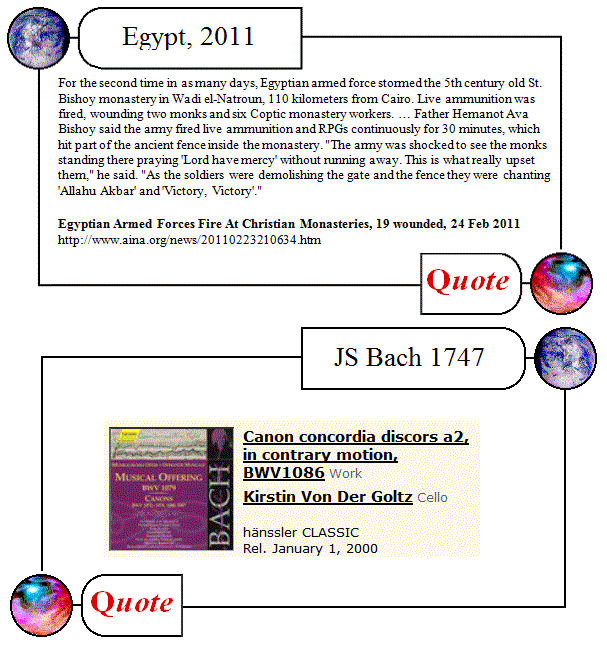
The description of Egyptian troops attacking a Christian monastery that forms the first quote in this DoubleQuote is horrifying in many ways.
quoprayer-counter-prayer.gif

Recent events in Egypt had featured mutual support between Muslims and their Coptic Christian neighbors, each group in turn acting as human shields to protect the other while they were praying. Here, by contrast, the army – which is effectively now “ruling” Egypt in the interregnum between the fall of Mubarak and the election of a new President and government – is attacking the humans it is supposed to protect.

But what does that have to do with Bach?

*

Part I: a monastery attacked in Egypt

This is vile.

Those who are being attacked happen to be Christians and monks, no less human on either account, and just as subject to bleeding as others – so they might ask, with Shakespeare‘s Shylock speaking for the Jews:

If you prick us do we not bleed? If you tickle us do we not laugh? If you poison us do we not die? And if you wrong us, shall we not revenge?

That last question of Shylock’s is an interesting one, and gets to the heart of what I want to discuss here, as we shall see.

Specifically, these human beings were monks. Muhammad had a higher opinion of monks than of many others. In the Qur’an, we find:

The nearest to the faithful are those who say “We are Christians.” That is because there are priests and monks among them and because they are free of pride.

*

Sigh.

These “followers” of Muhammad were attacking Christian monks with live ammunition and RPGs continuously for 30 minutes, wounding 19.

They felt superior to their compatriots the monks, they cried “God is Great” and “Victory, Victory” as they did it.

In this they resemble GEN Boykin, who famously responded to a Somali warlord claiming that God would protect him, “Well, you know what? I knew that my God was bigger than his. I knew that my God was a real God and his was an idol.”

I could easily have made that my second quote here, pairing it with the description of the Egyptian army attack on the monastery, for between the two of them they raise the question of whether weaponry is stronger than belief – and while some Christians might agree with General Boykin, some Muslims might agree no less strongly with the members of the Egyptian military shouting “Allahu Akbar”.

*

I believe that taking sides here misses the point.

Which I am happy to say, Abraham Lincoln made with considerable eloquence in his Second Inaugural Address in 1865, almost a century and a half ago:

The prayers of both could not be answered. That of neither has been answered fully. The Almighty has His own purposes.

That point is one which HaShem made to his angels, according to rabbinic teaching:

The Talmud teaches us that on the night that the Egyptian army drowned in the Red Sea, the first true moment of freedom for the Jews fleeing Egypt, God refused to hear the angels sing their prayers, and said “my creations are drowning in the sea, and you will sing songs?”

So, no — revenge is not the way to go…

*

But please note that the point I am making is not one of moral equivalence.

That God which created “both sides” in any human conflict and loves each and every one of his own creations, might indeed find one creed superior to another, as he might find one scientific law more accurately describing the workings of, say, gravitational attraction than another – or the night sky at Saint-Rémy portrayed by Van Gogh more or less moving than the thunderous sky over Toledo of El Greco.

In the view I am proposing, the “God who takes neither side” in fact takes both, but with this distinction: he sides with the wounded more than with those who inflict wounds – not because one side has a better creed than the other, but because he made us to learn not to unmercifully maim and destroy one another…

…one of whose names is The Merciful, in whose scriptures it is written:

If thou dost stretch thy hand against me, to slay me, it is not for me to stretch my hand against thee to slay thee: for I do fear Allah, the cherisher of the worlds.

…one of whose names is The Lord is Peace, in whose scriptures it is written:

Love your enemies and pray for those who persecute you.

*

Part II: Bach and contrapuntal analysis

All of which brings me to the second “quote” in my DoubleQuote above: JS Bach‘s “concordia discors” canon in two voices, BWV 1086 – which you can hear or purchase here.

Bach’s mastery was in counterpoint, the play of one musical idea against another, and in this particular work, the two ideas are exact opposite: in musical terms, the melody is played here against its inversion. And the point of counterpoint, if I may put it that way, is not to provide “harmony” but to show how discord can become harmonious and concordant — or to put that in the geopolitical terms that interest me, how conflict and opposition can be resolved…

Not, you understand, that this state of affairs then leads necessarily to the singing of Kumbaya or the kind of ending in which “they all lived happily ever after”.

Concordia discors: the resolution of the present conflict, in a continuing overall “music” of great power and beauty, in which further conflicts will inevitably arise and find resolution.

*

Here’s the essence: Bach takes contrasting and at times conflicting melodic ideas and makes music.

He teaches us to hear distinct and differing voices, to allow ourselves to hear and feel both the discomfort that their disagreements raise in us, and the satisfaction that comes as those disagreements are worked out. He does this by teaching us to hear them as voices within a choir, ribbons in a complex braid, making together a greater music that any of them alone could give rise to. And in this process, their differences are neither denied nor lost, but resolved and transcended.

Edward Said, whose politics my readers may dislike or like or even perhaps be unaware of, was for years the music critic for The Nation, wrote three books (and an opus posthumous) on music, and with his friend the pianist and conductor Daniel Barenboim co-founded the West-Eastern Divan Orchestra, named for the West-östlicher Diwan, Goethe’s collection of lyric poems.

Barenboim (the Israeli) wrote of Said (the Palestinian):

In addition to being well versed in music, literature, philosophy, and the understanding of politics, he was one of those rare people who sought and recognized the connections between different and seemingly disparate disciplines. His unusual understanding of the human spirit and of the human being was perhaps a consequence of his revelatory construct that parallels between ideas, topics, and cultures can be of a paradoxical nature, not contradicting but enriching one another.

And there we have it again: Bach’s insight, this time transposed by an accomplished musician into the key of thoughts and ideas…

*

Said talks quite a bit about counterpoint, both musically:

Musically, I’m very interested in contrapuntal writing, and contrapuntal forms. The kind of complexity that is available, aesthetically, to the whole range from consonant to dissonant, the tying together of multiple voices in a kind of disciplined whole, is something that I find tremendously appealing.

.

[Said, Power, Politics and Culture, p. 99.]

and politically:

When you think about it, when you think about Jew and Palestinian not separately, but as part of a symphony, there is something magnificently imposing about it. A very rich, also very tragic, also in many ways desperate history of extremes — opposites in the Hegelian sense — that is yet to receive its due. So what you are faced with is a kind of sublime grandeur of a series of tragedies, of losses, of sacrifices, of pain that would take the brain of a Bach to figure out. It would require the imagination of someone like Edmund Burke to fathom.

.

[Said, Power, Politics and Culture, p. 447.]

*

As I commented in an earlier post that ties in with this one, the great pianist Glenn Gould was also preoccupied with counterpoint, both in Bach’s music and in conversations overheard at a truck-stop cafe or on long train journeys — he too was “working” the parallel between melodic and verbal forms of counterpoint.

And JRR Tolkien made the reconciliation of discordant musics in a greater concord the central to his creation myth in The Silmarillion, “The Music of the Ainur”, which can now be read online at the Random House site.

*

Part III: invitation

May I strongly commend to your attention the movie, Of Gods and Men, which just opened in limited release, having won the grand jury prize at Cannes…

Return of the Vanished Imam?

Monday, February 21st, 2011

quomusa-al-sadr.jpg

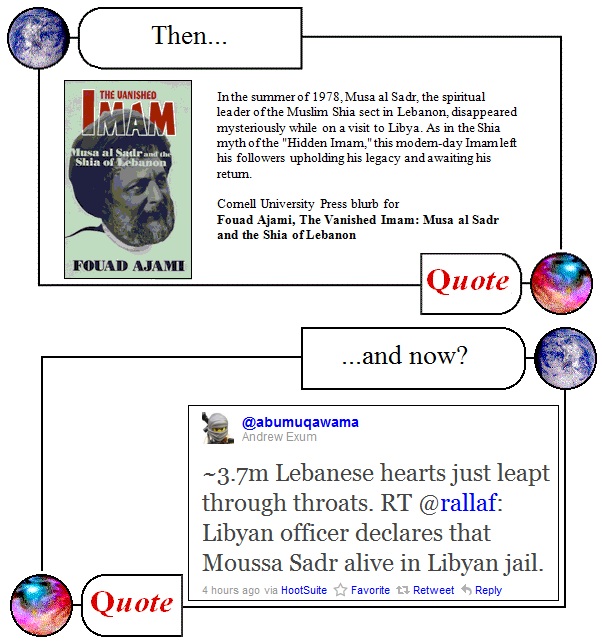
Fouad Ajami’s The Vanished Imam: Musa al Sadr and the Shia of Lebanon was among the first books I read about matters Islamic, and the close parallel between the vanishing of Musa al-Sadr and the vanishing — or, more properly speaking, Ghayba or occultation — of the Twelfth Imam or Mahdi struck me forcibly at the time.

I don’t have my copy to hand, so I can’t tell how strongly Ajami himself made the comparison — but I was certainly not alone. Daniel Pipes, in his review of Ajami’s book writes:

What made the Imam’s vanishing so significant is that it exactly fit the millennial expectations of Shiism, a faith premised on the disappearance of righteous leaders and their reappearance at the end of time.

And now it may be — the report has yet to be confirmed — that Imam Musa is back among us.

@rallaf is an Associate Fellow at London’s Chatham House.

*

The mind sees one thing, which reminds it of something else. It’s the oldest trick in the book, and it depends on the recognition of pattern, or you might say, parallelism.

The return of Imam Musa would be significant not merely for his admirers, not only for what he might have to say or what role — now aged 82, after 30 years in prison — he might yet play, but also, I suspect, for the vivid premonition of the Mahdi his return might stir…


Switch to our mobile site