zenpundit.com » horizontal thinking

Archive for the ‘horizontal thinking’ Category

Burning scriptures and human lives

Tuesday, April 5th, 2011

[ by Charles Cameron ]

*

Which is more sacred? You own life? Or an ideal you would be willing to die for?

I ask this, because we often think, act and speak as though one human life, any human life, is automatically more sacred, more to be preserved, than any idea – or book.

We make allowances, to be sure, and “thou shalt not murder” is no doubt closer to the Hebrew than “thou shalt not kill” – but we tend to think of human life as a paramount value, and in this we have the support both of our legal code (“murder one”) and of many scriptures, including the Qur’an, which declares, “whoso saveth the life of one, it shall be as if he had saved the life of all mankind” (for details, see below).

And I also ask this because Martin Luther King said, “If a man hasn’t discovered something that he will die for, he isn’t fit to live” — and even if I find MLK’s exact phrasing a little strange, I think I know what he’s getting at.

Somehow, then, I think we can agree that there may at times be good reasons to value something that’s not a human life but an ideal of some sort more than one’s own life itself, but that in general, a human life, any human life, is of comparable worth to one’s own.

.

One:

Which brings me to this thought experiment – a list of rhetorical questions designed to elicit thought, not to be answered like a questionnaire…

how-sacred-is.gif

.

Two:

These are rhetorical questions, and I’m asking them for specific reasons.

Under Islamic theology, for instance, the Qur’an cannot be destroyed, since it says of itself (Sura 82, al-Buruj, 21-22:

Surely this is a Glorious Qur’an, inscribed on an Imperishable Tablet.

It is physically possible to burn a physical “copy” [mushaf] of the Qur’an in book form— one particularly obnoxious pastor in Florida has recently done so, although he had been warned in advance by GEN Petraeus:

the safety of our soldiers and civilians would be put in jeopardy and accomplishment of the mission would be made more difficult.

— and the Muslims who recently bombed a Sufi shrine in the Punjab no doubt burned more than one such copy / mushaf, hence my final question in the list above.

.

Three:

I could add many other questions to the list — for instance:

  • For Protestants: How precious is the Saving Blood?
  • For Catholics: If someone bombs a church in which the Mass is being celebrated, does that destroy the Marriage Feast of the Lamb of which every Eucharist is a foretaste?
  • And if someone assassinates the priest while he is “in persona Christi” (in the person of Christ) celebrating Mass, does that kill Christ (again)?

That last, I should add, did in fact happen, not only more recently to Archbishop Romero in El Salvador, but also, several centuries ago, in the little parish church of the village of Brightwell-cum-Sotwell near Oxford where I was raised — and is commemorated there by a brass which reads:

Here lyeth the body of Master John Scoeffyld who died on the 15th day of the month of May in the year of our Lord 1507, on whose soul may God have mercy, Amen

So you see, I have a personal interest in these things…

.

Four:

As to the value of a human life, opinions vary…

Some humans feel the need to hold ethical discussions before wantonly taking other human lives:

For weeks, they had weighed the ethics of bagging “savages” and debated the probability of getting caught. Some of them agonized over the idea; others were gung-ho from the start. But not long after the New Year, as winter descended on the arid plains of Kandahar Province, they agreed to stop talking and actually pull the trigger.

Mark Boal, The Kill Team, Rolling Stone, March 27, 2011

Around two percent of the human race is psychopathic, I’ve read, and most of us can be strongly tugged and swayed by peer-pressure, this was wartime — the pressure-cooker of souls — and whatever got into those men could very likely get inside me, too.

Who’s to say I wouldn’t buckle under pressure like that?

.

Five:

But I’m at peace, here, philosophizing.

One could perhaps be forgiven for thinking the US values the loss of “two sons, two daughters and one grandchild” to an Afghan villager in Gardez at two sheep, because that’s all the payment that’s mentioned in a 2-page ABC News article about VADM William McRaven‘s visit to the village, in which he offered to sacrifice one of the sheep at the door by way of asking for forgiveness, as is customary among the Pashtun. That ABC report, however, was based on and cited a first-hand report in the London Times, which mentions also that the Afghan generals present “gave the family a wad of cash wrapped in a handkerchief. Relatives said there was almost $30,000 (£19,000).” The ABC version omitted that part… That’s a bit better than a couple of sheep – but even so, two sons, two daughters and a grandchild?

Look, that’s better than what the German Bundeswehr is willing to pay for the victims of an admitted bombing error in Afghanistan that killed a hundred or so people, perhaps five of whom were Taliban. From another ABC News report, worth reading in its entirety:

Now the Bundeswehr will be paying $5,000 — not for each life that was lost, but to each family of a victim or multiple victims. In other words, all families will receive the same compensation, no matter how many of their members were killed in the Kunduz bombing.

.

Six:

But, you know – no mention there of the sacred, except perhaps in VADM McRaven’s exemplary gesture.

So let’s go back to some religious authorities…

There is the Mishnah (Sanhedrin 4) teaching:

Therefore man was created alone to teach you that whoever destroys a single life from Israel, is considered by Scripture as though he destroyed an entire world; and whoever preserves a single life from Israel, is considered by Scripture as though he had preserved an entire world.

Some would argue that the qualification, “from Israel” renders this passage less than universal in its implications — yet the same passage goes on to say, without making any distinction between Jew and Gentile:

the Supreme King of kings, the Holy One, Blessed is He, fashioned each man in the mold of the first man, yet not one of them resembles another. Therefore, every single person is obliged to say: The world was created for my sake.

That would appear to cover every created human being… and that is clearly the sense of the Qur’an, in Sura 5, al-Maeda, 32:

We decreed for the Children of Israel that whosoever killeth a human being for other than manslaughter or corruption in the earth, it shall be as if he had killed all mankind, and whoso saveth the life of one, it shall be as if he had saved the life of all mankind.

Less generous and more specific, alas, is the Shafi’i jurist Ahmad ibn Naqib al-Misri, who writes in his Reliance of the Traveler:

The indemnity for the death or injury of a woman is one-half the indemnity paid for a man. The indemnity paid for a Jew or Christian is one-third of the indemnity paid for a Muslim. The indemnity paid of a Zoroastrian is one-fifteenth of that a Muslim

.

Seven:

I’ve already admitted that if the pressure were sufficient I might buckle – what about inspiration, how strong could I be if need be, how high do I reach?

So.

I ask myself: how much suffering am I ready to take on myself, to save the life of a child dying of leukemia in some country far from my home? And if my actions to date are anything to go by, my answer must be: not much.

That’s my walk.  Here’s the talk I talk.

Life is infinitely complex and rich in nuance — dappled, as Hopkins says, with swift, slow; sweet, sour; adazzle, dim

The value of one human life is the value of the world. The Qur’an is indestructible. It is deeply inadvisable to threaten, attempt or facilitate the destruction of man, world, or book:

He fathers-forth whose beauty is past change: Praise him.

Of the Mahdi and the Matrix

Saturday, April 2nd, 2011

[ by Charles Cameron ]

*

There’s a book by Douglas Harding that I very much doubt Samir Khan has read, which may still be relevant to the ad in Inspire #4 that Jarret Brachman pointed to in this piece on Cronus Global — in which he notes the parallel between Inspire‘s ad featuring the choice between paradise and hell, and the choice featured in The Matrix between the blue and red pills…

jarret.jpg

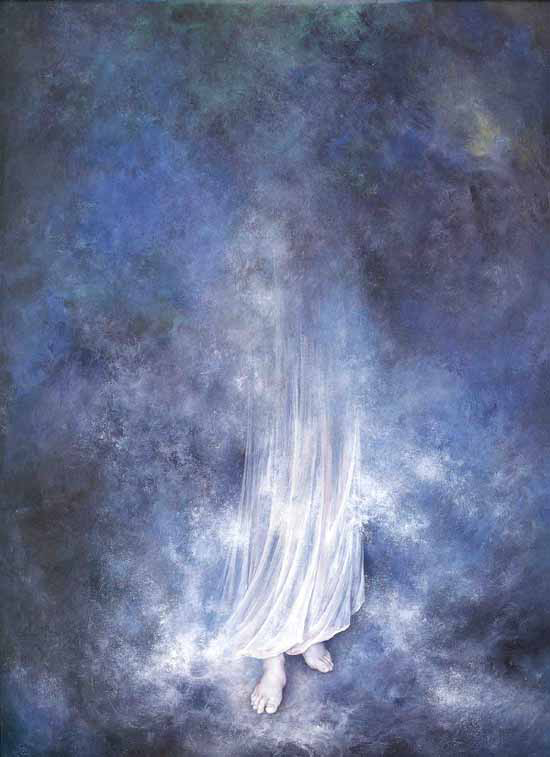
That image, with its headless figure, put me in mind of another image that greatly interests me — a portrayal of the Imam Mahdi by Mahmud Farshchian — so I rescued it from my files to see if it was a good enough match with the ad for me to suggest a possible second graphic influence to Jarret:

16_imam-zaman2.jpg

Not surprisingly perhaps — considering that Samir Khan’s work is, putting it crudely, an advertising graphic, whereas Farshchian’s is a work of devotional art, and that furthermore Inspire is a Salafi-jihadist journal while Farshchian is a pious Shi’ite — the match isn’t close enough for me to argue influence…

But it did set me thinking.

*

The title of the Harding book to which I referred above is On Having no Head, and although it now carries the subtitle Zen and the Rediscovery of the Obvious it actually draws on Islamic traditions quite a bit, quoting Rumi:

Behead yourself! … Dissolve your whole body into Vision: become seeing, seeing, seeing!

and Attar:

Cover your breast with nothingness, and draw over your head the robe of non-existence.

and proposing — I’m putting this into my own words, now — the notion that the physical form of a human face is in some sense no more than a mask, veil or hijab over that light “which lighteth every man that cometh into the world” (John 1.9) — a light too profound for the conventional gaze.

And it is this profundity, attributed in Islam to the prophets in general and superlatively to Muhammad, which makes their literal portrayal a matter of some controversy…

*

Farshchian’s Imam Mahdi, like Khan’s Islamist Morpheus, is headless, I’m suggesting, because, to speak figuratively, radiance has taken the place of the face.

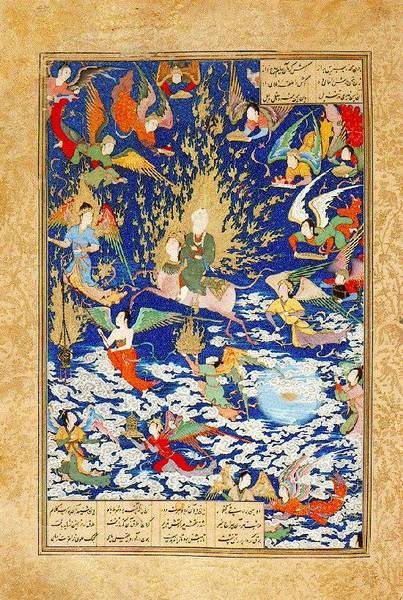
Which is also why, in this image of what must be for Muslims one of the holiest nights in the history of the world, the Night of the Mi’raj, the Prophet is portrayed without a face — or veiled — in this Persian miniature:

miraj_by_sultan_muhammad.jpg

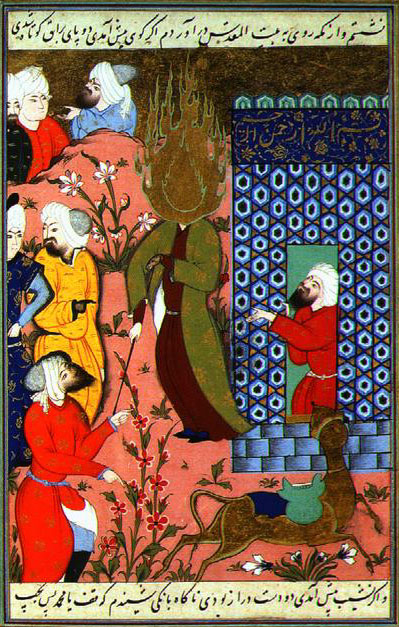
and transfigured by his own fiery “halo” of illumination in this one:

muhammad_miraj1.jpeg

Inspire #5: between front and back covers

Thursday, March 31st, 2011

[ by Charles Cameron ]

*

Okay. When what goes into the opening paragraphs of an editor’s note at the front of a magazine corresponds pretty exactly to what’s on the back cover, you have a sort of conceptual bracket that’s “holding” the rest of the content, and it pays to pay attention.

Here are the first paras of the “Letter from the Editor” that is featured on page 5 of the latest issue of AQAP’s English language magazine, Inspire, immediately after the front cover and index pages:

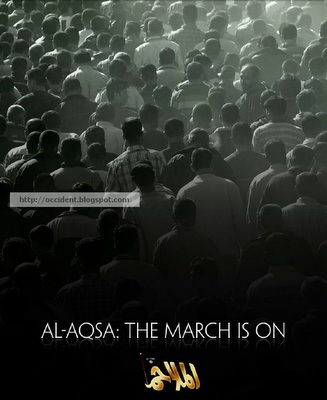
The cover of this issue is about the Tsunami of change that is sweeping the Arab world. With the removal of the despots, the ummah will speak its voice, and when it does, it will chant: Here we start and in al-Aqsa we’ll meet.The biggest barrier between the mujahidin and freeing al-Aqsa were the tyrant rulers. Now that the friends of America and Israel are being mopped out one after the other, our aspirations are great that the path between us and al-Aqsa is clearing up.

There could be no freeing of Palestine with the presence of the likes of King Abdullah to the East, Hosni Mubarak to the West and al-Saud to the South. Now that Hosni is gone, we heard the Imam of the Friday prayers praying: “O Allah we ask you to allow us to meet in al-Aqsa,” and the millions in Tahrir square roared with one voice: Amin.

Note that this explicitly ties the front cover (“about the Tsunami of change that is sweeping the Arab world”) with the back (“Here we start and in al-Aqsa we’ll meet”), shown here:

inspire-5-al-aqsa-the-march-is-on.jpg

[ graphic courtesy of Ibn Siqilli ]

As I’ve noted before, al-Aqsa isn’t just the focal point of the Palestinian / Israeli question, nor it is only the place at which the Prophet alighted from his steed, Buraq, and ascended to receive the divine instructions for prayer in the Miraj — it is also the destination of the Mahdi‘s victorious army in the Khorasan strand of ahadith.

Indeed, it has been suggested that the Pierced Rock of the Dome of the Rock in al-Aqsa is closely related to the Black Stone of the Kaaba. Kanan Makiya, in his part-fictional part-documentary book, The Rock, quotes Charles Matthews‘ translation of Burhan al-Din ibn Firka al-Fazari‘s Kitab Ba’ith al-Nufus ila Ziyarat al-Quds al-Mahrus (The Book of Arousing Souls to Visit Jerusalem’s Holy Walls) from Matthews’ Palestine: Mohammedan Holy Land:

Verily, the Kaaba is in an equivalent position to the Frequented House in the Seventh Heaven, to which the angels of Allah make pilgrimage. And if rocks fell from it, they would have fallen on the place of the Rock of the Temple of Mecca [i.e. the Black Stone]. And indeed, Paradise is in the Seventh Heaven in an equivalent position to the Holy Temple (in Jerusalem) and the Rock; and if a rock had fallen from it, it would have fallen upon the place of the Rock there. And for this case the city is called Urushalim, and Paradise is called Dar al-Salam, the House of Peace.

Indeed, David Roxburgh mentions all these matters, writing in Salma Khadra Jayyusi et al., The city in the Islamic world, vol. 1. p 756:

This movement corresponded to other efforts — before, during, and after the Crusades — to establish “geo-theological” connections between Jerusalem and Mecca, whose preeminent sanctity was inviolable up until the end of days. Examples linking Mecca to Jerusalem include the Prophet Muhammad’s nocturnal journey from Mecca to Jerusalem (isra) and his ascension from Jerusalem to the throne of God (miraj); the underground joining of the waters of Zamzam to Silwan (var. Siloam) during the “feast of the sacrifice” (id al-adha); and the transfer of the Kaba and its black stone from Mecca to Jerusalem during the last days. these various traditions linked Jerusalem to Mecca, sometimes by sets of doubled features, in a near symmetry and in a calendar that will culminate during the end of days.

So there’s an eschatological dimension to all these parallelisms, too…

*

And if for no other reason, then because I happen to love doubled features, symmetries and analogies of all sorts (and we were already speaking of graphics and Inspire #5), let me add this:

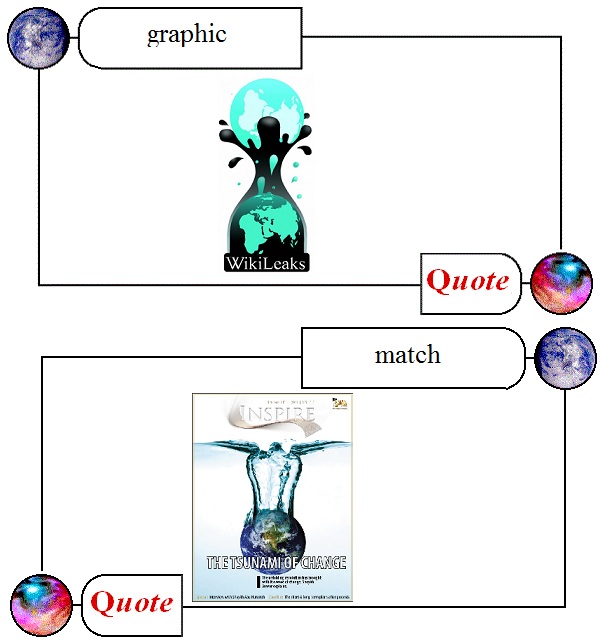
A tweet from @webradius via @azelin that I saw today noted that “the cover of Inspire 5 is remarkably similar to a wikileaks logo”.

I liked it.  And I’ve translated it here into my own DoubleQuotes format:

quographic-match.jpg

For those who are unfamiliar with the phrase, graphic match is another term for match cut — the gambit whereby one shot in a movie is directly juxtaposed to another with which it bears a close resemblance – essentially, a film director’s equivalent of rhyme.

Wikipedia gives two classic examples which are of particular interest to me because there is a “rhyme” between them, too, albeit a far more indirect one – the second being an hommage to the first.

Stanley Kubrick‘s 2001: A Space Odyssey contains a famous example of a match cut. After an ape discovers the use of bones as a tool and a weapon, there is a match cut to a spacecraft or satellite in orbit. The match cut helps draw a connection between the two objects as exemplars of primitive and advanced tools respectively.

Michael Powell and Emeric Pressburger‘s A Canterbury Tale contains the influence for the 2001: A Space Odyssey match cut in which a fourteenth century falcon cuts to a World War II aeroplane. The sense of time passing but nothing changing is emphasised by having the same actor, in different costumes, looking at both the falcon and the aeroplane.

*

Conclusion:

Parallelisms really are worth watching — always bearing in mind that one thing is never quite the same as another…

Corn’s Caliphates in Wonderland

Saturday, March 26th, 2011


They Just Don’t Make Caliphates Like They Used To….

SWJ Blog featured a lengthy (30 page) essay by Dr. Tony Corn on….well….many things. Corn begins with caliphates and then sort of takes off much like a blown up balloon abruptly released by a child prior to tying a knot in the end.

The Clash of the Caliphates: Understanding the Real War of Ideas by Dr. Tony Corn

….For one thing, within the global umma, there appears to be as many conceptions of the ideal Caliphate as there are Muslims. This grass-roots longing for a symbol of unity should be heard with the proverbial Freudian -third ear,?? and seen for what it really is, i.e., a symptom rather than a disease. For another, by agreeing to establish diplomatic relations with the 57-member Organization of the Islamic Conference (OIC), America and Europe have, in essence, already granted the OIC the status of a Quasi-Caliphate.

More important still, it is time for Western policy-makers to realize that the ideological rivalry between Saudi Arabia and Iran that has been going on since 1979 constitutes nothing less than a Clash of the Caliphates. Through a soft power strategy blurring the distinction between -public diplomacy?? and -political warfare,?? -humanitarian aid?? and -religious propaganda,?? the two states have been the main drivers of the re-Islamization process throughout the Muslim world. The one-upmanship dynamic generated by the rivalry between these two fundamentalist regimes is the main reason why, from the Balkans to Pakistan, the re-Islamization of the global umma has taken a radical, rather than moderate, dimension.

Ok, “caliphates” as a metaphor/analogy for geopolitical rivalry of Muslim states works but it is not really what Islamists or normal Muslims would mean by the term. It is a very odd usage. I’m not overly bothered by that because I tend to like analogies but Corn’s device here is apt to make the heads of area studies and Islamic history scholars explode. The whole essay is in this meandering, idiosyncratic, vein.

Now that is not to suggest that you should not read the piece. Dr. Corn held my attention all the way through and he has a number of excellent observations on many, loosely related, subjects. For example, after discussing the pernicious effects of Saudi donations and Edward Said’s agitprop theory of “Orientalism” on the intellectual objectivity of academia, Corn writes:

…The combined effect of the House of Saud and the House of Said is the first reason why the Ivory Tower has done such a poor job identifying the nature of Muslim Exceptionalism. A more indirect, yet more insidious, reason is that, unlike in the early days of the Cold War, American academics across the board today are trained in social sciences rather than educated in the humanities. For social scientists, Explanation (erklaren) and -theory-building?? take precedence over Understanding (verstehen) and -policy-making. The victory of the -numerates over the -literates in the 1970s has produced a generation of scholars who show a certain virtuosity when it comes to -research design, but display an amazing lack, not just of historical literacy, but of -historical empathy as well. Not to make too fine a point: the Long War is being waged by a generation of policy-makers who, however articulate, never learned anything about history in their college years

Corn is spot on here. Not only is it spot on, it is likely to get much worse. After a brief qualitative “bump” from Iraq-Afghan war  language trained vets, diplos, analysts and spooks peters out, we will have the Gen Y kids with K-12 educations scrubbed free of history, foreign languages and science graduating from college with communication and marketing degrees and entering government service. Hang on to your hat when that happens.

What Corn really requires to vault his essays to the next level are the services of an experienced editor because less would be more. The man is erudite and insightful. He writes forcefully and raises a number of points that are important and with which I agree. Corn, commendably, also makes more of an effort to connect the dots than most. But maybe, if you have an essay that references David Kilcullen, Trotsky, neo-Ottomanism, lawfare, Sam Huntington, neo-COIN, Nasser, Vatican II, the Comintern, the Hapsburgs, Ataturk, public diplomacy, al- Qaradawi, social media, Fascism, Marc Lynch, Youtube, network theory, the UN, hybrid wars and the Protestant Reformation, it might be time to up the Ritalin dosage a notch. Jesus, there’s either a book proposal or four different articles in that kitchen sink of an op-ed!

Read it and take what is useful.

Book Review: Grand Strategies by Charles Hill

Monday, March 21st, 2011

Grand Strategies by Charles Hill

Charles Hill, senior Cold War diplomat, Hoover Institution fellow and a co-founder of Yale’s popular Grand Strategy Program that amounts to a crash course in the kind of classical liberal education that universities once imparted to undergraduates but today pride themselves in doing so no longer. The popularity of Hill’s program,  therefore, is with the students moreso than campus activists or the faculty:

…Despite whispers of words like “elitist,” “conservative,” and “cult”-words considered synonyms by many at Yale-The Grand Strategy seminar, only a few years old, has become one of the university’s marquee classes. Grand Strategy, like Professor Hill, has its own myth. The liberals on campus call the class Grand Fascism. They are kidding, but only in part. Many Yale students and faculty are suspicious of the program. Students awed or repelled by Grand Strategy are the same ones who are awed or repelled by Professor Hill, and for the same reasons: the aura of power, the whiff of elitism, the promise of an answer to life’s messiest questions.


If the Grand strategy Course at Yale is a distillation of classical liberal education, Grand Strategies: Literature, Statecraft and World Order is Hill’s reification of the course as an education for the reader on how the evolution of the Western civilizational worldview makes possible grand strategy. The book is an intellectual tour de force by Hill, at some times an idiosyncratic one and at all times an interesting one. I have read many, though very far from all, of the classic texts that Hill critiques and uses to shape his argument but having a large library under your belt is not a prerequisite from understanding Grand Strategies. Far from it, one suspects Hill wrote the book with his seminar students in mind.

Hill examines the protean and mythopoetic relationship between cultural foundations and expressions of power and political wills in conflict represented by diplomacy and war, both navigated by grand strategy constructed from cultural vision. A recurring theme in Grand Strategies is the heroic structure of the epic tale, with the descent into the Underworld and revelation of the heroic destiny by the shades and an ascent (not always successful or as ideally envisioned) to a creative, transformative new order. The reader meets Achilles in many guises, marches upcountry with Xenophon, is cast out of Heaven by Milton, confronts Hobbes‘ Leviathan, defies Rosseau’s general will and exorcises the evil represented in Dostoyevskii’s The Possessed. And this only is a tenth of the narrative.

While I frequently found myself in agreement with Hill’s discernments of the texts, some of them struck me as strained or highly debatable, such as Hill’s reading of Plato as a wry ironist ( Hill borrows from Leo Strauss here but goes further, if I recall correctly, than Strauss did), something that Carroll Quigley, Karl Popper or many classicists would have disputed. Hill’s final chapter, “The Writer and the State” is entertaining and contains a laudatory anecdote about Hill’s former boss, the impressive SECSTATE George Schultz , but it lacked some of the gravity of earlier chapters.

Erudite and visionary, Grand Strategies is a grand synthesis by Charles Hill with lessons to learn on every page.

(Special hat tip to J. Scott Shipman who pushed me to read and review this book)


Switch to our mobile site