zenpundit.com » series

Archive for the ‘series’ Category

On the felicities of graph-based game-board design: fifteen

Wednesday, January 30th, 2019

[ by Charles Cameron — surprise, surprise — this isn’t the #15 I expected and predicted ]
.

In Two eminently watchable TV series by Hugo Blick I looked at narrative artistry as an approach to understanding complex problems — and I do mean complex, the Israeli-Palestinian and Hutu-Tutsi errh, situations..

Here, we consider artistry of another sort — polyphonic, graphical, yet still clearly artistic in execution ..

**

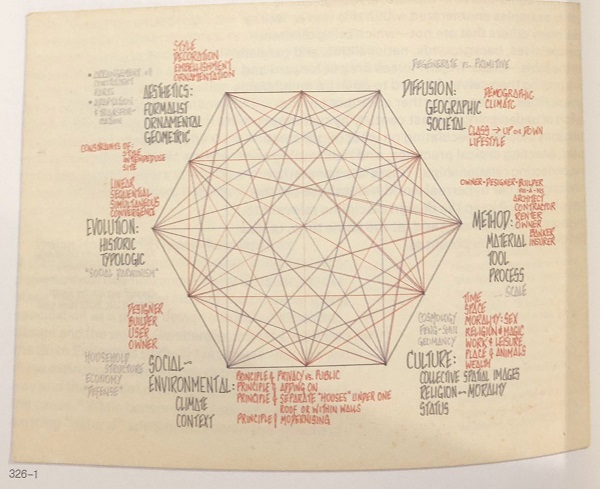
Here’s a drawing from Victor Papanek‘s Notebook — and very notebook it is — courtesy Roelof Pieters:

**

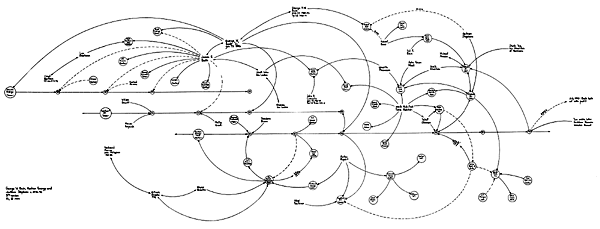
Compare the above with this example of Mark Lombardi‘s fine art “conspiracy” graphs from his book, Global Networks:

We’re getting positively calligraphic here, and approaching the scope of one of those Song dynasty scroll paintings that feature (am I right? memory, imagination!) a hermit disappearing into his cave in some obscure not quite corner of the scroll, while thunder wreaks havoc on armies by a river in almost center field..

Speaking of which..

Ah, but we’re straggling away from our topic: On the felicities of graph-based game-board design. The point is that the arts have many inventive ways to approach complexity.

I mean, we could start with Hamlet..

**

Earlier in this series:

  • On the felicities of graph-based game-board design: preliminaries
  • On the felicities of graph-based game-board design: two dazzlers
  • On the felicities of graph-based game-board design: three
  • On the felicities of graph-based game-board design: four
  • On the felicities of graph-based game-board design: five
  • On the felicities of graph-based game-board design: six
  • On the felicities of graph-based game-board design: seven
  • On the felicities of graph-based game-board design: eight
  • On the felicities of graph-based game-board design: nine
  • On the felicities of graph-based game-board design: ten
  • On the felicities of graph-based game-board design: eleven
  • On the felicities of graph-based game-board design: twelve
  • On the felicities of graph-based game-board design: thirteen
  • On the felicities of graph-based game-board design: fourteen
  • Two eminently watchable TV series by Hugo Blick

    Tuesday, January 29th, 2019

    [ by Charles Cameron — I suspect Mike Sellers & Ali Minai might find them of interest as subtle narrative avenues into complexity ]
    .

    I’ve been watching Black Earth Rising , British writer-director Hugo Blick‘s latest series, starring Michaela Coel:

    As with his earlier series, The Honourable Woman featuring Maggie Gyllenhaal, I’m transfixed. Here is complexity delivered — in both cases, brilliantly — on TV:

    Once Blick puts down his first card, as a viewer you think, “Oh, that’s good. That will be interesting.” Then he essentially flips the other 51 into the air and lets them fall all over the script. That’s the ambitious beauty of The Honorable Woman, which explodes across each episode with elaborate twists involving the Israelis, the Palestinians, the British and the Americans.

    **

    Sources:

  • Hollywood Reporter, The Complicated, Ambitious Brilliance of ‘The Honorable Woman’
  • Hollywood Reporter, ‘Black Earth Rising’: TV Review
  • IndieWire, Netflix Thriller Shows the Danger of Treating Global Politics Like a Game
  • **

    I have been discussing systems dynamics and complexity with my game designer friend Mike Sellers recently — see his brilliant book, Advanced Game Design: A Systems Approach — and complexity, glass bead games and AI with a new friend, Ali Minai — hear our podcast at BrownPundits. Let’s make it clear: I’m the student here.

    In the course of our discussion, I’d written:

    I think of novels and plays as offering approaches to an intuitive grasp of complex situations

    and

    I think polyphony and counterpoint are what we meet with in the social world, and indeed in our conflicted minds and hearts, and that Bach will prove to be the great master of our age, once we’ve matured enough to learn from him. But listening must come first, and that seems a skill that’s wildly at variance with our times..

    Mike responded:

    Novels and plays give us, I think, something of an implicit systemic view, in that we understand how a greater whole (a love story, a tragedy, etc.) emerges from the mutual interactions between actors. Same with counterpoint and polyphony — the notes mutually interact at the same time, and set up call-and-response interaction within our minds across time, to create a larger experienced whole from the entire musical piece.

    I’m trying to make those relationships more explicit and more generalized, seeing the commonalities in books, music, biology, and games

    so — for both Mike and Ali — I’d recommend these two Hugo Blick series as contemporary works of Shakespearean subtlety, to consider as avenues into coomplexity. And although I lack the linguistic skills to appreciate him I’m sure Ali would like to add the Urdu poet Ghalib to the list..

    So that’s my interest.

    Complexity, what is it? Which avenue takes us deepest into the heart of the matter?

    **

    Hugo Blick?

    Hugo Blick, who likes to teach the ambiguities to which a probing sense of morality will necessarily find itself subject, might like to examine “Combat charities” in the West and their jihadi twin:

    A NEW PHENOMENON OF THE 21ST CENTURY BATTLEFIELD

    “Combat charities”—entities that seek to provide non-profit military and political assistance to weaker armed groups or minorities resisting the military onslaught of others (like ISIS)—are one mechanism for foreign anti-ISIS volunteers to join the fight. “Combat charities” are a new rising phenomenon of the 21st century battlefield and political dispensation. They can significantly affect both local orders and international politics. [ … ]

    Thousands of Western foreign fighters have traveled to the Middle East in recent years to join the fighting that has engulfed the region. They have overwhelmingly participated on the side of jihadi organizations like the Islamic State (ISIS) or the Jabhat Fateh al-Sham (formerly the Nusra Front).

    However, a smaller and often unnoticed segment of these volunteers has embedded with groups that resist the jihadis, such as Kurdish, Assyrian, and Yazidi militias. These fighters vary in their motivations for joining the fight: Some are driven by moral outrage and seek to prevent the atrocities minority groups have suffered at the hands of the jihadis, while others are motivated by co-religionist solidarity. Some seek a sense of adventure and the adrenaline highs of military tourism, while others wish to escape problems at home, finding in the fight a form of self-medicating for post-traumatic stress disorder and other problems. [ … ]

    THE WESTERN PATHBREAKERS

    SOLI is the oldest and most established combat charity in the world. Founded and led by American citizen Matthew VanDyke, it operates in Iraq, and is building abilities to operate in Syria and North Africa. Since its creation in 2014, SOLI has helped form, train, and to certain extent equip the two largest Assyrian militias in northern Iraq fighting against ISIS. [ … ]

    …AND THEIR JIHADI TWIN

    Founded in May 2016, Malhama Tactical is the first sunni jihadi private military company. As Rao Komar, Christian Borys, and Eric Woods reported in Foreign Policy magazine in February, during its short existence Malhama Tactical has provided training and battlefield consulting for Jabhat Fateh al-Sham (formerly known as the Nusra Front, affiliated with al-Qaida) and the Turkistan Islamic Party, an Uighur extremist group from China’s restive Xinjiang province.

    Get that? Rival combat charities to throw a heavy dose of ambiguity into the already three-cornered Syrian situation..

    IMO, these combat charities on both sides of an already fraught situation might make excellent fodder for Hugo Blick‘s subtle story-telling mind..

    **

    Viewing:

  • Netflix, Black Earth Rising
  • Amazon, The Honorable Woman
  • Further reading — the full combat charities report:

  • Brookings, Combat charities or when humanitarians go to war:
  • Borders as metaphors and membranes

    Monday, January 14th, 2019

    [ by Charles Cameron — i continue in the opinion that limina, thresholds borders, have an archetypal importance that transcends and is embodied in individual cases ]
    .

    **

    With the Wall the dominating issue of the current US government shutdown, tracking the penumbra of borders is all the more important: things look very different when you squint at them.

    **

    Previous posts in this topic area:

  • Zenpundit, Liminality II: the serious part
  • Zenpundit, The Korean border / no border dance
  • Zenpundit, Borders, limina and unity
  • **

    Alexis Madrigal, A Border Is Not a Wall:

    Borders are an invention, and not even an especially old one. Predated by the printing press by a good 200 years, borders are constantly under revision. Even the zone of a border itself, the Supreme Court has held, extends far beyond the technical outline of a nation. Imagine a border as the human-made thing that it is, and it’s no longer surprising that it takes a multitude of forms: a line on a map, a fence, a bundle of legal agreements, a set of sensors, a room in an airport, a metaphor.

    As Elia Zureik and Mark B. Salter explain in a book on policing, a controlled border creates the notion that domestic space is safe. Protecting “the border” safeguards the home, the family, and a way of life. This idea of safety is so potent that it has shut down the United States government.

    But the border itself—the line on a map, or the gate at a crossing—isn’t what’s at issue; it’s the idea of the border, a membrane that defines a nation while maximizing its market power.

    **
    _
    Humanitarian concerns:

    Dr John Sullivan‘s paper, Determining Reasonable and Proportional Use of Tear Gas offers a number of provocative insights, including the prohibition on the use of tear gases (CN> CS< CR), pepper spray (OC, capsicum), and sleeping gas on battlefields -- provocative since we normally think of battlefields as "worse" than peacetime situations, and thus that what's prohibited in wartime should be so a fortiori in times poof peace..

    Here’s the border-specific instance / comment that caught my eye:

    In the border control setting, the recent use of tear gas by CBP agents against migrants seeking asylum at the San Ysidro port of entry has been criticized by the American Civil Liberties Union (ACLU), among others. The cross-border issues are also controversial and Mexico has demanded an investigation into the use of nonlethal weapons in the Tijuana incident.

    **

    In another post I hope will follow quickly on the heels of this one, I quote MSNBC host Bryan WIlliams telling Jon Meacham:

    if you’re going to clear those better angels of yours fo takeoff, remember the air traffic controllers are working without salaries..

    That’s an interesting juxtaposition if you think about it: angels and air traffic controllers f unction in two different above-earth atmospheres — heaven and sky, respectively — which used to be one at a time when myth and history were one, astrology and astronomy, alchemy and chemistry.

    Might we say there’s now a border between heaven and sky? If so, that next post can be considered an entry in this series, too.

    **

    Addendum, 1/15/2019:

    An excellent set of photos under that title educates us via our visual sensibility on the history and variety of walls:

    The current debate in the United States about building up and reinforcing the border wall with Mexico may have distinctly American roots, but the problems, and the controversial solutions, are global. Growing numbers of immigrants, terrorist activity, continued drug trafficking, and protracted wars have sparked the construction of temporary and permanent border barriers in many regions worldwide.

    Recommended!

    **

    Additional addendum:

    Ha, yes!

    On the felicities of graph-based game-board design: fourteen

    Tuesday, December 25th, 2018

    [ by Charles Cameron — this one, on sacrament, symbol and such, winds up being an intro to #15, not yet written ]
    .

    My last post On the felicities of graph-based game-board design drew forth a stunning tweeted response from JustKnecht, friend and fellow explorer or Hesse’s Glass Bead Game and the magic of ideas behind it:

    **

    That’s a fascinating graphical DoubleQuote, at first glance, so I dug into the two images, the left hand one coming from a Sembl post of mine in this series, On the felicities of graph-based game-board design: two dazzlers.

    It’s the one on the right, however, that opened doors for me — one door being the article by Gentner and Jeziorski, the other being Richard Boyd‘s article that follows it in Andrew Ortony (ed), Metaphor and Thought, 2nd ed, CUP (1993):

  • Gentner & Jeziorski, The shift from metaphor to analogy in Western science
  • Richard Boyd, Metaphor and Theory Change: What is ‘Metaphor’ a Metaphor for?
  • Notice, incidentally, the beautiful ouroboros in Boyd‘s title!

    Okay, that’s my Christmas reading.

    **

    It seems I’m way behind, and it’s time maybe for the HipBone Games to enter the slipstream of Philosophy as she is practiced these days.

    But first, and to put the good folks of Elizabeth Anscombe‘s discipline off the scent, there’s the question of Sacrament to consider. Sacrament, along with Entropy, is something Gregory Bateson instructed his medical students to comprehend if they are to be civilized in their discourse as future doctors and psychiatrists. In the first paragraph of the Introduction to his Mind and Nature, Bateson writes:

    Even grown-up persons with children of their own cannot give a reasonable account of concepts such as entropy, sacrament, syntax, number, quantity, pattern, linear relation, name, class, relevance, energy, redundancy, force, probability, parts, whole, information, tautology, homology, mass (either Newtonian or Christian), explanation, description, rule of dimensions, logical type, metaphor, topology, and so on. What are butterflies? What are starfish? What are beauty and ugliness?

    Note that the concept of “sacrament” occupies a place of honor second only to “entropy” in Bateson’s listing.

    **

    Sacrament?

    Sacrament?What does that have to do with the philosophy (and graphical rendering) of metaphor?

    First, here’s a quick look at the notion of Sacrament, from the Introduction: Mapping Theologies of Sacraments (pp. 1-12) of Justin Holcomb and David Johnson’s Christian Theologies of the Sacraments: A Comparative Introduction:

    In the prologue of the Gospel According to John the apostle writes about the incarnation of the Word of God, Jesus Christ, that “from his fullness we have all received, grace upon grace” (1:16). One of the means by which Christians believe we receive the grace of God in Christ is the sacraments. But what are the sacraments? As many Christians know, Augustine of Hippo succinctly defined a sacrament as being “an outward and visible sign of an inward and invisible grace.”

    The central sacrament of Christianity is the Eucharist, instituted by Christ with the words — pointing to the bread about to be broken and shared, in a complex that includes his coming crucifixion, and the institution of the Church as his continuing body or presence on earth — This is my Body.

    The Catholic view:

    The doctrine that Christ’s real presence is thus to be found in the communion wafer consecrated with the remembrance of those words at Mass is that of Transubstantiation — a contested doctrine to be sure. And the contest is viewed theologically as being between metaphor and simile.

    Thus, as I have noted before, Northrop Frye in his Anatomy of Criticism writes:

    The animal and vegetable worlds are identified with each other, and with the divine and human worlds as well, in the Christian doctrine of transubstantiation, in which the essential human forms of the vegetable world, food and drink, the harvest and the vintage, the bread and the wine, are the body and blood of the Lamb who is also Man and God, and in whose body we exist as in a city or temple. Here again the orthodox doctrine insists on metaphor as against simile, and here again the conception of substance illustrates the struggles of logic to digest the metaphor.

    The Reformed view:

    Simply put, the Reformed view, contra Frye, considers the Words of Institution as simile, see Literary Devices in the scripture [Caution: this link auto-downloads a Word doc]:

    A metaphor is an abridged simile

    — ie, Matthew 26.26 is to be understood as meaning not “this is my Body” but “This is like my Body”..

    Thus Daniel Featley DD in his Transubstantiation Exploded (1638) writes:

    If in this sentence “This is my Body,” the meaning be “this Bread is my Body,” the speech cannot be proper, but must of necessity be figurative or tropical.

    But in this sentence, “This is my Body,” the meaning is, “This Bread is my Body.“

    Ergo this speech cannot be proper, but must of necessity be figurative and tropical; and if so, down falls Transubstantiation built upon it, and carnal presence built upon Transubstantiation, and the oblation and adoration of the Host built upon the carnal presence.

    That’s a whole lot of toppling of the Catholic edifice, all predicated on a reading of Christ’s words as simile, not metaphor.

    Here “simile” seems to mean figurative rather than literal — where the Catholic view, as we have seen, aka “metaphor”, posits literal real presence in the form of a (transcendent) inward and spiritual grace..

    **

    A by-gone Queen of the Sciences

    How does this theology of metaphor fare today? Theology, my own discipline at Oxford, sadly seems a by-gone Queen of the Sciences. Thus William Grassie writes:

    Our medieval ancestors understood theology to be the queen of the sciences. Her twin sister Sophia — the Greek word for “wisdom” — was also venerated in the discipline of philosophy. It was hard to tell the two beauties apart, but together they once ruled the many domains of human knowledge.

    Theology departments today, however, are increasingly irrelevant backwaters in the modern university, engaged in seemingly solipsistic debates.

    Ouch.

    Just for the record, while we’re slipping a theological understanding of metaphor into our thinking on the topic, should also consider Coleridge on symbol:

    Now an allegory is but a translation of abstract notions into a picture-language, which is itself nothing but an abstraction from objects of the senses; the principal being more worthless even than its phantom proxy, both alike unsubstantial, and the former shapeless to boot. On the other hand a symbol … is chaacterized by a translucence of the special in the individual, or of the general in the special, or of the universal in the general; above all by the translucence of the eternal through and in the temporal. It always partakes of the reality which it renders intelligible; and while it enunciates the whole, abides itself as a living part in that unity of which it is the representative.

    **

    In the spirit of Hermann Hesse‘s Nobel-winning Glass Bead Game — and if you can’t abide the arts and humanities, then of EO Wilson‘s concept of consilience — these notions of sacrament, metaphor and symbol should be entered into the philosophical and scientific thought-stream on metaphor and its graphical representation, IMO, YMMV, &c.

    In case you missed all that.

    And so to the present readings, Boyd and Gentner & Jeziorski..

    **

    **

    Earlier in this series:

  • On the felicities of graph-based game-board design: preliminaries
  • On the felicities of graph-based game-board design: two dazzlers
  • On the felicities of graph-based game-board design: three
  • On the felicities of graph-based game-board design: four
  • On the felicities of graph-based game-board design: five
  • On the felicities of graph-based game-board design: six
  • On the felicities of graph-based game-board design: seven
  • On the felicities of graph-based game-board design: eight
  • On the felicities of graph-based game-board design: nine
  • On the felicities of graph-based game-board design: ten
  • On the felicities of graph-based game-board design: eleven
  • On the felicities of graph-based game-board design: twelve
  • On the felicities of graph-based game-board design: thirteen
  • On the felicities of graph-based game-board design: thirteen
    Friday, December 21st, 2018

    [ by Charles Cameron — the Trinity and National Security, Game Boards and Mathematics, Japanese wave patterns, Maestro Harding on the interconnectedness of “all branches of human knowledge and curiosity, not just music” — plus Blues Clues at the tail end ]
    .

    Not only have the last couple of days been riotous in Washington, with more news to track than I have eyes to see, but today, still reeling under the weight of Mattis‘ resignation, McConnell‘s statement in support and other matters, I found myself with a richesse of board-game and graph-related delights.

    **

    Trinitarian NatSec:

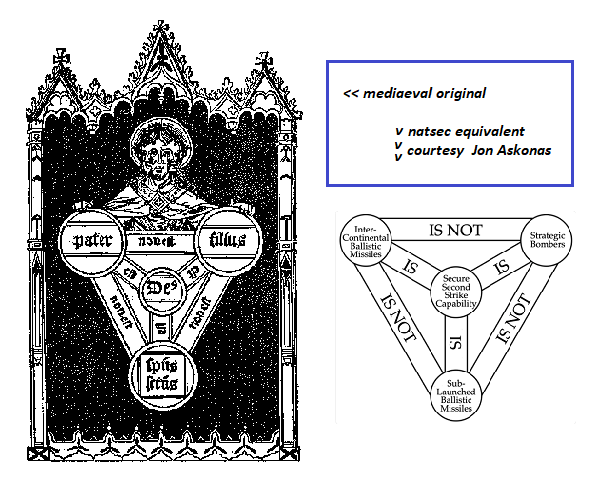
    Followers of this searies will be familiar with the Trinitarian diagram juxtaposed here with its equivalents from classical Kabballah and Oronce Fine:

    That little triptych is from my religion and games avenues of interest, but of course I’m also interested in matters of national security, as befits Zenpundit, the strategy & creativity blog. You can imagine my surprise and delight, then, in coming across a natsec version of the trinity diagram, in a tweet from Jon Askonas.

    Here’s my comparison:

    My own attention was first drawn to the Trinitarian diagram as a result of reading Margaret Masterman‘s brilliant cross-disciplinary work, “Theism as a Scientific Hypothesis”, which ran in four parts in a somewhat obscure and difficult to find journal, Theoria to Theory, Vol 1, 1-4, 1966-67.

    See:

  • Margaret Masterman, George Boole and the Holy Trinity
  • Margaret Masterman’s “Theism as a Scientific Hypothesis”
  • **

    Game Boards and Mathematics:

    I could hardly fail to be intrigued by Calli Wright‘s piece titled The Big List of Board Games that Inspire Mathematical Thinking, eh? And look, the first game they show is a graph-based board game, Achi:

    Dara also looks somewhat relevant.

    **

    Japanese wave designs:

    Again, those familiar with my games will know of my juxtaposition of Von Kármán with Van Gogh as a DoubleQuote — but let me quote from an earlier post, Sunday’s second surprise — the Van Gogh DoubleQuote:

    Here’s the Von Kármán / Van Gogh DQ, which I value in light of Hermann Hesse‘s Glass Bead Game as a clear bridge between one of the crucial dualities of recent centuries — the needless and fruitless schism between the arts and sciences, which has given rise not only the rantings of Christopher Hitchens and his less elegant disciple Bill Maher, but to such other matters as the Papal condemnation and “forgiveness” 359 years later of Galileo Galilei, Charles Babbage‘s Ninth Bridgewater Treatise, Andrew White‘s A History of the Warfare of Science With Theology in ChristendomW, and CP Snow‘s The Two Cultures:

    karman gogh

    And finally, here’s an ugraded version of the other DQ of mine that seeks to bridge the arts and sciences — featuring Hokusai‘s celebrated woodblock print, The Great Wave off Kanagawa (upper panel, below) and Jakob aka nikozy92‘s fractal wave, which I’ve flipped horizontally to make its parallel with the Hokusai clearer (lower panel) — Jakob‘s is a much improved version of a fractal wave compared with the one I’d been using until today:

    SPEC-DQ-Hokusai-fractal v 2.0 minikozy92

    That brings me to the Met’s marvelous offering, to which J Scott Shipman graciously pointed me:

    Here’s where you get the collection:

  • You Can Now Download a Collection of Ancient Japanese Wave Illustrations for Free
  • Rich pickings!

    **

    Maestro Harding and the Glass Bead Game:

    Finally, I’ve been delighted today to run across a couple of vdeos of my nephew, Maestro Daniel Harding, conducting the Swedish Radio Symphony Orchestra some years back in programs exploring the interplay of mathematics and other disciplines and music:

    and:

    Daniel is not working the graph-based angle that my games explore, but his thinking here is pleasantly congruous with my own. His work with the SRSO has, he says in the first video here, “to do with all branches of human knowledge and curiosity, not just music — because everything is connected”.

    You can’t get much closer in spirit to Hesse‘s Glass Bead Game than that!

    **

    Earlier in this series:

  • On the felicities of graph-based game-board design: preliminaries
  • On the felicities of graph-based game-board design: two dazzlers
  • On the felicities of graph-based game-board design: three
  • On the felicities of graph-based game-board design: four
  • On the felicities of graph-based game-board design: five
  • On the felicities of graph-based game-board design: six
  • On the felicities of graph-based game-board design: seven
  • On the felicities of graph-based game-board design: eight
  • On the felicities of graph-based game-board design: nine
  • On the felicities of graph-based game-board design: ten
  • On the felicities of graph-based game-board design: eleven
  • On the felicities of graph-based game-board design: twelve
  • **

    BTW:

    NatSec, yes, and a DoubleQUote. Too good to miss. Thanks again to John Askonas..


    Switch to our mobile site