zenpundit.com » series

Archive for the ‘series’ Category

For Jim Gant, On the Resurrection, 01

Monday, April 9th, 2018

[ by Charles Cameron –with breath, thinking this through ]
.

It seems to me that there are two chewable questions in all seriousness:

Does God Exist?

To which it seems to me that the only answer would be something along the line of this:

A roaring silence, in other words, which somehow worked itself out like this in the mind of one Franz Liszt — and he must have been pretty shaken by the end of it..

For the record, it’s my sense that if St Gregory of Nyssa had had a taste for Liszt and access to YouTube, he might have said much the same.. One cannot predicate existence of God, but one can experience revelation, eh?

*
Question #2 is the real shaker, though..

Did the Resurrection really happen?

*

On the felicities of graph-based game-board design: twelve

Friday, March 23rd, 2018

[ by Charles Cameron — Cambridge Analytica and Guardian logos, HipBone Game boards ]
.

A while back, I posted a series of pieces about the felicities of graph-based game-board design. This piece picks up from that series, with a bit of a refresher, and a pointer to the Cambridge Analytica logo.

First, the question arises of what graphs are. A graph, from a mathematical point of view, consists of nodes and edges: nodes are, in this diagram, the red circles, and edges are the lines connecting them:

We know a great deal about the mathematics of graphs, but they underlya vasst repertoire of modern systems, including — for an extreme. complex instance — the design of washing machines:

**

Back at least to medieval times, graphs can be found with concepts assigned to their nodes and the reasons connecting those conceptts assigned to their edges. These thre show one Jewish (Kabbalistic) conceptual graph, one graph of the four elements and their relaations, and a Christian ttrinitarian graph:

I have usedsc similar conceptual graphs as the boards of my HipBone Games. SHown herear ethree of my boards, together with a spiffy board by my friend and colleagues Cath Styles for her Sembl games:

**

All the above, to show you why all usees of graphs are potentially of interest to me, and why I am particularly interested in the Cambridge Analytica logo (left, below), which offers a graph in the shape of the human brain, and the logo the Guardian devised (right, below), to give visual continuity to their articles about Cambridge Analytica;

I think you can see how the Guardian logo would make a fine HipBone game board for teen Agatha Christie -type games.

**

Hey, on complexity — which graphs and diagrams are better at than “linear” verbal explanations — there’s this — not a graph! — from another post of mine — wow!:


Shaping strategy — Constant turbulence and disruption

**

Earlier in this series:

  • On the felicities of graph-based game-board design: preliminaries
  • On the felicities of graph-based game-board design: two dazzlers
  • On the felicities of graph-based game-board design: three
  • On the felicities of graph-based game-board design: four
  • On the felicities of graph-based game-board design: five
  • On the felicities of graph-based game-board design: six
  • On the felicities of graph-based game-board design: seven
  • On the felicities of graph-based game-board design: eight
  • On the felicities of graph-based game-board design: nine
  • On the felicities of graph-based game-board design: ten
  • On the felicities of graph-based game-board design: eleven
  • Sunday surprise — literal rainfall ancient and modern

    Sunday, March 19th, 2017

    [ by Charles Cameron — a DoubleQuote in the arts ]
    .

    Guillaume Apollinaire:

    **

    Il pleut

    Il pleut des voix de femmes comme si elles étaient mortes même dans le souvenir
    c’est vous aussi qu’il pleut merveilleuses rencontres de ma vie ô gouttelettes
    et ces nuages cabrés se prennent à hennir tout un univers de villes auriculaires
    écoute s’il pleut tandis que le regret et le dédain pleurent une ancienne musique
    écoute tomber les liens qui te retiennent en haut et en bas.

    Roger Shattuck, brilliant author of The Banquet Years: The Origins of the Avant-Garde in France) translates:

    It’s Raining

    It’s raining women’s voices as if they had died even in memory
    And it’s raining you as well marvellous encounters of my life O little drops
    Those rearing clouds begin to neigh a whole universe of auricular cities
    Listen if it rains while regret and disdain weep to an ancient music
    Listen to the bonds fall off which hold you above and below

    As Edward Hirsch comments at Poetry Foundation:

    The slanting lines of Apollinaire’s poem create the sensation of rain running downward across a windowpane. Graphic form and verbal music come together as each long vertical line becomes a rhythmic unit of meaning

    — which is itself a verbal / visual DoubleQuote!

    **

    Code running downward..

    **

    This was brought to mind by the magnificent title sequence of the Le Carré thriller The Night Manager:

    essentially completing a second DoubleQuote with those falling droplets. those rising bubbles — and there are several filmic equivalents of DoubleQuotes graphic matches aka match cuts — in the sequence itself: bomb cloud > martini, tea cups >machine gun, contrails > pearls..

    I’m always happy to see more Le Carré on film..

    On targeting as a mood this electoral season, 2

    Sunday, October 23rd, 2016

    [ by Charles Cameron — honor and shame ]
    .

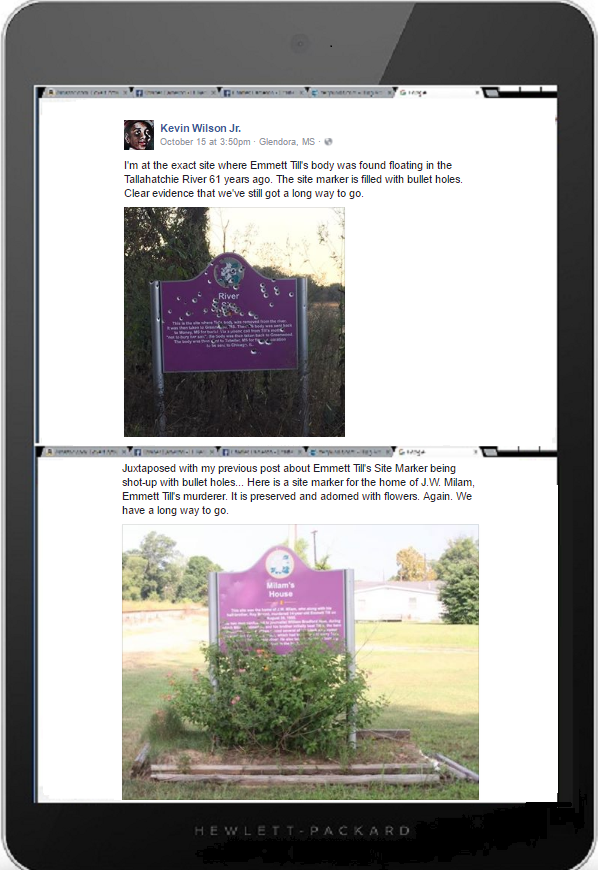
    dq-600-emmett-till

    Not “no comment” — speechless.

    On the felicities of graph-based game-board design: eleven
    Friday, October 21st, 2016

    [ by Charles Cameron — graphical thinking really has pretty much permeated the tech end of our culture at this point ]
    .

    Two more examples of graphics — in the double sense of the word, or graphics squared if you like, where graphs, in the node and edge mathematical & network sense are used within graphics, in the visual or illustrative sense:

    The first comes from a page on Carnegie Europe’s Strategic Europe blogpost titled Cyberspace and the World Order:

    2016-01-14_cyber_605

    The second is from the Eventbrite invite to The Future of Cybersecurity: A Conversation with Admiral Mike Rogers at Georgia State University on Moday 24th at 10am, courtesy of John Horgan.

    cdn-evbuc-com

    **

    From a graphic (visual) perspective, the symbolic content is in each case interesting, and I’d be glad to read any comments on why, for instance, there’s a honeycomb hex grid in the upper image, and why the information flow is so much more curvaceous after the lock than before it (assuming a left-to-right reading in temporal sequence) — and in the lower image, why some of the nodes and edges are slowly getting stained red (and here I’m guessing an epidemiological image for the spread of a virus).

    From a graphic (graph as potential HipBone game board) perspective, the upper graph doesn’t offer a game board as I envisage them, but the lower one certainly does, albeit this would be a complex game, with the sizes of nodes and lengths of edges to be taken somehow into account.

    **

    Earlier in this series:

  • On the felicities of graph-based game-board design: preliminaries
  • On the felicities of graph-based game-board design: two dazzlers
  • On the felicities of graph-based game-board design: three
  • On the felicities of graph-based game-board design: four
  • On the felicities of graph-based game-board design: five
  • On the felicities of graph-based game-board design: six
  • On the felicities of graph-based game-board design: seven
  • On the felicities of graph-based game-board design: eight
  • On the felicities of graph-based game-board design: nine
  • On the felicities of graph-based game-board design: ten

  • Switch to our mobile site