zenpundit.com » tribes

Archive for the ‘tribes’ Category

Christian cannibal: first the horror, then the meditation

Friday, January 17th, 2014

[ by Charles Cameron — you may not want to watch the video – read the text first, okay? ]
.

Here’s what the BBC-wallah said:

The Christians were victims; now they’re on top. It’s a dangerous time to be Muslim. A charred and dismembered body is dragged through the streets. Christians have just killed a Muslim passerby. Ouandja “Mad Dog” Magloire was at the head of the mob. He was in a blind fury that day. Muslims killed his pregnant wife, his sister in law, her baby, he tells me. They broke down the door and cut the baby in half. I promised I’d get my revenge. Revenge was an act of cannibalism. First, he stabbed j\his victim. You are Muslim, Muslim, Muslim, he said. I poured petrol over him, I burned him, I ate his leg, right down to the white bone. The victim was just passing through on a bus. Most Christians are horrified, but resigned. No-one tried to help him, say these eyewitnesses. Everyone is so angry with these Muslims. No way anyone was going to intervene.

This happened at two o’clock in the afternoon, when the streets were crowded with people, just like you see today. Everyone we’ve spoken to is still at a loss to know what to make of it. Was it the act of a madman, was it somebody who’d been pushed by sectarian hatred, was it explained perhaps, by traditional beliefs in magic and sorcery. These fighters are Christians but they also believe in magic. their amulets contain soil from their ancestors’ graves. Some carry the flesh of enemies they’ve killed. These charms are a delicate subject, not often discussed with outsiders. We are bullet-proof, says the commander. Mad Dog Magloire went further. perhaps his crime resulted from his own demons, but to some Christians he’s a hero. That doesn’t bode well for this country’s future.

If you want to watch him say it, it’s powerful. Here you go:

Okay, now for the meditation: I want to rescue something out of all this horror.

**

The very first thing I want to note is this:

We are bullet-proof, says the commander.

I’ve run across this before, it’s a common motif. Remember the Lakota Ghost Dance shirts? Johnny and Luther Htoo, the cigar-smoking twins who led God’s Army in Myanmar…? Televangelist Wilde Almeda of the Jesus Miracle Crusade in the Philippines?

This is just to say that in my view, religion with spiritual bullet-proofing is different from religion without it, no matter what name you tag the religion with.

**

Next up:

Most Christians are horrified, but resigned. … perhaps his crime resulted from his own demons, but to some Christians he’s a hero.

It could be tribal. It could be magical, maybe. It could be religious, specifically Christian. It could be Mad Dog Magloire‘s “own demons”. It could be, and surely was, that he saw his pregnant wife slaughtered before his own eyes.

But he projected his thirst for vengeance not on the man — a Muslim — who had butchered them, but on a guy in a passing bus who looked like he was Muslim.

**

Some weeks back, Commander Abu Sakkar of the Farouq Brigades in Syria ate what he took to be the heart of one of his enemies. It turned out to be his enemy’s lung.

  • If you think Mad Dog Magloire doesn’t represent Christianity, maybe Abu Sakkar doesn’t represent Islam.
  • If you think Abu Sakkar is representative of Islam, maybe Magloire is representative of Christianity.
  • I think it is fair to say that any religions with in excess of a billion adherents will find the odd cannibal among them in time of war.

    **

    But then consider this, in peacetime:

    In Ireland this week, a man confessed he’d murdered his landlord over a chess game, and eaten his heart. Forensics showed it was a lung that was missing

    **

    We are, after all, human.

    Concerning four flags and two tees

    Wednesday, October 16th, 2013

    [ by Charles Cameron — a brief meditation on word and image ]
    .

    Flags have been in the news quite a bit recently. There were the Marine Corps and Confederate flags carried by the protester outside the White House in the upper panel below:

    and the flag some protesting Native American (Lakota?) grandmothers took from the white supremacists who hoped to establish a community of the like-minded in the tiny town of Leith, North Dakota — in what one account called an improv “game” of “capture the flag”.

    So that’s two protests, right there. But the title of this post suggests it will concern “four flags and two tees” — and thus far I have mentioned three flags. The fourth is the flag worn as a tee-shirt decoration by one of the Grandmothers, and as shown below (upper panel) it is in fact the flag of the American Indian Movement:

    while by way of contrast, the tee worn by the confederate-and-marine-flags chap is a logo rather than a flag — it’s a Southern Thread Men’s Special Deluxe Art Tee to be exact. As the ad says:

    Alone or under a snap front shirt or a button down, you can show your southern roots or the vintage inspired western look.

    **

    My mind is a side-winder, as you know, so all this thinking about flags and logos got me thinking too about the Logos (or Word of God) and his standard.

    When the Emperor Constantine, for better or worse, co-opted Christianity or converted to it or both, his battle cry in hoc signo vinces (or in this sign you will conquer in late Barbarian, in case that’s your maternal tongue) raised the chi-rho as the sign, ensign, or battle flag — the logo if you will — of the newly baptised Roman Empire. The chi-rho — ☧ — combining the first two letters of the Greek word Christos, and meaning the Anointed One.

    **

    Flags and mottos are consequential things. Which comes first: the image, or the word?

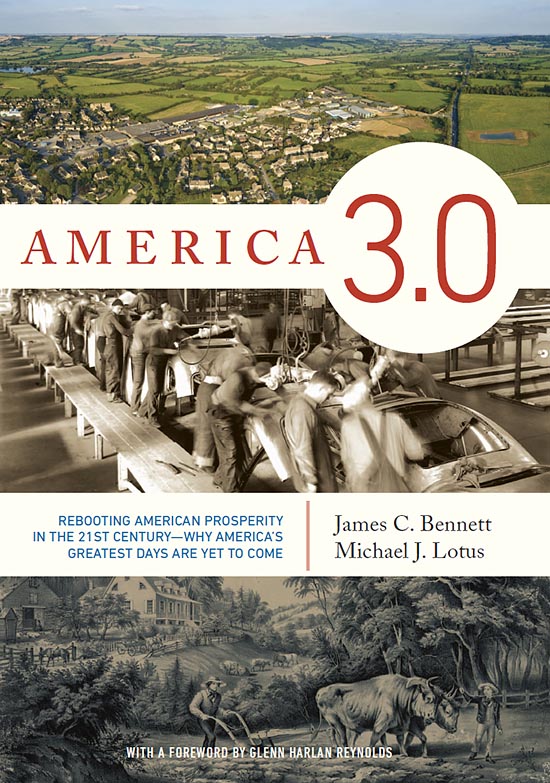
    Ronfeldt’s In-Depth Review of America 3.0

    Monday, September 23rd, 2013


     David Ronfeldt, RAND strategist and theorist has done a deep two-part  review of America 3.0 over at his Visions from Two Theories blog. Ronfeldt has been spending the last few years developing his TIMN analytic framework (Tribes, Institutions [hierarchical], Markets and Networks) which you can get a taste from here  and here or a full reading with this RAND paper.

    David regards the familial structure thesis put forward by James Bennett and Michael Lotus in America 3.0 as “captivating”  and “compelling” for  “illuminating the importance of the nuclear family for America’s evolution in ways that, in my view, help validate and reinforce TIMN”. Both reviews are detailed and should be read in their entirety, but I will have some excerpts below:

    America 3.0 illuminates significance of nuclear families — in line with TIMN (Part 1 of 2) 

    ….Bennett and Lotus show at length (Chapter 2, pp. 29-45) that the nuclear family explains a lot about our distinctive culture and society:

    “It has caused Americans to have a uniquely strong concept of each person as an individual self, with an identity that is not bound by family or tribal or social ties. … Our distinctive type [of] American nuclear family has made us what we are.” (p. 29)And “what we are” as a result is individualistic, liberty-loving, nonegalitarian (without being inegalitarian), competitive, enterprising, mobile, and voluntaristic. In addition, Americans tend to have middle-class values, an instrumental view of government, and a preference for suburban lifestyles. 

    As the authors carefully note, these are generally positive traits, but they have both bright and dark sides, noticeable for example in the ways they make America a “high-risk, high-return culture” (p. 38) — much to the bane of some individuals. The traits also interact in interesting ways, such that Americans tend to be loners as individuals and families, but also joiners “who form an incomprehensibly dense network of voluntary associations” — much to the benefit of civil society (p. 39). 

    In sum, the American-style nuclear family is the major cause of “American exceptionalism” — the basis of our freedom and prosperity, our “amazing powers of assimilation” (p. 53), and our unique institutions:

    “It was the deepest basis for the development of freedom and prosperity in England, and then in America. Further, the underlying Anglo-American family type was the foundation for all of the institutions, laws, and cultural practices that gave rise to our freedom and prosperity over the centuries.” (p. 52)The authors go on to show this for America 1.0 and 2.0 in detail. They also reiterate that Americans have long taken the nuclear family for granted. Yet, very different marriage and family practices are the norm in most societies around the world. And the difference is profoundly significant for the kinds of cultural, social, economic, and political evolution that ensue. Indeed, the pull of the nuclear model in the American context is so strong that it has a liberating effect on immigrants who come from societies that are organized around extended families and clans (p. 55) — an important point, since America is a land of immigrants from all over, not just from Anglo-Saxon nuclear-family cultures.

    ….As for foreign policy, the authors commend “an emerging phenomenon we call “Network Commonwealth,” which is an alignment of nations … who share common ties that may include language, culture and common legal systems.” (p. 260) Above all, they’d like to see the “Anglosphere” take shape. And as the world coalesces into various “global networks of affinity” engaged in shifting coalitions (p. 265), America 3.0 would cease emphasizing democracy-promotion abroad, and “reorient its national strategy to a primary emphasis on maintaining the freedom of the global commons of air, sea, and space.” (p. 263) [UPDATE: For more about the Network Commonwealth and Anglosphere concepts, see Bennett’s 2007 paper here.]

    Read the whole thing here.

    America 3.0 illuminates significance of nuclear families — in line with TIMN (Part 2 of 2)  

    ….Overlaps with TIMN themes and propositions

    Part 1 discussed America 3.0’s key overlap with TIMN: the prevalence and significance of the nuclear family in the American case. This leads to questions about family matters elsewhere. Furthermore, it should be pointed out that there is more to TIMN’s tribal form than the nature of the family. I also spotted several additional thematic overlaps between America 3.0 and TIMN, and I want to highlight those as well. Thus, in outline form, this post addresses:

    • Seeking a fuller understanding of family matters beyond the American case.
    • Gaining a fuller understanding of the tribal/T form.
    • Anticipating the rise of the network/+N form.
    • Recognizing that every form has bright and dark sides.
    • Recognizing the importance of separation among the forms/realms.
    • Recognizing that balance among them is important too.
    • Cautioning against the exportability of the American model.

    After these points, the post ends by summarily noting that America 3.0 is more triformist than quadriformist in conception — but a worthy kind of triformist plus, well worth reading.

    My discussion emphasizes the T and +N forms. Bennett and Lotus also have lots to say about +I and +M matters — government and business — and I’ll squeeze in a few remarks along the way. But this post mostly skips +I and +M matters. For I’m more interested in how America 3.0 focuses on T (quite sharply) and +N (too diffusely). 

    By the way, America 3.0 contains lots of interesting observations that I do not discuss — e.g., that treating land as a commodity was a feature of nuclear-family society (p. 105), and so was creating trusts (p. 112). Readers are advised to harvest the book’s contents for themselves.

    ….Caution about the exportability of the American model: TIMN sharpens — at least it is supposed to sharpen — our understanding that how societies work depends on how they use four cardinal forms of organization. This simplification leaves room for great complexity, for it is open to great variation in how those forms may be applied in particular societies. Analysts, strategists, and policymakers should be careful about assuming that what works in one society can be made to work in another. 

    ….In retrospect it seems I pulled my punch there. I left out what might/should have come next: TIMN-based counsel to be wary about assuming that the American model, especially its liberal democracy, can be exported into dramatically different cultures. I recall thinking that at the time; but I was also trying to shape a study of just the tribal form, without getting into more sweeping matters. So I must have pulled that punch, and I can’t find anywhere else I used it. Even so, my view of TIMN is that it does indeed caution against presuming that the American model is exportable, or that foreign societies can be forced into becoming liberal democracies of their own design.

    Meanwhile, America 3.0 clearly insists that Americans should be wary of trying to export the American model of democracy. Since so much about the American model depends on the nature of the nuclear family, policies that work well in the United States may not work well in other societies with different cultures — and vice-versa. Accordingly, the authors warn,

    “American politicians are likely to be wrong when they tell us that we can successfully export democracy, or make other countries look and act more like the United States.” (p. 24)

    “A foreign-policy based primarily on “democracy-promotion” and “nation-building” is one that will fail more times than not, … .” (p. 254)TIMN is not a framework about foreign policy. But as a framework about social evolution, it may have foreign-policy implications that overlap with those of America 3.0. In my nascent view (notably herehere, and here), the two winningest systems of the last half-century or so are liberal democracy and patrimonial corporatism. The former is prominent among the more-advanced societies, the latter among the less-developed (e.g., see here). As Bennett and Lotus point out, liberal democracy is most suitable where nuclear families hold sway. And as I’ve pointed out, patrimonial corporatism is more attractive in societies where clannish tribalism holds sway. 

    Read the rest here.

    This discussion about America 3.0 and TIMN seems particularly appropriate in light of the need to process, digest and distill the lessons of more than a decade of COIN and counter-terrorism warfare in Iraq, Afghanistan, Pakistan, Yemen and – increasingly- Africa. One of the more difficult aspects of COIN operations has been for American military and diplomatic to decipher the layered relationships and interplay of family honor, tribe, political institution, emerging market and networks in a nation shattered by dictatorship and war like Iraq or to import modern institutions and  a democratic political system in Afghanistan where they had never existed.

    Many of these aspects were opaque and were understood only through hard-won experience (frequently lost with new unit rotation) or still remain elusive to Americans even after ten years of fighting among alien cultures which were also permeated by the sectarian nuances and conflicts of Islam. A religion to which relatively few Americans adhere or know sufficiently about, yet is a critical psychological driver for many of our adversaries as well as our allies.

    Arguably, the eye-opening response of people to America 3.0 indicates we do not even understand ourselves, much less others

    Octavian Manea Interviews General David Petraeus

    Monday, September 2nd, 2013

    [by Mark Safranski a.k.a. “zen“]

    Octavian Manea has had an excellent series of COIN  interviews at SWJ and this is one of the more important ones:

    Reflections on the “Counterinsurgency Decade”: Small Wars Journal Interview with General David H. Petraeus

    SWJ: In his recent op-ed published in the New York Times, “The Pipe Dream of Easy War”, General H.R. McMaster warned against the fantasy of “a new era of war”, and especially about the dangers in the blind faith in the transformative effects that technology promises to have on war. He argued that over the past counterinsurgency (COIN) decade we relearned a few lessons that we really should keep in mind as we head into the future: “American forces must cope with the political and human dynamics of war in complex, uncertain environments”. His warning reminds me of an article you wrote in 1986 with General John Galvin about “uncomfortable wars”. You warned to take into consideration “the societal dimension of warfare”. To what extent do you see that prophecy still holding true post Iraq and post Afghanistan?

    General Petraeus: I think the essence of the article back in 1986 with General Galvin was frankly the importance of the human terrain in each particular situation, and the importance of understanding the terrain, having a very nuanced, detailed feel for the context of each situation, not just nationally, but sub-nationally and literally all the way down to each valley and each village. That kind of knowledge was achieved in Iraq and helped us enormously during the Surge. We had a greater understanding there, earlier than we did in Afghanistan, just because we had so many more forces on the ground, 165,000 American military alone at the height of the surge. In Afghanistan at the height of our deployment, we had 100,000 US troopers and about 50,000 coalitional forces, and we maintained that level for a relatively brief period of time. As I noted on a number of occasions, we never really got the inputs close to right in Afghanistan until late 2010.

    So, noting the importance of human terrain, I believe, is a fundamental aspect of crafting a counterinsurgency campaign. In fact, it was the biggest of the big ideas when we launched the Surge in Iraq, and we knew that since the human terrain was the decisive terrain, we would had to secure it as our principal focus – and to do so by living with the people, locating forward operating bases/joint security stations in the neighborhoods and villages, and specifically right on the sectarian fault-lines across which the heaviest fighting was ongoing in the capital. We ultimately established 77 additional locations just in the Baghdad area of operations alone, and many dozens more elsewhere throughout the country. There were other big ideas to be sure:  e.g., that you can’t kill or capture your way out of an industrial strength insurgency, such as we faced, therefore you need to reconcile with as many of the insurgents as was possible, seeking to maximize the number of the reconcilables; correspondingly, we also needed to intensify our campaign of targeted operations against the irreconcilables. But I think, fundamentally, it comes back to this issue, that it is all about people, counterinsurgency operations are wars in, among, and, in essence, for the people. And the first task of any counterinsurgency campaign has to be to secure those people.

    Read the rest here.

    Moral Degeneration in the Crucible of War

    Wednesday, June 12th, 2013


    The recent post on Is 4GW Dead? stirred a great deal of interest, so I would like to extend the discussion on a point that that is critical not only for those who have responsibility for conducting military campaigns, but for statecraft and policy as well.

    One of more important tenets of 4GW was the importance of “the moral level of war”, drawn from Colonel John Boyd’s thinking on the strategic impact of a combatant’s behavior, immoral  or exemplary, on all observers – belligerents, civilian noncombatants, neutral third parties, the media, the combatant’s own soldiers and citizens back home. Here is Boyd:

    Morally our adversaries isolate themselves when they visibly improve their well being to the detriment of others (allies, the uncommitted), by violating codes of conduct or behavior patterns that they profess to uphold or others expect them to uphold.

    · Morally we interact with others by avoiding mismatches between what we say we are what we are and the world we have to deal with, as well as by abiding by those other cultural codes or standards we are expected to uphold.

    In a Reader’s Digest version of Boyd,  heroic, noble and magnanimous  behavior is admirable and attractive while hypocrisy, cruelty and cowardice are repulsive and antagonizing characteristics. While the former won’t guarantee your victory and the latter, unfortunately, won’t ensure your defeat, they will be a significant factor in ameliorating or generating friction.  The impression given by an army impacts the will of the enemy to fight, the morale and discipline of the soldiers, the restiveness of the civilians, the loyalty of allies and the goodwill of neighbors.

    Boyd developed his thinking about the moral level of war in Patterns of Conflict  all the way up to grand strategy and above. The rub about the moral level  is that war is a crucible that puts every “cultural code” or “standard” to the test, as well as the character of the men fighting it and their leaders upon whom great responsibility rests.  Even with the best of intentions in policy and careful generalship in the field, the horrors of war can erode moral fiber and military discipline in an army, in a company or in the heart of one man. Nor does every army begin with good intentions and effective discipline – some fighting forces are scarcely to be regarded as “armies” at all while others embrace the darkness as a matter of policy.

    In terms of warfare, let us define “moral degeneration” as a degraded state of moral decline where a belligerent has effectively abandoned the operational and tactical restraints on conduct mandated by the Laws of War (i.e. war crimes are SOP) and in some instances, the vestiges of civilization.

    A textbook example of this kind of moral degeneration came to light a few weeks ago when a jihadi lunatic in Syria, a rebel commander Khalid al-Hamad, who goes by the name of “Abu Sakkar”, cut out the heart of a (presumably) dead government soldier and ate it on video. Charles Cameron expounded at length upon this minor atrocity here. I am not, to say the least, a fan of radical, revolutionary, transnational Sunni Islamism but I cannot honestly say that its proponents like Abul Mawdudi , Sayid Qutb, Abdullah Azzam, Osama bin Laden and their ilk ever openly advocated cannibalism. It is much more likely that Mr. al-Hamad’s behavior is explained by the ferocity of the civil war in Syria eroding customary norms of the combatants than  it is by Islamist ideology.

    Moral degeneration in war seems to spring from two directions:

    a) As a calculated act of Policy, from the top down, enforced by the leadership by military discipline and bureaucratic control.

    b) As a spontaneous reaction by soldiers or fighters, appearing from the bottom up, without orders and frequently, in spite of them, possibly due to a breakdown in the chain of command, an erosion of discipline or sheer mutiny for the age-old purpose of reprisal, pillage and rapine.

    The first category often occur with war as a convenient cover rather than a cause of grave crimes against humanity that leaders and  ideologues had long wished to carry out. The Armenian Genocide, as John Keegan wrote, belongs properly to the history of Ottoman imperial policy than it did WWI; in truth, the Genocide was the greatest and worst in a long succession of vicious pogroms that the Ottomans had launched against their Armenian Christian subjects during the reign of Abdul Hamid and the Young Turks. The Holocaust (which had some inspiration in Hitler’s mind, from the fate of the Armenians) was more closely tied to the evolution of  Nazi war policy but once Operation Barbarossa opened up the vast spaces of Soviet Eurasia, “the East” in Nazi parlance, the war itself increasingly took a backseat to expediting Hitler and Himmler’s ghastly and murderous racial priorities. This is a pattern of a priori planning, an escalating ideological radicalization of society that tends to be present with most of the large scale democides and genocides. It is the organizational powers of  coercion utilized by the state, or a mobilized faction of , it that makes the enormous scale of death possible, not the war.

    What is different and also dangerous about moral degeneration from the bottom-up, is that it is cultural evolution driven by the psychological effects of extreme violence at work and, unlike an act of policy, more likely to be diffused widely across society as a permanent change for the worse. Too many German soldiers in WWI, former peasants and artisans and boys from middle-class families, returned from the Western Front morally coarsened and addicted to the adrenalin rush of combat and became in succession Freikorps paramilitaries, Communist streetfighters, Nazi Stormtroopers and SS men. The World War also gave Russia the men of the Cheka, the Red terror and the first Gulags on the Bolshevik Left and brutal and mad warlords on the White Right.

    In more recent two decades, the break-up of Yugoslavia unleashed atavistic passions of ethnic hatred and atrocity, while organized society in Western African states and central Africa broke down entirely in transnational regional civil wars with unrestrained massacres and mass rape. As a result, there is little that is political but much that is primeval, at this juncture, to explain Joseph Kony’s motivations; he resembles nothing so much as a 21st century Kurtz. Mexico too is degenerating from the escalating violence of cartel insurgency and narco-cultas – there is not much tactical or strategic value in pagan death cults or human sacrifice but it is spreading:

    …Our impression is that what is now taking place in Mexico has for some time gone way beyond secular and criminal (economic) activities as defined by traditional organized crime studies.3 In fact, the intensity of change may indeed be increasing. Not only have de facto politicalelements come to the fore-i.e., when a cartel takes over an entire city or town, they have no choice but to take over political functions formerly administered by the local government- but social (narcocultura) and religious/spiritual (narcocultos) characteristics are now making themselves more pronounced. What we are likely witnessing is Mexican society starting to not only unravel but to go to war with itself. The bonds and relationships that hold that society together are fraying, unraveling, and, in some instances, the polarity is reversing itself with trust being replaced by mistrust and suspicion. Traditional Mexican values and competing criminal value systems are engaged in a brutal contest over the ?hearts, minds, and souls‘ of its citizens in a street-by-street, block-by-block, and city-by-city war over the future social and political organization of Mexico. Environmental modification is taking place in some urban centers and rural outposts as deviant norms replace traditional ones and the younger generation fully accepts a criminal value system as their baseline of behavior because they have known no other. The continuing incidents of ever increasing barbarism-some would call this a manifestation of evil even if secularly motivated-and the growing popularity of a death cult are but two examples of this clash of values. Additionally, the early rise of what appears to be cartel holy warriors may now also be taking place. While extreme barbarism, death cults, and possibly now holy warriors found in the Mexican cartel wars are still somewhat the exception rather than the rule, each of these trends is extremely alarming, and will be touched upon in turn.

    The crucible of war either tempers a people or it breaks them.


    Switch to our mobile site