zenpundit.com » blogosphere

Archive for the ‘blogosphere’ Category

Observations from the Pointy-End

Monday, October 31st, 2011


An interesting new blog. An operator type, an Iraq and Afghan vet,  quesopaper blogging from AfPakland on situational awareness and much later in the post, on leadership:

Running To Contact

….I thought we’d cover danger in Afghanistan again by examining, “When Insurgents attack.”

A quick aside…over the years one develops a sense for explosions. Some are “ours”…outgoing mortars, rounds from a gun or controlled detonations. We learn the sounds of different weapon systems. A helicopter followed by a high pitched drone and several whooshes is an Apache firing it’s main gun and rockets. Whomp Whomp Whomp  is an M60/M240. Ma duece says Bum Bum Bum. Artillery is LOUD and has a pointy sound when outgoing. Incoming is more spherical.

We also develop a sense of distance and direction for the booms…it’s all part of our survival mechanism. Another aspect is awareness of our surroundings. We constantly scan and consider what to do if we are attacked …where is the nearest bunker or where is the closest safest place?

This sounds frightening, but we all do this. Motorcycle riding is a good analog. When riding we have to be aware of spacing. Scanning for threats and escape routes saves a rider’s life.

The sound that puts me face first on the ground are mortars wobbling towards me. They make a unique sound that I can’t quite describe. Sort of of a frantic flutter…the closest sound I can come up with is the rattle of a door stop when accidentally brushed. Rockets and their vibrating engine sound are also unnerving. If you can hear them flying, they are too damned close…

Very relevant to past blog discussions of fingerspitzegehful and the OODA Loop – a good descriptive narrative, in fact, of OODA working correctly. Theory is not the interest of the quesopaper gent, but his firsthand observations of COIN in Afghanistan are intriguing, for those interested in military policy or theory. Ideas that are often great on a whiteboard or ppt slide but may not seem quite as great once they collide with reality.

Another post from quesopaper, in the vein of theoretical rubber meeting the practitioner road:

What do they Need?

….indulge me while I inject some confusion into our clarity regarding Afghans. This is a paraphrased version of a Benedictine Grima tale from her field work. If one desires knowledge about AfPak, particularly the female’s role, Ms Grima is THE source.

The tale….Two men travel to village 1. While there, they commit robbery and murder. These crimes are detected by local police. The police debate their response, and decide to chase the perpetrators.

They enter the criminal’s village (village 2) where locals set upon the police and kill them. These villagers for whatever reason don’t appreciate nor require police involvement in their affairs. Villages 1 and 2 are content to solve crimes of any type within their own system of justice. In response to the police incursion, village 2 blocks outside access to the road preventing further police/outsider interference. Up the road a bit, the next village (village 3) hears of this incident. The road blockage makes them fighting mad. A village 2 v. village 3 mini-war occurs; people die. Why? Village 3 needs that road to survive or, shoot-some other reason. We don’t and honestly; we can’t know.

The point isn’t “should we” or “shouldn’t we” be here; that’s a different blog…Fact is we are here.

So let’s do this…Let me take you to a village. You comment below on how we are going to help….maybe we’ll all learn something….

Read the rest here.

More on Boyd & Beyond II and Boydian Theory

Wednesday, October 19th, 2011

Two posts of note:

USNI Blog (Lucien Gauthier) – Training Sailors to be Autodidactic

….The conference spent a lot of time on the first half of the OODA-Loop, Observing and Orienting.  At some point I became convinced that the type of Sailor we need is one that is a “situational autodidact”.  Major Marcus Mainz, USMC, during his presentation made the brilliant comment that “training is for the known, education is for the unknown” in this sense, the spirit in which we must educate our Sailors must be towards making them capable of educating their self as needed when the unknown presents itself to them.

….For Sailors to take greater advantage of their experiences, they need to actively question their actions.  By this, I mean that a person analyses a question more than they do a statement.  But, it has been my experience that when someone recants an experience they had, it is a rare thing to hear someone say anything in terms of ‘why’ they did something.  Much more often someone only tells the ‘what’ of their actions.  Think of the Socratic Method, where Socrates would answer his students questions with another question.  A Sailor who has internalized such a ‘Socratic process’ would be in a position to provide more cogent feedback as well as learn from their mistakes more often than we do today.

What I am saying is not that the training we offer Sailors falls short of its objectives as they stand today.  But, that the spirit of the training is not where it needs to be-we focus our objectives too much on acting rather than orienting.  The training our Sailors receive are based on concrete and testable objectives that can be measured, quantified and turned into metrics, that fit well into powerpoint.  We do no help Sailors to become autodidactic-we are not training them to become students of their environment, but rather students of their school house.

We start to approach training Sailors to be autodidacts of their environment in the Operational Risk Management training we receive (One thing about ORM:  It is Boyd’s OODA-Loop operationalized.  The Navy has totally ripped off Boyd, and yet we never mention his name outside of the Warfare Universities-shame on us).  We need more and deeper training on ORM and how this method applies to everything we do, whether we consciously realize it or not.  In giving this deeper level or ORM, we should also find Sailors able to be more articulate of the process they’ve gone through.  Thereby becoming able to better train others of their experiences….

Naval affairs is not my bailwick, but my understanding of following online discussions by experts in the field like General Robert Scales, is that Professional Military Education across all the services is a) in need of significant reform and b) is facing a future of restricted budgets and possible deep cuts. My only firsthand knowledge of PME comes from a brief stint in June at The Army War College, courtesy of Dr. Steve Metz. The AWC curriculum was explained to me in detail by Col. Bill Lord, and while they were hitting the right notes in terms of trying to inculcate a strategic epistemology, the time frame allowed for doing so is extremely compressed.

Fast TransientsBoyd’s Conceptual Spiral – New Edition

This is from Dr. Chet Richards as well as Chuck Spinney….

Download Conceptual Spiral (152 KB PDF), Boyd’s take on the origin and importance of novelty:

Novelty is not only produced by the practice of science/engineering and the pursuit of technology, it is also produced by the forces of nature, by our own thinking and doing as well as by others. Furthermore, novelty is produced continuously, if somewhat erratically or haphazardly. Now, in order to thrive and grow in such a world, we must match our thinking and doing, hence our orientation, with that emerging novelty. (28)

Adds the original page numbers, which may seem a little odd because for readability this edition spreads several of Boyd’s originals over two or even three pages.  All of these will have the same number.

We are wired to crave and be attracted to novelty, it sets us thinking and generates insights and stimulates our creativity.

More on R2P, Second Thoughts by Slaughter? Plus, Drezner on Networks

Friday, September 30th, 2011

R2P is in the news while I slowly and laboriously wind my way through writing the next edition of the R2P is the New COIN series.

LATimes R2P and the Libya mission:When does ‘responsibility to protect’ grant countries the right to intervene?

The Palestinian bid for statehood and traffic congestion weren’t the only things going on in New York last week as the 66th U.N. General Assembly convened. One of the issues privately discussed by foreign ministers at the United Nations was the “responsibility to protect,” or R2P. This concept was central to the U.N. mandate to protect civilians in Libya, which led to NATO‘s aerial involvement there. As the dust settles in Tripoli, it has become necessary to refute a powerful myth that has developed among some pundits and politicians. That myth is that R2P bestows “the right to intervene” in Libya.Even though R2P features in just two paragraphs of the 40-page “outcome document” of the 2005 U.N. World Summit, historian Martin Gilbert has suggested that it constituted “the most significant adjustment to national sovereignty in 360 years.”R2P’s core idea is that all governments have an obligation to protect their citizens from genocide, war crimes, ethnic cleansing and crimes against humanity. It is primarily a preventive doctrine. However, R2P also acknowledges that we live in an imperfect world and if a state is “manifestly failing” to meet its responsibilities, the international community is obligated to act. It is not a right to intervene but a responsibility to protect.

The distinction is not diplomatic artifice. After the 1994 Rwandan genocide and the 1995 massacre in the Bosnian town of Srebrenica, the international community resolved to never again be a passive spectator to mass murder. Still, it would not have been surprising if R2P had quietly expired after 2005. The United Nations, after all, can be a place where “good ideas go to die.” Instead, within the U.N. the debate now is about how R2P should be meaningfully implemented, rather than whether such a responsibility exists….

If I were the House Chairman of the Foreign Affairs Committee or the Senate Armed Services Committee, I sure would like to know what those foreign ministers and especially our SECSTATE or UN Ambassador were saying about R2P! I might even suggest that,  in televised hearings, that before the US endorse or adhere to any newly fashionable concepts of sovereignty, the elected representatives of the people of the United States should be informed and consulted.

Simon Adams, like most commenters in the R2P debate, is focused on the impact an R2P doctrine as part of international law would have on military intervention, especially the frequency of American military intervention. This is reasonable because, logically, R2P implies much larger burdens and more frequent interventions overseas. But the flip side, if you look at the implication of “new sovereignty” as articulated by Dr. Slaughter, are changes to how we as Americans govern ourselves, transfers of power and authority to unelected officials, private interests and even foreigners, as well as  limitations on democratic consent.

[Limitations on the democratic consent of the unwashed masses seems to be popular lately with the political elite]

Speaking of Anne Marie Slaughter, she recently penned a curious op-ed about Afghanistan that is not a retreat from R2P, but comes across as at least a step back from seeking maximalist policy objectives with military force, in the face of messy realities:

Where the Afghanistan effort broke down

….For a long time I was convinced that the NATO intervention in Afghanistan could be successful at building a functioning Afghan government that would provide basic services to its citizens. My views were largely shaped by my regular conversations with my long-time friend Sarah Chayes, who lived in Kandahar for much of past decade running first a dairy cooperative and then a soap and fragrance business with Afghans. We were failing, in her view, because of the high NATO tolerance for the cancerous corruption that was sucking the life out of the country, starting at the top. Her book Punishment of Virtue tells the tale, describing how Afghans genuinely committed to rebuilding their country have been systematically driven out or killed by their compatriots who are profiting from the enormous in-flux of money and opportunity that inevitably accompanies large-scale Western intervention in a poor country. She thought, and I agreed, that the U.S. had had an opportunity to help rebuild a very different Afghanistan immediately after the invasion, and that it was still possible to empower the good guys if we were really willing to take on the bad guys profiting at the local, regional, and national level.

Over the past two years, I have reluctantly changed my mind. I have come to believe that where the problem is a predatory state, which the very presence of massive Western resources tends to fuel, it is essentially impossible for outsiders to spur or even effectively support a process of reform from within when we are a big part of the problem by being there in the first place. Stewart makes the argument succinctly and effectively: “the international community necessarily [lacks] the knowledge, the power, and the legitimacy to engage with politics at a local provincial level.”

I would add a much more personal dimension, one that is consistent with a 21st century focus on social actors and social relations as well as on governments and inter-governmental relations. The “international community” does not engage with Afghans. Individual men and women (mostly men) do. Those individuals – diplomats, soldiers, development professionals – develop personal relationships with Afghan officials at the national, provincial, and local level. They have to work together on common programs; moreover, the Americans or Europeans are doing their best to cultivate personal relationship in part to garner exactly the knowledge they know they lack. But once those relationships are established, how exactly is a general or a captain, an ambassador or a political counselor, a USAID Mission Director or a field development expert supposed to turn to his or her Afghan counterparts and interlocutors and explain that they should really stop taking bribes and looting the funds intended for their fellow Afghans? And once the denial is issued, as of course it must be, then what?  Accuse him or her of lying? The problems that are most central cannot even be talked about honestly. They are always someone else’s fault. But if they cannot be acknowledged, they cannot be resolved.

It is at this micro-level that policies must actually be implemented. And it is at this level that I conclude state-building military interventions are much more likely to fail than to succeed.

Slaughter, in my view, is more insightful with her empirical analysis of the granular mechanics of international relations than the theoretical and especially legal constructs she builds from them. Military force is a blunt instrument; whether you approach it from a Clausewitzian perspective or one partial to Sun Tzu, the ability to extract desired political concessions with violence – to compel the enemy to do your will – becomes more difficult and costly as your ends are at once both expansive and “fine-tuned”. We transformed and fine-tuned the societies of defeated Nazi Germany, Fascist Italy and Imperial Japan, but only after waging the greatest  total war since the Mongols sacked Persia. Bismarckian strategic talent to accomplish major ( but not maximalist) strategic goals at reasonably affordable ( but not cheap) costs is an extreme historical rarity.

Finally, Dan Drezner has re-engaged Slaughter on the point of networks in international relations and politics:

Do networks transform the democratic political process?

….As a social scientist, I must acknowledge that this is a powerful prima facie data point in favor of Slaughter.

And yet, it’s worth pushing the NYT thesis a bit. What happens when the coalition of like-minded individuals stop being of like mind? These sorts of protests can be very powerful on single-issue questions where a single policy change is desired. Maintaining this level of activism to affect the ongoing quotidian grubbiness of politics, however, is a far more difficult undertaking. Even if people can be mobilized behind the concept of “Policy X is Stupid!” getting the same consensus on “Policy Y is the Answer!” is harder. Over time, these kind of mass movements have an excellent chance of withering away or fracturing from within. See, for example, the Tahrir Square movement in Egypt.

Another thing, and this is important: unless the people in these movements actually vote in elections, then their agenda will be thwarted in the long run. Even if these kinds of networked movements are new, the political imperative to get elected and re-elected is not. If they don’t vote, then officials have a pretty powerful incentive to curry favor with the people who do vote, don’t take to the streets and don’t like these young whippersnappers with their interwebs have different policy preferences.

On the transformative nature of networks, I think Slaughter is, in the big picture, correct that scale free networks are different from hierarchies in important behavioral and structural ways. RAND scholar David Ronfeldt, a friend of this blog, has a paper that I would strongly recommend that looks at the sociopolitical nature of  tribes, hierarchies, markets and networks that has great relevance to this discussion. Drezner’s counter-point to Slaughter has traction because although networks are powerful, it is a matter of comparative advantage over other social forms in certain environments, but not all environments.

Moreover, a lot of what Slaughter is calling “networks” – especially the “governmental networks” that occur in and within IGOs are really organizations with the characteristic of modularity and are not naturally emergent scale free social networks like your twitter follower list. Secondly, networks have weaknesses as well as strengths and history is replete with networks – like political and social protest movements, peasant rebellions and revolutionary conspiracies – that were unceremoniously and thoroughly crushed by the power of ruling hierarchies. Third, and most important, the de facto existence of  tacit, dynamically evolving, social networks as political movers to be taken seriously is not itself a good reason to grant them de jure status in international law as legitimate, authority-wielding, actors.

In fact, I can think of many good reasons not to do so.

[Belated hat tips to Cheryl Rofer, Bruce Kesler, David Ronfeldt]

A bouquet from Breivik

Thursday, September 15th, 2011

[ by Charles Cameron — Breivik, network analysis, graphical presentation, morale and materiel, hard problem in consciousness ]

.

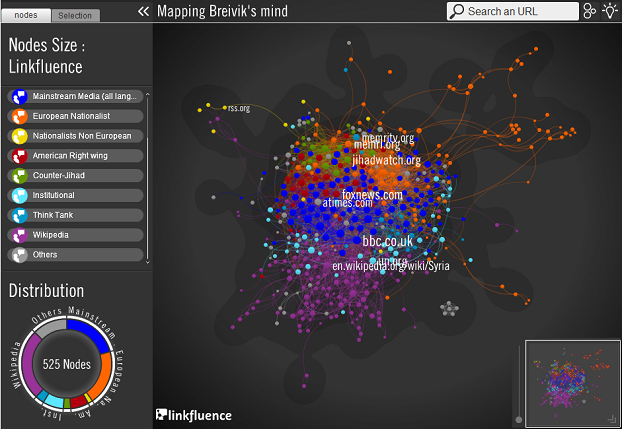
breivik-mind-map.png

If I might wax over-the-top lyrical for just a moment…

Like an early morning bouquet of wildflowers appearing out of the mists —

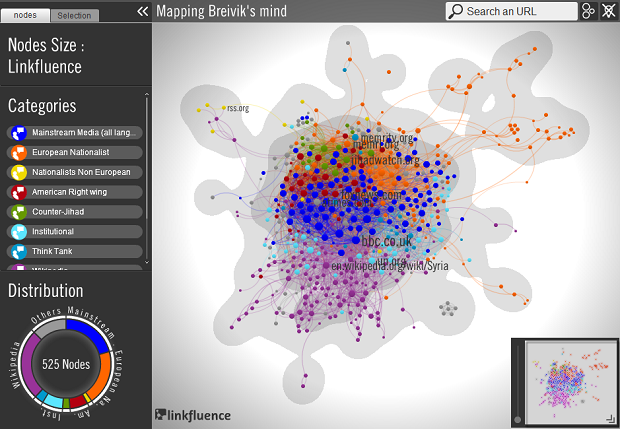
breivik-mind-map-02.png

or like some translucent sea creature perhaps, with galaxies in its veins and tendrils — the mind of Anders Breivik is imaged here by Britain’s Guardian datablog in a graphical mapping of the hyperlinks found in his 1500 page manifesto, and the links between the sites he links to.

Beautiful, no? Like an early morning bouquet?

*

Three things:

  • mapping Breivik’s online links for us is a valuable service.
  • the glamour of high-tech graphical interfaces can be deceptive.
  • there’s no map of the link between concept and act.

That last one, if you ask me, is the real bouquet.

We can know quite a bit about what Breivik read, and even figure out some of how he “connected the dots” – but the move from thinking about to taking action is the one that matters most – and we don’t have much of a handle on it.

It’s not on the map.

*

Such lacunae bother me.

A lot of our maps and models move between one quantity and another, and a lot of our thinking, correspondingly, has to do with materiel rather than morale — but nowhere is there a map or model of how quantity and quality affect each other, or how morale “force multiplies” materiel — even though “real life” moves seamlessly between (subjective, qualitative) mind and (objective, quantifiable) brain.

We have no map to walk us through the hard problem in consciousness — except our own insight.

And x-rays do not an insight make.

Elkus on Wikileaks and Sovereignty

Sunday, September 4th, 2011

Adam Elkus has a smart piece up at Rethinking Security that deserves wider readership:

WikiLeaks and Sovereignty

….WikiLeaks represents the idea that states have no inherent authority to hold onto vital national secrets. Because information is fundamentally boundless and unlimited by the “oldthink” of national borders and politics, state control over proprietary information is irrelevant. WikiLeaks and other radical transparency advocates believe that they-an unelected, transnational elite-can pick and choose which states are good and bad and whose secrets deserve exposure. And if information deserves to be free-and the only people who would keep it from being so are those with something to hide-then it is fine for non-state networks to arrogate themselves the right to receive and expose state secrets.

….While WikiLeaks is often positioned as a champion of digital democracy, it is actually wholly anti-democratic. It transfers power and security from national governments and their publics to unelected international activist organizations and bureaucrats. While this may seem like a harsh interpretation, there is no check on the likes of Julian Assange. Governments-even autocratic ones-still must contend on a day-to-day basis with the people. Even China had to face a reckoning after the Wenzhou train crash. WikiLeaks and other radical transparency organizations mean to replace one group of elites-which at least nominally can be called to court-with another who are accountable only to their own consciences.

Read the whole thing here.

Let me add a few comments to Adam’s excellent analysis.

Wikileaks and Julian Assange were not and have never been, lone wolves or information-must-be-free martyrs. They are allied with important institutions and individuals within the Western progressive elite, not least major media heavyweights like The New York Times, The Guardian and Der Spiegel, but also sympathizers within Western governments. Unless you think that Pvt. Bradley Manning was a hacker wunderkind with an intuitive grasp of which files that could be swept up to further a sophisticated political agenda, the man had some inside help from further up the food chain.

Adam is correct to describe these political factions as anti-democratic because they are and while leaking has been going on as long as there have been governments, we now have the emergence of a transnational generational clique that see themselves as entitled to rule and impose policies that comport with their social prejudices, economic self-aggrandizement and ideological fetishes, whether the people support them or not. A vanguard attitude, if not an organizational vanguard.

Wikileaks and other devices operating in shadowy undercurrents are their form of liberum veto against the rest of us in the instances where they are not completely in control, thus migrating political power from responsible state institutions to the social class that currently fills most of the offices and appointments. So far, their actions have been largely cost-free because their peers in government, however irritated they may be at the effects of Wikileaks, are loath to cross the Rubicon and hammer these influential conspirators with whom they went to school, intermarry, do business, live amongst and look out for the careers of each other’s children the way they have hammered Bradley Manning.

The same oligarchical class indulgence is seen in the financial crisis where almost none of the people responsible for massive criminal fraud in the banking and investment  sectors that melted the global economy have faced prosecution, unlike previous financial scandals like the S&L crisis or BCCI where even iconic figures faced grand juries. Instead of indictments, the new class received subsidies, bonuses and sweetheart, secret deals from their alumni chums running central banks and national governments. 

Carl Prinecommenting on a much narrower and wholly American slice of this corrupt camarilla, described this new class very well:

Let me be blunt.  A late Baby Boomer generation of politicians, bankers, reporters and generals has formed into a cancer inside this democracy, and their tumorous leadership won’t be kind to your future.

Unfortunately, this cancer is not limited to our democracy, it is the root of the decline of the West.


Switch to our mobile site