zenpundit.com » complex systems

Archive for the ‘complex systems’ Category

Are Insurgencies “Antifragile”?

Thursday, May 16th, 2013

I have been reading Nassim Nicholas Taleb’s latest book,  Antifragile . It’s a highly intriguing book and I will give it a full review soon, but Taleb’s core concept of antifragility is important  and lends itself to wide application. Here’s Taleb on what constitutes “antifragility” – things that gain or improve with disorder – which he was careful to distinguish not just from “fragility” but also from “robustness” and “resilience”:

Almost all people answer that the opposite of “fragile” is “robust”, “resilient” , “solid”, or something of the sort. But the resilient, robust (and company) are items that neither break nor
improve, so you would not need to write anything on them – have you ever seen a package with
“robust” stamped on it? Logically, the exact opposite of a “fragile” parcel would be a package on which one has written “please mishandle” or “please handle carelessly”. It’s contents would not just be unbreakable, but would benefit from shocks and a wide array of trauma. The fragile is the package that would be at best unharmed, the robust would at best and at worst unharmed. And the opposite of fragile is therefore what is at worst unharmed. [31]

Italics in original.

Taleb uses a number of metaphors – the Phoenix, the Hydra – as well as examples to get across the point that an antifragile entity overcompensates in reaction to stress/damage/disorder by becoming better, growing stronger, more powerful, adaptively improving itself. Think of the effects of weight training in building muscle or a wildfire spurring bountiful growth in an ecosystem. There’s more to Antifragile than this but the gist is sufficient for now.

Which brings me to the question, “Are insurgencies antifragile?”

The study of insurgency, terrorism and revolution, while important and useful tend to suffer from several drawbacks. One is compartmentalization and academic specialization. As Robert Bunker pointed out in Narcos Over the Border,  a problem like “criminal-insurgency” attracts very different reactions from Law enforcement, intelligence analysts, the military, counter-terrorism officials and other experts (to say nothing of politicians) which makes consensus over a common analytic framework very difficult. Sometimes even defining the problem across domains is frustrating. As a result, many studies are too narrow and the few admirably ambitiously broad ones are deeply stamped in the political lens of the era in which they were researched and written – i.e. imperialist Small Wars, the Cold War, the War on Terror, Pop-centric COIN of Iraq and Afghanistan wars etc.  It is a subject that requires both more (and more intellectually creative) scholarship and a greater degree of synthesis.

In the meantime, I’d like to offer some speculation in an effort to answer the question:

  • The characteristics of “antifragility” in terms of at least some kinds of insurgency bears a striking resemblance to that of “wicked problems“, which has also been used to categorize some enduring irregular conflicts. Particularly in the sense of not having natural stopping points , manifesting complex interdependencies and resistance to simple, silver bullet solutions that could destroy it.
  • Moreover, most successful insurgencies are not, contrary to Maoist theory, autochthonous  – they draw many resources from external sources – black globalization, foreign patrons, legitimate trade, fundraising – and from the very state waging counterinsurgency warfare against them. The Afghan Taliban would be a much poorer military force without the vast amount of American aid passing through the hands of Pakistan and the Karzai regime
  • An insurgency’s claim to being “antifragile” may rest as much or more upon the general political and socioeconomic environment being relatively chaotic than on the nature of the insurgent organization itself.  The Chinese, Russian and Lebanese civil wars, Mexico’s narco-insurgency, West Africa and Afghanistan in the 1990’s, the Congo basinand Iraq in the 2000’s all had polycentric and disorderly environments that allowed  irregular groups to rapidly rise and fall on a local and regional basis. By contrast, “bilateral” insurgency vs. state dynamics can stabilize conflict for decades
  • An insurgent organization may lose antifragility as it restructures itself over time to become either more robust (ex. –Hezbollah) subnational entity or to accept greater fragility in order to acquire state-like hierarchical advantages ( political discipline and specialization). Note that “fragile” does not mean “weak”, it means “vulnerable”. States can be very strong and concentrating massive amounts of resources and coercive force, yet be strangely vulnerable to internal coups, popular uprisings, economic collapse, strategic myopia or even natural disasters. One of the great dangers today are complex systems that combine epic power with extreme fragility – small disruptions by irregulars yield huge ROIs.
  • States might be able to seek a strategic advantage over insurgencies by improving their robustness and smother the relatively ineffectual kinetic attacks of guerrillas or terrorists with inertia, refusing to “feed” the growth of an antifragile insurgent opponent, starving them of material resources and political oxygen. India has trucked along with something like seventeen ongoing insurgencies and episodic acts of major terrorism for decades without the Indian state remotely being in jeopardy of being overthrown by, say, the Naxalites, Sikh extremists or Kashmiri Islamists. Compare that with the rapid collapse or retreat of the state in places like Somalia, Yemen, Libya, Mali, Syria and so on.
  • The effects of globalization and information technology, the ability to have  John Robb’sopen source” decentralized, fast-evolving, insurgencies, give an an impetus to insurgencies becoming antifragile. At a minimum, it improves the odds.
Comments welcomed

Thinking outside the cocoon…

Thursday, May 16th, 2013

[ by Charles Cameron — on caterpillars, butterflies, psyche and the alephs of Georg Cantor, with a glance at the vertiginous idea it might be “boxes all the way up and down”… ]
.

Let’s get the science — which is quite fascinating — taken care of first. Here’s our best current visualization of how a caterpillar, after crafting its cocoon, prepares to become a butterfly:

**

Words can sometimes tell us some things that images can’t — or explain things to parts of us that simply cannot comprehend them visually — so here for parallel processing is an account of part of the same business from Scientific American:

How does a caterpillar rearrange itself into a butterfly? What happens inside a chrysalis or cocoon?

First, the caterpillar digests itself, releasing enzymes to dissolve all of its tissues. If you were to cut open a cocoon or chrysalis at just the right time, caterpillar soup would ooze out. But the contents of the pupa are not entirely an amorphous mess. Certain highly organized groups of cells known as imaginal discs survive the digestive process. Before hatching, when a caterpillar is still developing inside its egg, it grows an imaginal disc for each of the adult body parts it will need as a mature butterfly or moth—discs for its eyes, for its wings, its legs and so on. In some species, these imaginal discs remain dormant throughout the caterpillar’s life; in other species, the discs begin to take the shape of adult body parts even before the caterpillar forms a chrysalis or cocoon. Some caterpillars walk around with tiny rudimentary wings tucked inside their bodies, though you would never know it by looking at them.

Once a caterpillar has disintegrated all of its tissues except for the imaginal discs, those discs use the protein-rich soup all around them to fuel the rapid cell division required to form the wings, antennae, legs, eyes, genitals and all the other features of an adult butterfly or moth.

**

It’s just possible that the bear’s ability to “die” in the winter and “be reborn” in spring gave use the original cirumpolar bear cult — and more generally, a propensity to believe that resurrection from the dead might be a physical, existential human possibility.

Humans watch animals pretty diligently — my old friend and mentor Wallace Black Elk once told me:

We watch the deer, and when they’re sick they know which plant is their aspirin: they eat that green medicine, and drink water. So we have deer medicine. We don’t need the mass-produced kind.

I don’t have the exact quote, but he also observed somewhat wryly that scouts from pharmaceutical companies used to watch him and see what medicines he used, in much the same way…

And if there’s any natural process that humans have watched with equivalent metaphysical interest to that which they may have shown in observing the bear’s pattern of hibernation and return, it would have been the process of metamorphosis in butterflies — whose name in Greek, psyche, is also the word for soul.

**

WB Yeats had a sense of the butterfly transcending both day-to-day human logic and death itself, when he wrote in his poem Tom O’Roughley:

‘Though logic choppers rule the town,
And every man and maid and boy
Has marked a distant object down,
An aimless joy is a pure joy,’
Or so did Tom O’Roughley say
That saw the surges running by,
‘And wisdom is a butterfly
And not a gloomy bird of prey.

adding just a few lines later:

What’s dying but a second wind?

**

What I’d like to do here is to take us from the plodding science of linear thought to which Yeats was (among other forms of linearity) objecting, towards the science — and poetry — of complexity, of nuance.

And I’d like to do it by skipping a couple of thoughts like a stone across water, inviting you to watch the ripples…

These are the leaps that connect the dots.. the creative leaps. And some leaps, it seems to me, are bigger and more demanding than others.

**

Is the leap from cocoon to butterfly in Hutching‘s quote really quite a huge leap? It certainly keeps some of our best scientists busy uncovering its hidden secrets. And the leap from butterfly to tornado, that Lorenz made? That would appear to me to be a larger leap, requiring a different mode of perception. And skipping from Hutchings to Lorenz, can we skim our stone of thought even further?

Putting two and two together is one thing: imagining “aleph null” for the first time, as Cantor did, that would be something else altogether. From two to four, I’m tempted to say, is a quantitative leap, while the imaginative leap from four, ten, or ten thousand to the alephs is qualitative.

How should we recognize and connect widely separated — yet deeply entangled — dots? What would prove to be the richest and most profound of creative leaps? Is there a move that will take us not just out of this box into the box it came in — but out of a whole matrioshka nest of boxes?

Those are the questions in my sandbox about now.

**

When we next meet, I’ll try to tie them in with this diagram that Adam Elkus recently pointed us to —

and with Hermann Hesse‘s Glass Bead Game for good measure.

Red lines and the credibility arms race

Friday, April 26th, 2013

[The views and opinions expressed here are solely the responsibility of Lynn C. Rees. They may not necessarily reflect the official views or opinions of Zenpundit] 

To deter, Barack Obama has publicly drawn a red line between tolerable and intolerable. We now watch to see and (perhaps) learn if open signaling of red lines has deterrent effect.

Open red lines intended to stave off the intolerable without ending in blows are as ancient as territorial instinct. Red frequents coloration of animals who’ve evolved warning signals embedded in their anatomy. Lines, though marked more by scent or suggested by signal, are also abundant among Man and nature.

“Bear”, my brother’s late Shar-Pei, vociferously defended my brother’s chain-linked fence line. All his toing and froing facing down suspicious pedestrians even wore a second line into the front lawn that paralleled the fence. His vigorous bark emerged from wolven ancestors to draw lines red in tooth and claw in wolven mind so it didn’t come to lines red in tooth and claw in wolven reality. 

But, if bluffs are called and barks prove to have more volume than bite, a red line will prove only as substantial as the bite and fight beyond it. If warning is not credibly conveyed and things fall apart, nothing may remain except bite and fight.

Bear’s bark proved a poor red line. While it sounded loud and formidable, when you opened the front gate and entered the yard, Bear would casually mosey up, sniff you, and promptly return to the barking line. Shar Peis are renowned for even-tempers. Bred as guard dogs in China, they often had to be brutalized or drugged into fight and bite. Bear was neither brutalized nor drugged so he lacked credible fierceness.

There is no certain calculus in drawing red lines. My calculus teacher wisely taught that variables have only one invariable certainty: they tend to vary. Man is not only variable, he is contrary. His contrariness not only votes present, it votes with real impact. If it were otherwise, you’d have a sort of Clausewitzian “red line by algebra: tally up one side of a red line in one column and tally the other side in another column. Then, when clearly displayed in public, those on either side would be forced to agree on how substantial the red line was and openly acknowledge its deterrent psychology.

Politics, the division of power, varies most in the intensity in which its division of power escalates confrontation toward violence. Some political contestants’ escalation is too hot. Others’ escalation is too cold. For others, their escalation will be just right. Some draw red lines and aggressively escalate political intensity based on broken red line theory: one small crack in your red line, like someone publicly urinating on it, means the entire red line will be stripped down to its bare chassis overnight if small infractions aren’t predictably and promptly punished. Others use them to draw folks along, perhaps as bait, perhaps as stalling tactics, while they do something else somewhere else. Some red lines are implicitly understood by all as being for entertainment purposes only.

Unfortunately, we’re armed with only a few rules of thumb to guide us in drawing and escalating red lining, most centered on creating intrinsic credibility:

  • …every power ought to be commensurate with its object…
  • …the means ought to be proportioned to the end…
  • …there ought to be no limitation of a power destined to effect a purpose, which is itself incapable of limitation…
  • A government ought to contain in itself every power requisite to the full accomplishment of the objects committed to its care, and to the complete execution of the trusts for which it is responsible, free from every other control but a regard to the public good and to the sense of the people.
  • As the duties of superintending the national defense and of securing the public peace against foreign or domestic violence involve a provision for casualties and dangers to which no possible limits can be assigned, the power of making that provision ought to know no other bounds than the exigencies of the nation and the resources of the community.
  • As revenue is the essential engine by which the means of answering the national exigencies must be procured, the power of procuring that article in its full extent must necessarily be comprehended in that of providing for those exigencies.
Beyond that, it’s a matter of converting intrinsic credibility into fully mobilizable and then field-deployable credibility. Angelo M. Codevilla writes:

John Quincy Adams, a student as well as a practitioner of statesmanship, believed that governments understand their own and others’ interests quite well. His involvement in diplomacy, which lasted from 1778 to the end of his presidency in 1829, convinced him not that negotiations are superfluous, but rather that they ratify the several parties’ recognition of existing realities regardless of agreements or lack thereof. Diplomacy can make it more comfortable to live with reality by clarifying mutual understanding of it. On the other hand, Adams’ magisterial notes on his 1823 recommendation that America spurn the invitation to join Britain in a declaration disapproving any attempt to recover Spain’s American colonies—that jointness would have added nothing to the reality of parallel British and U.S. opposition to such a venture—underlines the central fact about diplomacy: though it conveys reality, it does not amend it.

In 1968, Fred Ikle published How Nations Negotiate, which is used by diplomatic academies around the world. Too many graduates, however, forget its central teaching, which is that the diplomat’s first task is to figure out whether agreement is possible on the basis of “the available terms”—in short, whether both sides’ objectives, though different, are compatible. Only if they are can negotiations proceed according to what Ikle calls “rules of accommodation”—making sincere proposals, honoring partial agreements, etc. If the objectives are incompatible, the diplomats may choose to walk away, or to “negotiate for side effects”—to use the negotiations to undermine the other side’s government, sow dissention among its allies, deceive it, pocket partial agreements and renege on commitments, buy time, gather intelligence, etc. Disaster looms when one side follows the rules of accommodation while the other negotiates for side effects. The essence of Ikle’s teaching is that the negotiator’s primordial job is to judge correctly whether the other side is negotiating for “available terms” or is waging war through diplomatic means, and hence to choose whether to negotiate for agreement, walk away, or treat the diplomatic table as a battlefield. That choice is “perpetual,” he writes, because human motives are variable.

When the president publicly drew his red line:

Michelle and I have used a strategy when it comes to things like tattoos — what we’ve said to the girls is, ‘If you guys ever decide you’re going to get a tattoo, then Mommy and me will get the same exact tattoo in the same place,'” he said. “And we’ll go on YouTube and show it off as a family tattoo. And our thinking is that it might dissuade them from thinking that somehow that’s a good way to rebel.

He’s made his “primordial job” as a parent public. Under public scrutiny, he has to “judge correctly” whether Maliah or Sasha are negotiating for “available terms’ or “waging war” through tattooed means. He has to publicly choose whether to negotiate for agreement, walk away, or treat tattoos as a battlefield. As a parent, his choice is “perpetual”.

His credibility in deterring tattooed rebellion does have some fight and bite behind it. The Christian Science Monitor observes:

They’re still kind of young. Malia is 14 and Sasha is 11. They’re not marching into any tattoo parlor near Sidwell Friends School in upper northwest DC. First, there aren’t any – they can’t afford the rents there. Second, you’ve got to be 18 to get a tat in the city, we believe. The City Council approved that move recently.

This move may represent sufficient “provision for casualties and dangers to which no possible limits can be assigned” coupled with “the power of making that provision”. But whether tattoos escalate to where parent-child disagreement knows “no other bounds than the exigencies of the nation and the resources of the community” is the other half of Maliah and Sasha’s measure of President Obama’s credibility amd the deterrent quality of YouTubed shame over their coming teens.

The CSM doubts it. Conceding the president’s stratagem is “sort of based on assured mutual deterrence. Or preemption – you could call it that, too” and that it’s “interesting, in the sense that it’s a fairly coherent and intellectualized way to approach this common parental problem”, it observes:

…the real reason the preemption strategy probably appeals to the Obamas right now is that their daughters still listen to them. They can process cause and parental reaction and weigh options. They haven’t entered that period where common sense gets suspended, and they focus mostly on their own needs and wants, because that’s what teenagers do…

Once they are 18, they will be away from daily parental authority and tattoos might seem like a better idea. At that age, they don’t really think about long-term consequences, so they might get body art just to spite their parents. Or because they forgot their parents’ we-will-do-it-too vow. Or because they don’t care. Or just because… 

And then what happens? The president of the United States will probably feel obligated to get a tattoo of a butterfly at the base of his neck, because he vowed he would; and if he does not follow through, opponents will doubt his strength of will, or something like that.

I disagree. Rather than being “obligated”, the president retains his God-given agency. America’s greatest strategic thinker of the last fifty years will give him some advice:

You got to know when to hold ’em, know when to fold ’em,
Know when to walk away, know when to run.
You never count your money when you’re sittin’ at the table,
There’ll be time enough for countin’ when the dealin’s done

His choices as a parent are there “because human motives are variable”. As such, they will tend to vary, moment by moment, place by place, tattoo by tattoo. The president should carefully consider where and when he draws red lines, especially in public and especially when publicity is a key component of his red line’s hypothetical deterrent effect. Better to learn to gauge when to hold ’em and when to fold ’em now before the sarin calls of adolescence come around. Only then maybe there will be time enough for counting when the teenage years are done.

Sow wind, reap whirlwind

Sunday, December 30th, 2012

[ by Charles Cameron — on blowback, in praise of a Gregory Johnsen post, and literacy ]
.

William Blake, The Lord Answering Job Out of the Whirlwind

.

ED Hirsch and Joseph F Kett‘s New Dictionary of Cultural Literacy doesn’t appear to have an entry for the phrase “For they have sown the wind, and they shall reap the whirlwind” which is straight out of the prophet Hosea and is now something of a proverb in the form “sow the wind, reap the whirlwind”. Hunh.

It’s an elegant phrase. The translators of the King James Bible were masterful in their singular ear for English, and no doubt Hosea‘s original Hebrew (Hosea 8.7) is no less pithy. Seed preceding harvest is about as basic a notion of cause resulting in effect as one can find in the lived world of agriculture, with the actual mechanism through which it comes to pass hidden in the “black box” between them where, as another biblical passage (John 12.24) puts it:

unless a kernel of wheat falls to the ground and dies, it remains only a single seed. But if it dies, it produces many seeds.

**

Sow the wind…

It doesn’t sound like much, does it? Put an airy nothing in the ground…

reap the whirlwind.

If you were within media reach of the devastation that Sandy caused to New York and New Jersey — or Haiti (yet again) for that matter — you know what reaping the whirlwind is about. And the proverb, with the prophet behind it, tells us we get it by sowing the wind.

Blowback.

**

Gregory Johnsen, in a recent Waq-al-Waq post, Sowing the Wind: Three years of strikes in Yemen, pulls together three recent news pieces on Yemen to give us a view from 30,000 feet — in which blowback is clearly visible as the “whirlwind” his title implies we are already beginning to reap.

This sort of “here’s how the weather system looks from above” picture comes from the juxtaposition of key quotes, and since that’s one of my specialties, I’ll present two quotes that Johnsen selected in my own format devised with just that sort of exercise in mind:

That first quote is from Letta Tayler in Foreign Policy, and the second from Sudarsan Raghavan in the Washington Post.

As Johnsen puts it:

This is clear: the US bombs, kills civilians and AQAP sends compensation – ie, helps out the families that have been killed – and takes advantage of the carnage the US has sown to reap more recruits.

This is at once all too sad, and at the same time all too predictable.

**

There’s plenty more in Johnsen’s post, obviously, and being a trawler for religious details, I myself was particularly amused, or maybe alarmed, by this sentence:

That opening strike in the US’ war against AQAP in Yemen was a disaster, a strike so bad that the Pentagon lawyer who authorized it famously said later: “if I were Catholic, I’d have to go to confession.”

Indeed, as I hope to show shortly in a review of his book, The Last Refuge: Yemen, al-Qaeda, and America’s War in Arabia, Johnsen has a great deal to tell us, and he tells it with the added grace of a real appreciation for the language he uses.

Which brings me to the reason why I singled this particular post for commendation, given that I read a number of insightful people on a number of interesting topics each day.

Gregory Johnsen is literate, lettered.

**

I can’t estimate for myself just how many people would know and recognize the Hosea quote, nor how many more would at least know the proverb “sow the wind, reap the whirlwind” well enough to recognize its first half and provide the second half from memory… That’s why I looked it up in Hirsch’s New Dictionary of Cultural Literacy. And when I didn’t find it there, I have to say I wasn’t surprised.

Way back in 19232, was it, TS Eliot was dropping snippets of already obscure (obsolete?) texts in English, Italian, Latin, and French — from Thomas Kyd‘s Spanish Tragedy, Dante‘s Purgatorio, the Pervigilium Veneris, and Gérard de Nerval‘s El Desdichado — into his poem The Waste Land, with the comment “these fragments I have shored against my ruins.”

As Eliot would note later in Burnt Norton, “Words strain, / Crack and sometimes break, under the burden, / Under the tension, slip, slide, perish, / Decay with imprecision, will not stay in place…”… And how much more so the myths, fables and proverbs made of them — myths, fables and proverbs which pass down the embodied wisdom of generations, as this proverb from Hosea passes down embodied wisdom about blowback — or negative positive feedback loops, as a latter-day Hosea might call them.

Johnsen is, precisely in this sense, literate, and in addition to the benefit his analysis brings, it’s a delight to read him for that very reason.

But there’s an even bigger issue here — the one Eliot was on about — the question of what happens when we lose the cultural underpinnings which, I’ll repeat, pass down the embodied wisdom of generations?

Johnsen speaks to the present, to Yemen, to the Yemeni people and to American politics. But in quoting that fragment of a proverb in his title, and expecting us to recognize it, he also speaks to memory, to culture, and to wisdom — wisdom, the capacity to act wisely — to which memory and culture are portals.

**

William Blake painted The Lord Answering Job Out of the Whirlwind, which I’ve placed at the top of this post, and it is said in Job 38.1, “the Lord answered Job out of the whirlwind”.

In a forthcoming post — how often have I posted those words, and how seldom do I manage to fullfil them? — I hope to address the other possibility, the one in which as I Kings 19 has it (verses 11-12):

And, behold, the Lord passed by, and a great and strong wind rent the mountains, and brake in pieces the rocks before the Lord; but the Lord was not in the wind: and after the wind an earthquake; but the Lord was not in the earthquake: And after the earthquake a fire; but the Lord was not in the fire: and after the fire a still small voice.

But the Lord was not in the wind — it might be nice if the evangelists of righteous doom would remember that verse, before they inform us that a hurricane like Sandy is simply God reproving Cuba, Haiti and the eastern seaboard of the United States!

Steven Pinker on Analogy

Thursday, December 6th, 2012

[ by Charles Cameron — importance of analogy as an under-developed cognitive skill ]
.

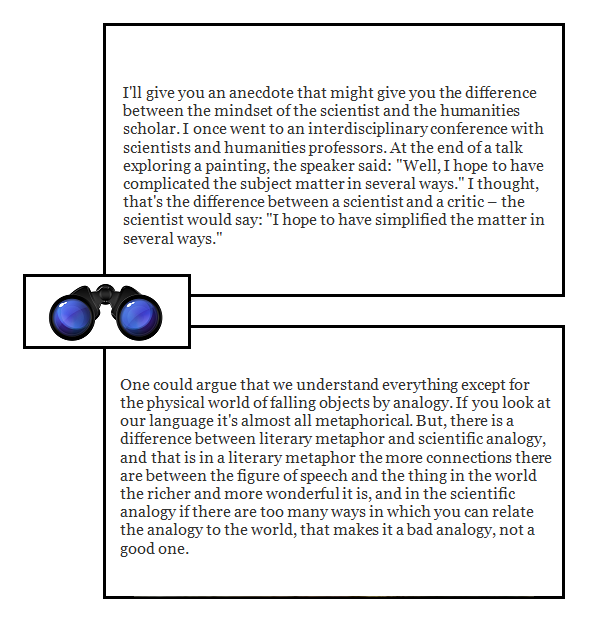
There was a interview with five prominent “science writers” in the Guardian a few days back, titled Science writing: how do you make complex issues accessible and readable? and one of the writers, Steven Pinker, makes two highly interesting observations:

**

There are a couple of things going on here that I’d like to note. One is that without intending to do so specifically, he is in essence formulating a view about a possible, central difference between scientific and religious thinking, since what he says about the humanities in general applies with great specificity to religion and the arts: in both religion and art, the expansive nature of “symbolism” is a key to the experience.

And that in turn prompts me to suggest that perhaps both the arts and religion are geared towards provoking, evoking or invoking an experience — whereas the sciences are geared towards obtaining an understanding.

I’ll have to think about that, and come to some sort of understanding of my own — perhaps expressed via symbolic means.

**

My second point of interest is that there’s an analogy to be made between Pinker’s two remarks: each of them has a form I could portray thus in terms of cause :: effect

science : humanities :: simplicity : complexity

Nobody present — the interviewer, Pinker himself, and four other very bright science writers — picked up on the close correspondence between those two statements at the time. And I find that very interesting.

I find it very interesting because the six of them were more interested in seeing what they could say (of what they already thought) than in saying what they could see (in light of the ongoing, immediate conversation).

I think we all tend to do that — which is why David Bohm‘s approach to dialogue is so important: if brings us to speak more into the moment as it surrounds us, not quite so much from the past as it has informed us.

**

Then there’s the interesting fact that Pinker’s sense of the difference between modes of thought in the humanities and the sciences as expressed in the top quote translates so directly to the difference between uses of analogy in the second — and his fairly emphatic statement:

one could argue that we understand everything except for the physical world of falling objects by analogy.

Analogy is the central device in our mental toolkit, and yet we know far more about trains of logic than we do about analogical leaps. We know so little, in fact, that distinguishing between “literary metaphor” and “scientific analogy” (both of which are based in the recognition of resemblance) on the basis of one looking for multiple, rich connectivity and the other for a single tight connection is something noteworthy enough for Pinker to bother to point it out. It is indeed a provocative and perhaps essential insight. But it is also pretty basic — dividing a field up into significant chunks, the way anthropology got divided into “cultural”, “archaeological”, “linguistic” and “physical anthropology”…

It’s time we learned to understand and use analogic with the same rigor we’ve applied to learning and using logic — and Sembl is just the tool for this.

**

Experience wants to be rich: factual understanding wants to be clear.


Switch to our mobile site