zenpundit.com » 21st century

Archive for the ‘21st century’ Category

Book Review: The Profession by Steven Pressfield

Monday, July 25th, 2011

The Profession by Steven Pressfield

We should begin this review with “Full Disclosure“:

I just finished reading The Profession by Steven Pressfield, which I enjoyed a great deal. Steve sent me an earlier draft doc of the book and I consider Steve a friend. Furthermore, in an extremely gracious gesture, Steve granted me (or at least zenpundit.com) the novelist’s equivalent to a walk-on cameo appearance in his book. Therefore, if you the reader believe that I cannot review this book objectively…well….you are right. It’s not possible 🙂 . Here are some other reviews by Shlok Vaidya, Greyhawk of Mudville Gazette and Kirkus if you want greater impartiality.

Nor am I going to delve into the mechanics of the plot structure and action sequence in The Profession. For one, I think too much of the story in a review of a work of fiction spoils the enjoyment for the group of readers who would be most interested. And you can get the blow by blow elsewhere.

Instead, I would like to draw your attention to how Pressfield has written this novel differently. And why that matters.

There is plenty of action in The Profession and the book really moves. It is violent, but not at a Blood Meridian level of cruelty and the murky political intrigue that surrounds the hero, the mercenary’s mercenary and “pure warrior” Gilbert “Gent” Gentilhomme, is a nice counterpoint to physical combat and technical military details. Many people will enjoy the novel on this level and The Profession would make for an exciting action film. Or perhaps a series of films along the lines of The Bourne Identity or those Tom Clancy movies with Harrison Ford. All well and good. But that is not why The Profession is worth reading – that’s merely why it is fun to read.

What surprised me initially about The Profession was how unlike Killing Rommel it was. Killing Rommel also had war and adventure, but it was a deep study in the character development of Chap, the protagonist, who had enough of a textural, cultural, authenticity as a young gentry class British officer of the WWII period as to make Killing Rommel seem semi-biographical. As a reader, I didn’t much care if Chap and his men succeeded in killing Rommel, only that I would be able to continue to see the story unfold from Chap’s perspective. Many artists believe characters and character interaction are the most important element in a story, from Saul Bellow to Quentin Tarantino. Their stories are captivating even though their narratives are not always particularly logical or centered on a grand conflict.

The Profession is not like that at all. In my view, Pressfield turned his creative energies, his knowledge for military affairs and his formidible ear for history away from character development and toward theme. This difference may or may not explain his own reports of difficulty in wrestling with this novel.

Reaching back to the lessons learned from late Republican Rome, Thucydides, Xenophon and seasoning it liberally with Machiavelli, Pressfield’s 2032 near-future is also jarringly allegorical with America of 2012. Like Rome of the 1st century BC or Athens after it’s defeat in the Peloponnesian War, America in The Profession is strategically paralyzed, politically polarized and teetering on the precipice of decay and decline. These historical inspirations have been mashed up with a dystopian 4GW world, filled with mercenary PMCs like Force Insertion and The Legion, terrorists, drones, tribes, criminal corporations and and a devious and cowardly global financial elite. A future more evenly distributed from the present.

The antagonist against whom the plot is structured is not the story’s nominal villain terrorist, but Gent’s Homeric father-figure, former Lieutenant General James Salter, USMC,  “the crawling man” who was martyred, disgraced, exiled and redeemed as the new master of Force Insertion’s Mideast deployed “armatures” (combined arms divisions) and the book’s geopolitical apex predator, who boasted:

” I was obeying a more ancient law” 

This marks a drastic shift in Pressfield’s use of characters from people existing in themselves with humanistic nuances to their use as philosophical archetypes to better express the theme, more like the technique of Fyodor Dostoyevskii, Victor Hugo or Ayn Rand.

The interplay between the kinetic Gent and the increasingly totemic Salter elucidates a theme that is creating tectonic political shifts in America and the world; a theme which is expressed explicitly to Gent at one point by the ex-Secretary of State, Juan-Estebaun Echevarria. The ex-Secretary plays Cicero to Salter’s Caesar, but Gent is ultimately cast in the role of a very different Roman by the manipulative Salter. Pressfield, in honing the various characters, including AD, Maggie Cole, El-Masri and others, is also drawing on Alcibiades, Critias, Livy, Homer, Robert Graves, Joseph Conrad and the pattern of mythic epics. Salter is at once a pagan chieftain and a philosopher-king, a civilized Kurtz or a barbaric John Galt, who after continuous dissembling, in a brutally honest speech, gives his followers, his enemies, Gent and even himself, no opportunity to morally evade what he has become or his reasons for what he proposes to do. A speech that resonates with the negative trends we see today.

The Profession is a cautionary tale outfitted in kevlar.

Oslo and Utoya — short version

Saturday, July 23rd, 2011

[ by Charles Cameron — leads related to Anders Breivik, suspected in Oslo bombings / Utoya shootings ]

.
I may follow this post up with a longer and more detailed version, time permitting – but for now, this presents the lines of inquiry I am following.

The alleged Oslo bomber and Utoya Island shooter, with 90+ deaths to his credit, was not a Muslim jihadist, as many at first suspected, and as at least one Islamist-identified group claimed. Anders Behring Breivik was a Norwegian with strong anti-Islamic views.

Large gobbits of his posts on the Norwegian blog site “document.no” are now available for serious study: there’s an English translation (possibly mechanical) on ScribD and a better one appearing in sections on Leo’s Passagen blog.

Juan Cole titled his blog comment, White Christian Fundamentalist Terrorism in Norway, referencing a Norwegian police spokesman who called Breivik a “Christian fundamentalist”. Breivik was not a Fundamentalist. He was a Protestant – but one who hoped individual Protestants would gradually join the Catholic Church, and one who was himself (paradoxically) active in Freemasonry. But his religious views, as expressed in his document.no postings, were peripheral to his main concerns.

He was an entrepreneur, a millionaire, and a political “conservative” who claimed to be anti-racist. His major political emphasis seems to have been on resisting the “Islamization” of Europe, which he regarded as a form of “demographic warfare” waged by Islamists with passive facilitation by the “multikulti” or multiculturalists. In one of his posts, he suggested the formation of a “cultural Euro-version of a Tea Party movement”.

He was also the owner of a successful farming enterprise, with a reported 700 employees — hence his ability to obtain large quantities (6 tons) of fertilizer of a kind useful in making bombs.

According to the Swedish “Expo” site, he was affiliated with a Nazi web forum.

Two other possible sources for information:

This is not standard evangelical behavior, this is not standard white, male, or white male behavior, this is not standard blogger behavior, this is not standard Norwegian behavior, this is not standard gamer behavior, this is not standard right wing behavior — but it is all too tragically human, this behavior…

There’s a lot to untangle here; this is one complex individual, and we’d do well to get a detailed and nuanced understanding of the various drivers in play…

Wylie’s Military Strategy

Saturday, July 23rd, 2011

 by J. Scott Shipman

Wylie

Military Strategy, by Rear Admiral J.C. Wylie, Jr., USN (1911-1993)

This is a very brief review and recommendation for a book that I discovered recently. Admiral Wylie’s short Military Strategy (about 85 pages in the original edition) was published in 1967, but written in the mid-fifties while Wylie was “at sea in a single-screw low-speed amphibious cargo ship.” He remarked these ships were “not demanding  of a captain’s attention as is, for instance, a destroyer.”My copy was published in 1989 by the  Naval Institute Press  as part of their Classics of Seapower series and has an excellent preface by John B. Hattendorf that will give those unfamiliar with Wylie’s life experience a good foundation. This copy also has a postscript written by Wylie “twenty years later” and three related essays published previously in Proceedings magazine.

Given Military Strategy’s brevity, I’ll resist the urge to provide long quotes. Wylie and an associate’s search for articulating the relevance of the navy in the never-ending budget battles brought them in contact with the famed mathematician John von Neumann of Princeton. Wylie used a paraphrase of von Neumann as a starting point: “With respect to strategy as a subject of study, its intellectual framework is not clearly outlined, and its vocabulary is almost nonexistent. These two primary tasks are badly in need of doing…” He sets out to do just that and does a nice job.

Wylie defines strategy as: “A plan of action designed in order to achieve some end; a purpose together with a system of measures for its accomplishment.” He discusses the military mind and strategy, and how often the military focuses on principles to the exclusion of real strategy. Wylie outlines methods of studying strategy that are simple and well thought-out. Wylie makes a compelling case for a general theory of strategy. He says: “A theory is simply an idea designed to account for actuality or to account for what the theorist thinks will come to pass in actuality. It is orderly rationalization of real or presumed patterns of events.” Further, he continually stresses the importance of assumptions being based in reality, and not wishful thinking or the last war/battle.

His chapter on existing theories is worth the price of the book. He provides a type of Cliff’s Notes overview of the four theories he sees as core: the maritime, the air, the continental, and the Maoist. Of the last, he masterfully lifted sections from Mao’s On Guerilla Warfare, Che Guevera on Guerilla Warfare, and Vo Ngugen Giap’s People’s War People’s Army. He observed of the later, “these books are not only theory, the portray a hard reality of contemporary warfare.” To our people in uniform, in particular, unfamiliar with these books, Wylie provides an accessible and informative introduction to the type of war being waged by Islamic jihadists and how they attempt shape the battle field.

He develops a brilliant point that destruction doesn’t necessarily translate into control, and that often destruction is driven more by emotion than strategy.

Wylie goes on to provide a general theory of strategy that, using his words, has “substance and validity, and practicality.” As Seydlitz89 said in a recent comment thread here: “Wylie is amazing.  So many ideas in such a small book!  He misread Clausewitz and overrated Liddell Hart – which are probably connected, but overall?  He comes up with some very basic ideas about strategic theory which are ever sooooo useful.  I’ve re-read his small book several times and always come up with something that either I’d forgotten or that I had missed earlier.  Wylie’s basic approach to theory is as a practitioner, not as an academic, much like Clausewitz before him.”

Indeed, Wylie provides a nice scaffold for any type of strategy, military or business. For me his approach was refreshing in a genre where, more often than not, dogma and ego walk hand-in-hand.  Time and again, he offers that his ideas may be wrong and encourages readers to think and wrestle with the concepts provided. Wylie writes in his postscript: “As far as I know, no one as ever paid attention to it [the book]. I don’t know whether this is because it is so clear and obviously valid that no one needs to, or because it is of no use at all. I suspect it could be the latter, but I really do not know.”

This little book comes with my highest recommendation. If you’re in uniform and just getting started with strategic concepts/thinking, this is an excellent place to start.

Interesting referenced titles:

Military Concepts and Philosophy, Henry E. Eccles 

The Military Intellectuals in Britain, 1918-1939, Robin Higham 

An Introduction to Strategy, General Andre Beaufre 

Theory of Games and Economic Behavior, John von Neumann 

Strategy in Poker, Business and War, John McDonald 

Augmented Reality Emerging on Major Platforms

Thursday, July 21st, 2011

This was pretty cool, from Lewis Shepherd’s blog, Shepherd’s Pi:

Virtual recipe stirs in Apple iPad, Microsoft Kinect

Who says Apple and Microsoft can’t work together?  They certainly do, at least when it involves the ingenuity of their users, the more inventive of whom use technologies from both companies (and others).

Here’s a neat example, “a just-for-fun experiment from the guys at Laan Labs” where they whip up a neat Augmented Reality recipe: take one iPad, one Kinect, and stir.


Some technical detail from the Brothers Laan, the engineers who did the work:

We used the String Augmented Reality SDK to display real-time 3d video+audio recorded from the Kinect. Libfreenect from http://openkinect.org/ project was used for recording the data coming from the Kinect. A textured mesh was created from the calibrated depth+rgb data for each frame and played back in real-time. A simple depth cutoff allowed us isolate the person in the video from the walls and other objects. Using the String SDK, we projected it back onto a printed image marker in the real world.” – source, Laan Labs blog.

Shepherd has more on the technology here.

If AR is doable on an iPad fast and dirty by wizardly geeks then Apps for the casual technoprimitives cannot be long off.

Plus ça change I

Wednesday, July 20th, 2011

[ by Charles Cameron — backstory of Google+ ]

.

dq-circles.jpg

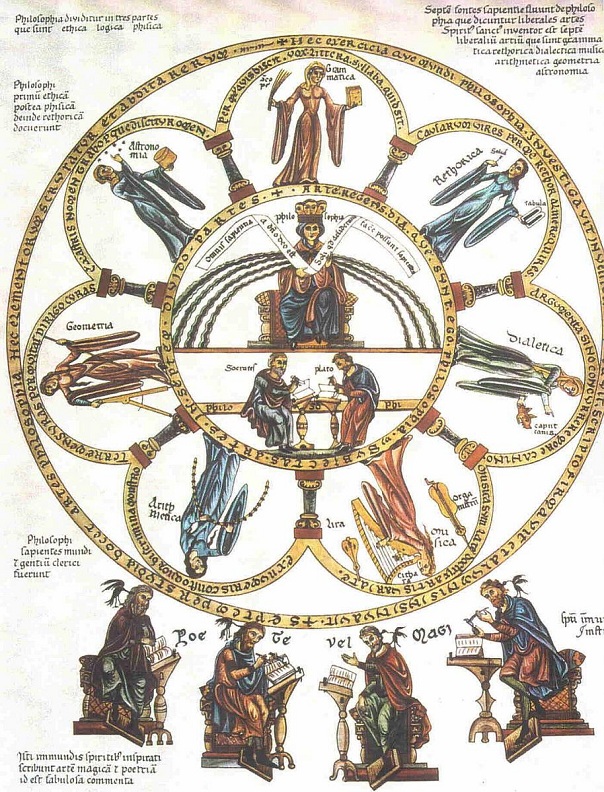
Herrad von Landsberg seems to have corralled seven of his best friends — the Septem Artes Liberales— into his “Hortus deliciarum” on Google+ back in 1180.

Here’s a larger version, for your viewing convenience:liberal-arts-med.jpg


Switch to our mobile site