zenpundit.com » 19th century

Archive for the ‘19th century’ Category

Inventing Grand Strategy and Teaching Command—currently reading

Tuesday, April 24th, 2012

[by J. Scott Shipman]

Inventing Grand Strategy and Teaching Command, by Jon Tetsuro Sumida

This monograph piqued my interest several weeks ago, as I consider whether or not to re-read Alfred Thayer Mahan‘s classic The Influence of Sea Power on History, 1660-1783. I’m about twenty years removed from my original reading, and honestly wasn’t ready for it when I did read it, so much of what I remember remains a blur at best.

Professor Sumida leads with a Preface entitled, Musical Performance, Zen Enlightenment, and Naval Command. Sumida draws parallels between the performance of music and the artistry inherent in sound leadership during war. Boyd’s ideas with respect to harmony came to mind. Sumida also draws parallels between Mahan’s ideas and Zen and offers:

“Mahan’s writing about the art and science of command resembles Zen in three major respects — a pedagogy that attempts to teach that which cannot be directly described in words, the absence of doctrinal ends, and a recognition of the limitations of ratiocination as the basis of action under conditions of rapid and unpredictable change.”

After finishing the first chapter of Professor Sumida’s work, I was struck by how relevant Mahan’s ideas with respect to leadership development seem to be in harmony with ideas advanced of late regarding the need for disruptive thinkers (this links to Mark’s excellent summary). Sumida portrays Mahan as man convinced of the need for naval executive education that goes beyond the scientific and mechanical, and focused rather on the “deep knowledge” and “truths” found only in history (I agree). He writes:

Mahan “was convinced that constant and rapid mechanical innovation had upset planning and education to the detriment of command confidence and authority. He feared the consequences of a navy led by indecisive men, bred by bureaucratic routine—or worse, subservience to corrupt civilian officialdom—to follow rules or act politically.”

At only 116 pages, Sumida’s monograph would normally be a quick read, but I plan to savor every word—and probably read more Mahan.

More to come.

Cross posted at To Be or To Do.

America in Arms, John McAuley Palmer, a review

Tuesday, February 28th, 2012

[by J. Scott Shipman]

America in Arms, John McAuley Palmer (1870-1955)

Thanks to our blog friend Joseph Fouche, I discovered Brigadier General Palmer’s excellent history of how America has organized the army both in peacetime and in times of war. Fouche introduced Palmer in an excellent piece called, How Did We Get Here.

The Prologue to this excellent book begins:

When Washington became President, he had two main planks in his administration platform. His first plank called for a sound financial system; his second plank called for a sound national defense system.

Thanks to Alexander Hamilton, his Secretary of the Treasury, his first plank was installed before the end of his first administration. But it was not until 1920, more than one hundred and thirty years later, that Congress established a modern adaptation of his military organization. And it was not until 1940 that Congress completed the Washington structure by accepting the principle of compulsory military training and service in time of peace.

Thus begins one of the best written books I’ve read since Rear Admiral J.C. Wylie’s Military Strategy. While the authors cover different topics, both write in crisp, efficient prose and say what they mean the first time. One won’t find much fluff or nuance in either book; I like that.

Palmer traces the history of how America has organized to fight wars, and more often than not, the “how” is not pretty (we usually play catch-up in the early days of conflict). Palmer’s purpose in writing “this little book” was “to tell how Washington arrived at his military philosophy: how and why he was unable to persuade his countrymen to accept it; how their rejection of his advice affected their subsequent history; and finally how, after a century and a half their descendants have have been impelled to return to his guidance.” From the period of 1783 through 1911, Palmer’s book is history. Following 1911, Palmer provides “first-hand experience of the events described.”

Palmer begins with an early (pre-Constitution) inquiry to Washington by Congress on his views on a proper military policy for the new nation. Washington shopped the query around to Generals Steuben, Knox, Huntington, Pickering, Health, Hand and Rufus Putnam. Their responses were strikingly similar; “a well-regulated militia” would be sufficient for national defense. They agreed on a small regular army to patrol the Indian frontier and other “special duties” that could not be performed by citizen soldiers.

Palmer discovered Washington’s “Sentiment on a Peace Establishment” when researching his Washington, Lincoln, Wilson: Three War Statesmen. Washington’s treatise was pretty straightforward:

A Peace Establishment for the United States of America may in my opinion be classed under four different heads Vizt:

First. A regular and standing force, for Garrisoning West Point and such other Posts upon our Northern, Western, and Southern Frontiers, as shall be deemed necessary to awe the Indians, protect our Trade, prevent the encroachment of our Neighbours of Canada and the Florida’s, and guard us at least from surprizes; Also for security of our Magazines.

Secondly. A well organized Militia; upon a Plan that will pervade all the States, and introduce similarity in their Establishment Manoeuvres, Exercise and Arms.

Thirdly. Establishing Arsenals of all kinds of Military Stores.

Fourthly. Accademies, one or more for the Instruction of the Art Military; particularly those Branches of it which respect Engineering and Artillery, which are highly essential, and the knowledge of which, is most difficult to obtain. Also Manufactories of some kinds of Military Stores.

(Would highly recommend reading the entire piece.)

Palmer accounts for Washington’s seeming contradiction on the issue of militias, and points out that Washington was specific in his low opinion of an “ill-organized militia” (one based on short enlistments and political connections influencing the selection of leaders—a problem which endured in Lincoln’s Union Army). Washington favored a “well-organized militia” with the Swiss model ranking high in his esteem. Of the generals providing Washington with their thoughts, Palmer writes that Steuben and Knox were largely in agreement with Washington’s ideas. Both were in general agreement on the organization of small infantry divisions, or legions divided between New England, the Mid-Atlantic, and the South Atlantic. Under the direction of Congress, in 1786, General Knox (then Secretary of War) completed a Plan for a General Arrangement of the Militia of the United States.

The following plan is formed on these general principles.
1st.
That it is the indispensible duty of every nation to establish all necessary institutions for its own perfection and defence.
2’ndly,
That it is a capital security to a free State for the great body of the people to possess a competent knowledge of the military art.
3’dly,
That this knowledge cannot be attained in the present state of society but by establishing adequate institutions for the military education of youth— And that the knowledge acquired therein should be diffused throughout the community by the principles of rotation.
4’thly
That every man of the proper age, and ability of body is firmly bound by the social compact to perform personally his proportion of military duty for the defence of the State.
5’thly;
That all men of the legal military age should be armed, enrolled and held responsible for different degrees of military service.
And 6thly,
That agreeably to the Constitution the United States are to provide for organizing, arming and disciplining the Militia, and for governing such part of them as may be employed in the service of the United States, reserving to the States respectively the appointment of the officers, and the authority of training the Militia according to the discipline prescribed by Congress.

Congress did not enact the Knox plan as the United States, still under the Articles of Confederation was “insolvent” and unable to act. Palmer estimated that had Knox’s plan been adopted in 1786, “it is my estimate that the advanced corps would have numbered 60,000 men at the end of three years.” Those numbers would grow progressively as the population increased, so that at the outbreak of the Civil War, “the first line of the civilian army would have numbered about 500,000 men. ” By WWI in 1914, that number would have been about 1.8 million.

As president, Washington’s military policy was closely aligned to the Knox plan (Washington amended the original). The change involved a reduction in the required training for the advanced corp—then, as now, costs were the motivating factor for the reduction, but Washington wanted to get a national infrastructure approved. As mentioned previously, the Swiss model factored heavily among Washington and his general’s thinking—with the essential difference between the Swiss plan and Knox being the “distribution of training time.”

The first Congress was reluctant to embrace Washington’s ideas and instead passed the “notorius Militia Act of 1792.” Palmer said this Act made “our military system worse than before the bill was introduced. The old militia organization [the “ill-organized” that Washington deplored] with its phony regiments and divisions now had Federal sanction and was made uniformly bad throughout the nation.”

Washington was defeated in his efforts to develop and deploy a national militia. Washington in warning of foreign entanglements in his Farewell Adress also reminded us of the realities nations must shoulder:

If we remain one People, under an efficient government, the period is not far off, when we may defy material injury from external annoyance; when we may take such an attitude as will cause the neutrality we may at any time resolve upon to be scrupulously respected; when belligerent nations, under the impossibility of making acquisitions upon us, will not lightly hazard the giving us provocation; when we may choose peace or War, as our interest guided by justice shall Counsel…Taking care always to keep ourselves, by suitable establishments, on a respectably defensive posture, we may safely trust to temporary alliances for extraordinary emergencies.

Palmer covers the efforts of Jefferson, and then, Madison to develop a cogent national military organization. The War of 1812 illustrated the the dangers of “the ill-organized militia” as it was, as organized the militias were found wanting. A new force emerged from the War of 1812 and that new force was the regular army. Palmer concludes this chapter: “The history of our modern regular army really begins with the War of 1812. Since then it has never failed to give a good account of itself. It won the pride and gratitude of the American people just when the failure of the national militia had filled them with contempt and humiliation.”

“A new military gospel” was formed after the War of 1812, and the War Department became the new headquarters of the regular army. Madison’s successors had to start over as the archives (including Washington’s Sentiments) were destroyed when the British burned the capitol in 1814. John C. Calhoun, Secretary of War under Monroe, advocated an “expansible standing army”—the antithesis of Washington’s ideas. Palmer said, this “expansible-standing-army” plan hampered American plans for preparedness for more than a century…[through 1941] and…is not quite dead.” The problem was “how” to expand this force in time of war.

As Palmer traces the military policy from Florida to Mexico, and the Civil War, the same problems recurred: the standing army was stretched thin at the outset of conflict and ill-equipped to train recruits provided by the Several States. Added to this was the problems of short enlistments, that in some cases left commanders waiting to pursue the enemy while waiting for fresh troops (Battle of the City of Mexico).

After the Civil War Congress took action to attempt a solution to the broken military organization problem. The Burnside Commission was formed with veterans of the Civil War, but without Washington’s wisdom to guide them. Palmer recounts the accident of history where General Emory Upton had just finished reviewing Washington’s military writings—but missed Sentiments (referenced in a footnote). Upton missed the “key” to Washington’s thinking on an “efficient citizen army.” It appears Upton took the Washington he had read and connected to the expansible standing army idea—and missed Washington’s true intent.

Elihu Root became Secretary of War in 1899 and traced our military faults in the Spanish American war to “defective organization.” The defective organization, in Root’s estimation was this paragraph in Army regulations: “The military establishment is under orders of the Commanding General of the army in that which pertains to its discipline and control. The fiscal affairs of the army are conducted by the Secretary of War through the several Staff Departments”—dual control. While he was resisted, in 1903 the office of the chief of staff was created. Palmer calls this the first of Root’s “great reforms.” He followed by formalizing planning and organizing “the American war army.” A General Staff college was formed to educate those who would serve in the newly reorganized Army. Root and his use of Upton’s work made an indelible mark on the army, and in many ways made the army more professional and able. On the downside, I sense Root provided the shell of what is now the massive military bureaucracy.

I’ll conclude my chronological review here, as the author enters the narrative in first person while signed to Henry L. Stimson, Secretary of War. Suffice it to say, Palmer’s recounting of “how” we have traditionally organized our army is a very informative read. I have seen many “reading lists” of generals and leaders, but haven’t seen this old book on any of those lists—it should be. The “tribal” disconnect between the regular army and the National Guard is explained (not in so many words, mind you), and Palmer’s recounting of the dangerous power of doctrine and dogma is worth the read. The writer of the biblical book Ecclesiastes said, “There is nothing new under the sun.” In America in Arms, military personnel and general reader will find that many of today’s challenges have been challenges since our Founding.

This book has my highest recommendation—especially if you are a serving army officer or have interest in American military organization. This is a great old book. Get a copy; Palmer has much to teach us.

Postscript: Another friend of this blog, Lexington Green, recommended Citizen and Soldiers: The Dilemmas of Military Service, by Eliot Cohen, in the comments to the same post posted at chicagoboyz.net. On Lex’s recommendation, I ordered and have Cohen’s book, but have not yet read.

Second Postscript: I purchased America in Arms from a used book dealer on abe.com, and was fortunate to get a first edition hardback (ex-library book) in excellent condition. This particular title spent time on the shelves of The Catlin Memorial Free Library, Springfield Center, NY, and was placed there by the Arthur Larned Ryerson Memorial; Mr. Ryerson perished on the Titanic. In addition, this particular edition was also published by Yale by the Foundation established in the memory of Philip Hamilton McMillan (check the wife and children entry), Yale Class of 1894. Quite a pedigree for any book; a book that will remain safely in my collection. (the photo above is a snap-shot of my copy)

Justice, Coercion, Legitimacy, State-Building and Afghanistan

Tuesday, January 17th, 2012

Discussion has been emerging in the foreign policy blogosphere of   late  regarding sovereignty and the other day, Afghanistan scholar Antonio Giustozzi opined on coercion, a necessary tool of a state seeking to wield a monopoly of force.

Theory is good and the discussion is an important one with implications for US foreign policy, but it helps when debate is informed by empirical examples from practitioners.  Quesopaper, a blog by  someone out in the field  in Afghanistan has been dormant for a while, but sprang alive again with a timely post:

Rule of Law, The Afghan Springer Show 

….Rule of Law is one of the key aspects to “fixing” Afghanistan. When the Taliban dominated the country, they controlled the “courts.” As Taliban influence waned, the US and partner nations have sought to create a more traditional court system. I can’t speak intelligently on why “WE” decided to create a more western form of law in Afghanistan, but I can say, it’s not the correct approach.

I work in a remote district. It’s over an hour to the main provincial (think state) government center. The difference between the two places is about as extreme as possible. The villages, even the district center (think country govt) lack ANY essential services. There are no plumbing systems, no electricity, no garbage service…nothing. Yet, the people here survive; and dare I say? Thrive.

Like most farming folks, the people here like to be left alone. The people appreciate the Govt–Government of the Islamic Republic of Afghanistan aka “GIRoA”–but they only want so much help. Rule of Law doesn’t fit into their needs.

So, how do rural locals settle disputes?

I just recently worked with a local governor as he negotiated the resolution of a 25 year dispute. Dispute doesn’t really describe what happened…feud is more appropriate. Each side had multiple murders, one family had 1300 fig trees destroyed. Decades of money in dispute. The feud was complicated enough that the Taliban failed to resolve the issue in nearly seven years of negotiations. Negotiations require buy-in from many parties…I could go on about this, but I doubt I can make it any clearer…

Land disputes are among the thorniest local civil society issues in Afghanistan, and one where the generally corrupt and inept Karzai regime draws a particularly poor comparison with the Taliban insurgency’s ability to provide “rough justice” where the richer, more influential party to the dispute does not automatically win through bribery. Land claims are blood issues in peasant-agrarian societies in general and all the worse in honor cultures that tolerate vendettas – that the brutal Taliban could not force a settlement in this case, or did not dare to try – speaks volumes.

….Finally, our district (county govt) governor is called upon to start the process of reconciliation. This BTW is MAJOR progress for the legitimacy of GIRoA. It means the people trust this man to handle this dispute. It might become national news (for Afghanistan) though you will never hear this story on any US network or .com site (except quesopaper.com). After weeks of massaging each side, pulling out their story, commitments (commitment to settle is vital in these things) and “evidence.”

An aside about evidence…in a society that is mostly verbal and illiterate, nearly anything written can become something that it is not…WTF are you talking about Pietro? What I mean is, give someone who can’t read a document. That paper is written in a foreign language, with foreign letters. Tell him its a deed to a piece of land…wait 35 years. Now, tell that man’s grandson that the land he’s been farming for 10 years; that his family has worked for generations, isn’t actually his.

Now he has nothing; he can’t provide for his family. Tell him, his paper is a receipt for a Persian rug, not a deed…explain that he owes the real land owner for the use of that property and revenues generated. Let me know how that goes…if you smell cordite it probably didn’t go to well.

For very poor people who live at the margins of subsistence, the stakes could not be higher, which can make rolling the dice on private violence attractive (this is also why land reform programs are only a short term stopgap in economic development and reform. Agrarian population almost always exceeds arable land and as the plots get smaller, they are less productive).  Dying on your feet with a weapon in hand looks a lot more honorable to a hard-pressed farmer than watching your children waste away from starvation as the other villagers gossip about your plight.

A state with legitimate authority can preempt or suppress such private violence, but is also expected to solve the problem.

….Back to our story…The governor calls in Sharia/Islamic law experts and elders from both tribes and other community elders. Mix that group into a bunch of small rooms and start shifting groups from room to room…hours of discussions (which looks like arguing to me). Don’t forget, this thing hasn’t been settled before, it’s serious business, and here serious business is settled with an AK. At anytime the whole ordeal can melt into violence.

Success is fleeting. I have a gun, no fooling…I’m armed….

Go to quesopaper to find out what happened next. 🙂

Part of the problem is, as quesopaper indicates, our Western framework. We began experimenting with rule of law to settle property claims and commons rights starting, oh, in 14th century England with land enclosures and we did not really finish for good until after Reconstruction in the very late 19th century. That’s 500 years for the “Rule of Law” as we understand it to become the standard for 100 % of the population, 100% of the time.

And along the way, there was blood. Rivers of it. From the Highlands of Scotland, to the piney woods upcountry of Appalachia to the Black Hills and the great Western Range Wars. The gavel of the judge had to be preceded by the soldier’s rifle, the settler’s six shooter, the rebel’s musket and knives used in the dead of night.

Are Afghans in far rural villages closer to a Manhattan attorney or an English tenant whose access to the pasture has been closed off by his noble lord against all custom and ancient right? What quesopaer is seeing is “state building” from scratch, from the bottom up. Slow, painful, difficult to be certain, but more likely to be durable than imported abstractions imposed from the top down.

We are leaving Afghanistan, it is clear. Any state that we leave behind that can resist the Taliban must be able to stand behind and enforce a rule of law as Afghans understand and accept it.


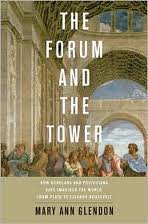
The Forum and The Tower, a review

Sunday, November 20th, 2011

[by J. Scott Shipman]

the-forum-and-the-tower.jpeg

The Forum and The Tower by Mary Ann Glendon

“The relationship between politics and the academy has been marked by mutual fascination and wariness since the time of Plato.”

The first sentence on the flap of the dust jacket of this very good and informative small book. Professor Glendon, who is the Learned Hand Professor of Law at Harvard Law school, set out to write a book for her students that would answer ageless questions such as:

“Is politics such a dirty business, or are conditions so unfavorable, that couldn’t make a difference? What kinds of compromises can one make for the sake of getting and keeping a position from which one might be able to have influence on the course of events? What kinds of compromises can one make for the sake of achieving a higher political goal? When does prudent accommodation become pandering? When should one speak truth to power no matter what the risk, and when is it acceptable, as Burke put it, to speak the truth with measure that one may speak it longer? When does one reach the point at which one concludes, as Plato finally did, that circumstances are so unfavorable that only the reasonable course of action is to “keep quiet and offer up prayers for one’s own welfare and for that of one’s country”?”

Professor Glendon answers these questions and more through brief examinations of the lives and works of some of history’s most important figures:

Plato

Cicero

Justinian, Tribonian, and Irnerius

Machiavelli

Thomas Hobbs and Edward Coke

John Locke

Jean-Jacques Rousseau

Edmund Burke

Tocqueville

Max Weber

Oliver Wendell Holmes

Eleanor Roosevelt and Charles Malik

All in all, I believe Professor Glendon has provided a uniquely valuable book to help her students and other readers to answers those questions. In short but focused chapters of about 20 pages each, she provides mini-biographies of the subjects above and how they answered the some of the questions both in their lives and in their philosophy. Some of her subjects were thinkers lacking the abilities for the public square, Plato, for instance, but were enormously influential just the same. Rare were those like Cicero and Burke who were equally comfortable in the political arena or the academy.

My favorite chapters were on Plato, Cicero, Machiavelli, and Burke—mostly because I’ve read a respectable amount of their work. That said, I have not read Plato’s The Laws—and Professor Glendon suggests it is much better than The Republic—which I have read and did not much enjoy. Not surprisingly, The Laws will be on my list for this winter.

The inclusion of Eleanor Roosevelt and Charles Malik was something of a surprise, but Professor Glendon is weaving a sub-story through each chapter and illustrating how Roosevelt and Malik’s work on the Universal Declaration of Human Rights was something of culmination and extension of over 2,000 years of thinking and political action—not in the context of human progress towards a utopia of sorts, which she wisely rejects,  but rather a reflection the common threads of political thought throughout history.

While this is not criticism, I would have liked to have seen a chapter on John Adams and Thomas Jefferson, and a chapter on Karl Marx, whom she frequently mentions.

This is a book that is approachable and readable, and in our tumultuous domestic and global political climate, important.

She closes with this illuminating sentence:

“If one message emerges from the stories collected here, it is that just because one does not see the results of one’s best efforts in one’s own lifetime does not mean those efforts were in vain.”

Professor Glendon is to be commended for a job “well done!”

The book comes with my highest recommendation and may be the best book I’ve read this calendar year. Add this book to your must read list.

.
Referenced works you may find of interest (some of these works are out of print and expensive—for simplicity I’ve used Amazon links): 

The Laws of Plato, translated by Thomas Pangle

Cicero: The Life and Times of Rome’s Greatest Politician, by Anthony Everitt

Cicero, A Portrait, by Elizabeth Rawson (Glendon praised this book.)

A Panorama of the World’s Legal Systems, John Henry Wigmore

The Life of Nicolo Machiavelli, Roberto Ridolfi

The Prince, translated by Harvy Mansfield

Machiavelli, by Quentin Skinner

The Lion and the Throne, Catherine Drinker Bowen

The Spirit of Modern Republicanism, by Thomas Pangle

Statesmanship and Party Government, by Harvy Mansfield

The Great Melody, A Thematic biography of Edmund Burke, by Conor Cruise O’Brien (I read this wonderful book in 1992 when it was released: highly recommended.)

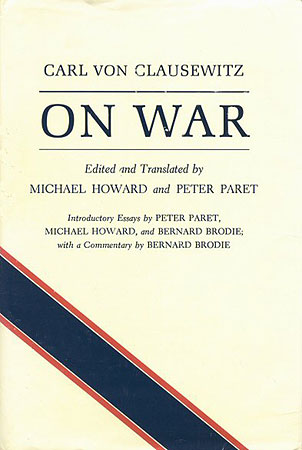
On War as an Unfinished Symphony

Thursday, November 3rd, 2011

cvcforming.jpg

On War by Carl von Clausewitz has been the most influential book on strategy and war of all time.

We can say this because On War is the standard by which all other works of strategy are measured and only a few compared – notably Sun Tzu’s Art of War and The Peloponnesian War by Thucydides. The odd thing is that we can say this despite the fact that On War is more frequently shelved, cited or understood secondhand rather than read, even by military professionals. And furthermore, within the narrow demographic that reads Clausewitz seriously and critically, there can be heated dispute over what he meant, due to the difficulty of the text. Then there are the secondary effects, historical and military, of Clausewitz having been misunderstood, forgotten, ignored or at times, his strategic philosphy consciously rejected.

The shadow cast by On War is all the more remarkable given it’s circumstances of publication. Clausewitz died in 1831, at fifty-one, of cholera, having finally risen to a military post his talents merited. He had been writing On War since 1816 and it was far from completed or refined to his satisfaction and it is highly unlikely, in my view, that Clausewitz would have consented to it’s publication in the condition in which he left it. His determined and intellectually formidible widow, Marie von Clausewitz, further shaped the manuscript of On War, guided by her intimate knowledge of her husband’s ideas and was likely the best editor Clausewitz could have posthumously had.


Nevertheless, to my mind On War remains a magnificent unfinished symphony.

What would On War have looked like if Clausewitz had lived another twenty-five or thirty some years? Assuming continued good health, Clausewitz would have seen, perhaps commanded in, the First Schleswig War and at least studied the Crimean War from afar. He would have had another quarter-century of reading and mature reflection on his subject. Clausewitz, who had a keen understanding of history, would have also witnessed the grand European upheaval of liberal revolution in 1848 that rocked the Hohenzollern monarchy to it’s core. What new insights might Clausewitz have gleaned or expanded upon? Would his later chapters On War have evolved to equal the first?

Having outlived Marie (who died in 1836), would Clausewitz have become a deeply changed man?

What I find it difficult to believe is that Clausewitz, with his creatively driven and philosophically exacting mind,  would have been content to let the manuscript of On War rest where it stood in 1831. Or that we read today what Carl von Clausewitz ultimately intended.


Switch to our mobile site