Hammes – Who Participates in War?
Thursday, April 29th, 2010
From the Strategy Conference…..
From the Strategy Conference…..
From the Strategy Conference…….
A couple of internet amigos who are hard-core Clausewitzians have put pen to paper of late ( or keys to board):
Wilf Owen at SWJ Blog:
The subject of this article is a broad technical and operational examination of how almost any country on earth can currently gain a viable level of military power by building on the enduring elements of combined arms warfare. These elements are enduring and appeared in the first twenty years of the twentieth century. It is further suggested that skillfully applied this type of capability may enable its user to confront and possibly defeat NATO type expeditionary forces.
A number of popular opinions about the future nature of warfare have created a substantially misleading impression that the skills and equipment required for formation level combined arms capability, such as that possessed by NATO during the cold war is no longer needed, because few potential enemies possess similar peer capability. Thus the object of the article is to show just how simply a peer or near-peer capability can be acquired, and maintained.
Contrary to popular belief, there are many examples of where military action by irregular forces has inflicted battlefield defeats on regular forces. The most famous are the Boer defeats of the British Army during “Black Week” in December 1899 and the Hussite Wars of the 15th Century, where irregular forces, using improvised barricades made of ox wagons (wagenburgs) were able to stand against and defeat the armoured knights of the Holy Roman Empire. In both cases each irregular force was able to generate conventional military force from fairly meager resources. There is nothing novel, new or even complex, in this approach. It is common, enduring and proven.
Wilf, as usual, pulls few rhetorical punches. Read the rest here.
Now for the second piece, which rated a place of honor at Dr. Christopher Bassford’s Clausewitz Homepage (for those readers here whose interests are outside the realm of Clausewitzian strategy or military theory, this is sort of like a parish priest having their Sunday sermon published by the Vatican):
seydlitz89 at Clausewitz.com:
The Clausewitz Roundtable at Chicagoboyz.
My interest in Clausewitz goes back to my childhood when, being very interested in simulated wargames, I bought of copy of On War as a member of the military book club-that is at 12. This was the the old, 19th-Century translation. I found it hard going and gave up about a third of the way through.
It was only about 20 years later, after my service on active duty in the Marine Corps and serving as a US Army intelligence officer in Berlin, that I finally actually read On War, that being the Howard/Paret translation, and realized that there was very much more to the work than I had ever suspected. Being involved in strategic HUMINT collection was the spark that indicated for me the need of strategic theory, and specifically a theory that could be flexible enough to cover all sorts of conflicts, from industrial war to tense relations between otherwise friendly states or other political entities.
….I found out about the Chicagoboyz Clausewitz Roundtable quite by accident. I was doing my usual Google search of “Clausewitz” under “news” when a post at Zen Pundit’s blog popped up. As my comments and the responses show, I was more than eager to contribute.
What resulted was a very interesting mix of views on Clausewitz, some from people who had been familiar with Clausewitz through their military backgrounds or other reasons, as well as intelligent people who simply had picked up the book and started to read. While this roundtable discussion would not be a good introduction to Clausewitz, since a beginning student might be led far astray by some of the comments, the roundtable did produce a wide variety of interesting perspectives and applications that the serious student of Clausewitz should find stimulating. In short, the Chicagoboyz Clausewitz Roundtable reflects both the advantages and disadvantages of using the Internet as a forum for dialogue, as an attempt at establishing a dialectic. The weaknesses would include the nature of blog posting in general, which requires a serious proofreading effort after the fact in spite of the best intentions of the poster.
Read the rest here ( seydlitz89 gives a nice nod in his essay to the moving spirit behind the roundtable, Lexington Green)
I’ve participated in and helped organize quite a few online roundtables and Think Tank 2.0 events, and while all of them were successful and had their own zeitgeist, I can safely say that The Clausewitz Roundtable was the best.
Andrew Exum said the Surge succeeded. Dr. Bernard Finel says “prove it“.
From Abu Muquwama:
Just Admit It: The Surge Worked
….We can argue about how many other factors aside from U.S. diplomatic and military operations led to the stunning drop in violence in 2007. There was a civil war in 2005 and 2006, tribes from al-Anbar “flipped” in 2006, and Muqtada al-Sadr decided to keep his troops out of the fight for reasons that are still not entirely clear. Those are just three factors which might not have had anything to do with U.S. operations. But there can be no denying that a space has indeed been created for a more or less peaceful political process to take place. Acts of heinous violence still take place in Baghdad, but so too does a relatively peaceful political process.
From BernardFinel.com:
….Violence was a problem for Iraqi civilians and for the U.S. military. Reducing violence has unquestionably served humanitarian purposes in Iraq and has also saved American lives. But that has nothing to do with “conceptual space” or the broader “success” of the surge.
I mean, come on, if you’re going to write a post that essential expects to settle a debate like this one, snark and assertions much be balanced with rigorous analysis. But Exum doesn’t demonstrate any real understanding of the dynamics of violence in civil conflicts.
My suggestion is that you first read each gentleman’s posts in their entirety.
The first part of the dispute would be what is the standard of “success” that we are going to use to evaluate “the Surge”. I’m not certain that Exum and Finel, both of whom are experts in areas of national security and defense, would easily arrive at a consensus as to what that standard of measurement would be. Perhaps if they sat across from one another at a table and went back and forth for an hour or so. Or perhaps not. I have even less confidence that folks whose interests are primarily “gotcha” type partisan political point-scoring on the internet, rather than defense or foreign policy, could agree on a standard. Actually, I think people of that type would go to great lengths to avoid doing so but without agreement on a standard or standards the discussion degenerates into people shouting past one another.
In my view, “the Surge” was as much about domestic political requirements of the Bush administration after November 2006 as it was about the situation on the ground in Iraq. In my humble opinion, COIN was a better operational paradigm that what we had been doing previously in Iraq under Rumsfeld and Bremer, but the Bush administration accepted that change in military policy only out of desperation, as a life preserver. That isn’t either good or bad, it simply means that measuring the Surge is probably multidimensional and the importance of particular aspects depends on who you are. An Iraqi shopkeeper or insurgent has a different view from a USMC colonel or a blogger-political operative like Markos Moulitsas Zúñiga. Ultimately, the standard selected involves a level of arbitrary judgment. I can say the Surge was a success because the US was not forced to execute a fighting withdrawal from Iraq as some, like William Lind, was likely to happen but that’s probably not a narrow enough standard to measure the Surge fairly.
The second part of the dispute involves methodological validity, or “rigor” in making the evaluation, which was raised by Dr. Finel. I agree with Finel that in intellectual debate, rigor is a good thing. Generally in academia, where social scientists frequently suffer from a bad case of “physics envy”, this means unleashing the quants to build a mathematical model to isolate the hypothetical effects of a particular variable. I freely admit that I am not certain how this could be done in a situation as complex as the Iraqi insurgency-counterinsurgency in 2007 and still retain enough reliability to relate to reality. The act of isolating one variable is itself a gross distortion of the reality of war. There would have to be some kind of reasonable combination of quantitative and qualitative methods here to construct an argument that is comprehensive, rigorous and valid. I think Bernard should propose what that combination might be in approximate terms.
The third part of the dispute involves the medium for the rigorous argument over the Surge. I’d suggest that, generally, a blog post is not going to cut it for reasons intrinsic to the medium. First, blog posts have an unspoken requirement of brevity due the fact that audience reads them on a computer screen. While you can say something profound in just a few words, assembling satisfactory evidentiary proofs in a scholarly sense requires more space – such as that provided by a journal article or book. Blogging is good for a fast-paced exchange of ideas, brainstorming, speculation and, on occasion, investigative journalism. It’s a viral, dynamic medium. While there are examples of bloggers rising to levels of greater intellectual depth, these are exceptions rather than the rule in the blogosphere.
This is not a dispute that is going to be resolved because the parties are unlikely to find a common ground on which they can agree to stand.
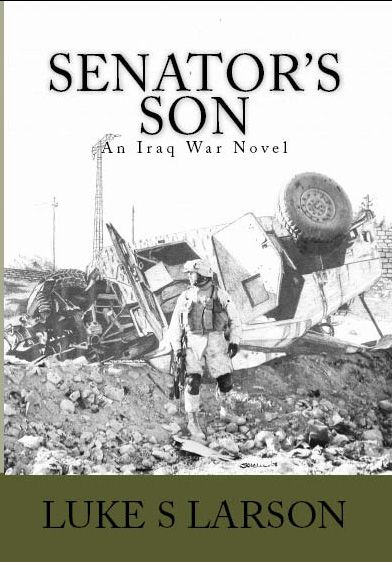
Senator’s Son: An Iraq War Novel
Fiction is not a genre that I usually review here, or get an opportunity to read often, but I received a courtesy review copy of a book Senator’s Son, by Iraq war vet, Marine officer and new novelist Luke Larson and was curious. The Iraq War and the War on Terror have produced a fine array of thoughtful books by veterans, war reporters and military thinkers like Fiasco, One Bullet Away and The Strongest Tribe, all of which were non-fiction memoirs, journalistic histories and quasi-policy books. By virtue of writing Senator’s Son as a novel, Larson was taking a different path in explaining his war.
There are two books at once in Senator’s Son. The first, is of course, a story, with characters and a plot and rising action, action, tragedy and theme – all the usual aspects of literature which I am not especially practiced at evaluating here. The second part is a contextual explanation of COIN by an author who lived the Iraq War. To his credit, Larson contacted me personally to request a “No bulls**t review”, so I will give the man what he asked for.
As an explanation of COIN, I think the book is a must read for anyone unfamiliar with the subject and the nuanced complexities that COIN entails. The gritty, unforgiving, human suffering and moments of triumph of soldiers waging “pop-centric” COIN that gets lost in powerpoint slides, in the dry abstractions of journal articles and blogospheric arguments far removed from the ground is present in ample measure in Senator’s Son. Many times, I paused in a passage and thought, “hmmm….I did not consider that”. Or “This is what the soldiers bear up under without complaint”. More people need to read that and digest what we ask of our men and women in Iraq and Afghanistan.
Senator’s Son also lays out, fairly methodically, how COIN theory may have been interpreted and debated by soldiers outside the wire, including cameo appearances or mention of real life COIN leaders woven into the story. The characters Bama, Cash, Rogue, Isaac, Gonzo the Iraqi and more, resist and adapt, struggling with their environment, unseen enemies and the political pressures of higher authorities, registering both frustration and progress in executing the mission of Golf Company. There’s even diagrams. If Senator’s Son is not on official COIN reading lists, it should be.
As a pure novel, judged on literary standards, Senator’s Son reflects its’ status as a “first novel” of a talented author whose vision of the craft is emerging. Larson excels at creating scenarios, staccato vignettes for the characters to act ( Larson may also have a future as a screenwriter – his book naturally flows in the mind like a movie). There’s always a believable, environmental, “texture” present that exceeds that of short story and science fiction writers, yet as a novelist, Larson leaves enough to the reader’s imagination so that the story moves at a dramatic pace.
Characterization in Senator’s Son is uneven. It takes a while for the individual personalities of the characters to shine beyond their common “Marine-ness” and we get only the briefest glimpse of the malign nature of the enemy, and that secondhand through the eyes of an Iraqi character. That probably is an accurate representative of the experience of most US soldiers and Marines in Iraq who are not interrogators; furthermore, having the antagonist that the characters struggle against be the total environment is perfectly legitimate. It would have been interesting for me to have seen how Larson would develop and utilize a figure who was the focus of evil; however that task would be fairly incompatible with getting an effective message across regarding COIN, success of which does not hinge on the defeat of super-villains or the resolution of black-white moral absolutes but is complexity written in shades of gray.
Finally, as an avid reader, I found Senator’s Son to be a page-turner. Several times, I looked at the clock while reading for what seemed to me a short time, noted it was 1:30 am and was regretful that I had to put it on my bedstand ( I always finished the chapter first though 🙂 ) only to repeat the process the following night. Strongly recommended.
ADDENDUM – OTHER REVIEWS of SENATOR’S SON by:

Zenpundit is a blog dedicated to exploring the intersections of foreign policy, history, military theory, national security,strategic thinking, futurism, cognition and a number of other esoteric pursuits.
Customized Web Site & Blog Design

