zenpundit.com » non-state actors

Archive for the ‘non-state actors’ Category

Guest Post: Charles Cameron on Khorasan – A Muslim Once and Future Kingdom

Tuesday, January 19th, 2010

 Charles Cameron, my regular guest blogger, is the former Senior Analyst with The Arlington Instituteand Principal Researcher with the Center for Millennial Studies at Boston University. He specializes in forensic theology, with a deep interest in millennial, eschatological and apocalyptic religious sects of all stripes.

Khorasan: A Muslim Once and Future Kingdom

by Charles Cameron

The title of an interview in a Taliban sponsored magazine with Hammam Khalil al-Balawi — the Jordanian jihadist physician and double-agent / informant who signed himself Abu Dujana al-Khorasani on jihadist forums, and carried out the recent CIA bombing in Khost — is intriguing in a self-referential, “Doug Hofstadter might like this” sort of way:

Interview with Brother Abu Dujanah al-Khorasani, a Well-Known Blogger in Jihadi Forums, and a Newcomer to the Land of Khorasan.

In his appearances on the web, al-Balawi / Abu Dujana had given himself the geographic cognomen “al-Khorasani” meaning “from Khorasan” — yet he was a Jordanian by birth, and the interview title calls him a “newcomer” to Khorasan, while the interviewer himself remarks, “Abu Dujanah al-Khurasani (sic) is actually now inside Khorasan, and the decision to travel to the lands of jihad is a divine blessing and a magnificent grace.”

The Khorasan that Abu Dujana “is actually now inside” is presumably Afghanistan on the literal, geographical level — but what of the Khorasan of the mind and heart to which, as his choice of handle indicates, Abu Dujana must have long aspired?

What is the significance of “Khorasan”?

It’s a bit like “Jerusalem” — only yesterday I was reading that Grand Rapids, Michigan is referred to as “Jerusalem” by some folk of Dutch extraction in the Pacific Northwest. I think we’ll get the sense of the idea if we call it of “Khorasan of sacred memory and present hope”.  As the UCLA scholar Jean Rosenfeld puts it (personal communication):

In any event, Khorasan refers to much more than a former region of the Islamic empires.  It has a mythical meaning that is being taken seriously as a “once and future kingdom” in the millennial mindset of al-Qaida.

The territory once called Khorasan — and the borders covered by that name shifted a great deal over the centuries — covered parts of what we now know as Iran (which still has a province named Khorasan), Turkmenistan, Uzbekistan, Afghanistan and NW Pakistan.  I’m finding references that suggest the name originally meant “the place where the sun rises” — the East, the Orient.

Rosenfeld suggests that Khorasan “is code in al-Qaida for the warrior sect itself” — “the army of the (future) caliphate in the mind of the International jihad” and thus, Al-Qaida in Fawaz Gerges’ broad sense.  My own reading ties it in with the ahadith about the “black banners of Khorasan” and the army which will sweep down from Khorasan to Jerusalem…

As I’ve noted before   there are many variant ahadith describing the army of the Mahdi.  Here is one commonly cited version:

If you see the black flags coming from Khurasan, join that army, even if you have to crawl over ice, for this is the army of the Caliph, the Mahdi and no one can stop that army until it reaches Jerusalem.”

Quite how we should align that with actual jihadist entities such as AQ core and or its subsidiaries or the various bodies called Taliban, however, I’m not sure. The clearest implication I can see is to the place of origin of the Mahdi’s army.

It is at least as much an eschatological as a geographic claim.

Since the imagery of Khorasan is closely tied to that of black flags, I would like to take a slight detour here.  We have seen that the black flags signify the army of the Mahdi, but what are its origins, and how widely is it used?

The Islamic Imagery Project at West Point Combating Terrorism Center lists “Black Flag” under the heading “Warfare Motifs“, saying:

The Black Flag (al-raya) traces its roots to the very beginning of Islam.  It was the battle (jihad) flag of the Prophet Muhammad, carried into battle by many of his companions, including his nephew ‘Ali ibn Abi Talib.  The flag regained prominence in the 8th century with its use by the leader of the Abbasid revolution, Abu Muslim, who led a revolt against the Umayyad clan and its Caliphate.  The Umayyads, the ruling establishment of the Islamic world at the time, were seen as greedy, gluttonous, and religiously wayward leaders.  The Abbasid revolution, then, was aimed at installing a new, more properly Islamic ruling house that would keep orthodox Islam at the center of its regime. Since then, the image of the black flag has been used as a symbol of religious revolt and battle (i.e. jihad).  In Shiite belief, the black flag also evokes expectations about the afterlife.  In the contemporary Islamist movement, the black flag is used to symbolize both offensive jihad and the proponents of reestablishing the Islamic Caliphate.

The flag is frequently identified with specific jihadist groups — thus Bill Roggio, writing in Long War Journal, refers to “the al rayah, the black flag of al Qaeda” in his 2007 article, “Musa Qala and the NATO offensive”.

Likewise, the Somalian president Abdullahi Yusuf Ahmed in 2006 is reported to have spoken in 2006 of “the ‘black flag’ of Al-Qaeda and the Taliban” — and as recently as this month, Al-Shabaab “vowed to replace the Somali flag with its (al-Shabaab’s) black flag”.

So the Black Flags or banners represent the Prophet as warrior at one end of Islamic history and the Mahdi’s army from Khorasan at the other — and have been adopted as symbols of jihad by different groups from the Abbasids to al-Shabaab. They are indeed indicative of jihad, but it is their association with Khorasan that gives them a specifically Mahdist reference.

The defeat of the Umayyads and establishment of the Abbasid caliphate, and hence also the golden age of Islamic culture, was strongly supported by forces raised in Khorasan, and David Cook in his Contemporary Muslim Apocalyptic Literature suggests that “the Abbasids sought to present their movement as the fulfillment of messianic expectations, and so they produced a great quantity of materials given in the form of hadith traditions to indicate that the Mahdi would come from this region.”

The tale lives on. As I’ve mentioned before, Cook notes that bin Laden’s mentor, Abdullah Azzam, made fresh use of this line of messianic tradition and “popularized the position of Afghanistan as the messianic precursor to the future liberation of Palestine” in his book, From Kabul to Jerusalem, while bin Laden refers to finding “a safe base in Khurasan, high in the peaks of the Hindu Kush” in his 1996 Declaration of Jihad.

The spiritual geography, then, is clear: Khorasan is that place in the east, somewhere in the general region including eastern Iran and northern Afghanistan, from which the Mahdi’s army will come — and it is very plausibly also a place the jihadist might need to “crawl over ice” to reach.

I think Rosenfeld is right in suggesting that al-Balawi’s geographic cognomen is a significant one, as is “Abu Dujana” — the name of a particularly valiant companion of the Prophet, as I discussed in a previous post.

But which of the various jihadist forces currently deployed in Afghanistan and nearby might be the nucleus of the Mahdi’s forces? The army with black flags from Khorasan has been identified with the Abbasids, with the Iranian revolutionaries, and with the Taliban. Bin Laden would presumably wish for it to be with al-Qaida, and Cook also says, this time in Understanding Jihad:

Since Afghanistan, as Khurasan, has powerful resonance with many Muslims because of the messianic expectations focused on that region, this gave the globalist radical Muslims associated with al-Qa’ida under the leadership of Bin Ladin additional moral authority to proclaim jihad and call for the purification of the present Muslim governments and elites.

In Jordan via the jihadist web forums, al-Balawi signaled his identification with the victorious army of the coming Mahdi and with jihadists in Afghanistan by his choice of the cognomen “al-Khorasani” — but the name alone does not tell us which particular jihadist group he might have been thinking of, and that may not even have been an question he felt the need to resolve at that time.

  Once in Khorasan itself, al-Khorasani left us two “media” items, a magazine interview and a video, and we might hope that they would add to our understanding of the more literal, geographical meaning his name carried, for they clearly indicate his associations.

According to Flashpoint-Intel, who provided the version of the interview I’ve seen, al-Khorasani’s interview was given to “Vanguards of Khorasan” which they describe as “a well-known Taliban propaganda magazine” and released by the Al-Fajr Media Center, which they term “the official online logistical arm of Al-Qaida”. SITE refers to “Vanguards” as “the … magazine of al-Qaeda in Afghanistan”. Others more familiar with the logistics may want to clarify the point.

The video, then, seems to give the clearest indication. Al-Khorasani was taped sitting next to Hakimullah Mehsud, the head of the Terik- i-Taliban Pakistan or TPP (whose death in a drone strike is reported but unconfirmed at the time of writing), and indicated his allegiance with the words, “We will never forget the blood of our emir Baitullah Mehsud” — referring to Hakimullah’s predecessor.

In general, “Khorasan” doesn’t appear to function as code for a particular jihadist organization, but as a more general symbol for victorious jihad — coming from the East, faithful to the truth, unstoppable, ushering in the Caliphate, serving the cause of the Mahdi, and thus heralding the End of Days.

I’m intrigued to note that the Australian analyst / scholar Leah Farrall at All Things Counter Terrorism blogged on Abu Dujana today  (after I’d “completed” this post) and closed her post with an aside. I’ll quote the whole paragraph for context, but it’s the last point that ties in here:

Another point of interest is Khorasani’s  internet history circa 2001- 2003. Despite what Khorasani said in his interview in the Taliban magazine ( I think it was the Taliban mag if memory serves), one does not get to be a forum administrator overnight. I watched another person rise through the ranks this way and he had direct contact with  a mid-level AQ commander. It still took him 18 months or so. This brings me back to my question about Khorsani’s early internet history and possible real world history. As an aside, back then, in the early days you didn’t write Khorasani, Kandahari etc unless you had been there. It was used as an identifier. This has changed in recent years but I do wonder about this with him too.

Leah’s curiosity on this point reminds me that along with the general symbolism of Khorasan, which I have tried to explore here, there are intriguing aspects to the particular use Abu Dujana made of the name.

I look forward to any further thoughts she may have.

Grateful thanks to Jean Rosenfeld for our very helpful conversations around this and related topics, and for the comment that gave me its title.

Robb Throws Down the Gauntlet

Sunday, January 17th, 2010

To the legacy society of the nation-state and the hierarchical transnational corporation:

MILESTONE

….It’s time to up the ante and move onto the next phase:  the birth and rapid growth of new societal networks.*  This is going to be a fun ride!

* As in, new societal networks that can outcompete (trounce evolutionarily) all existing status quo organizational forms  (this should not be confused with the diminutive form of ‘social networking,’ as in Facebook and Twitter).

Long term, I think this is correct and that Robb is, as usual,  ahead of the curve on what will become the zeitgeist in the next few decades ( I will add that this evolutionary path appears to be happening much faster than I had considered, by at least 15-20 years). The movement in the 21st century will be toward networked civilizations on one end of the spectrum that will be pretty nice places to be and on the other, a kind of emergent, hypermobile, barbarism where life is hell on Earth. 

The proper response for existing institutions is to swing their resources, their mass and their remaining legitimacy behind the triumph of the former and gracefully adapt and acclimate rather than be disintegrated by the latter. I considered this in the essay ” A Grand Strategy for a Networked Civilization” that I wrote for Threats in the Age of Obama (p.208):

….Nation-states in the 21st century will face a complex international ecosystem of players rather than just the society of states envisioned by traditional Realpolitik. If the predictions offered by serious thinkers such as Ray Kurzweill, Fred Ikle or John Robb prove true, then  technological breakthroughs will ensure the emergence of “Superempowered Individuals”[1] on a sizable scale in the near future.  At that moment, the reliance of the State on its’ punitive powers as a weapon of first resort comes to an end.  Superemepowered individuals, separatist groups, insurgents and an “opting-out” citizenry will nibble recalcitrant and unpopular states to death, hollowing them out and transferring their allegiance elsewhere.

While successful states will retain punitive powers, their primary focus will become attracting followers and clients in whom they can generate intense or at least dependable, loyalty and leverage as a networked system to pursue national interests.  This represents a  shift from worldview of enforcement  to one of empowerment, coordination and collaboration. States will be forced to narrow their scope of activity from trying to supervise everything  to  flexibly providing or facilitating core services, platforms, rule-sets and opportunities – critical public goods – that the private sector or social groups cannot easily replicate or replace.  Outside of a vital core of activity, the state becomes an arbiter among the lesser, interdependent, quasi-autonomous, powers to which it is connected.”

In other words, America and our “leaders” need a Boydian strategy and a ruthless commitment to honest clarity and sacrifice in order to weather the transition and retain some relevance. This is what makes the current cultural trend toward a political economy of oligarchy among the elite so worrisome. Their careerist self-interest and class values will push them to make all the wrong choices at critical junctures.

Innovating Institutional Cultures

Monday, January 11th, 2010

John Hagel is in a small category of thinkers who manage to routinely be thinking ahead of the curve ( he calls his blog, where he features longer but more infrequent posts than is typical,  Edge Perspectives). I want to draw attention to the core conclusion of his latest:

Challenging Mindsets: From Reverse Innovation to Innovation Blowback

Innovation blowback

Five years ago, John Seely Brown and I wrote an article for the McKinsey Quarterly entitled “Innovation Blowback: Disruptive Management Practices from Asia.” In that article, we described a series of innovations emerging in Asia that were much more fundamental than isolated product or service innovations. We drew attention to a different form of innovation – institutional innovation. In arenas as diverse as motorcycles, apparel, turbine engines and consumer electronics, we detected a much more disruptive form of innovation.

In these very diverse industries, we saw entrepreneurs re-thinking institutional arrangements across very large numbers of enterprises, offering all participants an opportunity to learn faster and innovate more effectively by working together. While Western companies were lured into various forms of financial leverage, these entrepreneurs were developing sophisticated approaches to capability leverage in scalable business networks that could generate not just one product innovation, but an accelerating stream of product and service innovations.

…. Institutional innovation is different – it defines new ways of working together, ways that can scale much more effectively across large numbers of very diverse enterprises. It provides ways to flexibly reconfigure capability while at the same time building long-term trust based relationships that help participants to learn faster. That’s a key breakthrough – arrangements that support scalable trust building, flexibility and learning at the same time. Yet this breakthrough is occurring largely under the radar of most Western executives, prisoners of mindsets that prevent them from seeing these radical changes.

Read the whole thing here.

Hagel is describing a mindset that is decentralized and adaptive with a minimum of barriers to entry that block participation or information flow. One that should be very familiar to readers who are aware of John Boyd’s OODA Loop, the stochastic/stigmergic innovation model of John Robb’s Open Source Warfare, Don Vandergriff’s Adaptive Leadership methodology and so on. It’s a vital paradigm to grasp in order to navigate and thrive in the 21st century.

Western executives (think CEO) may be having difficulty grasping the changes that Hagel describes because they run counter to cultural trends emerging among this generation of transnational elites ( not just big business). Increasingly, formerly quasi-meritocratic and democratic Western elites in their late thirties to early sixties are quietly embracing oligarchic social stratification and use political or institutional power to “lock in” the comparative advantages they currently enjoy by crafting double standards through opaque, unaccountable authorities issuing complex and contradictory regulations, special exemptions and insulating ( isolating) themselves socially and physically from the rest of society. It’s a careerism on steroids reminiscient of the corrupt nomenklatura of the late Soviet period.

As the elite cream off resources and access for themselves they are increasingly cutting off the middle-class from the tools of social mobility and legal equality through policies that drive up barriers to entry and participation in the system. Such a worldview is inherently zero-sum and cannot be expected to notice or value non-zero sum innovations.

In all probability, as an emergent class of rentiers, they fear such innovations when they recognize them. If allowed to solidify their position into a permanent, transnational, governing class, they will take Western society in a terminal downward spiral.

A Short Rant……

Sunday, December 27th, 2009

“In the wake of the latest failed terrorist incident, the TSA announced a new round of security procedures designed to greatly inconvenience millions of air passengers without doing anything to increase their security…”

Here’s an idea. Let’s start using basic counterintelligence principles to screen prospective travelers to the United States and bar those young, unmarried, Muslim men having affiliations with radical mosques, madrassas, imams, extremist Islamist political groups or a history of  mental illness and erratic behavior from receiving visas to enter the United States. This clown should never have been able to get a visa. His own father, a senior government official of a foreign nation, was trying to red-flag him as a potential al Qaida terrorist  for us(!).

Would such a policy catch every prospective terrorist? No. Nothing will.

But it should at least keep out the no-brainer cases who currently are admitted to the U.S. under our politically correct TSA-DHS-State immigration regime. There’s really no upside to allow radical activists, recruiters for Hizb ut-Tahrir, Hezbollah fundraisers, and other enemies of civilized existence into our country. Or better yet, any Western country. Sure, CAIR will complain but as that organization is an unindicted co-conspirator in a terrorism case, in terms of civil rights, they are not exactly the NAACP.

In the meantime, maybe the airlines will start distributing catheters to pasengers whose landings are delayed.

Five Questions: An Interview with Chief Ajmal Khan Zazai

Thursday, December 24th, 2009

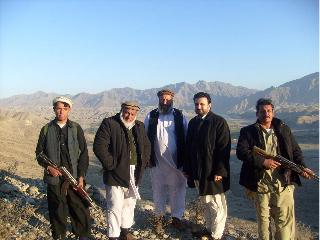
Those of you who also regularly read Steven Pressfield’s site, It’s the Tribes, Stupid have come across his interview series with Ajmal Khan Zazai, elected paramount tribal chief of his home district in the Zazi valley of Paktia province in Afghanistan ( near Tora Bora and bordering Pakistani Waziristan). Chief Zazai fought in the Soviet War and at one time, was imprisoned by Pakistan’s ISI. On March 15, 2000, the Taliban assassinated Chief Zazai’s father, Chief Raiss Afzal Khan Zazai in his family house in Peshawar, Pakistan.

As paramount chief, Chief Zazai raised a Tribal Police Force that is presently working with the U.S. Army’s 10th Mountain Division to secure the Zazi valley. Chief Zazai’s force has come under attack, as insurgents have fought to stop his efforts.  His commander, Amir Muhammad, has personally survived several assassination attempts in the last several months. On two occasions in 2008, warlord-financed hit men attempted to assassinate Chief Zazai. One attack nearly succeeded, leaving several wounded and one man deadzazai.jpg

Steve cordially arranged for me to ask Chief Zazai a few questions via email regarding his perspective on the historical background of the war against the Taliban and the current situation in Afghanistan. My questions are in bold type and Chief Zazai’s answers are in normal text:

FIVE QUESTIONS: AN INTERVIEW WITH CHIEF AJMAL KHAN ZAZAI:

1.  Some American academics have argued that the day of “the tribe” is long past in Afghanistan, having been battered by governmental intrusion and war since at least 1978, and that a better understanding of Afghan identity for Americans is to look at the “Qaum” and other very local loyalties. How accurate is that description?:

“Qaum” means “Tribe” in Pashtu and also in the Dari Language. 

The 1978 coup was not the first bloody revolution Afghanistan saw, as I have said on many occasions, Afghanistan has gone through many turmoils and turbulences throughout its history and has survived as a nation and country. For one to get convinced that after the 1978 Red revolution that the tribal structure was gone for good, then one would also have to argue how this tribal structure survived till 1978 when Ghengis Khan burned almost half of Afghanistan?  What about Hulagu Khan, Tamerlane, the Persian empire, the Mughals and prior to all that Alexander the Great? [The tribes ] having seen all these bloody empires and survive untill 1978 is amazing, isn’t it?

To justify the argument simply by referring to the 1978 bloody Red revolution and claim the tribal structure was gone, is dead and has vanished in Afghanistan, would simply be ignorance and a lack of understanding of the rich Afghan culture and Afghan way of life.

The Bonn Agreement appointed Hamid Karzai for 6 months as an interim President of Afghanistan back in 2002. When 6 months passed, did the UN or US call for election? No, of course not. Who then who appointed Mr. Karzai as a President for 2nd time to be the President of the transitional government? It was the “Loya Jirga” and not through the election process. A Loya Jirga is a pure Afghan Tribal process and procedure of making things happen!

Let’s take a look at how the current Afghan Constitution was approved  and came into an effect:

The constitution of Afghanistan was not approved by the Afghan Parliament and Senate as the Parliament and Senate did not exist at the time. In fact the constitution was approved by the “Loya Jirga”; although there was a large presence of the Warlords and criminals in both those Loya Jirgas, nevertheless they served their purpose.

Now, why would one argue that the tribal structure does not exist in Afghanistan or it’s a thing of the past? Closing our eyes from the truth does not mean the truth would vanish. We have a phrase in Pashto which means “One can not hide the sun with just two fingers”.

If one believes they need to find local loyalties in Afghanistan, the locals are the tribes. Why would some go around in [semantic] circles and confuse themselves? 

2.  In your interviews with Steve Pressfield, you discussed the presence of warlords in the Afghan government of Hamid Karzai, men with very bad records.  There have also been reports in the media, from time to time, of Ex-Khalqi Communists serving the regime. Are these men a similar problem to the warlords in your view?

When the Russians withdrew their forces in 1989 and left behind the Communist regime of Dr Najibullah, many thought that the regime would collapse in just days or in weeks, but Najibullah’s government survived for five long years despite the daily rains of rocket attacks on Kabul and only collapsed in 1992. Then the so-called Mujahideen took charge of Kabul and Afghanistan, but soon we saw that these power hungry men started fighting each other over the Throne of Kabul. Their bloody civil war of lasted from 1992 untill 1996 and turned Afghanistan into a pile of rubble.

 Many Afghans were turned against these so-called Mujahideen because these leaders and their commanders became involved in killing innocent men, women and children, looted people’s livelihoods and literally turned all of Afghanistan into a war zone. We witnessed that in just five years these “Mujahideen” warlords destroyed Kabul and all other major cities in Afghanistan. People started to hate them more than they hated the old Communists, so in a way, the crimes which were initially committed by the Communists were covered up when the Afghan people witnessed the subsequent brutality of these so-called Mujahideen leaders and commanders.

I strongly believe the Afghan civil war was also orchestrated by the  KGB/FSB in order to engage these Freedom fighters in Afghanistan and prevent them from crossing over to infiltrate the [formerly Soviet] Central Asian States, and also to cover the atrocities committed by the Red Army against the Afghans in Afghanistan. The KGB/FSB calculated shrewdly that if these “Mujahideen” leaders accomplished a united Islamic government in Afghanistan, it would spill over into the entire Central Asian countries. Although many believed in the West at the time that Russia was almost finished and gone, that was a mistake Westerners made in trying to understand the Russian mind set. 

I strongly believe that the Afghan Communists are responsible for the destruction of Afghanistan. They still have the Marxist-Leninist theory in their heads and we recently have witnessed that many of these Afghan ex-Communists are keeping close ties to Moscow. I believe these Khalqis and Parchamis are now part of the problem as they are now receiving support from Russia.   

3.  Afghanis, especially Pushtuns, have a well-deserved historical reputation as fierce fighters.  Yet there is more to life than war, even in a warrior society. What does a young Afghan man in his late teens or twenties hope for?  What would he see as “progress” or better times?

Much is been said about the Afghans, Pashtuns in the media and honestly I disagree with much of it because no nation, no tribe no people wish for a war as war only brings devastation, destruction and miseries.

Yes, the Afghans are great fighters, but that does not mean they wish for a war all their life. We needed to fight against the Russian invasion and I still strongly believe we have done the right thing defending our country and nation against Communism; as I said earlier, things went wrong when these so-called Mujahideen or Freedom fighters leaders started fighting one another. I believe every Afghan wishes for peace and stability in Afghanistan. Yes there are some who will continue fighting, but we all know they are small in numbers and are not significant. The reason many young men are part of the Taliban and other insurgents is the lack of employment , lack of better life conditions and of course lack of any positive attention from their government in Kabul. At this moment if you ask me, why are these young men are turning to Taliban and are fighting the US, NATO and the Afghan government? You will hear a simple answer from me and that is lack of employment opportunity for these youth who are mostly uneducated.

I will tell you my own experience: I was only 16 when I used to go to Afghanistan from Pakistan from time to time to fight against the Russians. I knew the consequences of being killed, but I was not going to Afghanistan in order to be killed, I was going to Afghanistan to fight the Russians. Now things are opposite, many young men are brainwashed by evil men and these young men wish to die, that’s why there are many suicide attacks now. I remember very well in my days when we were busy fighting the Russians, that we never had suicide bombers. This is very new to us and it has been brought form outside Afghanistan.

I believe the Afghan government and the US/NATO should provide training programmes to all those young Afghan men at around age of 16 and above who have lost the chance to go to school and get education. By learning skilled trades, I believe they will be in a position to earn a loaf of bread for themselves and their family and in this way we will prevent many young men from falling in the trap of believing being a suicide bomber means a life in the hereafter with the 72 virgins which will await them at the corridor of heaven.

4.  You have spoken at length with Steve Pressfield about the 10th Mountain Division and your positive relationship with them.  How successful have American and NATO units been in making connections elsewhere with Afghan tribal leaders compared to the 10th Mountain Division?

I do not have any information to the regard that if the US Army has any close contacts with other Tribal leaders. In my case, I have pushed hard for this partnership, regardless of any obstacles that were created for us to even have a decent understanding, but now it seems to be working. In the entire Afghanistan, I am the first Tribal Leader who denounced the Taliban and Al Qaeda openly and more practically, by forming TPF (Tribal Police Force) from my Tribesmen to fight these evil men without any financial assistance from the US Army, US Government, NATO or the Afghan Government. My TPF programme is by the people and for the people – I think it is on the same lines of your democracy “By the people and for the people”!

5). A friend of mine, the strategist Thomas PM Barnett, has been advocating a much greater international presence in Afghanistan, including not just NATO but China, Russia and India, with direct business investment as well as providing military and civilian aid workers. Would this development be a welcome one?

I believe this is a positive step in bringing a broader coalition and the entire International community to help and be involved in Afghanistan; but although this approach might be purely for business purposes, it could pose a future problem as most of these nations are not very sure of the US and NATO policy in the long term and present intentions. Afghanistan has always maintained very good and close relations with India, and throughout this friendship, India had no political ambitions and that what made India look good until the 90’s when India supported the Northern alliance. [As a result] I believe India has lost that status of being a neutral friend of Afghanistan. Also, the growing presence of Indians in Afghanistan is sending some disturbing alarms to our immediate neighbor (Pakistan).

Things needs to be balanced and Afghanistan needs a better understanding [of FDI] and not just bringing in anyone which could only lead to disruption and anxiety in long term. As an example, the large copper mines in Logar Province were won in a biding by a Chinese company – later it was revealed that the Chinese paid large kick backs to the minister of mines. In my opinion, involving more Chinese and Russian corporations would mean more corruption in Afghanistan.

Russian firms are already involved in Afghanistan. Most of them are involved in espionage and there are Chinese corporations and I believe they are doing the same. It would be more fruitful [for Afghans] for your friend to encourage Western corporations and companies to invest in Afghanistan.

Thank you, Chief Zazai.


Switch to our mobile site