zenpundit.com » authors

Archive for the ‘authors’ Category

Book Review: The Human Factor

Friday, June 18th, 2010

The Human Factor: Inside the CIA’s Dysfunctional Intelligence Culture by Ishmael Jones

A former clandestine officer of the CIA who operated overseas without benefit of diplomatic cover, “Ishmael Jones” has painted one of the most damning insider accounts of a puportedly self-serving and risk-averse CIA’s management culture that has ever been written. Jones’ description of a mendacious and incompetent CIA headquarters bureaucracy has less in common with critical documents like the 9/11 Commission Report or the legendary Church Committee hearings than it does with the literature produced by Soviet dissidents and defectors during the Cold War.

Jones, who quotes from the iconic 1990’s film Glengarry Glen Ross, yearned to be in an aggressive covert intelligence service whose case officers would “Always Be Closing” . Instead, he finds a Central Intelligence Agency topheavy with career managers averse to approving operational approaches to potential sources, eager to recall effective and productive officers permanently home on the slightest pretexts, comfortable with padding their incomes through familial nepotism and not above lying to Congress or political superiors in the Executive Branch. Jones navigates successfully through three consecutive overseas assignments via a strategy of keeping HQ in the dark about his activities, never becoming known as an “administrative problem” to HQ paper-shufflers and advancing operational costs from his own pocket, with the CIA eventually in arrears to Jones to the tune of $ 200,000.

CIA management in The Human Factor resembles nothing so much as the Soviet nomenklatura crossbred with the Department of Motor Vehicles. Even if we were to allow for exaggeration for humorous effect, or frankly discount 50 % of Jones’ examples outright, the remainder is still a horrifying picture of Langley as an insular bureaucracy that excels far more at Beltway intrigue than at foreign espionage or covert operations. Jones also discusses the tenure of CIA directors George Tenet and Porter Goss, the Valerie Plame story and the post-9/11 intelligence “reforms” that aggravated the CIA management culture’s worst tendencies. Jones concludes by stating flatly that the CIA cannot be fixed and should be abolished, with its useful operational personnel transferred to the Departments of State and Defense.

ADDENDUM:

An excellent – and more detailed – review of The Human Factor by  by fellow Chicago Boyz blogger, James McCormick:

Mini-Book Review – Jones – The Human Factor

….Other reviews of this book have proclaimed Human Factor a rather boring recollection of examples of institutional ineptitude and better as a guidebook for potential employees than a useful description of the CIA but I feel this is in fact the most useful book on the CIA’s clandestine service since:

Orrin Deforest and David Chanoff, Slow Burn: The Rise and Bitter Fall of American Intelligence in Vietnam, Simon & Schuster, 1990, 294 pp.

David Atlee Phillips, The Night Watch: 25 Years of Peculiar Service, Atheneum, 1977, 309 pp.

which covered clandestine case officer activities, first person, in Vietnam and Latin America.

Like these two aforementioned titles, Human Factor focuses on the day-to-day challenges of being a covert case officer … the “teeth” in any intelligence organization. It is noteworthy that the Director of Central Intelligence has rarely, if ever, been one of those covert (non-State Department) officers. It’s as if your dentist was being overseen by experts in small-engine mechanics.

Ishmael recounts the minutiae of what reports he needed to write, the porous e-mail systems he had to manipulate, and the permissions he needed to gain. The timing and delays of decisions from Langley … the phrasing and terminology that was necessary to get anyone back in the US to allow any activity whatsoever. As a former stock broker, Jones was entirely comfortable with the challenges of “cold-calling” and dealing with “No” over and over again. But this wasn’t the case for his fellow trainees or for any of his superiors. At every turn, he was able to contrast his experience in the Marines (and military culture), and with Wall Street’s “make the call” ethos, with what he was experiencing as one of the most at-risk members of the Agency

John Robb at BoingBoing

Tuesday, June 15th, 2010

John has a nice interview with futurist and augmented reality pioneer Chris Arkenberg, over at BoingBoing:

John Robb Interview: Open Source Warfare and Resilience

….The United States is suffering both the economic decline of its industry and the ongoing dismantling of the social welfare apparatus supporting the citizenry. In your opinion, will this inevitably lead to some form of armed insurgency in America?

Yes. The establishment of a predatory and deeply unstable global economic system – beyond the control of any group of nations – is in the process of gutting developed democracies. Think in terms of the 2008 crisis, over and over again. Most of what we consider normal in the developed world, from the middle class lifestyle to government social safety nets, will be nearly gone in less than a decade. Most developed governments will be in and out of financial insolvency. Democracy, as we knew it, will wither and the nation-state bureaucracy will increasingly become an enforcer for the global bond market and kleptocratic transnational corporations. Think Argentina, Greece, Spain, Iceland, etc. As a result, the legitimacy of the developed democracies will fade and the sense of betrayal will be pervasive (think in terms of the collapse of the Soviet Union). People will begin to shift their loyalties to any local group that can provide for their daily needs. Many of these groups will be crime fueled local insurgencies and militias. In short, the developed democracies will hollow out

Hat Tip to Charles Cameron.

Interviewed by Steven Pressfield

Saturday, June 12th, 2010

Shameless Self-Promotion Department:

In an unusual turn of events, I was the subject of an interview by novelist and historian Steven Pressfield, author of Gates of Fire and The War of Art.

Steve has an interview section on his newly redesigned site and I join a series of bloggers and authors like Instapundit  Glenn Reynolds, Tim O’Brien and Seth Godin who have sat down, in a virtual sense, with Steve for a discussion about writing and creativity. Having done such interviews of others in the past, it was a good experience to be on the receiving end of questions, for which I thank Steve:

The Creative Process: Mark Safranski

SP: Mark, what is the ZenPundit philosophy? Howdo you decide which stories or posts (or even guest bloggers) you want to include? What criteria do you use?

MS: Good question. My philosophy is something I also try to impart in my teaching.

Marcus Aurelius said “Look beneath the surface; let not the several qualities of a thing nor its worth escape you.” Most phenomena have many dimensions, multiple causes and second and third order effects. To deal with all of this complexity, we simplify matters by looking at life through an organizing frame, which we might call a worldview, a schema, a paradigm or a discipline. Whatever we call our mental model, we tend to become wedded to it because it “works.” It helps us understand some of what we are looking at-and in getting good at applying our model, advances us professionally and brings prestige or material rewards. So we will defend it to the death, from all challengers!

That’s getting carried away. Our mental model is just a tool or, more precisely, a cognitive lens. We need to be less attached to our habitual and lazy ways of looking at the world, put down our magnifying glass and pick up a telescope. Or, bifocals. Or, a microscope. Stepping back and applying different perspectives to a problem or an issue will give us new information, help us extrapolate, identify unintended consequences or spot connections and opportunities. When I do analytical pieces, I try to take that approach….

Read the rest here.

Book Review: WAR by Sebastian Junger

Thursday, June 3rd, 2010

WAR by Sebastian Junger

I just finished reading my courtesy review copy of WAR by journalist and author Sebastian Junger, on his firsthand observation of the war against the Taliban in the Korengal Valley, waged by the soldiers of the 2nd Platoon of Battle Company. I cannot say that I found WAR to be an enjoyable read – though Junger is a polished writer – a more accurate description is that WAR is powerful, thought-provoking, at times moving and, ultimately, a very disturbing account of the war in Afghanistan.

Junger, whose previous works include The Perfect Storm: A True Story of Men Against the Sea and Fire, was embedded along with photojournalist Tim Hetherington, with 2nd Platoon during their COIN campaign in Korengal, a mission that resulted in some of the bloodiest firefights and highest American casualties of the Afghan war and withdrawal from a rugged valley sometimes known as “Afghanistan’s Afghanistan”. The Korengalis, related to the people of Nuristan, are noted for their xenophobic hostility to outsiders, which was directed at times toward the Taliban as well as Americans. Junger reports that the US only succeeded in controling a quarter of Korengal and contesting roughly half of the six mile by six mile valley with the Taliban and local “accidental guerrillas”motivated by money, excitement, religious zeal or revenge to attack the Americans.
WAR is not an especially “political” or “policy” book discussing the war from some remove. Junger’s primary interest are the men of second platoon at Restrepo, an outpost dedicated to the memory of a valorous medic who had been killed. O’Byrne, Anderson, Stitcher (who has “INFIDEL” tattooed across his chest), Jones, Moreno, Bobby to name just a few soldiers Junger interviewed and witnessed how they lived in the moment. That moment could comprise the adrenaline high of combat, agonies of grief, anticipatory tension before the next ambush, the angst of boredome behind the wire and especially the iron bonds of brotherhood in a small unit tempered by fire.

What comes through in War, aside from the extremity of the terrain and the uncertainty of ever-present danger, men being shot without warning by the enemy, even in Restrepo, is how very few men are actually involved in combat. Battle Company is the vaunted “tip of the spear” but when only a few hundred men were taking a wildly disproportionate percentage of all combat contacts in a nation the size of Afghanistan ( Junger cites 20 %) the spear begins to look more like a tiny sewing needle connected to a Leviathan-like noncombatant-administrative tail, surreally outfitted with fast food courts.

There’s a peculairly granular quality to Junger’s WAR, the grittiness of the squalid conditions in which soldiers live, the depths of their physical sufferings and mental exhaustion, their primal fear of letting their comrades down in battle and being responsible for getting friends killed. There are also epiphanies of bravery and carrying the day against the odds, men living who but for chance would have died on some rock strewn hill and lusty celebration after the deaths of their enemies. The sort of politically incorrect, atavistic, jubilation that is culturally frowned upon by people who are comfortably safe and far away.

What disturbed me most about WAR was not just how few Americans are carrying the burden of the combat in Afghanistan but how disconnected these few soldiers and their sacrifices are from the rest of the military itself. Junger’s epilogue with O’Byrne, a fine soldier who is a major figure in the book, and his inability to readjust and shift from the battlefield to garrison or civilian life is deeply depressing. “The Army’s trying to kill me” O’Byrne declared, finding a momentary refuge in alcohol, but little help from the military bureaucracy.

Junger attempted to show the war in Korengal as seen from the perspective of the privates, NCO’s and junior officers of Battle Company who lived and died there, from his interviews and his own participation in their patrols as they came under fire or as they gingerly parleyed with Korengali elders in isolated villages. Eschewing theory or a historian’s search for causation, Junger attempts to let the soldiers words and actions drive the narrative.

Sebastian Junger’s WAR is raw and undecorated by sentiment.

Some Anglospheric Multimedia

Thursday, May 27th, 2010

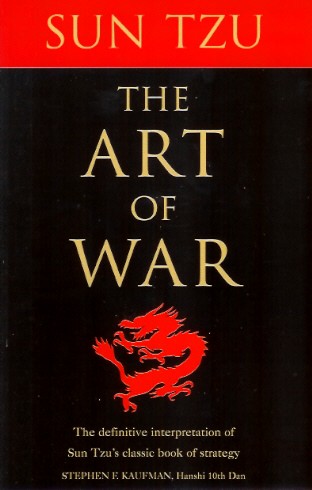
The Art of War by Sun Tzu

A BBC podcast on Sun Tzu’s classic The Art of War. Perhaps the most sublime work on strategy of all time ( Hat tip to The Warlord)

Next, and unrelated: 

Via blogfriend Robert Paterson, a new talk by educational and creativity thought leader, Sir Ken Robinson. The ritual TED bowing to Al Gore notwithstanding, if you are interested in education issues, this is a must see video.


Switch to our mobile site

