zenpundit.com » authors

Archive for the ‘authors’ Category

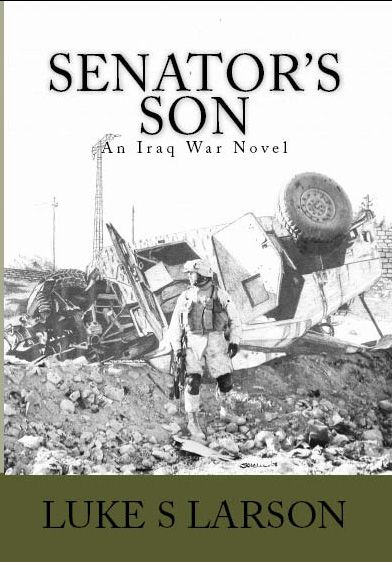
Review: Senator’s Son by Larson

Monday, March 15th, 2010
larson.jpg

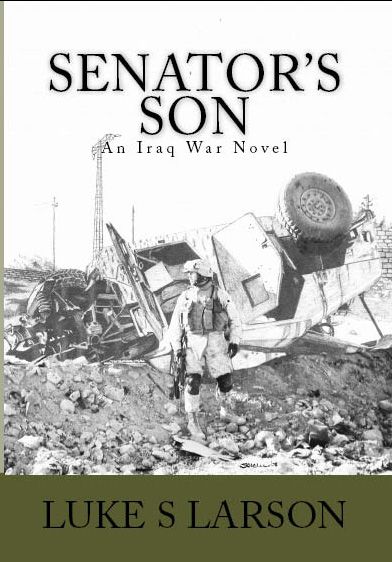
Senator’s Son: An Iraq War Novel by Luke S. Larson

Fiction is not a genre that I usually review here, or get an opportunity to read often, but I received a courtesy review copy of a book Senator’s Son, by Iraq war vet, Marine officer and new novelist Luke Larson and was curious. The Iraq War and the War on Terror have produced a fine array of thoughtful books by veterans, war reporters and military thinkers like FiascoOne Bullet Away  and The Strongest Tribe, all of which were non-fiction memoirs, journalistic histories and quasi-policy books. By virtue of writing Senator’s Son as a novel, Larson was taking a different path in explaining his war.

There are two books at once in Senator’s Son. The first, is of course, a story, with characters and a plot and rising action, action, tragedy and theme – all the usual aspects of literature which I am not especially practiced at evaluating here. The second part is a contextual explanation of COIN by an author who lived the Iraq War. To his credit, Larson contacted me personally to request a “No bulls**t review”, so I will give the man what he asked for.

As an explanation of COIN, I think the book is a must read for anyone unfamiliar with the subject and the nuanced complexities that COIN entails. The gritty, unforgiving, human suffering and moments of triumph of soldiers waging “pop-centric” COIN that gets lost in powerpoint slides, in the dry abstractions of journal articles and blogospheric arguments far removed from the ground is present in ample measure in Senator’s Son. Many times, I paused in a passage and thought, “hmmm….I did not consider that”. Or “This is what the soldiers bear up under without complaint”. More people need to read that and digest what we ask of our men and women in Iraq and Afghanistan.

Senator’s Son also lays out, fairly methodically, how COIN theory may have been interpreted and debated by soldiers outside the wire, including cameo appearances or mention of real life COIN leaders woven into the story. The characters Bama, Cash, Rogue, Isaac, Gonzo the Iraqi and more, resist and adapt, struggling with their environment, unseen enemies and the political pressures of higher authorities, registering both frustration and progress in executing the mission of Golf Company. There’s even diagrams. If Senator’s Son is not on official COIN reading lists, it should be.

As a pure novel, judged on literary standards, Senator’s Son reflects its’ status as a “first novel” of a talented author whose vision of the craft is emerging. Larson excels at creating scenarios, staccato vignettes for the characters to act ( Larson may also have a future as a screenwriter – his book naturally flows in the mind like a movie). There’s always a believable, environmental, “texture” present that exceeds that of short story and science fiction writers, yet as a novelist, Larson leaves enough to the reader’s imagination so that the story moves at a dramatic pace.

Characterization in Senator’s Son is uneven. It takes a while for the individual personalities of the characters to shine beyond their common “Marine-ness” and we get only the briefest glimpse of the malign nature of the enemy, and that secondhand through the eyes of an Iraqi character. That probably is an accurate representative of the experience of most US soldiers and Marines in Iraq who are not interrogators; furthermore, having the antagonist that the characters struggle against be the total environment is perfectly legitimate. It would have been interesting for me to have seen how Larson would develop and utilize a figure who was the focus of evil; however that task would be fairly incompatible with getting an effective message across regarding COIN, success of which does not hinge on the defeat of super-villains or the resolution of black-white moral absolutes but is complexity written in shades of gray.

Finally, as an avid reader, I found Senator’s Son to be a page-turner. Several times, I looked at the clock while reading for what seemed to me a short time, noted it was 1:30 am and was regretful that I had to put it on my bedstand ( I always finished the chapter first though 🙂 ) only to repeat the process the following night.  Strongly recommended.

ADDENDUM – OTHER REVIEWS of SENATOR’S SON by:

Thomas P.M. Barnett 

Shrinkwrapped 

Shane Deichman

Mackinlay’s Insurgent Archipelago & Other Books

Tuesday, March 9th, 2010

The Insurgent Archipelago by John Mackinlay

At the strong recommendation of Colonel Gian Gentile, I ordered The Insurgent Archipelago: From Mao to Bin Laden by Dr. John Mackinlay of King’s College, London and a hardcover copy just arrived this afternoon. Judging from the table of contents and the sources in Mackinlay’s endnotes, The Insurgent Archipelago will present a tightly written argument on the nature of COIN. For a well regarded  and informative review, see David Betz of Kings of War blog, brief excerpt below:

Review: The Insurgent Archipelago

….The book is sweeping, as the subtitle ‘From Mao to Bin Laden’ suggests; yet it is also admirably succinct at 292 pages including notes and index.[2] In design it is exceedingly clear, consisting of three parts-‘Maoism’, ‘Post-Maoism’, and ‘Responding to Post-Maoism’, which reflect the basic components of his argument. Insurgency’s classical form is the brainchild of the carnivorously ambitious strategic and political genius Mao Zedong who gave meaning to the now familiar bumper sticker that insurgency is ’80 per cent political and 20 per cent military’. Mao’s innovation was to figure out what to fill that 80 per cent with: industrial scale political subversion by which he was able to harness the latent power of an aggrieved population to the wagon of political change, to whit the victory of the Chinese Communist Party in the Chinese Civil War which ended with the proclamation of the People’s Republic of China in 1949

….The problem is that what we now face in the form of ‘global insurgency’ is not Maoism but Post-Maoism-a form of insurgency which differs significantly from that which preceded it.[6] We have, in essence, been searching for the right tool to defeat today’s most virulent insurgency in the wrong conceptual tool box. This is perhaps the most uncomfortable truth to be laid out in this book; another worrying one is that the security interests of Western Europe differ markedly from those of the United States-because the threat in the former emerges from their own undigested Muslim minorities which are alienated further by their involvement in expeditionary campaigns which, arguably at least, serve the needs of the latter well enough

Oddly, this will be the second book by a former British Gurkha officer that I’ve read in the last six months; the first being The Call of Nepal: My Life In the Himalayan Homeland of Britain’s Gurkha Soldiers by Colonel J.P. Cross, which I played a minor role in getting reissued here by Nimble Books, along with Lexington Green. After just thumbing through a few pages, Dr. Mackinlay already strikes me as a far less mystically inclined military author than does the esteemed but eccentric Colonel Cross.

I am way behind in my book reviews. Fortunately, Charles Cameron is stepping up with a new series of posts this week, which will give me some time to write reviews at least for Inside Cyber Warfare: Mapping the Cyber Underworld and Senator’s Son: An Iraq War Novel and then read Mackinlay. Ah, this designated guest blogger business is proving to be most convenient! 🙂

What Would You Want in an E-book?

Tuesday, March 2nd, 2010

My amigo, the novelist Steven Pressfield, is considering writing a sequel to his The War of Art, but in E-book form:

Writing Wednesdays #27: “Help!”

….Here’s the issue. I’m thinking about writing a follow-up to The War of Art. Sort of a War of Art 2.0. Some things I’d like to know from your perspective are:

1) Would you be interested in such a book? (Tell the brutal truth; don’t be kind.) Would you consider buying it?

2) In what ways would such a book be most helpful to you? As a motivational aid? A kick in the butt? For further insights on Resistance? On professionalism? Something else?

I have my own ideas on these issues, but it would help me a lot to hear what you think.

3) If War of Art 2.0 could be exactly what you want, what would it be? If it had three main sections, what would they be? If the book could deliver a specific feeling as you closed the final page, what would that feeling be?

Would it be like the original War of Art or would it be different? In what ways?

5) Does it matter to you if the book comes out in hardcover? (It doesn’t to me.) Would paperback be just as good? What if it was released as an eBook that you had to download and print out-is that worthwhile or a pain in the butt?

I’m thinking of constructing the book so that it could be read on an iPad-in other words, including video or links along with the text. If you were reading it on an iPad or other such device, what type of videos would you like to see included?

Some years back, I was briefly involved in some preliminary discussions with venture capitalist Dave Davison, on how to take a book and make it into an extended Web 2.0 experience. This was well before the Kindle or the Nook and a designated platform did not exist. Ideas were kicked around with a designer, but nothing ever came of it, being just a little too far ahead of the technology.

My question is: What additional features would you like to have with an E-book that you do not have now? Regardless of the content, what would you like an E-book to do in terms of an experience beyond just providing you with a text?

Arquilla on the New Rules of War

Thursday, February 25th, 2010

John Arqilla, along with David Ronfeldt, was the pioneering military and security theorist who forseaw the rise of networked non-state adversaries, which they detailed in their now classic book, Networks and Netwars. Below, in a Foreign Policy mag article, Arquilla expounds on the failure of the Pentagon to adapt sufficiently to leverage the power of networks or counter those opponents who have done so.

The New Rules of War

When militaries don’t keep up with the pace of change, countries suffer. In World War I, the failure to grasp the implications of mass production led not only to senseless slaughter, but also to the end of great empires and the bankruptcy of others. The inability to comprehend the meaning of mechanization at the outset of World War II handed vast tracts of territory to the Axis powers and very nearly gave them victory. The failure to grasp the true meaning of nuclear weapons led to a suicidal arms race and a barely averted apocalypse during the Cuban missile crisis.
 
Today, the signs of misunderstanding still abound. For example, in an age of supersonic anti-ship missiles, the U.S. Navy has spent countless billions of dollars on “surface warfare ships” whose aluminum superstructures will likely burn to the waterline if hit by a single missile. Yet Navy doctrine calls for them to engage missile-armed enemies at eyeball range in coastal waters.
 
The U.S. Army, meanwhile, has spent tens of billions of dollars on its “Future Combat Systems,” a grab bag of new weapons, vehicles, and communications gadgets now seen by its own proponents as almost completely unworkable for the kind of military operations that land forces will be undertaking in the years ahead. The oceans of information the systems would generate each day would clog the command circuits so that carrying out even the simplest operation would be a terrible slog.
 
And the U.S. Air Force, beyond its well-known devotion to massive bombing, remains in love with extremely advanced and extremely expensive fighter aircraft — despite losing only one fighter plane to an enemy fighter in nearly 40 years. Although the hugely costly F-22 turned out to function poorly and is being canceled after enormous investment in its production, the Air Force has by no means given up. Instead, the more advanced F-35 will be produced, at a cost running in the hundreds of billions of dollars. All this in an era in which what the United States already has is far better than anything else in the world and will remain so for many decades.
 
These developments suggest that the United States is spending huge amounts of money in ways that are actually making Americans less secure, not only against irregular insurgents, but also against smart countries building different sorts of militaries. And the problem goes well beyond weapons and other high-tech items. What’s missing most of all from the U.S. military’s arsenal is a deep understanding of networking, the loose but lively interconnection between people that creates and brings a new kind of collective intelligence, power, and purpose to bear — for good and ill…..”

Read the rest here.

It was nice to see Arquilla give some props to VADM Art Cebrowski, who is underappreciated these days as a strategic thinker and is much critricized by people who seldom bothered to read anything he actually wrote. Or who like to pretend that he had said a highly networked Naval task force is a good way to tackle an insurgency in an arid, mostly landlocked, semi-urban, middle-eastern nation.

It also occurs to me that one of the reasons that the USAF resisted drones tooth and nail is that robotics combined with swarming points to en end ( or serious diminishment) of piloted warplanes. Eliminating the design requirements implicit in human pilots makes for a smaller, faster, more maneuverable, more lethal aircraft that will probably be infinitely cheaper to make, more easily risked in combat and usable for “swarming”. Ditto attack helicopters.

Of course, nuclear bombers will probably stay in human hands. Probably.

ADDENDUM:

Contentious Small Wars Council thread on Arquilla begun by “student of war” and defense consultant Wilf Owen. I have weighed in as has Shlok Vaidya.

Guest Post: Deichman Reviews Senator’s Son

Monday, February 22nd, 2010

My friend and sometime co-author Shane Deichman reviews Senator’s Son: An Iraq War Novel  by Luke S. Larson ( my review will be coming later this month).  For those readers unfamiliar with Shane, he is a former USMC Science Adviser at JFCOM. Physicist. Former Managing Director of Operations for IATGR. Former Managing Director of EnterraSolutions, LLC. ORCAS (Oak Ridge). Currently with the National Missile Defense Agency, Shane blogs at Wizards of OzDreaming 5GW and Antilibrary:

Review: Senator’s Son

by Shane Deichman

Nearly 25 years ago, as a freshman college student balancing a science major with the obligatory credits in the Humanities, my English 101 professor introduced me to the concept of “verisimilitude“: the likeness or resemblance of a creative writing effort to reality. While this was a difficult feat for me in my writing assignments, it is something that Luke Larson has effortlessly achieved in his first novel, Senator’s Son.

Luke was a journalism major at a rival PAC-10 school, courtesy of an NROTC scholarship to the University of Arizona, and as a junior officer in the U.S. Marine Corps served two tours in Iraq (both in al Anbar province – first in 2005 during the election of the Iraqi Transitional Government that was to draft a permanent constitution, and again in 2007 during the Iraqi national referendum and the start of General Petraeus’s “Surge”).

Senator’s Son wastes no time hurling the reader into the breech. Written in a tempo prestissimo style, this rapid-fire novel gives you a no-holds-barred perspective of modern counterinsurgency from multiple perspectives: the families at home with a dissociated populace; the wounded warriors battling the demons of recovery, opiate pain-killer addictions and Post-Traumatic Stress Disorder; the careerist bureaucrats that infiltrate every large organization; and most importantly the junior officers and non-commissioned officers who must make up for “higher’s” planning inadequacies and strategic myopia. Larson’s use of a 2047 scenario in the southwest Pacific, with a lone Senator holding the deciding vote on whether or not to commit U.S. military power abroad, helps to reinforce the strategic consequences our actions today can have on future generations.

Set in 2007 Ar Ramadi, a city of nearly a half-million that serves as the provincial capital of al Anbar province just west of Baghdad, Senator’s Son is the story of the platoons of GOLF Company. GOLF is a Marine company (part of a Marine battalion tied to an Army brigade) responsible for sweeping missions in south Ramadi in the days prior to the 2007 Iraqi national referendum (and a few months prior to “The Surge”). Their early ventures from the “Snake Pit” (a heavily fortified Marine firm base) poignantly demonstrate the complexities of contemporary warfare.

The force protection concerns are palpable – one can almost smell the raw sewage flowing through the ruined streets of a dying city, and feel the peering eyes of snipers tracking you in their sights. Every piece of litter is a potential Improvised Explosive Device, and every sound a threat. And like Mayor Giuliani’s “Broken Windows” theory in late 1990s New York City, the reluctant shift from a hardened, up-armored patrol mindset to one of cooperative engagement with a foreign culture underscores the essence of counterinsurgency (COIN) doctrine now codified in FM 3-24/MCWP 3-33.5: Counterinsurgency.

Like real life, there are few “happy endings” in this book. Each platoon commander in GOLF has his own strengths and fallibilities: from steadfast Bama’s bravery and bigotries to the maverick Greg’s ingenuity and independence. And each must face his own demons in the prose that Larson deftly weaves.

At a minimum, Senator’s Son is a brilliant primer on leadership: how to learn which rules are worth breaking, the importance of adaptability when there are no black-or-white situations but only gray, and the primacy of relationships.

But it is also a tribute to those who answer a call to serve – whether they serve in their own communities as volunteers, or have the privilege of wearing the Eagle-Globe-and-Anchor of a Marine (like my grandfather, a mortarman with CHARLIE-1-6 in Guadalcanal and Tarawa, and my grandmother, a clerk-typist at Hunters Point-San Francisco who met my grandfather after his malaria washed him out of the Fleet Marine Force). Senator’s Son is a testament to the resilience of those who carry the burden of personal sacrifice with such humility that we can take our own freedom for granted.

This book is a “must read” for anyone who cares about the greater world beyond our neighborhood – and the role that power (be it the “hard” power of weaponry and kinetic energy, or the “soft” power of relationships) can play in shaping the world for better or for worse.

(cross-posted at Antilibrary, Wizards of Oz and Zenpundit)


Switch to our mobile site