I’ve enjoyed a sporadic conversation with Steve Pressfield , author of Gates of Fire and Killing Rommel, ever since he started his Tribes site. While most of our discussions had to do with COIN, tribalism, ancient history and Afghanistan, Steve is also generous with his time and advice with those who aspire to become better writers. Pressfield distilled his philosophy of writing, learned from the school of hard knocks, into a short handbook, The War of Art which I heartily recommend. Steve also features a “Writing Wednesdays” as a weekly tutorial in the writer’s craft and the acquisition of a professional mindset.
In the spirit of “Writing Wednesday”, Steve invited me to pose three questions to him based on my impressions of The War of Art. Here are my questions and Steve’s answers:
ZP: You write in The War of Art about “the muse”and Socrates‘ “heaven-sent madness”. It sounds very much like the “flow” described by creativity theorist Mihaly Csikszentmihalyi. Does the intensity of that experience ever lead the artist astray ?
SP: In my experience, Mark, the writing process bounces back and forth between two poles. One is the let-‘er-rip mode, which could be called “flow,” or “Dionysian.” That’s the one when the Muse possesses a writer and he just goes with it. But yes, as you suggest, it can lead you astray. It’s the like the great ideas you have at three in the morning after two too many tequilas. This mode has to be balanced by a saner-head mode, which sometimes to me almost feels like a different person–an editor, a reviser. That’s really when you put yourself in imagination in the place of the reader and ask yourself, as you’re reading the stuff that this “other guy” wrote: “Does this make any sense?  Is this any good? Have I got it in the right place, in the right form? Should I cut it, expand it, modify it, dump it entirely.” Then you become cold-blooded and professional. You get ruthless with your own work. This is the time, I think, when “formula” wisdom can help, when you can ask yourself questions like, “What is my inciting incident?” or “What is my Act Two mid-point.” Not when you’re in the flow, or you’ll censor yourself and second-guess yourself. But now, when you’re rationally evaluating what you produced when you were in flow.
This back-and-forthing, I imagine, would be true in any artistic or entrepreneurial venture. It’s great to let it rip and really get down some wild, skatting jazz riffs. But then we have to come back and ask ourselves, “Is this working for the audience? Is this working for the work itself?”
ZP: Amateurs reach a tipping point where they “Turn pro”. Is turning professional more from innate character or from the lessons of experience?
SP: Some people are born “pro.” I have two friends, identical twins, who are both tremendous producers of excellent work and they’ve never suffered a minute of Resistance in their lives. The lucky bastards. For the rest of us though (at least this is my experience), only after many painful hard knocks … really when it becomes simply too excruciating to continue living as an amateur (and thereby suffering the agonies of never completing anything, always screwing up, forever feeling inadequate in our own eyes and just plain not respecting ourselves) do we finally, out of sheer emotional self-preservation, say to ourselves, “This crap has gotta stop! We gotta get our act together!”
ZP: Artists run straight into hierarchies, filled with gatekeepers, between ourselves and a goal. Go through or go around?
SP: There’s an axiom in Hollywood that if you write a truly great script, it will not go unrecognized. I think this is true. What I mean by that is that gatekeepers can be our friends. They can open gates as well as close them. In fact, I vote for jettisoning the term “gatekeeper.” It’s negative and self-defeating–and it’s an insult, I think, to the editors, agents, publishers and development executives whose agenda is not to exclude us, the artists. In fact they’d like nothing more than to discover fresh talent, a hot new manuscript, a great pitch or biz proposal. In my own experience, I got shot down again and again when my stuff wasn’t ready and wasn’t good. But once I had done the work and elevated my material to the professional level, I found open doors and helping hands.
All that is not to say that “going around” can’t be a good idea too. Look at Seth Godin, who’s the poster boy for damning the torpedoes and taking his stuff straight to the marketplace with incredible success. In my own career though–now that you’ve made me think about it, Mark–I realize I’ve always gone the traditional route. And the “gatekeepers” I’ve met have become, almost within exception, great friends and allies–and I’ve wound up helping them, in other ways, almost as much as they’ve helped me.
Thanks Steve!


that theory to the design of organizations, staffs, leadership, information management and the creation of cohesion in units. In doing so, he takes on many currently popular theories such as Effects-Based Operations, the observe-orient-decide-act loop, the use of postmodern theory and language.

 by Len Colodny and Tom Shachtman – just arrived in my mailbox yesterday. Flipped through it today and scanned the index; it looks like a book that would appeal to both “political” bloggers, including Nixon aficianados and the security-defense-foreign policy types who compose a large segment of the readership here.


 by Xenophon ( Wayne Ambler, trans.).
  by Carl von Clausewitz (Michael Howard, Peter Paret, trans.)
 by Julius Caesar
 by Paul Cartledge
 by Adrian Goldsworthy
 by Thomas P.M. Barnett
 by Michael Tanji (ed.)
 by Martin van Creveld
 by P.W. Singer
 by Grant T. Hammond
 by Doug Stanton
 by James Palmer
 by Douglas E. Schoen
 by Samuel Logan
 by Juan Cole
 by Vali Nasr
 by Steven Johnson
 by Steven Pressfield
 by Clay Shirky
 by Stephen R. Donaldson
 by Malcolm Gladwell
 by Wendy Smith
 by Charles Murray
 by Rafe Esquith
 by Robert J. Marzano
 by Richard Strong
 by Robert E. Eaker
 by Heidi Hayes Jacobs
 by Carl D. Glickman
 by Liane Holliday Willey
 by Todd Whitaker
 by Sara Lawrence-Lightfoot
 by Joyce Levy Epstein
 by William A. Owings
 by Kenneth Strike
 by Kenneth Strike
 by James Noll
 by Louis Fischer
 by Reginald Leon Green
 by Roland S. Barth
 by Michael Fullan
 by Carol A. Tomlinson
 by Ronald H. Heck
 by Victoria L. Bernhardt
 by J.P. Cross
 by Richard E. Nisbett
 by Howard Bloom

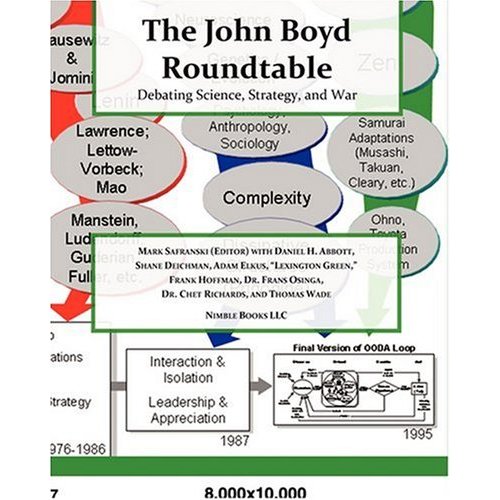
 – Mark Safranski (Ed.)


 – John Robb
 – Frans Osinga


 by Jeffrey Carr

 by
by 

