zenpundit.com » analytic

Archive for the ‘analytic’ Category

Bin Laden’s death and a White House or Palace

Tuesday, May 3rd, 2011

[ by Charles Cameron ]
.

Okay, you may groan and skip quickly to the next post or perhaps read with bemused interest every time I post here about Islamic eschatology — but in either case you might have hoped that the death of bin Laden would have no apocalyptic resonance whatsoever.

Sadly enough, Anjem Choudary — co-founder with Omar Bakri Muhammad of the UK’s Islamist group al-Muhajiroun – has a press release posted on his website today titled May Allah grant Sheikh Usama Martyrdom. It begins:

The announcement this morning of the death of Sheikh Usama Bin laden has been met with joy in the United States and by other enemies of Islam and Muslims. I would like remind everyone that someone much better and much more significant then Sheikh Usama Bin laden passed away in the past, namely the Messenger Muhammad (saw) and that this never stopped the Jihad nor the spread of Islam to the East and West. Indeed the Messenger Muhammad (saw) said that the day of judgement will not come until a group of Muslims conquer the White House.

The hadith in question comes from Sahih Muslim, Book 19, On Government (Kitab Al- Imara) 4483, and reads as follows:

Narrated Jabir ibn Samurah:
.
It has been narrated on the authority of Amir ibn Sa’d ibn AbuWaqqas who said: I wrote (a letter) to Jabir ibn Samurah and sent it to him through my servant, Nafi’, asking him to inform me of something he had heard from the Messenger of Allah (peace_be_upon_him). He wrote to me (in reply): I heard the Messenger of Allah (peace_be_upon_him) say on Friday, the day on which al- Aslami was stoned to death (for committing adultery): The Islamic religion will continue until the Hour has been established, or you have been ruled by twelve Caliphs, all of them being from the Quraysh. I also heard him say: A small force of the Muslims will capture the white palace, the palace of the Persian Emperor or his descendants. I also heard him say: Before the Day of Judgment there will appear (a number of) imposters. You are to guard against them. I also heard him say: When God grants wealth to any one of you, he should first spend it on himself and his family (and then give it in charity to the poor). I heard him (also) say: I shall be your forerunner at the Cistern (expecting your arrival).

I suppose I should apologize, but “until the Hour has been established” and “Before the Day of Judgment” are both clear “end times” references.

A poster on SunniForum quotes this hadith from Muslim, one of the two hadith collections regarded as most reliable and given the epithet “sahih” (authentic), and follows it with another, citing Al-Tabarani, Al-Mu’jam al-Kabeer 2.198:

Jabir b. Samura said: I heard the Messenger of Allah (may peace be upon him) say on Friday evening, the day on which Ma’ez al-Aslami was stoned to death (for committing adultery): A small force of the Muslims will capture the white house. I said: Kisra? he replied Kisra.

Be it noted that while “white palace” or “white house” would both be appropriate translations of the term used, Kisra clearly refers not to the house of the US President in Washington DC, but to the palace of Khosrau (Chosroes) I of Persia in Ctesiphon (now an impressive ruin in Iraq).

*

I expect I found the Anjem Choudary press piece following a lead from Aaron Zelin, and if so I owe him double thanks – because he also pointed me to this quote from a member of the Ansar Forum:

al-Qaeda are the people of the Victorious Sect, which recognizes the last of the banner to the Mahdi

The victorious sect is the one sect of Islam out of very many that holds fast to the Prophet’s teaching, see the hadith collected here. As UCLA historian Jean Rosenfeld noted in a comment on the al-Sahwa blog:

Al-Qaida took the Salafi myth of the Saved Sect and the Victorious Group and applied it to themselves. This is in line with the need for converts to see themselves as heroes carrying out a transcendent purpose.The Saved Sect was turned into an eschatological myth by bin Ladin and his compatriots. It is a group of warriors who sacrifice themselves for the Din, the Land, and the people. The members of the Sect are a vanguard and they are few. Not only are they attacked by their opponents, but fellow Muslims may persecute them. Thus, if the group remains small and is regarded as practicing fitnah and is denounced, that only validates the group’s certitude that it is the Saved Sect. Only this sect — out of “72 sects” (note: this is probably a symbolic number meaning “many”) — will attain paradise at the end time.

*

A couple more clear instances of end-times associations in the (Sunni) jihadist current…

So….General Kayani….

Tuesday, May 3rd, 2011

In which ISI safe house do you have Zawahiri stashed, anyway?

None dare call Pakistan a Rogue State….until last night.

We’re going to be hearing it a lot more often, I think. Which is good because it is reality.

Perhaps it is time to look at al Qaida through a historical, analytical, lens that questions “To what degree was it always a state-sponsored terrorist organization?”
Recommended Reading on Bin Laden’s Death:

CNAS Experts Comment On Death Of Osama bin Laden

Lieutenant General David Barno, USA (Ret.), Senior Advisor and Senior Fellow: “The death of Osama bin Laden marks the most significant U.S. victory to date in the U.S war on terrorism.  Its full consequences will play out in the coming weeks and months, but it is not too early to characterize this event as a true ‘game changer’ in a decade-long conflict. Bin Laden’s influence came not from his daily command and control of al Qaeda cells around the world, but from the inspiration that his iconic leadership provided. His taunting image, his fiery words and his seemingly unstoppable videos have all served to sustain the motivation of a growing franchise of like-minded groups. Bin Laden’s death unravels that critical motivational thread, one that is unlikely to be replaced.  Al Qaeda as a brand built on one man’s personality and apocalyptic vision has just suffered a blow that, over time, may well prove lethal.  For now, it remains a deadly, diffused organization – but its end may now be more imaginable.”

Foreign Policy (Daveed Gartenstein-Ross) –Don’t Get Cocky, America

Essentially, bin Laden sat at the top of a major multinational organization during the Afghan-Soviet war. Its members included fighters, aid workers, and other volunteers. It enjoyed a significant media presence, external donors, and widespread support. And when al Qaeda later engaged in a global fight against America, bin Laden and his companions similarly understood the media and the struggle for sympathy and allegiance throughout the Muslim world as crucial battlefields. In a 2005 letter to al Qaeda in Iraq leader Abu Musab al Zarqawi, bin Laden’s deputy Ayman al Zawahiri noted that “more than half of this battle is taking place in the battlefield of the media.” Zawahiri said that when it comes to attaining the caliphate, one of al Qaeda’s overarching goals, “the strongest weapon which the mujahidin enjoy, after the help and granting of success by God, is popular support from the Muslim masses.”

Col. W. Patrick Lang –#Are we there yet?

Any notion that some portion of Pakistan’s military and security institutions did not know of UBL’s long term presence in the suburbs of Islamabad is just silly.  Abbotabad is the home of Pakistan’s West Point.  Many retired officers live in the town.  We are to believe that the Pakistan equivalent of the FBI did not take an interest in this big compound with no telecommunications connectivity?  We are supposed to believe that?  I have too much respect for the Pakistanis to believe that.  They knew.  This is part of the phenomenon of “distancing” from the US that we have discussed so thoroughly here at SST.  If we think the Pakistanis are “allies,” then we are fools.

SWJ Blog –Bin Laden News Roundup, Bin Laden’s Abbottabad Compound and Robert Haddick’s A really bad day for bin Laden – and for Pakistan

Most notable was Obama’s willingness to shatter America’s relationship with Pakistan in order to take a gamble on getting bin Laden. For this raid is a black day for Pakistan and its relationship with the United States. As the White House background briefing on the raid makes clear, the United States kept the raid completely concealed from the Pakistani government. Combine this with the fact that bin Laden was found in a highly protected compound in a wealthy town near Pakistan’s capital, and a stone’s throw from a Pakistani military academy. Americans will be right to conclude that Pakistan was bin Laden’s long-time friend and not America’s. What little support Pakistan still enjoys in Washington will now likely melt away. Pakistan will have to look to China, its last friend, for the support it will need to survive.

That’s it.

Time for a Grand Strategy Board?

Monday, April 25th, 2011

The Gerousia

“I have not lived so long, Spartans, without having had the experience of many wars, and I see among you of the same age as myself, who will not fall into the common misfortune of longing for war from inexperience or from a belief in it’s advantage and safety”

Archidamus, King of Sparta

One thing on which most commentators, academics and former officials seem to agree is that the United States government has a difficult time planning and executing strategy. Furthermore, that since 1991 we have been without a consensus as to America’s grand strategy, which would guide our crafting of policy and strategy. This failing bridges partisan divisions and departmental bureaucracies; there are many career officials, political appointees and even a few politicians, who can explain the nuances of the Afghan War, or the Libyan intervention, the depreciatory tailspin of the US Dollar or America’s Russia policy – but none who would venture to say how these relate to one another, still less to a common vision.

Sadly, they do not, in fact, relate to one another – at least not, as far as I can discern, intentionally.

Few American policies or even military operations (!) in one country can be said to have been conceived even within a coherent and logically consistent regional strategy and it is not just common, but normal, to have DIME agencies working at completely contradictory purposes in the same area of operations. The interagency process, to the extent that it exists, is fundamentally broken and incapable of interagency operational jointness; and the institutional coordinating mechanism for any “whole of government” effort, the National Security Council, has become too consumed with crisis management. A mismatched prioritization of resources which leaves little time for the kind of long range planning and strategic thinking that allows nations to seize the initiative instead of reacting to  events.

It would be a useful corrective for the better conception and execution of US policy, for the President and the Congress to create a special board for grand strategy that could give presidents and key officials frank assessments and confidential guidance to help weave their policy ideas into a durable and overarching national strategy. One that might last beyond a few days’ headlines in The New York Times.

The President of the United States, of course has a number of bodies that could, should but do not always provide strategic advice. There’s the Defense Policy Advisory Board, an Intelligence Advisory Board,  the National Intelligence Council, the State Department’s Policy Planning Staff, the Office of Net Assessment and not least, the NSC itself and the Joint Chiefs of Staff, whose Chairman, by act of Congress, is the military advisor to the President and Secretary of Defense. While strategic thinking does percolate from these entities, many have very specific mandates or, conversely, wide ranging briefs on matters other than strategy. Some operate many levels below the Oval Office, are filled with superannuated politicians or have personnel who, while intellectually brilliant, are excessively political and untrained in matters of strategy. The Joint Chiefs, the professionals of strategy, are highly cognizant of the Constitutional deference they are required to give to civilian officials and are very leery of overstepping their bounds into the more political realms of policy and grand strategy.

What  the President could use is a high level group just focused on getting strategy right – or making sure we have one at all.

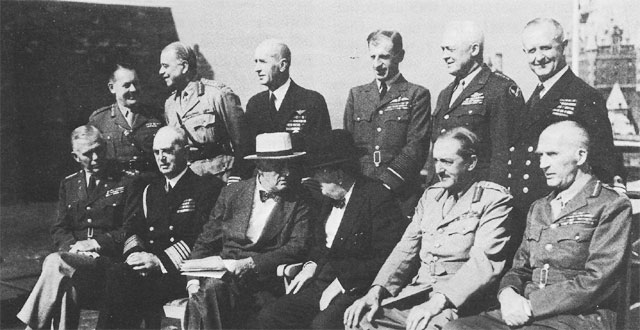
I’m envisioning a relatively small group composed of a core of pure strategists leavened with the most strategically oriented of our elder statesmen, flag officers, spooks and thinkers from cognate fields. A grand strategy board would be most active at the start of an administration and help in the crafting of the national strategy documents and return periodically when requested to give advice. Like the Spartan Gerousia, most of the members ( but not all) would be older and freer of the restraint of institutional imperatives and career ambitions. Like the Anglo-American joint chiefs and international conferences of WWII and the immediate postwar era, they would keep their eye on the panoramic view.

combined-chiefs.jpg

The Octagon Conference – FDR, Churchill and the Combined Chiefs of Staff

Here’s my grand strategy board in a hypothetical perfect world, unlike the one that prevails inside the beltway. I’m sure people will quibble with particular names or will suggest others. I freely admit, for example, that I do not have the best grasp of who our leading intellectual powerhouses are in the Navy, Air Force or the closed world of intelligence analysis and this impairs my ability to put together the list. Nevertheless, I’m trying anyway:

Let’s start with a group of acclaimed and eminent strategic thinkers who have demonstrated over a long tenure, their ability to consider matters of war, peace and statecraft as well as the nuances of strategic theory:

Thomas Schelling -Chairman
Andrew Marshall
Edward Luttwak
Colin Gray
Joseph Nye

Next, some senior statesmen:

Henry Kissinger
George Schultz
Zbigniew Brzezinski

Madeleine Albright

General officers and one colonel with a demonstrated talent for challenging conventional assumptions:

Lieutenant General Paul van Riper
General James Mattis 
General Jack Keane
Colonel John Warden

Two economists:

Alan Greenspan
Nouriel Roubini

Two scientists:

Freeman Dyson
E.O. Wilson

Mixed group of strategists, historians, practitioners and theorists:

David Kilcullen
John Robb
John Negroponte

Barry Posen
Antulio Echevarria

Chet Richards
Micheal Vlahos
Thomas P.M. Barnett
Stephen Biddle
Robert Conquest
Duane Clairridge
Jack Matlock
Martin van Creveld

Visionaries and Contrarians:

Nicholas Nassim Taleb
William Gibson
Ray Kurzweill
Andrew Bacevich

What are the problems with my grand strategy board (aside from having zero chance of coming into being)? 

For one, it is probably way too large. In my efforts to balance expertise in strategy with varied thinking it grew bigger than what is manageable in real life, if the group is to be productive.

Secondly, it is an exceedingly white, male and conservative leaning list – though to some extent that reflects the criteria of experience, the field of strategy itself and the nature of American politics.  Barbara Ehrenreich, for example, is definitely bright but her politics are fundamentally opposed to effectively maximizing American power in the world or the use of military force – thus making her of little use except as a voice of dissent.

Another limitation of this exercise is the idiosyncratic eclecticism of my approach – this was a blog post written over a few days in my spare time and not a methodical inquiry into who in American life would verifiably be the “best qualified” to help construct a grand strategy. There are “insiders” who command great respect within the national security, defense and intelligence communities who are unknown to the general public, or even this corner of the blogosphere, who would be enormously helpful to such a board. Finally, a grand strategy board would not be a panacea; it would be subject to all the inertial pressures that over time would reduce it’s ability to effect change, just as the Policy Planning Staff and the NSC have been “neutered” over decades by the forces of the status quo.

That said, the above group or one reasonably comparable to it could, for a time, markedly improve the construction of strategy , assuming American leaders are willing to enlist such advice, put aside short term political considerations and pursue long term strategic goals.

Whom would you nominate to a grand strategy board?

Grand Strategic Viewing:

A two part meditation, part ii: of monks and militants

Wednesday, April 20th, 2011

[ by Charles Cameron ]
See also part I: Scenario planning the end times

*

Today I received a book in the mail from Powell’s: C Christine Fair and Sumit Ganguly‘s Treading on Hallowed Ground: Counterinsurgency operations in Sacred Spaces. That covers the spread of my interests pretty concisely. I’m reminded that Dietrich Bonhoeffer, the German theologian who was complicit in several attempts to assassinate Hitler, once said, “Only he who cries out for the Jews may sing Gregorian chants” – again, the intersection of the sacred and harsh “facts on the ground”.

I am interested in this intersection partly because my father was a warrior and my mentor a priest and peace-maker, and partly because that mentor, Fr. Trevor Huddleston CR, taught me to anchor my life in the contemplative and sacramental side of things, then reach out into world with a view to being of service – an idea that he movingly expressed in this key paragraph from his great book, Naught for your comfort:

On Maundy Thursday, in the Liturgy of the Catholic Church, when the Mass of the day is ended, the priest takes a towel and girds himself with it; he takes a basin in his hands, and kneeling in front of those who have been chosen, he washes their feet and wipes them, kissing them also one by one. So he takes, momentarily, the place of his Master. The centuries are swept away, the Upper Room in the stillness of the night is all around him: “If I, your Lord and Master, have washed your feet, ye ought also to wash one another’s feet.” I have knelt in the sanctuary of our lovely church in Rosettenville and washed the feet of African students, stooping to kiss them. In this also I have known the meaning of identification. The difficulty is to carry the truth out into Johannesberg, into South Africa, into the world.

A few days ago I saw a film that encompasses that same range – from the contemplative to the brutal – telling the story of the Cistercian (Trappist) monks of Tibhirine in the Atlas mountains of Algeria, the warmth of affection that existed between them and their Muslim neighbors, the mortal threat they came under from Muslim “rebels” whose wounded they had cared for, their individual and group decisions to stay there in Tibhirine under those threats, and their eventual deaths.

*

It is an astonishing story, and my copy of John Kiser‘s book, The Monks of Tibhirine: Faith, Love and Terror in Algeria, which also tells that story, already has more tabs in it noting phrases and whole paragraphs I’ll want to return to than any altar missal – and I’m only two-thirds of the way through it.

I don’t wish to retell the story – I’d rather you saw the film, Of Gods and Men, in the theater if possible, on DVD if not, or read the book, or both – but a few of those book-marked passages stand out for me.

First, Algeria – in the words of Albert Camus:

Algeria is land and sun. Algeria is a mother, cruel and yet adored, suffering and passionate, hard and nourishing. More than in our temperate zones, she is proof of the mix of good and evil, the inseparable dialectic of love and hate, the fusion of opposites that constitute mankind

That sets the scene – and I am inescapably reminded of that comment of Solzhenitsyn, which I quoted at the end of my first response to Abu Walid:

Gradually it was disclosed to me that the line separating good and evil passes not through states, nor between classes, nor between political parties either – but right through every human heart – and through all human hearts. This line shifts. Inside us, it oscillates with the years. And even within hearts overwhelmed by evil, one small bridgehead of good is retained. And even in the best of all hearts, there remains … an uprooted small corner of evil.

Algeria brings that separation into sharp relief – the monks of Tibhirine knew and acted on their knowledge that it passes through each and every human heart.

Next, the Qur’an. When the monks first meet the militants, their prior, Fr. Christian de Chergé, begins to quote from Sura 5, and the militant leader completes the verse:

The nearest to the faithful are those who say “We are Christians.” That is because there are priests and monks among them and because they are free of pride

The view I wish to present here in describing the monks of Tibhirine is not a view from left or right but from a contemplative perspective — and while I do not believe it the only perspective to be considered, I think we do well to heed the insights of Christian monks — a group to whom even the Muslim scriptures give praise.

Then, the Rule of St Benedict:

Just as there is the zeal of bitterness that is evil and separates us from God and leads to hell, so also there is a good zeal which removes vices and leads to God and eternal life.

This, then, was the spirit in which the monks of Tibhirine served and loved their God – and their neighbors as themselves.

And finally, the Bible, from the book of Job:

My face is flushed from weeping and on my eyelids is the shadow of death; although no violence is in my hands and my prayer is pure.

*

It was with that shadow playing on his eyelids that Fr. de Chergé penned these words of immense generosity:

Facing a GOODBYE …

If it should happen one day — and it could be today — that I become a victim of the terrorism which now seems ready to engulf all the foreigners living in Algeria, I would like my community, my Church and my family to remember that my life was GIVEN to God and to this country.

I ask them to accept the fact that the One Master of all life was not a stranger to this brutal departure.

I would ask them to pray for me: for how could I be found worthy of such an offering?

I ask them to associate this death with so many other equally violent ones which are forgotten through indifference or anonymity.

My life has no more value than any other. Nor any less value. In any case, it has not the innocence of childhood.

I have lived long enough to know that I am an accomplice in the evil which seems to prevail so terribly in the world, even in the evil which might blindly strike me down.

I should like, when the time comes, to have a moment of spiritual clarity which would allow me to beg forgiveness of God and of my fellow human beings, and at the same time forgive with all my heart the one who would strike me down.

I could not desire such a death. It seems to me important to state this.

I do not see, in fact, how I could rejoice if the people I love were indiscriminately accused of my murder.

It would be too high a price to pay for what will perhaps be called, the “grace of martyrdom” to owe it to an Algerian, whoever he might be, especially if he says he is acting in fidelity to what he believes to be Islam.

I am aware of the scorn which can be heaped on the Algerians indiscriminately.

I am also aware of the caricatures of Islam which a certain Islamism fosters.

It is too easy to soothe one’s conscience by identifying this religious way with the fundamentalist ideology of its extremists.

For me, Algeria and Islam are something different: it is a body and a soul.

I have proclaimed this often enough, I think, in the light of what I have received from it.

I so often find there that true strand of the Gospel which I learned at my mother’s knee, my very first Church, precisely in Algeria, and already inspired with respect for Muslim believers.

Obviously, my death will appear to confirm those who hastily judged me naive or idealistic:
“Let him tell us now what he thinks of his ideals!”

But these persons should know that finally my most avid curiosity will be set free.

This is what I shall be able to do, God willing: immerse my gaze in that of the Father to contemplate with him His children of Islam just as He sees them, all shining with the glory of Christ, the fruit of His Passion, filled with the Gift of the Spirit whose secret joy will always be to establish communion and restore the likeness, playing with the differences.

For this life lost, totally mine and totally theirs, I thank God, who seems to have willed it entirely for the sake of that JOY in everything and in spite of everything.

In this THANK YOU, which is said for everything in my life from now on, I certainly include you, friends of yesterday and today, and you, my friends of this place, along with my mother and father, my sisters and brothers and their families — you are the hundredfold granted as was promised!

And also you, my last-minute friend, who will not have known what you were doing:

Yes, I want this THANK YOU and this GOODBYE to be a “GOD BLESS” for you, too, because in God’s face I see yours.

May we meet again as happy thieves in Paradise, if it please God, the Father of us both.

AMEN! INCHALLAH!

Algiers, 1st December 1993
Tibhirine, 1st January 1994

Christian +

*

I note with sadness today the death of Tim Hetherington, photo-journalist and co-director of the film Restrepo, together with that of his colleague Chris Hondros, in Misrata, Libya. Their cameras, and those of others like them, brought and will bring the grimness of war home, into the living rooms of peace.

More on Where Good Ideas Come From

Tuesday, April 19th, 2011

Dr. Von weighed in on Steven Johnson’s Where Good Ideas Come From with an extensive book review last December( I posted on Johnson here. On a related note, read Charles Cameron’s comment about the limitations of linear thinking here):

Where do New Ideas come from?

….But what exactly are innovation and creativity? The dictionary definition of innovation is ‘the introduction of new things or methods,’ while creativity is ‘the ability to create meaningful new ideas, forms or methods’ that are original and imaginative. So the key notion is the development of new ideas in whatever field one is working. A question naturally develops, which is where do new ideas come from? How do we begin preparing children now to be creative and innovative in the future? In the past, many would have first thought about the arts as being the training ground for creativity. Now, we realize that the development of the abilities and mindsets and skills necessary to be creative in every field of study is necessary.Steven Johnson’s new book, Where Good Ideas Come From: The Natural History of Innovation, provides the argument that there are seven common themes that have led to the vast majority of great ideas throughout history. He gives numerous examples of such ideas, ranging from Darwin’s development of the theory of evolution to the of the GPS system, from Google to the creation of the first mechanical computing devices centuries ago, and so on. It is an interesting read.Here is a summary of the seven themes that lead to good ideas. Keep in mind there is certainly some degree of overlap and relationships between the themes, but overall they can be thought of as distinct concepts.1. The Adjacent Possible: Even if you have an interest in some topic or problem, if there is not a good environment conducive to presenting the necessary pieces to solve the problem, good ideas will almost certainly not develop. You may be brilliant with some of the information (i.e. pieces of a puzzle) in your mind that is necessary to solve a problem, but if your surroundings are not able to provide the remaining pieces of information or experiences, you will endlessly search for them to no avail. If you are isolated from others who know something about your problem or issue, or if there is no means of gathering further information (which is becoming less of a problem with the advent of the Internet), or if your environment does not provide the physical infrastructure or supplies to finish building a new physical device, you will be unable to develop the Idea or solution to your problem.

2. Liquid Networks: Great ideas can develop when information is allowed to flow through a larger network. One possible network is a social network, or often and more specifically, a professional network. The focus of this is the ability to collaborate to solve problems. It turns out that there are almost no great ideas throughout history that have been developed in isolation or by an individual who did not need any help in the development of that great idea. One may think Newton or Einstein did their work in isolation, but this is not entirely true. Those two individuals come about as close as you can get to not needing a network to develop the laws of motion or relativity, but they relied on some level of feedback, reading others’ work, and ultimately talking and discussing issues with close colleagues and friends.
An interesting study was done that looked at how research groups reach the coveted ‘Eureka!’ moment, where a new discovery is made. It turns out that these rare moments of discovery or problem solving almost never happen in the lab! Instead, the ‘Aha!’ are yelled out at the conference table, where members of the group are throwing ideas around and sharing results of their latest work over the past week. The person who figures it out needs to have input they have not thought about from the larger group or network, before the grand idea is formed….

Read the rest here.


Switch to our mobile site
