zenpundit.com » legitimacy

Archive for the ‘legitimacy’ Category

Five Questions: An Interview with Chief Ajmal Khan Zazai

Thursday, December 24th, 2009

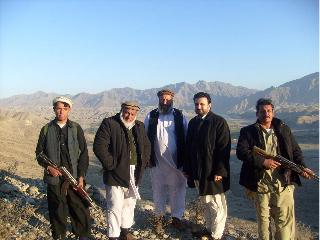
Those of you who also regularly read Steven Pressfield’s site, It’s the Tribes, Stupid have come across his interview series with Ajmal Khan Zazai, elected paramount tribal chief of his home district in the Zazi valley of Paktia province in Afghanistan ( near Tora Bora and bordering Pakistani Waziristan). Chief Zazai fought in the Soviet War and at one time, was imprisoned by Pakistan’s ISI. On March 15, 2000, the Taliban assassinated Chief Zazai’s father, Chief Raiss Afzal Khan Zazai in his family house in Peshawar, Pakistan.

As paramount chief, Chief Zazai raised a Tribal Police Force that is presently working with the U.S. Army’s 10th Mountain Division to secure the Zazi valley. Chief Zazai’s force has come under attack, as insurgents have fought to stop his efforts.  His commander, Amir Muhammad, has personally survived several assassination attempts in the last several months. On two occasions in 2008, warlord-financed hit men attempted to assassinate Chief Zazai. One attack nearly succeeded, leaving several wounded and one man deadzazai.jpg
Steve cordially arranged for me to ask Chief Zazai a few questions via email regarding his perspective on the historical background of the war against the Taliban and the current situation in Afghanistan. My questions are in bold type and Chief Zazai’s answers are in normal text:

FIVE QUESTIONS: AN INTERVIEW WITH CHIEF AJMAL KHAN ZAZAI:

1.  Some American academics have argued that the day of “the tribe” is long past in Afghanistan, having been battered by governmental intrusion and war since at least 1978, and that a better understanding of Afghan identity for Americans is to look at the “Qaum” and other very local loyalties. How accurate is that description?:

“Qaum” means “Tribe” in Pashtu and also in the Dari Language. 

The 1978 coup was not the first bloody revolution Afghanistan saw, as I have said on many occasions, Afghanistan has gone through many turmoils and turbulences throughout its history and has survived as a nation and country. For one to get convinced that after the 1978 Red revolution that the tribal structure was gone for good, then one would also have to argue how this tribal structure survived till 1978 when Ghengis Khan burned almost half of Afghanistan?  What about Hulagu Khan, Tamerlane, the Persian empire, the Mughals and prior to all that Alexander the Great? [The tribes ] having seen all these bloody empires and survive untill 1978 is amazing, isn’t it?

To justify the argument simply by referring to the 1978 bloody Red revolution and claim the tribal structure was gone, is dead and has vanished in Afghanistan, would simply be ignorance and a lack of understanding of the rich Afghan culture and Afghan way of life.

The Bonn Agreement appointed Hamid Karzai for 6 months as an interim President of Afghanistan back in 2002. When 6 months passed, did the UN or US call for election? No, of course not. Who then who appointed Mr. Karzai as a President for 2nd time to be the President of the transitional government? It was the “Loya Jirga” and not through the election process. A Loya Jirga is a pure Afghan Tribal process and procedure of making things happen!

Let’s take a look at how the current Afghan Constitution was approved  and came into an effect:

The constitution of Afghanistan was not approved by the Afghan Parliament and Senate as the Parliament and Senate did not exist at the time. In fact the constitution was approved by the “Loya Jirga”; although there was a large presence of the Warlords and criminals in both those Loya Jirgas, nevertheless they served their purpose.

Now, why would one argue that the tribal structure does not exist in Afghanistan or it’s a thing of the past? Closing our eyes from the truth does not mean the truth would vanish. We have a phrase in Pashto which means “One can not hide the sun with just two fingers”.

If one believes they need to find local loyalties in Afghanistan, the locals are the tribes. Why would some go around in [semantic] circles and confuse themselves? 

2.  In your interviews with Steve Pressfield, you discussed the presence of warlords in the Afghan government of Hamid Karzai, men with very bad records.  There have also been reports in the media, from time to time, of Ex-Khalqi Communists serving the regime. Are these men a similar problem to the warlords in your view?

When the Russians withdrew their forces in 1989 and left behind the Communist regime of Dr Najibullah, many thought that the regime would collapse in just days or in weeks, but Najibullah’s government survived for five long years despite the daily rains of rocket attacks on Kabul and only collapsed in 1992. Then the so-called Mujahideen took charge of Kabul and Afghanistan, but soon we saw that these power hungry men started fighting each other over the Throne of Kabul. Their bloody civil war of lasted from 1992 untill 1996 and turned Afghanistan into a pile of rubble.

 Many Afghans were turned against these so-called Mujahideen because these leaders and their commanders became involved in killing innocent men, women and children, looted people’s livelihoods and literally turned all of Afghanistan into a war zone. We witnessed that in just five years these “Mujahideen” warlords destroyed Kabul and all other major cities in Afghanistan. People started to hate them more than they hated the old Communists, so in a way, the crimes which were initially committed by the Communists were covered up when the Afghan people witnessed the subsequent brutality of these so-called Mujahideen leaders and commanders.

I strongly believe the Afghan civil war was also orchestrated by the  KGB/FSB in order to engage these Freedom fighters in Afghanistan and prevent them from crossing over to infiltrate the [formerly Soviet] Central Asian States, and also to cover the atrocities committed by the Red Army against the Afghans in Afghanistan. The KGB/FSB calculated shrewdly that if these “Mujahideen” leaders accomplished a united Islamic government in Afghanistan, it would spill over into the entire Central Asian countries. Although many believed in the West at the time that Russia was almost finished and gone, that was a mistake Westerners made in trying to understand the Russian mind set. 

I strongly believe that the Afghan Communists are responsible for the destruction of Afghanistan. They still have the Marxist-Leninist theory in their heads and we recently have witnessed that many of these Afghan ex-Communists are keeping close ties to Moscow. I believe these Khalqis and Parchamis are now part of the problem as they are now receiving support from Russia.   

3.  Afghanis, especially Pushtuns, have a well-deserved historical reputation as fierce fighters.  Yet there is more to life than war, even in a warrior society. What does a young Afghan man in his late teens or twenties hope for?  What would he see as “progress” or better times?

Much is been said about the Afghans, Pashtuns in the media and honestly I disagree with much of it because no nation, no tribe no people wish for a war as war only brings devastation, destruction and miseries.

Yes, the Afghans are great fighters, but that does not mean they wish for a war all their life. We needed to fight against the Russian invasion and I still strongly believe we have done the right thing defending our country and nation against Communism; as I said earlier, things went wrong when these so-called Mujahideen or Freedom fighters leaders started fighting one another. I believe every Afghan wishes for peace and stability in Afghanistan. Yes there are some who will continue fighting, but we all know they are small in numbers and are not significant. The reason many young men are part of the Taliban and other insurgents is the lack of employment , lack of better life conditions and of course lack of any positive attention from their government in Kabul. At this moment if you ask me, why are these young men are turning to Taliban and are fighting the US, NATO and the Afghan government? You will hear a simple answer from me and that is lack of employment opportunity for these youth who are mostly uneducated.

I will tell you my own experience: I was only 16 when I used to go to Afghanistan from Pakistan from time to time to fight against the Russians. I knew the consequences of being killed, but I was not going to Afghanistan in order to be killed, I was going to Afghanistan to fight the Russians. Now things are opposite, many young men are brainwashed by evil men and these young men wish to die, that’s why there are many suicide attacks now. I remember very well in my days when we were busy fighting the Russians, that we never had suicide bombers. This is very new to us and it has been brought form outside Afghanistan.

I believe the Afghan government and the US/NATO should provide training programmes to all those young Afghan men at around age of 16 and above who have lost the chance to go to school and get education. By learning skilled trades, I believe they will be in a position to earn a loaf of bread for themselves and their family and in this way we will prevent many young men from falling in the trap of believing being a suicide bomber means a life in the hereafter with the 72 virgins which will await them at the corridor of heaven.

4.  You have spoken at length with Steve Pressfield about the 10th Mountain Division and your positive relationship with them.  How successful have American and NATO units been in making connections elsewhere with Afghan tribal leaders compared to the 10th Mountain Division?

I do not have any information to the regard that if the US Army has any close contacts with other Tribal leaders. In my case, I have pushed hard for this partnership, regardless of any obstacles that were created for us to even have a decent understanding, but now it seems to be working. In the entire Afghanistan, I am the first Tribal Leader who denounced the Taliban and Al Qaeda openly and more practically, by forming TPF (Tribal Police Force) from my Tribesmen to fight these evil men without any financial assistance from the US Army, US Government, NATO or the Afghan Government. My TPF programme is by the people and for the people – I think it is on the same lines of your democracy “By the people and for the people”!

5). A friend of mine, the strategist Thomas PM Barnett, has been advocating a much greater international presence in Afghanistan, including not just NATO but China, Russia and India, with direct business investment as well as providing military and civilian aid workers. Would this development be a welcome one?

I believe this is a positive step in bringing a broader coalition and the entire International community to help and be involved in Afghanistan; but although this approach might be purely for business purposes, it could pose a future problem as most of these nations are not very sure of the US and NATO policy in the long term and present intentions. Afghanistan has always maintained very good and close relations with India, and throughout this friendship, India had no political ambitions and that what made India look good until the 90’s when India supported the Northern alliance. [As a result] I believe India has lost that status of being a neutral friend of Afghanistan. Also, the growing presence of Indians in Afghanistan is sending some disturbing alarms to our immediate neighbor (Pakistan).

Things needs to be balanced and Afghanistan needs a better understanding [of FDI] and not just bringing in anyone which could only lead to disruption and anxiety in long term. As an example, the large copper mines in Logar Province were won in a biding by a Chinese company – later it was revealed that the Chinese paid large kick backs to the minister of mines. In my opinion, involving more Chinese and Russian corporations would mean more corruption in Afghanistan.

Russian firms are already involved in Afghanistan. Most of them are involved in espionage and there are Chinese corporations and I believe they are doing the same. It would be more fruitful [for Afghans] for your friend to encourage Western corporations and companies to invest in Afghanistan.

Thank you, Chief Zazai.

Disputing Global Dystopia:Phillips on “Our Dark Age Future”

Sunday, August 23rd, 2009

Longtime reader Isaac recently alerted me to an important article in the most recent edition of PARAMETERS. Some excerpts:

Deconstructing our Dark Age Future” by LTC. P. Michael Phillips

….This article suggests that the system of Westphalian states is not in decline, but that it never existed beyond a utopian allegory exemplifying the American experience. As such, the Dark Age thesis is really not about the decline of the sovereign state and the descent of the world into anarchy. It is instead an irrational response to the decline of American hegemony with a naïve emphasis on the power of nonstate actors to compete with nation-states. The analysis concludes that because the current paradigm paralysis places a higher value on overstated threats than opportunities, our greatest hazard is not the changing global environment we live in, but our reaction to it.

….The state as described in this article differs greatly from the ideal imagined in the Westphalian paradigm. States do not universally enjoy unrestricted sovereignty. Nor are they equal. In fact, the sovereignty of a great number of the states in the international system is merely ascriptive.27 Because these imperfect conditions have more or less existed since long before 1648, it may be more helpful to think of any observed chaos in the international system as the natural condition, rather than a decline into disorder. If the system is not melting down, are so-called nonstate actors as significant for the long-term as they appear to be for the present?

….For some observers, this so-called NSA victory over a modern state underscores their warnings of impending global chaos. But in making this declaration, they fail to appreciate the source of Hezbollah’s strength: its dependent relationship with Iran, and to a somewhat lesser extent, Syria. Hezbollah did not create out of whole cloth its impressive array of modern weapons, nor did it independently develop the tactics, techniques, and procedures to employ them. Instead, Iranian weapons completed Hezbollah’s impressive arsenal, and Iranian Revolutionary Guard Corps advisers created the command and control center that coordinated the militiamen’s missiles.

Read the whole thing here.

This was an interesting read for me; many points with which to agree and disagree. A few thoughts in no particular order:

I am sympathetic to Col. Phillips’ criticisms of the overly abstract and detached nature of IR in regard to the nature of international law and sovereignty. You can certainly see that “arid” and “imperialistic” attitude in many academics and NGO activists who like to present their novel theories and interpretations as “international law” when they lack any historical basis whatsoever (and are usually gamed to be highly restrictive on the authority of Western sovereign states to use force and permissive/exculpatory of the actions of Marxist/radical/Islamist terrorists or insurgents).  Much of Phillips’ condemnation of IR smacking of unreality from a practitioner’s perspective is spot on.

That said, while definitely fuzzy and spottily adhered to in practice international law is not entirely “illusory”, nor is it a byproduct of 20th century Wilsonian American exceptionalism as Phillips argued. Perhaps Hugo Grotius rings a bell? Or Alberico Gentili? Or the long history of admirality courts? Like common law or an unwritten tribal code, international law has evolved over a very long period of time and does exert some constraint upon the behavior of sovereigns. Statesmen and diplomats think about policy in terms of the impression it will make on other sovereigns, and international law is one of the yardsticks they contemplate.  Admittedly, at times the constraint of international law is quite feeble but in other contexts it is strong. An American military officer, who can see firsthand the effect of creeping JAG lawyerism on command decisions on the battlefield ( in my view, greatly excessive and harmful ) and in the drafting of byzantine ROE, should know better than to make such a silly statement.

Phillips main argument is about the direction of international relations and non-state actors and he comes down firmly on the supremacy of states, at least the Great Powers and regional power states enacting an age-old realpolitik. Non-state actors are an overhyped and trendy threat and really amount to a continuation of traditional proxy warfare, where powers harass each other by subsidizing barbarian “raiders”; Phillips makes much use of Hezbollah as a modern example. Juxtaposed against the more extreme claims of the 4GW school or of Martin van Creveld, Phillips criticism looks reasonable because it is easy to make an empirical case that falsifies the absolutist claim that all states everywhere are in decline or that war is endemic.  They are not and war is not.

Matched against the real world however, Phillips’ argument suffers. In terms of sovereignty and legitimacy, the globe is a ball of swiss cheese – in what Thomas P.M. Barnett terms “the Gap” there are deep holes in Africa, Asia and even Latin America where states could be but are not. Somalia has not had a state since 1991. The Congo is a vast swath of warlordism and democide on a scale of millions (!). The Lebanese government is the de facto junior partner in Lebanon to the Hezbollah militia. Mexico next door is increasingly militarizing its law enforcement apparatus toward full-blown counterterrorism and COIN because of the erosion of state authority vs. the anarchy being spread by the narco-cartels. Are sovereign states more stable and authoritative than fifty years ago? Some are. Many are not. Others are relatively fragile potemkin villages. This is why 4GW theory, while historically flawed, retains analytical strategic resonance – in some regions of the world, the premises of 4GW apply very well. Better in fact, than the traditional schools of thought.

Again, Phillips has written an interesting and thought-provoking article with salient ideas. My problem rests more with the length to which he takes some of his assertions. Phillips swings the pendulum a little too far in the opposite direction where a synthesis would serve better.

ADDENDUM:

Dr. Charli Carpenter at The Duck of Minerva, weighs in on Phillips with  Westphalian Illusions.

Another Voice for Bottom Up Strategy in Afghanistan

Saturday, August 15th, 2009

Dr. Seth Jones of RAND.

Going Local: The Key to Afghanistan

It is striking that most Americans who try to learn lessons from Afghanistan’s recent history turn to the failed military exploits of the British or Soviet Union. Just look at the list of books that many newly deployed soldiers are urged to read, such as Lester Grau’s “The Bear Went Over the Mountain” and Mohammed Yousaf and Mark Adkin’s “The Bear Trap,” which document some of the searing battlefield lessons that contributed to the Soviet defeat. Yet, outside of some anthropologists, few people have bothered to examine Afghanistan’s stable periods. The lessons are revealing.

The Musahiban dynasty, which included Zahir Shah, Nadir Shah, and Daoud Khan ruled Afghanistan from 1929 to 1978. It was one of the most stable periods in modern Afghan history, partly because the Musahibans understood the importance of local power. Many U.S. policy makers have not grasped this reality, still clinging to the fantasy that stabilizing Afghanistan requires expanding the central government’s writ to rural areas.

Read the rest here.

Hat tip SWJ Blog.

Escobar on the Hojjatiyeh behind Iran’s Pasdaran Clique

Friday, July 3rd, 2009

Pepe Escobar writing in the Asia Times had a very interesting article on Iran’s hardline faction, centered in the Pasdaran and security services, and the religious group behind them, the Hojjatiyeh, a term which I had not previously heard ( hat tip to Russ Wellen):

Requiem for a revolution 

An iron-clad cast
The key man to watch is Major General Mohammad-Ali Jafari. In 2006, he became the IRGC’s top commander. At the time he was already thinking in terms of the enemy within, not an external enemy. He was actively working on how to prevent a velvet revolution.
It’s essential to remember that only a few days before the election, Brigadier General Yadollah Javani – the IRGC’s political director – was already accusing Mousavi of starting a “green revolution”. He said the Guards “will suffocate it before it is even born”.The IRGC has always been about repression. They literally killed – or supported the killing of – all secular political groups in Iran during the 1980s, especially from the left. After the founder of the Islamic Republic, Ayatollah Ruhollah Khomeini, died in 1989 they split into two sides. One side thought Iran needed a (slight) opening; they were afraid of a popular counter-revolution. Today, they are mostly reformist leaders or reform sympathizers.

The other side was, and remains, ultra-conservative. They include the already mentioned Jafari and Javani, as well as Ahmadinejad and his current Minister of Interior, Sadegh Mahsouli, the man who oversaw the election.

The religious strand runs parallel and overlaps with the military strand – this is always about a military dictatorship of the mullahtariat. So one must refer to the Hojjatiyeh, an ultra-sectarian group founded in the 1950s. Khomeini banned them in 1983. But they were back in force during the 1990s. Their spiritual leader is Ayatollah Mesbah Yazdi, known as “the crocodile” in Iran. Two weeks before the elections, Yazdi issued a fatwa legitimizing any means necessary to keep Ahmadinejad in power.

That was the green light to steal the elections. It’s essential to remember that Ahmadinejad replaced no less than 10,000 key government bureaucrats with his cronies in these past four years. These people were in charge of the maze of official organizations involved in the election and the vote counting.

Ayatollah Mesbah Yazdi believes that Iran’s supreme leader is chosen by Allah – when Allah tells the 86 members of the Council of Experts to find the leader. That’s how Khamenei was “found” in 1989 – even though he was (and remains) a minor scholar, and never a marja (source of imitation). What Yazdi wants is an oukoumat islami – a hardline Islamic government sanctioned by none other than Allah.

An informative piece. Read the rest here.

Escobar is also the author of Globalistan: How the Globalized World is Dissolving Into Liquid War and Obama Does Globalistan, published by Nimble Books.

Chavez Playbook Fails in Honduras

Sunday, June 28th, 2009

With an arrest warrant from the Honduran Supreme Court (hat tip NYkrinDC), the Honduran military today removed from office President Manuel Zelaya, a political protege of Venezuelan President Hugo Chavez, for proceeding with an illegal referendum designed to lay the groundwork for an unconstitutional additional term in office. Zeleya has been sent into exile in Costa Rica.

Zelaya’s referendum had been rejected by the Supreme Court, the Congress and even his own political party. Zelaya had ordered the military to support the referendum, when Army chief  Gen Romeo Vasquez refused, Zelaya attempted to fire him and subsequently took possession of the ballots by leading a large crowd of supporters to a military base where they had been impounded.

The Congress had already moved to investigate Zeleya’s fitness for continuing office prior to today’s coup. Venezuelans and Nicaraguans had been infiltrating Honduras in order to help Zelaya’s supporters with the referendum, and predictably, Chavez reacted with frustration at the setback dealt to Zelaya’s Bolivarian “soft coup” before it could even get off the ground to change the system itself.

Given Honduras unhappy history, military involvement in politics is naturally suspect, but in this instance, it was the civilian president who was determined to act against the constitutional order, operate outside it and break the rules in his own political interest. What happened in Honduras seems to me to be less a pro-active coup than a reactive counterrevolution by the military and broad elite. That Hondurans resented the hijacking of their country by the international left, orchestrated at home by a Chavez stooge is unsurprising, but the best strategic move now would be for the Honduran military to turn over power to Zelaya’s constitutionally designated successor, Congress President Roberto Micheletti, and let the civilian government take appropriate legal action, if any, against Zelaya and any foreign ALBA apparatchiks active in this crisis.

According to Zelaya’s initial comments, the USG has thus far,  mostly stayed out of this affair, refusing to sanction Zelaya’s removal, except to issue a mild reprimand against the Honduran military’s action.

ADDENDUM:

The State Department attempts to square the circle with intellectually incoherent positions.

ADDENDUM II:

Chirol at Coming Anarchy weighs in:

….Former President Manuel Zelaya, ally of Venezuelan thug in chief Hugo Chavez, sought to illegally hold a referendum on changing the Honduran constitution. This could have allowed him to run again in violation of the country’s current term limits. It’s a classic trick of would-be-dictators and luckily did not succeed. While some in the media and elsewhere are labeling this a coup, I would not not. It’s rather a ‘coup’ in the same sense as Turkey has experienced several times whereby the military removed leadership that was violating the country’s laws.

Some may argue that the military’s removal of the president by force was not democratic. Indeed, on the surface it would seem to be illegal, however given that the president was pressing on with his illegal actions, declared so by the supreme court, congress and the military, it was in fact a fairly reasonable and foreseeable response. While of course, I do not encourage such actions by any military in general, in the case of Honduras, the constitutionally mandated checks on presidential power had failed. Since Zelaya blatantly continued his illegal activity, we can in fact be thankful that he was ousted before having a chance to rewrite the constitution and turn the country into an even poorer, worse off Venezuelan satellite.

ADDENDUM III:

Having just suffered a humiliating electoral defeat at home, leftist Argentinian President Cristina Fernandez, vows to accompany Zelaya back to Honduras.


Switch to our mobile site

