zenpundit.com » intelligence

Archive for the ‘intelligence’ Category

Should I whisper, should I scream? – Abu Musab al-Suri redux, Pt 2

Thursday, March 1st, 2012

[ by Charles Cameron — typology of intelligence failures, analytic blind spot, millennial movements, prophecy as strategy, abu Musab’s end times chronology ]
.

To tie in with the first part of this double-post, let me quote Aaron Zelin again:

I’ll back that up with Jean-Pierre Filiu‘s observation that in Abu-Musab al-Suri’s reading of jihadist history, “events lead on from one another toward the appearance of the Mahdi” — and that in Abu-Musab’s own words, “We shall be alive, then, when Allah’s order comes.”

I’ll give a brief account of the chronology below. Let’s get on with this.

1.

I don’t believe that Richard Landes, my mentor at the Center for Millennial Studies, mentions Abu Musab al-Suri in his Heaven on Earth: The Varieties of the Millennial Experiences (again as with Furnish, I could be wrong) — but if there’s a single book that will convince you of the enormity of our blind spot when it comes to taking millennial movements seriously, it’s this masterwork — simply stunning.

The thrust of his book is that millennial movements have been quite deliberately overlooked twice by the grand narratives of western civilization — first by religious writers who were embarrassed by the repeated cycle of enthusiasm followed by failure of end times prophecies and retroactively marginalized the topic, and more recently by…

secular historians, determined to push religion into the background of their story, [who] were hardly interested in highlighting religious phenomena that even the ecclesiastical historians considered ridiculous.

It is to undo the damage that this two-fold blindedness has caused us that Landes writes his remarkable book, covering in extraordinarily wide-ranging scholarly detail and with insight and wit, that current in human fear and hope he terms “the most protean belief in human history: millennialism.”

2.

In other words, the “the most protean belief in human history” has been consistently disregarded for way too long by academics, pundits and experts.

Put that in the context of this trenchant paragraph from Richards Heuer‘s Psychology of Intelligence Analysis, just recently quoted and indeed highlighted by Clint Watts and John E. Brennan in their paper Capturing the Potential of Outlier Ideas in the Intelligence Community:

Major intelligence failures are usually caused by failures of analysis, not failures of collection. Relevant information is discounted, misinterpreted, ignored, rejected, or overlooked because it fails to fit a prevailing mental model or mind-set.

3.

Rejected and overlooked?

Even the Psalmist (118.22) knows the importance of what’s rejected:

The stone which the builders rejected has become the chief cornerstone.

And just in passing, I’d argue that two of the seven “outlandish, unthinkable, and wholly anomalous” outliers that Watts & Brennan offer as bulleted examples in their paper — the Khomeini and bin Laden events — would have shown up rather more prominently had a subset of analysts been tasked to keep an eye on millenialist and / or specifically mahdist movements.

4.

Very quickly, then, here are some of the recent reports regarding al-Suri from well-informed analysts which seem to pay little mind to the Mahdist strand in his strategic thinking:

  • Raff Pantucci‘s January 26, 2012 post Whither al Suri? focuses on the implications of al-Suri’s release and quotes Brynjar Lia — insightful, but no mention of Mahdism.
  • Aaron Zelin‘s February 3 Foreign Policy post on al-Suri’s release comes closest to mentioning an apocalyptic angle when he writes:

    Additionally, his lore will grow in light of an alleged vision he had this past August, which was relayed by online jihadist Jundi Dawlat al-Islam (“Soldier of the Islamic State”), a member of the important Shamukh al-Islam Arabic Forum. “I have been informed that the Shaykh [Suri] saw in the past days a vision that he will have an important role in Bilad al-Sham (Syria), we ask Allah that it becomes true,” the jihadist wrote. Suri’s release will be seen as a vindication of that vision by his supporters, and no doubt boost his influence.

    The significant role of Shams — “the apocalyptic theater par excellence” — in al-Suri’s narrative is something J-P Filiu emphasized (p. 189).

  • Bill Roggio‘s February 5 piece for Long War Journal is an excellent backgrounder as befits LWJ — but no mention of eschatological strategy there, either.
  • Jarret Brachman‘s February 6 Abu Musab al-Suri Still Matters Online at Chronus Global is a brief note, just a tip-off that al-Suri is still influential…
  • MEMRI‘s February 8, 2012 The Release of Top Al-Qaeda Military Strategist/Ideologue Abu Mus’ab Al-Suri from Syrian Prison – A Looming Threat makes no mention of al-Suri’s eschatological thinking, and neither does their more extensive report on al-Suri, Al-Qaeda Military Strategist Abu Mus’ab Al-Suri’s Teachings on Fourth-Generation Warfare (4GW), Individual Jihad and the Future of Al-Qaeda, to which their February 2012 post links.
  • And the Jamestown Foundation‘s Feb 10 piece by Murad Batal al-Shishani, Syria’s Surprising Release of Jihadi Strategist Abu Mus’ab al-Suri, in their Terrorism Monitor v 10 # 3 doesn’t mention the apocalyptic angle — and Jamestown is where I heard Ali A Allawi speak on Millenarianism, Mahdism and Terrorism: The Case of Iraq back in 2007!

    Curious…

  • Ah well, there’s always Zenpundit [vbg].

    5.

    Okay, it looks to me as though we’re still so focused on the “nizam la tanzim / system not organization” and “lone wolf / leaderless resistance” aspects of al-Suri’s work, significant as they are, that it’s easy to overlook that damned ridiculous “end times” stuff the fellow also considers important, strategically speaking.

    So for the record, here’s the chronology of future events as J-P Filiu recounts it:

    Events will unfold in the following manner: “The Arabian Peninsula will be preserved [from harm] until the destruction of Armenia, Egypt will be preserved until the destruction of the [Arabian] peninsula, Kufa will be preserved until the destruction of Egypt, the city of impiety [mad?nat al-kufr] will be conquered only after the great wars, and the Antichrist will appear only after this conquest.” The concentrically expanding path of apocalyptic devastation will then close in upon Palestine, the sanctuary of Judeo- Crusader “impiety,” where the ultimate confrontation with the Byzantines will take place in and around the city of Acre.

    Well, that’s part of it, but you should read Filiu’s pp 186-191 for a fuller account — and somebody, please send me a reliable translation of those last 100 pages of abu Musab’s Call if you have one!

    Sadly, I don’t read or speak Arabic.

    6.

    Okay, that’s it, I’ve shouted, or whispered or whatever.

    The books at the top of this post are:

    David Cook, Contemporary Muslim Apocalyptic Literature
    Timothy Furnish, Holiest Wars: Islamic Mahdis, Their Jihads, and Osama bin Laden
    Jean-Pierre Filiu, Apocalypse in Islam
    Richard Landes, Heaven on Earth: The Varieties of the Millennial Experience

    All four are worthy of your consideration.
    Should I whisper, should I scream? – Abu Musab al-Suri redux, Pt 1

    Wednesday, February 29th, 2012

    [ by Charles Cameron — abu Musab al-Suri, analytic blind spot, prophecy as strategy, redux redux redux ]
    .

    Abu Mus’ab al-Suri appears to have been released from prison recently. Speaking of which, we seem to have a blind spot.

    1.

    Here’s how an Egyptian activist who was in prison with Abu Musab in 2005 described their conversations, as reported three days ago in The Arab Digest:

    Abu Musab’s Philosophy in prison was about spreading hope, and what we have to do now to strengthen our connection to Allah; it is the strong power to restore trust in that we will prevail, and that the nation’s projects will not stop at the tyrants’ plans, and the occupation of Afghanistan. The prophet’s prophecies assures the return of Afghanistan and the rise of the black flags army from Khurasan. We will win and continue our role together till victory – May Allah relieve you Abu Musab – these words had a profound effect on our morale, they ended all of our pains in a moment when we foresee a future and our duties.

    As my analyst friend Aaron Zelin, who kindly pointed me to this extract and has himself written on al-Suri for Foreign Policy said:

    Yes indeed — Aaron is exactly right. And just to be clear on this, let me repeat myself:

    Abu Musab al-Suri is the man who “wrote the book” – the 1,500-page book – on jihad. And as you may remember, his book builds to what Jean-Pierre Filiu calls “a hundred-page apocalyptic tract” while also commenting that there is “nothing in the least rhetorical about this exercise in apocalyptic exegesis. It is meant instead as a guide for action.”

    And that black flags army from Khurasan? Those are not just any old black flags, they’re the banners of the “end times army” of the Mahdi.

    2.

    If you wrote a 1500 page book about jihad and devoted the last 100 pages to describing a set of “end times” prophecies that predicted where and in what order various battles would take place, would you have added those last hundred pages in because you had paper to spare and time to kill?

    Or would you have climaxed your book with those hundred pages because those end times prophecies were what the whole business was all about?

    And if, on the other hand, you were in the business of analyzing jihadist strategic literature with a view to understanding the jihadist enemy, would you more or less skip those last hundred pages because they’re just “repetitive theological justification” — because, let’s face it, it’s weird religious stuff?

    3.

    Abu Musab al-Suri is the man who introduced Peter Bergen to bin Laden, and of whom Bergen later wrote:

    He was tough and really smart. He seemed like a real intellectual, very conversant with history, and he had an intense seriousness of purpose. He certainly impressed me more than bin Laden.

    While he was at large prior to his capture in 2005, the FBI offered a $5 million bounty for information as to his whereabouts.

    And Abu Musab al-Suri’s 1,500 page Call to Global Islamic Resistance has been described by counter-terrorist researcher Brynjar Lia as “the most significant written source in the strategic studies literature on al-Qa’ida”.

    A source which has has a 100-page closing section which discusses “end times” hadith…

    WTF? you might well ask — WTF?

    4.

    Here’s one answer to WTT? It comes from Tim Furnish, who (unless I’ve missed it, always a possibility) doesn’t mention al-Suri in his book Holiest Wars: Islamic Mahdis, Their Jihads, and Osama bin Laden, which as you can tell from the subtitle is precisely and exactly about Mahdist warfare — but he does let us know, right in the first paragraph, why Mahdist warfare is important, telling us:

    Muslim messianic movements are to fundamentalist uprisings what nuclear weapons are to conventional ones…”

    Okay, perhaps you think Furnish is screaming — here’s something more like a whisper from J-P Filiu as to what a Mahdist movement might portend:

    An appeal to the imminence of apocalypse would provide it with an instrument of recruitment, a framework for interpreting future developments, and a way of refashioning and consolidating its own identity. In combination, these things could have far-reaching and deadly consequences.

    So. Should I shout, or should I whisper?

    5, 6, 7…

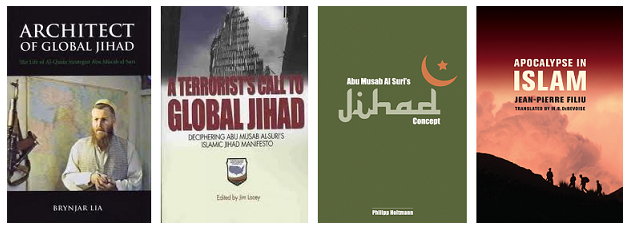
    This is getting too long, I have too much more to say, I want to tie this in with Richards Heuer and Clint Watts and the Psalms of David, so I’ll just list the books illustrated at the head of this post for your convenience now —

    Brynjar Lia, Architect of Global Jihad: The Life of Al Qaeda Strategist Abu Mus’ab al-Suri
    Jim Lacey, A Terrorist’s Call to Global Jihad: Deciphering Abu Musab al-Suri’s Islamic Jihad Manifesto
    Philipp Holltmann, Abu Musab Al-Suri’s Jihad Concept
    J-P Filiu, Apocalypse in Islam

    — and I’ll be back with a follow-up post tomorrow.

    Tech Issues and the Stratfor Scandal

    Monday, February 27th, 2012

    I am having some tech issues with posts – though as they do not seem to be impeding the vigorous blogging efforts of Charles Cameron, I suspect the problem is on my end. Highly aggravating.

    That said, here’s a must-read news story. Potentially very, very wide ripple effects:

    GizmodoWikileaks Reveals Privately Run CIA’s Dirty Secrets

    ….Stratfor’s clients are the US Government, other countries and military organizations, as well as private companies like Lockheed Martin, Northrop Grumman or Raytheon. They have a global network of spies in governments and media companies, including “secret deals with dozens of media organizations and journalists, from Reuters to the Kiev Post.” According to the emails, these spies get paid in Swiss bank accounts and pre-paid credit cards.

    Wikileaks says that the emails also reveal the creation of a parallel organization called StratCap. Apparently, this organization would use Stratfor network of informants to make money in financial markets. Wikileaks claims that the emails show how then-Goldman Sachs Managing Director Shea Morenz and Stratfor CEO George Friedman put StratCap in motion in 2009.

    Here are some of the highlights, according to Wikileaks:

    Global network of informants

    The Global Intelligence Files exposes how Stratfor has recruited a global network of informants who are paid via Swiss banks accounts and pre-paid credit cards.

    Who are their spies?

    Government and diplomatic sources from around the world give Stratfor advance knowledge of global politics and events in exchange for money. Stratfor has a mix of covert and overt informants, which includes government employees, embassy staff and journalists around the world.

    How they control their sources

    “[Y]ou have to take control of him. Control means financial, sexual or psychological control… This is intended to start our conversation on your next phase” – CEO George Friedman to Stratfor analyst Reva Bhalla on 6 December 2011, on how to exploit an Israeli intelligence informant providing information on the medical condition of the President of Venezuala, Hugo Chavez.

    Using secret information to make money in financial markets

    Stratfor’s use of insiders for intelligence soon turned into a money-making scheme of questionable legality. The emails show that in 2009 then-Goldman Sachs Managing Director Shea Morenz and Stratfor CEO George Friedman hatched an idea to “utilise the intelligence” it was pulling in from its insider network to start up a captive strategic investment fund. […] CEO George Friedman explained in a confidential August 2011 document, marked DO NOT SHARE OR DISCUSS: “What StratCap will do is use our Stratfor’s intelligence and analysis to trade in a range of geopolitical instruments,particularly government bonds, currencies and the like“…..

    Ouch.

    If I were George Friedman, I’d disappear about now.

    I have never been overly impressed with Stratfor’s analytical prowess, having had readers, like Morgan, who from time to time sent me copies of their subscription level publication. Sometimes, Stratfor would produce spot on work but I found some of their forecasts to be marred by bizarre tangents and improbable assertions. Had I realized at the time that Statrfor’s real effort went into collecting inside information to play the markets I’d have been more generous in my assessment.

    Geopolitical analysis was only Stratfor’s hobby. 🙂

    The speeds of thought, complexities of problems

    Wednesday, February 1st, 2012

    [ by Charles Cameron — instinct, rationality, creativity, complexity and intelligence ]
    .

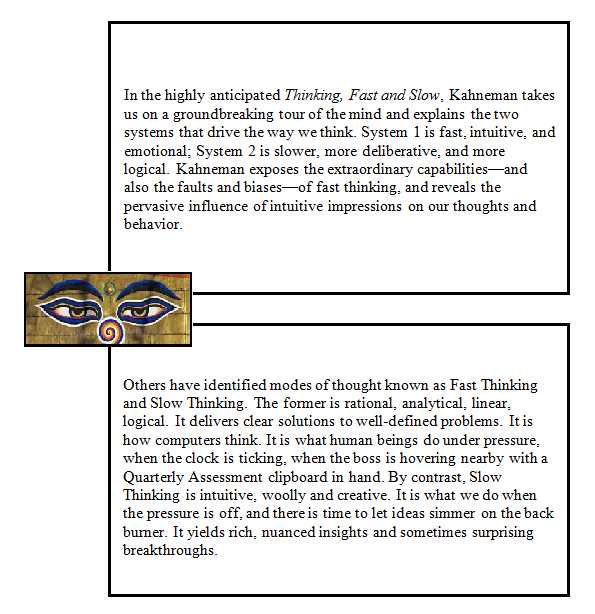
    Guy Claxton, Hare Brain, Tortoise Mind
    Daniel Kahneman, Thinking, Fast and Slow

    You might think, taking a quick glance at their titles, that these two books would be in substantial agreement with one another about the speeds of thought. But consider these two comments, in one of which the deliberative, logical mind is “slower” than the intuitive and emotional — while in the other, it is the rational mind that is “faster” and the intuitive mind which is “slower”. Brought together, the two quotes are amazing — it would seem that either one or the other must be wrong:

    \

    Happily, I don’t believe either one is wrong — I think it’s more a matter of there being three speeds of thought, and the two books in question using different terminologies to emphasize different distinctions between them.

    Here’s a more extended version of Guy Claxton’s position:

    Roughly speaking, the mind possesses three different processing speeds. The first is faster than thought. Some situations demand an unselfconscious, instantaneous reaction. … Neither a concert pianist nor an Olympic fencer has time to figure out what to do next. There is a kind of ‘intelligence’ that works more rapidly than thinking. This mode of fast, physical intelligence could be called our ‘wits’. (The five senses were originally known as ‘the five wits’.)

    Then there is thought itself — the sort of intelligence which does involve figuring matters out, weighing up the pros and cons, constructing arguments and solving problems. A mechanic working out why an engine will not fire, a family arguing over the brochures about where to go for next summer’s holiday, a scientist trying to interpret an intriguing experimental result, a student wrestling with an examination question: all are employing a way of knowing that relies on reason and logic, on deliberate conscious thinking. … Someone who is good at solving these sorts of problems we call ‘bright’ or ‘clever’.

    But below this, there is another mental register that proceeds more slowly still. It is often less purposeful and clear-cut, more playful, leisurely or dreamy. In this mode we are ruminating or mulling things over, being contemplative or meditative. We may be pondering a problem, rather than earnestly trying to solve it, or just idly watching the world go by. What is going on in the mind may be quite fragmentary. What we are dunking may not make sense. We may even not be aware of much at all. As the English yokel is reported to have said: ‘sometimes I sits and thinks, but mostly I just sits’. […]

    That third mode of thinking is the one Claxton identifies with “wisdom” — which is interesting enough. Just as interesting, though, is his identification of this slowest mode of thought with “wicked problems”:

    Recent scientific evidence shows convincingly that the more patient, less deliberate modes of mind are particularly suited to making sense of situations that are intricate, shadowy or ill defined. Deliberate thinking, d-mode, works well when the problem it is facing is easily conceptualised. When we are trying to decide where to spend our holidays, it may well be perfectly obvious what the parameters are: how much we can afford, when we can get away, what kinds of things we enjoy doing, and so on. But when we are not sure what needs to be taken into account, or even which questions to pose — or when the issue is too subtle to be captured by the familiar categories of conscious thought — we need recourse to the tortoise mind.

    I haven’t read either book, and I’d hope that Kahneman as well as Claxton actually addresses all three speeds of thought. But my immediate point is that the slowest of the three forms of thought is the one that’s best suited to understanding complex, wicked and emergent problems.

    And that’s the one that can’t be hurried — the one where the Medici Effect takes effect — and the one which provides Claxton with one of his finest lines, with which he opens his book, a western koan if ever I saw one:

    There is an old Polish saying, ‘Sleep faster; we need the pillows’, which reminds us that there are some activities which just will not be rushed. They take the time that they take.

    More on that front shortly, insha’Allah and the creek don’t rise.

    Ruminating on Strategic Thinking II. : Social Conditions

    Tuesday, January 3rd, 2012

    A follow up to Part I.

    How does a society, as opposed to individuals, develop a capacity for “strategic thinking” ?

    While war is an obvious answer, it is not an advisable first resort. First of all, although war teaches hard lessons about strategy, the costs of losing a war are high. Secondly, the costs of winning a war can be high. Thirdly, few people, relatively speaking to the number involved, have any direct input into genuinely strategic decisions during wartime; most will either gain tactical experience or be relegated to support functions. At best, wars seem to create a cohort of excellent tactical leaders with the potential to, someday, mature into strategic leaders or strategists. At worst, from a war, the wrong lessons may be drawn and institutionalized to create a future disaster.

    What conditions produce strategic thinkers for a state? A brief example from American history:

    Here are some of the US leadership of WWII, the postwar “Wise Men” and their Cold War successors, collaborators, thinkers and military chiefs:

    Franklin Roosevelt, Henry Stimson, Joseph Grew, Dean Acheson, Douglas MacArthur, Charles E. Bohlen, George F. Kennan, Paul Nitze, George C. Marshall , Harry S. Truman, Robert A. Lovett, Dwight D. Eisenhower  , John J. McCloy , W. Averell Harriman, William Donovan, James F. ByrnesChester Nimitz,  John Foster Dulles,  James Forrestal, Vannevar Bush,  Allen Dulles, Ernest King, Albert Wohlstetter, Dean Rusk, Hyman RickoverHerman Kahn, Robert McNamara,  Bernard Brodie, Fritz G. A. KraemerMcGeorge BundyRichard Nixon, Thomas Schelling, Henry Kissinger

    Some commonalities that these individuals shared, sometimes in pluralities and others in large majorities:

    Above average to very high IQ
    Middle class to high socioeconomic status
    Eastern Establishment
    Fraternal organizations
    Male
    Protestant
    Episcopalian
    Ivy League education
    Law 
    Politics
    Military service
    Diplomacy
    Wall St.
    Harvard
    Yale
    Princeton
    Columbia
    Harvard Law
    Military Academy
    University of Chicago
    Berkeley
    Skull & Bones
    Scroll & Key
    WWI
    WWII
    RAND
    Executive Branch
    Nuclear weapons/arms control/power

    This list could be expanded or reduced on a number of grounds. For example, the list is composed of men primarily because almost no women, with very few exceptions, even from elite backgrounds, had an opportunity during the first 2/3 of the 20th century to contribute to strategic decisions or policy making. We could also include other characteristics, but what we have is sufficient for some broad generalizations.

    • First, these men generally engaged in careers that featured complex activities that stressed and rewarded incisive analysis of factual scenarios, assessment of risk and potential benefits, intuitive judgment and organizational abilities – law, politics, the stock market, diplomacy and corporate leadership. A minority of the list had formal training in advanced mathematics.

    • Secondly, the men all had the social wherewithal and ambition to gain entry into educational and social institutions that were by definition, highly exclusive on more than a strictly meritocratic basis. For many from higher SES families, this presented no significant barrier but for the “outsiders” like Kennan, Nixon or Rickover, it was a formidable obstacle to overcome. In either case, there were social mores or even commonly held prejudices to which they had to adapt in order to “fit in”. Despite this demonstration of social intelligence, most members of our list were not  professional politicians (but those that were made an impact on American history much greater than that of an “average” president).

    • Thirdly, the presence of such overlapping experiential commonalities, while not creating a formal “strategic community” was probably sufficient to impart a strategic mentalité as to how the world really worked, red in tooth in claw, as well as implicit ideological assumptions as how the world ought to work, if perfected. This meant that strategic debates about American national security could take place within the framework of commonly held assumptions and reference points. While certain individuals might be disliked (MacArthur, Truman, Nixon) or regarded warily, with little trust (Nixon, FDR, Kahn) their strategic arguments were nevertheless widely understood within the elite and could be assessed on their merits – an excellent environment for building an elite consensus and continuity on matters of policy and strategy. This condition may be a political prerequisite for a democratic state’s formulation and adoption of a successful grand strategy.

    If we wonder why the United States has been so ineffective at strategy in recent years, maybe we should look at how our current (and most importantly, future) elite’s formative experiences have sharply diverged from their strategically gifted WWII-Cold War predecessors.


    Switch to our mobile site