zenpundit.com » intelligence

Archive for the ‘intelligence’ Category

Social and Individual Components of Creativity

Thursday, April 14th, 2011

This is very good. And it is fast.

I have enjoyed several of Steven Johnson’s previous books, Emergence and Mind Wide Open and his latest one, Where Good Ideas Come From looks to be a must read, though I think those of you who have read Wikinomics or works like Flow by Mihaly Csikszentmihalyi will find some of Johnson’s points in the video to be familiar as will those long time readers who have seen my views on horizontal thinking   and  insight.

My students watched this and reacted by defining themselves as those who were creative mostly through social collaboration but a decided minority required solitude and an environmental filter to think clearly and creatively – not a catalyst of a series of  social-intellectual stimuli. For them, the cognitive load generated by the environment amounted to an overload, a distracting white noise that short-circuited the emergence of good ideas.

This suggests to me that there are multiple and very different neuronal pathways to creativity in the brain and a person’s predisposition in their executive function, say for example the classic “ADHD” kid at the back of the class, may have different requirements to be creative than a peer without that characteristic. It also means that creativity may be subject to improvement if we can cultivate proficiency in several “styles” of creative thinking.

On Libya

Friday, April 1st, 2011

I thought it might be interesting to look at some views of the Libyan War and then offer some remarks of my own. Of course, readers are encouraged to read each source in full rather than just my excerpt: First up….

CNAS (Andrew Exum & Zachary Hosford)Forging a Libya Strategy: Policy Recommendations for the Obama Administration

….The most dangerous outcome for the United States is also the most likely, which is a stalemate that prolongs U.S. and allied military intervention in Libya. The relative lack of sophistication and organization among rebel fighting forces means they may be unable to regain the momentum in Libya and defeat Gadhafi’s forces in open combat absent significant direct and indirect support from U.S.and allied militaries – which is not explicitly authorized by UNSCR 1973 and might not be supported by the U.S. Congress.

A stalemate in Libya would effectively result in a de facto partition of the country with a severely underundergoverned and disorganized safe haven in eastern Libya for the rebels that could provide refuge for various militant and criminal groups capable of exporting violence and instability to other countries in North Africa and the Middle East. Such a scenario would prolong U.S. and allied military intervention as only a major Western investment in developing the independent governance, economic and security force capacity of eastern Libya would be likely to forestall this outcome. However, such an investment is highly unlikely due to the overarching fiscal constraints facing the United States and NATO countries and competing priorities.

Nice work on a very important policy brief by Exum and Hosford. This one was “tight”, written to the point, properly focused on strategic variables rather than getting bogged down in debatable specialist minutia and delivering clear policy option scenarios. Written in exactly the right mode for a White House/NSC staffer or deputy to SEC to digest and disseminate to their boss or peers. Kudos, gents.

I think Ex and Hosford have correctly diagnosed Libya as a potential albatross for the US from which we stand to gain very little benefit even in the best case scenario. I disagree with their assertion that it would be a tolerable outcome to leave Gaddafi in power. No, that ship has already sailed and we have had enough Lockerbies. To imagine that there will not be ongoing blowback from a rump Gaddafi regime in a fragile neighborhood with which the US will repeatedly have to deal is just not at all realistic.

The Allies badly wanted Gaddafi out. They will have to be pressured now to follow through and the US needs to make it clear that we will neither babysit an enraged, cornered, Gaddafi for the next seven years, tying down an aircraft carrier group and costing the US taxpayer billions, nor we will accept the Brits and French hanging Gaddafi’s triumphant survival on our doorstep as an “American defeat” while skating away diplomatically (which is their Plan B if we refuse to do a Panama type operation for them). They will have to finish the job on the ground themselves and ensure Gaddafi’s death or departure with our support, but not the reverse. Or Paris and London can help build a real rebel army, salted liberally with PMC units and SOF “advisers” to stiffen spines.

CRS Report ( Christopher M. Blanchard) – Libya Unrest and US Policy

….The complexity of these factors and the stress that ongoing fighting places on their interrelationships creates challenges both for Qadhafi supporters and opposition groups. As both parties seek to navigate the political waters of the upheaval and look ahead to potential postconflictscenarios, they face difficult questions about current tactical choices and future means for promoting national reconciliation and governing effectively.

For the opposition, the question of foreign military intervention is complicated by opposition leaders’ desire for external assistance and their appreciation for the strong nationalist, anticolonial sentiment shared by most Libyans. Internally, political differences and competing demands among the opposition’s constituent groups may complicate the maintenance of a united front against Qadhafi counterattacks and complicate efforts to speak with one voice in dealings with the international community. Other regional examples suggest that such internal differences may prove even more challenging for any transitional authority in the aftermath of the conflict…

In a sea of government waste and middling competence, the Congressional Research Service stands out as a gem, giving the taxpayers a tremendous informational “bang for the buck” in reports prepared by experts on a vast array of subjects. While not an advocacy piece, the report is a valuable “backgrounder” on the Libyan War of a kind that you cannot get from the MSM.

Marc Lynch – Why Obama had to act in Libya

….And my conversations with Arab activists and intellectuals, and my monitoring of Arab media and internet traffic, have convinced me that the intervention was both important and desirable.  The administration understood, better than their critics, that Libya had become a litmus test for American credibility and intentions, with an Arab public riveted to al-Jazeera.  From what I can see, many people broadly sympathetic to Arab interests and concerns are out of step with Arab opinion this time.    In the Arab public sphere, this is not another Iraq — though, as I’ve warned repeatedly, it could become one if American troops get involved on the ground and there is an extended, bloody quagmire.  This administration is all too aware of the dangers of mission creep, escalation, and the ticking clock on Arab and international support which so many of us have warned against.  They don’t want another Iraq, as Obama made clear…. even if it is not obvious that they can avoid one. 

Lynch is an Arabist, and while the internet traffic aspect is skewing the demographic, al-Jazeera coverage is a dominant information effect in Arab public with limited literacy. It is sort of the Walter Cronkite effect from the 60’s in play again, if the primary trusted source is broadcasting an interpretation, it takes on the air of truth for a majority of viewers. That said, it matters very little whether al-Jazeera is giving kudos to the US if the average rebel can’t fire an RPG, quickly unjam and reload his AK-47 under fire, get water or food in the field or dig simple trench and sandbag defenses. Guys milling about nervously out in the open road, brandishing weapons and arguing amongst themselves will get their clocks cleaned by any opponent with even marginal military training and leadership. Gaddafi’s military forces are fourth rate – this is not Saddam’s army of 2003, much less of 1991 – but they can handle untrained and leaderless groups easily enough.

Which brings us to…..

Thomas P.M. BarnettArming the Libyan rebels

…There’s also al-Qaeda in the Islamic Maghreb (AQIM), but that group has frankly struggled to be taken seriously as a force, as it’s mostly a relabeling of an existing group that was going nowhere (bigger the territory in the title, more likely, in my mind, that it’s not exactly succeeding anywhere). Up to now, no one has portrayed that group as Libyan-centric.  Yes, they will show up, but that’s standard.  The reality, as noted in the piece, is that you have to train on what you provide, so we’ll have people on the ground (besides the CIA already there).  If things go really sour, then we burn that bridge when we come to it.  But this is not a logical showstopper.  A Libyan long divided in two and suffering civil conflict will do the same – or far better – for AQIM than a concerted arms push to dethrone the guy.  So, again, factor them in as the cost of doing any sort of business here, but do not elevate them into the decision-tilting bogeyman, because they’re not, and speculating in the press doesn’t make them so.

Going the Reagan Doctrine route was my original preference on Libya and I am still in favor of sponsoring an insurgency war against Gaddafi, with a couple of caveats.

First, SECDEF Robert Gates’ strong aversion to doing this gives me some pause, given his background as a former head of the IC and his access as SECDEF to our best current intelligence (which, admittedly, may not be that much). His judgment should be given considerable weight. Secondly, where are the Arabs? A hundred or so experienced NCO’s and junior officers from Egypt and KSA would be of immense help in establishing unit discipline and basic training for the rebels. The Saudis very well might be contributing substantial amounts of cash but that’s no longer good enough. The Arab League needs to show it’s alleged support for helping the rebels and removing Gaddafi with boots and not just empty words.

Reflexively, American policy makers face a great temptation to “own” the crisis and micromanage the Libyan War against some impossibly unrealistic standard of success. Let’s resist it. We should help drive nails in Gaddafi’s coffin but we don’t need to be the main hammer. Sometimes less is more and the Libyan rebels getting rid of their tyrant badly is better than us doing it for them well.

Inspire #5: between front and back covers

Thursday, March 31st, 2011

[ by Charles Cameron ]

*

Okay. When what goes into the opening paragraphs of an editor’s note at the front of a magazine corresponds pretty exactly to what’s on the back cover, you have a sort of conceptual bracket that’s “holding” the rest of the content, and it pays to pay attention.

Here are the first paras of the “Letter from the Editor” that is featured on page 5 of the latest issue of AQAP’s English language magazine, Inspire, immediately after the front cover and index pages:

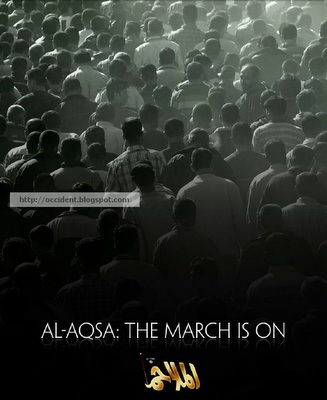
The cover of this issue is about the Tsunami of change that is sweeping the Arab world. With the removal of the despots, the ummah will speak its voice, and when it does, it will chant: Here we start and in al-Aqsa we’ll meet.The biggest barrier between the mujahidin and freeing al-Aqsa were the tyrant rulers. Now that the friends of America and Israel are being mopped out one after the other, our aspirations are great that the path between us and al-Aqsa is clearing up.

There could be no freeing of Palestine with the presence of the likes of King Abdullah to the East, Hosni Mubarak to the West and al-Saud to the South. Now that Hosni is gone, we heard the Imam of the Friday prayers praying: “O Allah we ask you to allow us to meet in al-Aqsa,” and the millions in Tahrir square roared with one voice: Amin.

Note that this explicitly ties the front cover (“about the Tsunami of change that is sweeping the Arab world”) with the back (“Here we start and in al-Aqsa we’ll meet”), shown here:

inspire-5-al-aqsa-the-march-is-on.jpg

[ graphic courtesy of Ibn Siqilli ]

As I’ve noted before, al-Aqsa isn’t just the focal point of the Palestinian / Israeli question, nor it is only the place at which the Prophet alighted from his steed, Buraq, and ascended to receive the divine instructions for prayer in the Miraj — it is also the destination of the Mahdi‘s victorious army in the Khorasan strand of ahadith.

Indeed, it has been suggested that the Pierced Rock of the Dome of the Rock in al-Aqsa is closely related to the Black Stone of the Kaaba. Kanan Makiya, in his part-fictional part-documentary book, The Rock, quotes Charles Matthews‘ translation of Burhan al-Din ibn Firka al-Fazari‘s Kitab Ba’ith al-Nufus ila Ziyarat al-Quds al-Mahrus (The Book of Arousing Souls to Visit Jerusalem’s Holy Walls) from Matthews’ Palestine: Mohammedan Holy Land:

Verily, the Kaaba is in an equivalent position to the Frequented House in the Seventh Heaven, to which the angels of Allah make pilgrimage. And if rocks fell from it, they would have fallen on the place of the Rock of the Temple of Mecca [i.e. the Black Stone]. And indeed, Paradise is in the Seventh Heaven in an equivalent position to the Holy Temple (in Jerusalem) and the Rock; and if a rock had fallen from it, it would have fallen upon the place of the Rock there. And for this case the city is called Urushalim, and Paradise is called Dar al-Salam, the House of Peace.

Indeed, David Roxburgh mentions all these matters, writing in Salma Khadra Jayyusi et al., The city in the Islamic world, vol. 1. p 756:

This movement corresponded to other efforts — before, during, and after the Crusades — to establish “geo-theological” connections between Jerusalem and Mecca, whose preeminent sanctity was inviolable up until the end of days. Examples linking Mecca to Jerusalem include the Prophet Muhammad’s nocturnal journey from Mecca to Jerusalem (isra) and his ascension from Jerusalem to the throne of God (miraj); the underground joining of the waters of Zamzam to Silwan (var. Siloam) during the “feast of the sacrifice” (id al-adha); and the transfer of the Kaba and its black stone from Mecca to Jerusalem during the last days. these various traditions linked Jerusalem to Mecca, sometimes by sets of doubled features, in a near symmetry and in a calendar that will culminate during the end of days.

So there’s an eschatological dimension to all these parallelisms, too…

*

And if for no other reason, then because I happen to love doubled features, symmetries and analogies of all sorts (and we were already speaking of graphics and Inspire #5), let me add this:

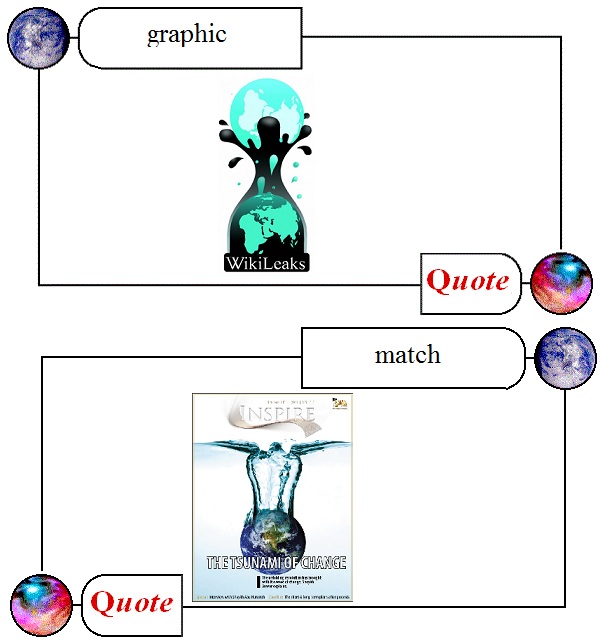
A tweet from @webradius via @azelin that I saw today noted that “the cover of Inspire 5 is remarkably similar to a wikileaks logo”.

I liked it.  And I’ve translated it here into my own DoubleQuotes format:

quographic-match.jpg

For those who are unfamiliar with the phrase, graphic match is another term for match cut — the gambit whereby one shot in a movie is directly juxtaposed to another with which it bears a close resemblance – essentially, a film director’s equivalent of rhyme.

Wikipedia gives two classic examples which are of particular interest to me because there is a “rhyme” between them, too, albeit a far more indirect one – the second being an hommage to the first.

Stanley Kubrick‘s 2001: A Space Odyssey contains a famous example of a match cut. After an ape discovers the use of bones as a tool and a weapon, there is a match cut to a spacecraft or satellite in orbit. The match cut helps draw a connection between the two objects as exemplars of primitive and advanced tools respectively.

Michael Powell and Emeric Pressburger‘s A Canterbury Tale contains the influence for the 2001: A Space Odyssey match cut in which a fourteenth century falcon cuts to a World War II aeroplane. The sense of time passing but nothing changing is emphasised by having the same actor, in different costumes, looking at both the falcon and the aeroplane.

*

Conclusion:

Parallelisms really are worth watching — always bearing in mind that one thing is never quite the same as another…

Of war and miracle: the poetics, spirituality and narratives of jihad

Wednesday, March 30th, 2011

[ by Charles Cameron ]

*

Issue #5 of the AQAP magazine Inspire is now available for viewing.

I am reasonably confident that with attention focused on such things as al-Awlaki‘s response to the various uprisings across the middle east, the delightful computer graphic (a throw back to the era of green print on black screens) which shows Ben Ali and Mubarak “booted” and Gadhafi and Saleh “in progress” – and the translation of a chunk of Abu Musab as-Suri on “Individual Terrorism Jihad and the Global Islamic Resistance Units” – a lot of eyes will glaze over during the course of reading “My Life In Fallujah” (pp. 56 ff).

The piece sounds promising – something to read about Fallujah from the enemy viewpoint for after action / lessons learned purposes… but then it gets into miracles:

The brothers received extraordinary miracles from Allah as a sign to strengthen them and these miracles were in all different forms. It got to the point where some of the things that occurred might not have been believable to the brothers had they not seen them with their own eyes but that is the grace of Allah which He bestows on whom He wills.

… and my bet is that snoring ensues…

Though not among the readers to whom it is pitched.

.
One:

What if we don’t regard the piece as a mirror for our own knowledge of events in Fallujah, but as an opening into the enemy’s grand narrative and – gasp – spirituality?

The piece continues:

Now let me relate some of the stories of fighting with the enemy and the miracles some of the brothers received. I will start mentioning some of these great miracles

There was a brother named Abu az-Zubair as-Sana’ani. He was killed at the beginning days of the battle. We used to go out in the daytime to engage with the enemy. Hardship and severe exhaustion were afflicting us due to the hot weather that was in the beginning of Ramadan.

So that brother came at the time of afternoon and sought permission from the Amir to break his fast. Some brothers advised him to have patience and suggested to him that he could have a shower and then rest for a while. The brother went inside to sleep out of fatigue and we were sitting in front of that house. The brother didn’t sleep long and we saw him coming out towards us with a cheerful face saying to us that he had seen a dream while he was asleep. The brothers asked him what was it; he told them that he saw a very beautiful woman coming to him, carrying a plate full of all kinds of fruits. She was waking him up, standing by his head and telling him: O Abu az-Zubair, don’t break your fast. You are invited to break your fast with us today. The brother then said that he felt comfort and relief. There was a brother called Abu Tariq who interpreted dreams so he told him that by Allah’s will, it will be something good. After that the brother decided to continue fasting.

We had a timetable for twelve people to cook food and that day was his turn. He went to the kitchen and we stayed outside, sitting next to the wall of that house so that we weren’t seen by the spy planes. We stayed there until it was about time to break fast. Suddenly an F-16
jet showed up in the horizon and targeted that kitchen with a missile where that brother was! A while after when the dust had settled, we went in the kitchen and saw that brother had been martyred. It was amazing how the smell of musk was all over the room, how the smile was on his face!

Thereupon the brothers’ moral was raised and they were making takbir. These were from the unforgettable moments.

It seems wise to compare this with the Miracle of Uthmaan recounted by Abdullah Azzam on p. 27 of his book, The signs of Ar-Rahmaan in the Jihad of Afghanistan — indeed, I’m surprised Inspire didn’t make the connection:

One morning Uthmaan (ra) said: Last night I saw Rasulullah sallAllaahu alayhi wa sallam in my dream, and he said: Oh Uthmaan, break your fast with us. He was martyred that same day, whilst in the state of fasting.

If one considers such stories not as “superstitious” or examples of “magical thinking” – one easy way to discount them – nor as “diabolic” and emblematic of a “false religion” – another – if, in fact, one reads them with some empathy for their content as faith-narratives, they are profoundly moving, and will no doubt be so to many of their intended readers.

This particular narrative – an earthly fast broken in heaven – could well be a motif in the Aarne-Thompson classification system for folkloric motifs.

Note also the reliance on dreams and dream interpretation – a reliance which also figures prominently in the transcript of bin Laden‘s discussion of 9/11.

.
Two:

Another miracle was the incident of Abu Abd ar-Rahman at-Turki who was a student of knowledge that memorized the Qur’an and the six books of hadith. He was amongst a group that went out to confront a breakthrough of the enemy. While the brothers were gathered to organize a defensive plan, this brother made takbir and rushed towards the enemy. Some brothers called him back but he didn’t pay attention to their words. He shouted back to them saying “I am seeing the hoor! I am seeing the hoor!” When this brother reached the enemy’s area, he was shot by a tank shell leaving his lower body completely severed. Some brothers managed to drag him out of there to a safe house which I was in. Even though the brother was between consciousness and unconsciousness, he was still advising brothers to fear Allah and to keep firm upon the truth. His lower half was ripped out, yet he was still reassuring the brothers and would always raise his vision upwards telling them that he is seeing the hoor coming, and that they should keep firm because this is the path of jannah. At hearing that, the brothers’ spirits were high and they felt relieved. Abu Abd ar-Rahman declared the shahada and then kept fainting until his soul departed his body. At that point we smelled the musk coming out of him and saw peace on his face. This smell of musk from the mujahidin would be something that was smelt regularly.

This “smell of musk” too (also found in the story of Abu az-Zubair above) is a regular feature of martyrdom tales, and features in the same work by Azzam, for instance in this report:

Moulana Arsalaan narrated to me:A student named Abdul Baseer attained shahaadat while with us. It was very dark. Fathullah, another mujaahid, and I went in search of his body. He said to me: “Is the Shaheed close. I perceive a fragrant scent”. I picked up the scent, and we reached the body by following the scent. In the darkness, I could see a noor (light) in the blood, which was gushing forth from his wound.

Indeed, as I have pointed out before, this motif has a parallel in the Catholic tradition of the “odor of sanctity” – “the perfume-like scent given forth by the bodies of saints during their lifetime or after death … symbols of the fragrance of extraordinary virtue” [as defined in Fr. John Hardon’s Modern Catholic Dictionary].

It appears in the Arthurian legends, too, as Malory describes the death of Sir Lancelot – notice here, too, the motif of the joyous dream:

And so after midnight, against day, the Bishop [that] then was hermit, as he lay in his bed asleep, he fell upon a great laughter. And therewith all the fellowship awoke, and came to the Bishop, and asked him what he ailed. Ah Jesu mercy, said the Bishop, why did ye awake me? I was never in all my life so merry and so well at ease. Wherefore? said Sir Bors. Truly said the Bishop, here was Sir Launcelot with me with mo angels than ever I saw men in one day. And I saw the angels heave up Sir Launcelot unto heaven, and the gates of heaven opened against him. It is but dretching of swevens, said Sir Bors, for I doubt not Sir Launcelot aileth nothing but good. It may well be, said the Bishop; go ye to his bed, and then shall ye prove the sooth. So when Sir Bors and his fellows came to his bed they found him stark dead, and he lay as he had smiled, and the sweetest savour about him that ever they felt.

.
Three:

There was a brother named Abu Dujanah at-Taifi. As soon as he entered Fallujah at the beginning of the battle, he asked the brothers to let him go to the front lines but the brothers told him that he had to learn shooting first. He replied, “By Allah! I won’t be anywhere except the front lines.” His brother was present there so they agreed to his request and allowed him to go there.Thereupon he said: ”By Allah! If the Americans come forward, then Allah will see from us that which He loves.” He then went to stay inside a trench to keep an eye on the front lines.On the second day when he saw the enemy breaking through, he jumped out and got ready to strike them with an RPG but before he could fire it, he was struck by a tank, and as a result, his body was torn apart. His body stayed there for six days before we were able to retrieve it.

To our surprise, blood was still coming out of his body even though the weather was so hot that if you were to place a piece of meat outside for half a day, it would eventually get rotten.

His blood was seeping as if he was just killed and his index finger was in the position of tashahud [that section of Muslim prayer where the index finger is raised while reciting the shahada or confession of faith]. His brother was a little bit sad at hearing the news but once he saw his body, he felt so much comfort.

E Cobham Brewer’s Dictionary of Miracles: Imitative, Realistic, and Dogmatic looks to be a terrific source for the kind of research I’m doing here – that’s the “Brewer” of Brewer’s Dictionary of phrase and fable – and p 372 of the 1894 edition has a section on “Bodies of Saints Incorruptible” prefaced by a quotation from Psalm 16.10: “Thou wilt not suffer Thy Holy One to see corruption”.

His body preserved, his finger raised in the gesture of  salat … powerful.

.
Four:

Another incident that has to be mentioned is when the Americans were breaking-through from the direction of the Shuhada district. The brothers in that area were few in numbers so they were attacked fiercely and their lines were nearly broken but all praise be to Allah, it started drizzling all of a sudden, and then the brothers were strengthened and encouraged. The enemy was fleeing so we did not know whether they fled because of the brothers fighting or because they saw something else. The enemy acted as though they had been frightened by something. The brothers only numbered six. The enemy was massive as they were accompanied by tank corps and armoured vehicles but their withdrawal was bizarre. At that time we remembered the verse of the Qur’an where Allah says:

And sent down upon you from the sky, rain by which to purify you and remove from you the evil [suggestions] of Shaytan and to make steadfast your hearts and plant firmly thereby your feet [8: 11].

Once again, the motif of merciful rain should not be unfamiliar to us – if not from the New Testament‘s “He makes His sun rise on the evil and on the good, and sends rain on the just and on the unjust” then at least from Shakespeare‘s “The quality of mercy is not strain’d, / It droppeth as the gentle rain from heaven / Upon the place beneath…”

.
Five:

How many references to literary analysis, or archetypal analysis for that matter, can you find in Heuer‘s classic Psychology of Intelligence Analysis?
Elementary, my dear Watson — for humans

Wednesday, March 2nd, 2011

[ by Charles Cameron ]

On the face of it, the two events described here – the super-match in which IBM’s Watson computer beat two human Jeopardy champs, and the crowd-sourced protein-folding experiment in which nearly 60,000 gamers fared better than a supercomputer — would seem to say, respectively, that computers can defeat humans, and that humans can beat computers. So what’s to believe?

quoexperiments.gif

I don’t think the opposition holds up on closer inspection, however.

Watson may have beaten the human contestants in Jeopardy, but as the paragraph I quoted shows, it was nonetheless a human that “had the last word”.

Ben Zimmer in The Atlantic goes on to describe just how clever that “last word” actually was:

If you are a fan of The Simpsons, you’ll be able to identify it as a riff on a line from the 1994 episode, “Deep Space Homer,” wherein clueless news anchor Kent Brockman is briefly under the mistaken impression that a “master race of giant space ants” is about to take over Earth. “I, for one, welcome our new insect overlords,” Brockman says, sucking up to the new bosses. “I’d like to remind them that as a trusted TV personality, I can be helpful in rounding up others to toil in their underground sugar caves.”
.
Even if you’re not intimately familiar with that episode (and you really should be), you might have come across the “Overlord Meme,” which uses Brockman’s line as a template to make a sarcastic statement of submission: “I, for one, welcome our (new) ___ overlord(s).” Over on Language Log, where I’m a contributor, we’d call this kind of phrasal template a “snowclone,” and that one’s been on our radar since 2004. So it’s a repurposed pop-culture reference wrapped in several layers of irony.

Frankly, Watson isn’t up to that level of clever – it would take a Sherlock or a Mycroft to pull that off…
.
So in that first instance, the computer apparently beats the humans, but the humans come across as brighter than the computer all the same.
.
More or less the opposite happens with my second example. Here we have tens of thousands of humans pitted against a single computer, and the humans appear to have the edge – but do they?
.
It’s not the individual human brain that wins here, but what you might term “massively parallel human processing” – which isn’t nearly as impressive.
.
So there are in fact three kinds of ingenuity on display here: the original small-group human ingenuity that constructed the machine, the machine’s own mechanical ingenuity, and the combined ingenuity of sixty thousand humans in distributed collaboration

*

Look, here’s my challenge. The folks at IBM need to read Hermann Hesse’s Magister Ludi, and figure out how to create the sort of computer that could best Joseph Knecht at his own game

Let’s make that a little easier. they need to be able to recognize rich analogies across wide disciplinary distances — well enough to come up with a relationship comparable in its impact on two previously unrelated fields of knowledge to, say, the Taniyama-Shimura conjecture linking elliptic curves and modular forms

Simpler still: they need to be able to play one of my HipBone Games – see Derek Robinson‘s description of the games in The HipBone Games, AI and the rest — well enough to pass a Turing test.

*

Elementary, my dear Watson…


Switch to our mobile site

