zenpundit.com » intelligence

Archive for the ‘intelligence’ Category

Cognitive Reflections Part I.

Saturday, January 2nd, 2010

While flawed, this is still an excellent summative article from The New York Times on the brain and learning ( hat tip to Michele):

Adult Learning | Neuroscience  How to Train the Aging Brain

….Recently, researchers have found even more positive news. The brain, as it traverses middle age, gets better at recognizing the central idea, the big picture. If kept in good shape, the brain can continue to build pathways that help its owner recognize patterns and, as a consequence, see significance and even solutions much faster than a young person can.

The trick is finding ways to keep brain connections in good condition and to grow more of them.

“The brain is plastic and continues to change, not in getting bigger but allowing for greater complexity and deeper understanding,” says Kathleen Taylor, a professor at St. Mary’s College of California, who has studied ways to teach adults effectively. “As adults we may not always learn quite as fast, but we are set up for this next developmental step.”

Educators say that, for adults, one way to nudge neurons in the right direction is to challenge the very assumptions they have worked so hard to accumulate while young. With a brain already full of well-connected pathways, adult learners should “jiggle their synapses a bit” by confronting thoughts that are contrary to their own, says Dr. Taylor, who is 66.

Teaching new facts should not be the focus of adult education, she says. Instead, continued brain development and a richer form of learning may require that you “bump up against people and ideas” that are different. In a history class, that might mean reading multiple viewpoints, and then prying open brain networks by reflecting on how what was learned has changed your view of the world.

“There’s a place for information,” Dr. Taylor says. “We need to know stuff. But we need to move beyond that and challenge our perception of the world. If you always hang around with those you agree with and read things that agree with what you already know, you’re not going to wrestle with your established brain connections.”

There are some problems with the article, starting with the assumption that the negative differences of middle aged brains are a product primarily of age rather than habitual use. While there are developmental differences in cognition, if you stop doing something at any age which you are mentally proficient – say calculus equations, creating rhymes, playing chess – you will grow less efficient at that activity over time. Use it or lose it. People in their 40’s to 60’s are typically leading lifestyles that are very different from full time students.

There is also enormous value in mastering a second field ( which initially is all “new information”). A person’s accumulated expertise, formal education and life experience can be thought of as a “cognitive map“. Ideally, you want to both continuously enlarge the size of your cognitive map (“lifelong learning”) and improve the efficiency and versatility of your ability to access the information (recall), discover patterns or elusive aspects (insight, horizontal thinking, analogies) and use the knowledge constructively and purposefully ( synthesis, creative thinking, problem solving).

 By nature though, humans are mentally lazy.  We are predisposed toward “Automaticity” and would find it hard to get through the day attemppting to reason through every action in a sequential series of steps, so our brains are inclined to take the path of least resistance . Recall is a lot easier a cognitive function than is generating new insights, orientation of new data into the big picture or engaging in complex problem solving, which is why the mental stimulus of novelty and conflicting viewpoints are so important. We need to be prodded.

It is no coincidence that tolerating exposure to differing viewpoints (political, methodological, religious – whatever) and assessing them objectively and critically is something that most adults have great difficulty doing. The defensive emotional surge that many people feel when facing antipodal views not only protects the ego, but by intefering with the ability of the frontal lobes to engage in critical, abstract, reasoning, the brain prevents the “waste” of time/energy of having to do the hard work of (perhaps) fundamentally re-thinking the premises that order our worldview. Not only are many zealous partisans unwilling to listen to opposing views and process their arguments rationally and fairly, they are often cognitively unable to do so! Unfortunately, that “bitter medicine” of evaluating critical feedback is exactly what our brains need in order to stay mentally sharp and adaptive.

The true believers who organize echo chambers and police the community for adherence to the “party line” are drugging their brains with ideology and corrupting their OODA Loop.

Stocking Stuffers……

Saturday, December 12th, 2009

In a burst of raw self-interest – and also a little love for my blogfriends – these books make nifty gifts for any war nerd or deep thinker on your Christmas list:

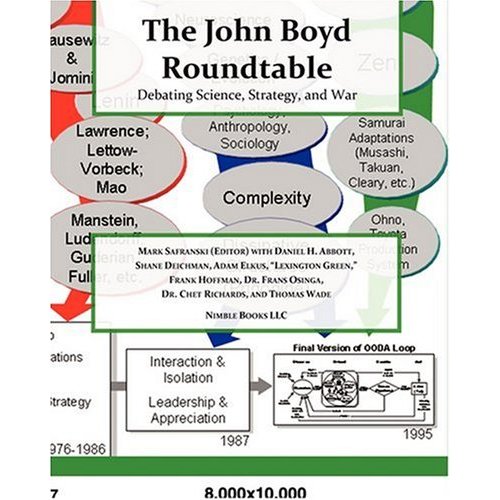
The John Boyd Roundtable: Debating Science, Strategy, and War – Mark Safranski (Ed.)


Threats in the Age of Obama – Michael Tanji (Ed.)

Great Powers: America and the World After Bush – Thomas P.M. Barnett

Brave New War: The Next Stage of Terrorism and the End of Globalization – John Robb

Science, Strategy and War: The Strategic Theory of John Boyd – Frans Osinga


The Genius of the Beast: A Radical Re-Vision of Capitalism  by Howard Bloom

Intelligence and How to Get It: Why Schools and Cultures Count  by Richard Nisbett

Inside Cyber Warfare: Mapping the Cyber Underworld  by Jeffrey Carr

This Is for the Mara Salvatrucha: Inside the MS-13, America’s Most Violent Gang  by Samuel Logan

Full Disclosure:

In copmpliance with new Federal regulations of dubious Constitutional merit, I hearby declare ZP does not accept money for publishing reviews or any paid advertising. Courtesy review copies were extended to me by authors or publishers acting on behalf of Sam Logan, Tom Barnett and Jeff Carr. I edited the first book in this post and was a contributing author to the second one. All of the books, with the exception of Cyber Warfare have been the subject of prior reviews or posts at ZP.

Brief Metacognition

Tuesday, December 1st, 2009

Very, very busy but the following two items struck me as useful advice for sharpening our mental edges.

First, John Robb linked to a series of posts by Eric Drexler of Metamodern. Al of them were good but I particularly liked the following one:

How to Understand Everything (and why)

….Formal education in science and engineering centers on teaching facts and problem-solving skills in a series of narrow topics. It is true that a few topics, although narrow in content, have such broad application that they are themselves integrative: These include (at a bare minimum) substantial chunks of mathematics and the basics of classical mechanics and electromagnetism, with the basics of thermodynamics and quantum mechanics close behind.

….To avoid blunders and absurdities, to recognize cross-disciplinary opportunities, and to make sense of new ideas, requires knowledge of at least the outlines of every field that might be relevant to the topics of interest. By knowing the outlines of a field, I mean knowing the answers, to some reasonable approximation, to questions like these:

What are the physical phenomena?
What are their magnitudes?
What are their preconditions?
How well are they understood?
How well can they be modeled?
What do they make possible?
What do they forbid?

And even more fundamental than these are questions of knowledge about knowledge:

What is known today?
What are the gaps in what I know?
When would I need to know more to solve a problem?
How could I find it?

It takes far less knowledge to recognize a problem than to solve it, yet in key respects, that bit of knowledge is more important: With recognition, a problem may be avoided, or solved, or an idea abandoned. Without recognition, a hidden problem may invalidate the labor of an hour, or a lifetime. Lack of a little knowledge can be a dangerous thing.

Secondly, reading through Richard Nisbett’s Intelligence and How to Get It: Why Schools and Cultures Count ( see this monster, two-partbook review by James McCormick at Chicago Boyz), the intriguing findings of the “Venezuela Project” run by none other than the late Richard Herrnstein of Bell Curve fame. Nisbett writes (74-75):

Herrnstein and his coworkers devised a very advanced set of materials geared to teaching seventh-graders fundamental concepts of problem solving that were not targeted to any particular subject matter. In effect they, they tried to make the children smarter by giving them handy implements for their intellectual tool kits.

What were those non-subject specific, cognitive skills?

  • Basics of Classification
  • Hypothesis Testing
  • Discovery of Properties of Ordered Dimensions
  • Analogies
  • Simple Propositions
  • Principles of Logic
  • Constructing and Evaluating Complex Arguments
  • Weighing opportunity costs vs. probability of success for a goal
  • Evaluating credibility and relevance of data

I would have added metaphors, pattern-recognition and intuitive thinking games but it was a fine set of skills and the results were remarkable, according to Nisbett:

The instruction resulted in big changes in children’s ability to solve problems that the new skills were designed to improve….for language comprehension, .62 SD [ standard deviation]; for learning how to represent ‘”problem spaces,” .46 SD; for decision making, .77 SD; for inventive thinking, .50 SD. In short, general problem solving skills can be taught, and taught moreover in a brief period of time.

In psychometric terms, for a 13 year old, these scores represent phenomenal improvements in cognitive performance and indicate the plasticity of some aspects of measured intelligence. Why have such activities not become commonplace in public schools? Or universities?

Why indeed?

The Internet is Re-Wiring your Brain….in a Good Way

Tuesday, October 20th, 2009

More fodder for the digital vs. dead tree debate:

UCLA Study: The Internet Is Altering Our Brains

….After the initial brain scan, subjects went home and conducted Internet searches for one hour a day for a total of seven days over a two-week period. These practice searches involved using the web to answer questions about various topics by exploring different websites and reading information. Participants then received a second brain scan using the same Internet simulation task, but with different topics.

The first scan of participants with little Internet experience showed brain activity in the regions controlling language, reading, memory and visual abilities. The second brain scan of these participants, conducted after the home practice searches, demonstrated activation of these same regions, but there was also activity in the middle frontal gyrus and inferior frontal gyrus – areas of the brain known to be important in working memory and decision-making.

….The results suggest that searching online may be a simple form of brain exercise that might be employed to enhance cognition in older adults,” Teena D. Moody, the study’s first author and UCLA researcher, said in a statement.

When performing an online search, the ability to hold important information in working memory and to take away the important points from competing graphics and words is essential, Moody noted.

I will be interested in seeing brain scan comparisons between digital natives who were on computers from the time they were toddlers, and the digital immigrants.  My son, for example, learned to read on his own long before pre-school from looking at words on a computer screen ( less “learned” than spontaneously “realized” the symbol-sound-conceptual connection ) while his sister, who had a more traditional exposure to reading, learned later ( more “taught”).

Another difference, while they are both equally skilled at reading, adjusted for an age, she is an avid reader who devours large books (mostly fiction) while her brother reads instrumentally, for knowledge or expository explanations (mostly natural science subjects. Only “Clone Wars” attracted him to read fiction).

“The Big Picture”- the Nexus between Education and Grand Strategy

Thursday, July 16th, 2009

This will be the first of several related posts. 

The other day, I happened to be talking to my friend Dr. Von, a physicist and educator, and he brought up a post by The Eide Neurolearning Blog, on educating children in terms of “big picture thinking”:

What is ‘big picture’ thinking? Business consultant Andrew Sobel described it as:

1. Having a simple framework
2. Using analogies and metaphors
3. Developing multiple perspectives
4. Looking for patterns and commonalities
….

Instead of training for compliance, careful rule-following, and exact memorization or a paragon of crystallized intelligence, we need to make more room for ‘big picture’ thinkers – while still recognizing the need for basic skills and knowledge.….Pint-sized big picture thinkers really do exist and they seem to be over-represented among gifted children who underperform or cause behavioral disruptions in their early elementary school years. Many of these kids are ‘high conceptual’ thinkers, those who like discovering novel subjects, themes, and things that don’t make sense(“The thing that doesn’t fit is the interesting thing” – Richard Feynman), but the reason for this is often not random – inductive learners (learners who derive rules from examples) use novelties to generate new hypotheses or new rules.If you really want to teach and interest big picture thinkers, you would expose them to rich multisensory and chronologically-advanced experiences. Look for subjects, phenomena and ideas that could be compared and contrasted. Complexity should be embraced and not shunned. For big picture thinkers – complex is simple and simple is complex. Complexity often brings more meaning because there are enough examples that one can make a pattern.….Many of them are seeking the overarching framework inside which they can put their new bit of knowledge. Often these are ‘why’ kids – who need to know why something is true, not just that something is true.

The Eides have given an excellent explanation of the big picture thinker as a cognitive type and had some implied suggestions in that description on how a teacher or professor could approach students to get them thinking – models, metaphors, analogies, exposure to patterns and multiple perspectives. Note: all students willl derive some benefit from these techniques and become better at seeing the larger context. Many people can, with sufficient practice, can become significantly better, but the natural big picture thinkers are the ones who will react with insightful leaps of reasoning, imagination and questions with little or no prompting.

Unfortunately, such experiences in public schools and even our universities have become increasingly rare. Dr. Von explains why:

When I talk with students (juniors and seniors in high school) about how different subjects and classes are taught, invariably it comes down to great amounts of memorization. Most students, when you engage them in real conversations about the education they receive, will open up freely and get right to the point…because of the continued emphasis on grades and GPAs by colleges, students feel the need to focus first on memorization and get the grade on the test, and then move on to the next topic without much concern with what was just studied. When this is the case in school, has true learning just occurred? Likely not, if students are unable to recall and actually apply concepts that were covered in the past.

….To make matters worse, as students rely so heavily on memorization and short-term success on tests (and this is driven home even more in the ‘high stakes testing’ environment we find ourselves in in the era of No Child Left Behind, as resently implemented), those students, many of whom are gifted, as the Eides point out, who prefer complexity in their learning, are not benefitting from the way many (most) classrooms are run. By complexity, I mean those students who want to ‘see the big picture.’ Those students who want to know why something works, and how it is related to the material that was studied last semester as well as to the material that was covered in another class. For example, I love when students in my physics classes come to me asking about how to interpret and apply a particular integral result which was just studied in calculus class, or how Einstein’s theories changed political and military history, as studied in a history course. Those moments happen every so often, as a result of student curiosity and their wanting to truly learn about the material rather than memorize something for the test, and good teachers recognize such moments when they happen…

It falls to me to discuss why it matters: As a nation we are crippling the next generation of visionaries by retarding their intellectual growth with bad educational policy as surely as we might if we were adding lead to their drinking water.

Scientists and inventors, philosophers and artists, entrepreneurs and statesmen, individuals who conceive of and accomplish great things do not emerge from schools and colleges that emphasize low-level thinking and a curriculum without intellectual depth or rigor. They emerge in spite of them.

To force a systemic improvement in public education, the Bush administration pushed through “No Child Left Behind” with rigid timetables, mandated high stakes testing and punitive consequences for schools and districts not making standards. That is to say, the Bush administration addressed the lack of rigor in educational process with a sledgehammer – but ignored the lack of rigor in educational substance ( at least directly – under NCLB some schools had to toughen their curriculum to teach to the state test, but other schools or schools in different states dumbed down for the same reason – curricular alignment).

That NCLB forced public schools to ensure that our weakest students verifiably succeed at understanding the fundamentals is laudable. That this emphasis increasingly comes at the cost of schools only educating all their students at the level of the fundamentals is inexcusable. Perhaps criminal. NCLB is the overarching legal framework that was superimposed on a system whose content was (and often still is) frequently less than demanding and taught by instructors who themselves have not majored in the subject they are teaching. 

At the postsecondary level, long before the measure and punish model of NCLB arrived at k-12 schools, colleges and universities abandoned any semblance of a core curriculum or traditional canon and undergraduate degree requirements were larded with plenty of au courant esoterica as course options. Esoterica formerly left for footnotes in dissertations or as the subject of longwinded, diatribes at the dreary meetings of extremist splinter parties. Ivy League, big state schools, small third tier colleges – it does not matter; with only a few exceptions, the “cafeteria a la carte” model of undergraduate education prevails.

While a few students absorb and become true believers of fashionable cant, most students graduate high school and college unaffected by the large amounts of rubbish and trivia they have been exposed to because it was presented without any kind of sensible context and being committed to short term memory, quickly forgotten. The real damage to students comes from the cumulative effect of the absence of substance – the waste of time where meaningful content and the pressure to think through hard problems should have been.

The costs of educational myopia are here and they will grow worse with time. We already see sharply declining public support for science (because more people are now ignorant of basic scientific literacy),  lower rates of innovation and other negative economic effects. In the area of governance, across the board, regardless of party label or ideology, we have national leaders in their 40’s, 50’s and early 60’s who see the world primarily in short-term, tactical terms and who confuse career or class interest with governing in the national interest. Oligarchy is inherently a non-strategic worldview because it eschews making choices because choices require sacrifice in the near term in order to acquire systemic advantages in the long term. 

Oligarchy” seems like a a harsh word because we think of “oligarchs” as being selfish, exceedingly greedy, political sociopaths. While such figures do exist outside of TV and the movies (Burmese junta, Iranian hardliners, Soviet politburo etc.) most people are neither particularly malicious nor eager to consciously and openly do things society acknowledges to be wrong or counterproductive. Even less so are they eager to be seen by the public as incompetent. The problem is that, frequently, people are prisoners of their own limited frame of reference and, when their conscience might be tweaked, they excel at rationalization and denial.

This is not a question of smart or dumb or of expecting politicians to be moral paragons. There’s plenty of IQ wattage inside and outside of Washington, DC and petty larceny in politics goes back to the stone age. Rather, on average, the difficulty is that our nation’s intellectual potential has not been effectively maximized. Is it reasonable to educate people in a way where all subjects are disconnected from one another, prioritizing narrow specialization, emphasizing accumulating facts over understanding principles, rewarding the “right answer” instead of the “best question”, demanding conformity instead of curiosity and then expect our leaders to be visionaries and adaptively creative statesmen who think in strategic terms?

Why would our societal orientation in complex, dynamic, fast moving situations be good when our educational system trains people only to think through simplified, linear, sequential problems? Strategic thinkers need to be able to see “the big picture” and handle uncertainty, or they cannot be said to be strategic thinkers.

The ship of state has been steered, over the last forty or so years, into an epistemological cul-de-sac and we are headed for the rocks. America needs a grand strategy for a competent citizenry in order to reach the point where it can again have a grand strategy to deal with an unruly world.

LINKING TO THIS POST:

Red Herrings

Project White Horse

Fabius Maximus

The Committee of Public Safety ( provides an extensive analysis of the subject)

RELATED TOPIC:

Liberty/SecurityRethinking liberal arts


Switch to our mobile site