zenpundit.com » music

Archive for the ‘music’ Category

The human voice, counterpoint, & the analysis of complex systems

Saturday, February 9th, 2019

[ by Charles Cameron — with Mike Sellers and Ali Minai particularly in mind, and more to come.. ]
.

Roomful of Teeth:

That’s composer Caroline Shaw‘s Partita for 8 Voices, a piece she wrote for Roomful of Teeth.

A piece she composed and wrote for them — in the remainder of this post, we’ll explore the overlap of text (writing) and music (composition) in increasing subtlety and detail..

**

I’m brought to make this post by a paragraph I read in a fascinating New Yorker article, Roomful of Teeth Is Revolutionizing Choral Music. Roomful of Teeth is the group whose music I first praised in Pulitzer : Lamar :: Nobel : Dylan?, and showcase again in the video clip above.

Here’s that New Yorker para:

The human voice is the world’s most astonishing instrument, it’s often said. It’s capable of everything from a trill to a bark to an ear-splitting scream, from growling harmonics to liquid acrobatics, lofted on the breath like a lark on an updraft. Instrument is the wrong word, really. The voice is more like a chamber ensemble: winds and strings and blaring horns, strung together end to end. It’s a pump organ, a viola, an oboe, and the bell of a trumpet, each instrument passing the sound along to the next, adding volume and overtones at every step. Throw in the percussion of the lips and tongue, and the echoing amphitheatre of the skull, and you have a full orchestra playing inside you.

My aim in this post is to add that “full orchestra playing inside you” to that other internal polyphony of contrasting desires, identities, and emergent thoughts, and the external polyphony of all those voices with a stake in our common concerns, risk assessments and deliberations — which are constituent of our complex analytic topics.

Done.

**

The rest is context…

I’ve often talked about the notion that the analysis of complex human systems involves dealing with multiple stakeholder voices, also on occasion with the many internal voices within each individual, and suggested that music offers the clearest equivalent or analogy that humans successfully and repeatedly navigate. Specifically, the twin notions of polyphony — the sounding together of many voices — and more specifically counterpoint — the juxtaposition of conflicting voices and the possible resolution of their conflicts from dissonance to harmony in an iterative process — are clearly relevant to analytic practice, albeit drawing on a tradition that will seem wildly cross-disciplinary to many analysts.

Relevant here is Edward Said‘s definition of counterpoint:

In counterpoint a melody is always in the process of being repeated by one or another voice: the result is horizontal, rather than vertical, music. Any series of notes is thus capable of an infinite set of transformations, as the series (or melody or subject) is taken up first by one voice then by another, the voices always continuing to sound against, as well as with, all the others. Instead of the melody at the top being supported by a thicker harmonic mass beneath (as in largely vertical nineteenth century music), Bach’s contrapuntal music is regularly composed of several equal lines, sinuously interwoven, working themselves out according to stringent rules

In my view , which I have repeatedly expressed, Johann Sebastian Bach, the master of contrapuntal writing, is a significant exemplar for us at this time. And if it should be argued that musical methods cannot be transposed — another musical term — to matters of verbal thought, let me say that the great Bach pianist Glenn Gould towards the end of his life made specifically contrapuntal human voice radio plays for the Canadian Broadcasting Company..

**

Gould’s contrapuntal mind:

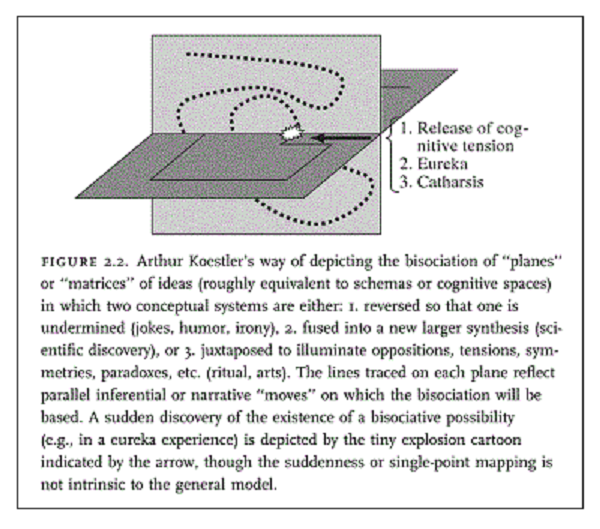
Among Gould‘s eccentricities — David Howes in Glenn Gould’s Contrapuntal Constitution calls them bi-centricities, a phrase that reminds us of Arthur Koestler‘s notion of the creative leap as the bisociation of two planes or matrices, are:

the way he liked to have one AM and one FM station playing all the time in his apartment, one for news, the other for music; the way he could learn a score while talking on the phone; and the way he enjoyed eavesdropping on three or four conversations at the same time going on at neighbouring tables in the restaurants he haunted (Kostelanetz 1983: 127).

We can see here that Gould‘s basic thinking is in terms of multiple voices, often contrasting, in simultaneous awareness — Gould, Howes continues, spoke of counterpoint as “an explosion of simultaneous ideas”. As Gould puts it, Howes reports, when speaking of his radio programs for human voices:

The basis of it was that we tried to have situations arise cogently from within the framework of the program in which the two or three voices … [recorded previously in conversation with Gould, but with the latter’s voice edited out for the final version] … could be overlapped, in which they would be heard talking – simultaneously, but from different points of view – about the same subject. We also tried to treat these voices as though they belonged to characters in a play, though all the material was gained from interviews. It was documentary material, treated in a sense as drama (cited in Payzant 1982: 131).

This, then, is Gould‘s contrapuntal radio, and we can see Gould vividly transposing conytrapuntal imagination from the musical sphere to that of the varieties of human verbalization.

**

As not an aside but the re-introduction of a theme previously only hinted at, here is Arthur Koestler on the conceptual or creative leap:
**

Okay, our concept of music must shift, change, expand, if we are to consider Gould‘s Idea of North as a musical composition — in ways that are consistent with my own development of contrapuntal analysis. As Anthony Cushing explains in Glenn Gould and ‘Opus 2’: An outline for a musical understanding of contrapuntal radio with respect to The Idea of North:

A musical understanding of North requires re-thinking some traditional elements of music theory: harmony must take into consideration semantic content and shifting topic areas; form follows somewhat traditional musical structures (ternary, binary, etc.); and texture encompasses layering of literal voices and dispenses with traditional notions of melody. One must also consider the spatial component of tape composition, in which voices inhabit locations in a sound field. The later documentaries in the trilogy and the Leopold Stokowski and Pablo Casals tribute radio documentaries contribute to a more complete musical concept of contrapuntal radio — complex polyphonic textures, stereo sound, pitch-based harmonic content — the germ of contrapuntal radio was developed and actualized in North.

I’d like to take that lead, given us by the masterful pianist Glenn Gould, across into the field of analytic understanding — as a stream of analysis complementary and in counterpoint (for instance) to “big data” analytic tools — contrapuntal analysis characteristically working with a few, humanly-selected verbal utterances rather than data-points algorithmically-selected in the millions.

**

Moving to a larger geopolitical canvas, Edward Said once told an interviewer:

When you think about it, when you think about Jew and Palestinian not separately, but as part of a symphony, there is something magnificently imposing about it. A very rich, also very tragic, also in many ways desperate history of extremes – opposites in the Hegelian sense – that is yet to receive its due. So what you are faced with is a kind of sublime grandeur of a series of tragedies, of losses, of sacrifices, of pain that would take the brain of a Bach to figure out. It would require the imagination of someone like Edmund Burke to fathom.

We see here the invocation of Bach in a context of geopolitical analysis — one paragraph in the life-work of Said, who was a music critic as well as a well-known Palestinian-American public intellectual.

That single paragraph — and Gould‘s clear understanding that contrapuntal thinking can be applied to the polyphony of human voices, not just in the musical sphere — prompts me to go further, and assert that complexity studies with application to the human condition and intelligence and geopolitical analysis will all, sooner or later, arrive at the practice of contrapuntal thinking as basic to their deeper purposes.

**

Refocusing at the national level, on Glenn Gould‘s native Canada:

I’ve mentioned the simultaneity of voices in social contexts such as listening, hearing and understanding the views and voices of multiple stakeholder. In similar vein, Howes suggests Gould‘s own taste for counterpoint stems from and reflects the Canadian Constitution:

Gould understood music to provide a model of society, and the performing artist, hence, to be performing society, as well as music. Along these lines, counterpoint, Gould’s preferred musical style, provides a specially apt model for comprehending the constitutional structure of the Canadian state. Gould’s interest in keeping the different voices of a fugue distinct, equal, and bound together parallels the concern of the Canadian state to keep the different parties to Confederation distinct, equal and bound together. In this difficult task, however, there is always a risk of overemphasizing or losing one of the voices. If Quebec is proclaimed “a distinct society” will that disturb the equality of the provinces (for surely all are distinct); if it is not, will that lead to the separation of Quebec and the break-up of Confederation? This bi-cultural counterpoint confronts Canadians daily, from the bilingual product information on their cereal boxes to the reports of English/French political jousting on the evening news.

Counterpoint, or in more general terms, polyphony, is non-dialectical, for it involves the interweaving of voices, of ideas, rather than the Hegelian process of thesis-antithesis-synthesis. Polyphony as social theory does not, therefore, entail the negation of any countervailing views the way, say, a dialectical social philosophy would. With polyphony, accommodation or peaceful co-presence takes the place of negation.

**

Readings:

  • New Yorker, Roomful of Teeth Is Revolutionizing Choral Music
  • NY Times, The Glenn Gould Contrapuntal Radio Show
  • Open Culture, Listen to Glenn Gould’s Shockingly Experimental Radio Documentary
  • Hermitary, Glenn Gould’s The Solitude Trilogy
  • Canadian Icon, Glenn Gould’s Contrapuntal Constitution
  • Politics & Culture, An interview with Edward Said

  • Charles Cameron, Pulitzer : Lamar :: Nobel : Dylan?
  • Charles Cameron, Getting deeper into Koestler

  • Mike Sellers, Advanced Game Design: A systems Approach
  • Ali Minai, A core concern of our research is the desire to catch ‘creativity in the act.’
  • **

    More Teeth — your reward for reading this far:

    And BachGlenn Gould plays Contrapunctus IX from The Art of Fugue — on organ:

    We should start with Lenin musing on Beethoven

    Saturday, February 2nd, 2019

    [ by Charles Cameron — music, mildness and massacres — do we have a scalpel that can peel the mildness back to explain where the massacres come from? ]
    .

    Lenin listens, muses:

    From the Russian film, Appassionate, Here’s Lenin listening and, towards the end, musing, to the music:

    Vladimir Lenin asks Rudolf Kehrer to play Beethoven’s Appassionata, Piano Sonata no. 23, op. 57, and at the end says, ‘Nothing I know is better than the Appassionata’. … The footage comes from this rare film entitled Appassionata:

    **

    Here’s the full Lenin quote:

    I know of nothing better than the Appassionata and could listen to it every day. What astonishing, superhuman music! It always makes me proud, perhaps with a childish naiveté, to think that people can work such miracles! … But I can’t listen to music very often, it affects my nerves. I want to say sweet, silly things, and pat the little heads of people who, living in a filthy hell, can create such beauty. These days, one can’t pat anyone on the head nowadays, they might bite your hand off. Hence, you have to beat people’s little heads, beat mercilessly, although ideally we are against doing any violence to people. Hm — what a devilishly difficult job!

    Some people already know this quote, some don’t.

    **

    Here, Lang Lang plays Beethoven’s Appassionata in its colossal entirety:

    **

    Mildness and massacres.

    Hitler, who began as an art student, liked Wagner; Lenin liked Beethoven. Shall we blame classical music for the Shoah and Gulags?

    Somehow, if we could peel back the mildness, we might find the massacres. Does anyone have a suitable psychiatric or spiritual scalpel?

    One delicious ouroboros and miscellaneous chyrons &c

    Friday, January 25th, 2019

    [ by Charles Cameron — all the way through to Roger Stone and a clip from Godfather II ]
    .

    First, in the place of honor, this brilliant sign protesting the government shutdown. Ouroboric in form, simple, succinct, pithy:

    That’s a protest haiku, if ever I saw one, in a detail from the original photo.

    **

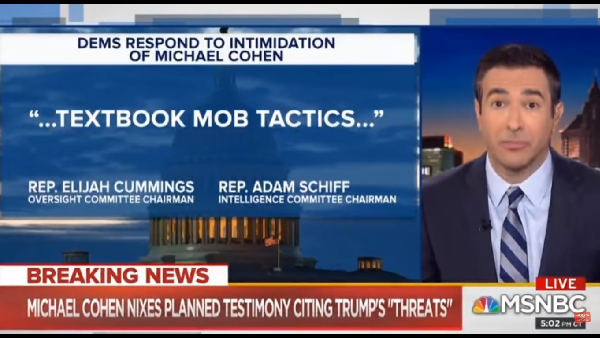
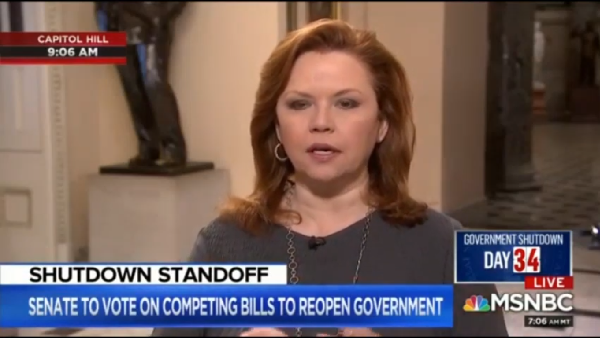
    And while we’re on the topic of haikus, chyrons — those texts at the foot of TV screens — are the haiku of news media. Here are some I’ve collected recently — I’ll add more here as we go, since adding them in the comments section requires tweeting them so as to have a URL to work with..

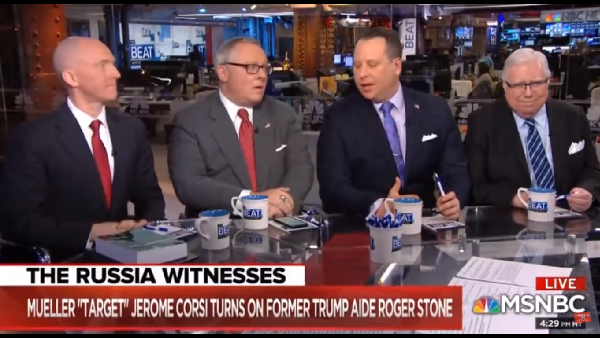
    As I’ve said elsewhere, that Carter Page, Michael Caputo, Sam Nunberg, Jerome Corsi joint interview by Ari Melber was fantastic television.

    **

    I generally pick chyrons to screengrab for their game or war metaphors, but pithy and witty will get me every time.

    **

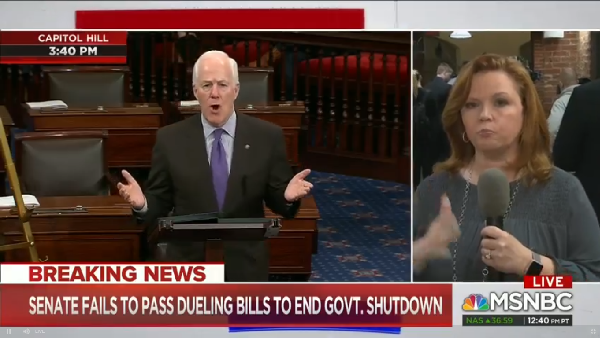
    Kelly O’Donnell (immediately above) said memorably, “It’s a sort of dueling banjos of legislation..”

    Hey:

    Double #FAIL

    And now, the Roger Stone indictment, with its movie reference. There have been plenty of pundits an news anchors referencing the Godfather movies, and that “textbook mob tactics” reference from the new chairmen of the Oversight and Intel committees. but AFAIK this is the first such reference from the Mueller team in a court document, and notable as such.

    Plus I guess I’ll need to revisit the Godfather series to keep up with current affairs..

    Borders as metaphors and membranes

    Monday, January 14th, 2019

    [ by Charles Cameron — i continue in the opinion that limina, thresholds borders, have an archetypal importance that transcends and is embodied in individual cases ]
    .

    **

    With the Wall the dominating issue of the current US government shutdown, tracking the penumbra of borders is all the more important: things look very different when you squint at them.

    **

    Previous posts in this topic area:

  • Zenpundit, Liminality II: the serious part
  • Zenpundit, The Korean border / no border dance
  • Zenpundit, Borders, limina and unity
  • **

    Alexis Madrigal, A Border Is Not a Wall:

    Borders are an invention, and not even an especially old one. Predated by the printing press by a good 200 years, borders are constantly under revision. Even the zone of a border itself, the Supreme Court has held, extends far beyond the technical outline of a nation. Imagine a border as the human-made thing that it is, and it’s no longer surprising that it takes a multitude of forms: a line on a map, a fence, a bundle of legal agreements, a set of sensors, a room in an airport, a metaphor.

    As Elia Zureik and Mark B. Salter explain in a book on policing, a controlled border creates the notion that domestic space is safe. Protecting “the border” safeguards the home, the family, and a way of life. This idea of safety is so potent that it has shut down the United States government.

    But the border itself—the line on a map, or the gate at a crossing—isn’t what’s at issue; it’s the idea of the border, a membrane that defines a nation while maximizing its market power.

    **
    _
    Humanitarian concerns:

    Dr John Sullivan‘s paper, Determining Reasonable and Proportional Use of Tear Gas offers a number of provocative insights, including the prohibition on the use of tear gases (CN> CS< CR), pepper spray (OC, capsicum), and sleeping gas on battlefields -- provocative since we normally think of battlefields as "worse" than peacetime situations, and thus that what's prohibited in wartime should be so a fortiori in times poof peace..

    Here’s the border-specific instance / comment that caught my eye:

    In the border control setting, the recent use of tear gas by CBP agents against migrants seeking asylum at the San Ysidro port of entry has been criticized by the American Civil Liberties Union (ACLU), among others. The cross-border issues are also controversial and Mexico has demanded an investigation into the use of nonlethal weapons in the Tijuana incident.

    **

    In another post I hope will follow quickly on the heels of this one, I quote MSNBC host Bryan WIlliams telling Jon Meacham:

    if you’re going to clear those better angels of yours fo takeoff, remember the air traffic controllers are working without salaries..

    That’s an interesting juxtaposition if you think about it: angels and air traffic controllers f unction in two different above-earth atmospheres — heaven and sky, respectively — which used to be one at a time when myth and history were one, astrology and astronomy, alchemy and chemistry.

    Might we say there’s now a border between heaven and sky? If so, that next post can be considered an entry in this series, too.

    **

    Addendum, 1/15/2019:

    An excellent set of photos under that title educates us via our visual sensibility on the history and variety of walls:

    The current debate in the United States about building up and reinforcing the border wall with Mexico may have distinctly American roots, but the problems, and the controversial solutions, are global. Growing numbers of immigrants, terrorist activity, continued drug trafficking, and protracted wars have sparked the construction of temporary and permanent border barriers in many regions worldwide.

    Recommended!

    **

    Additional addendum:

    Ha, yes!

    GBG: another form of associative linkage

    Friday, January 11th, 2019

    [ by Charles Cameron — a meander to ponder, wonder, wander, a maze to amaze, or as CS Peirce might say, a muse to amuse, an amuse-bouche ]
    .

    Here’s a quick, long run-down of my HipBone games, where they came from, and where they’ll be going if book and online game plans come together.

    My various HipBone and related games are intended as playable variants on Hermann Hesse‘s great Glass Bead Game (GBG for short).

    You remember this?

    As I said before:

    I don’t know how Theodor von Kármán came by his Vortex Street, and I’ve spent a decade in Pasadena wandering its streets and even picked up his four volume works — signed — at a CalTech book sale — but if he had the Van Gogh painting in the back of his mind, there’s the beginning, the seed of an awesome leap.

    And you might say van Gogh made a mighty leap, pre-intuiting the von Kármán pattern in the night sky..

    This DoubleQuote is my favorite move in the game that has obsessed me for the last thirty or so years, the Glass Bead Game as described in Hermann Hesse in his Nobel-winning novel of the same name.

    Linking arts and sciences as it does, I see it as a move at the nave roof-apex of what Hesse describes as the “hundred-gated cathedral of mind”.

    The essence of a move in Hesse‘s game is associative linkage.

    **

    I’m using this post as something of a primer on my game thinking, before proposing a recent instance of a type of associative leap / example of a game move.

    **

    There are many fairly basic types of associative linkage that provide the connextive tissue between the items in an ontology:

  • this is the same as that
  • this causes that
  • this is the opposite of that
  • this symbolices that
  • this is above that
  • this is inside that
  • this is the parent of that
  • this follows that
  • this governs that
  • this proves that
  • **

    Getting more complex and multi-layered, John Robb once posted:

    Some philosophical thinking:

  • Human knowledge, at an elemental level, can be described as a “transformation” of data.
  • Complex ideas are built using layers of “transformations” with each layer feeding into the next (think pyramid)
  • We teach these transformations at home and at school to our children.
  • We communicate by sharing transformations.
  • Questions We Need to Answer in the Age of Cognitive Machines:

  • How many transformations would it take to model all human knowledge?
  • How deep (how many layers of transformation is human knowledge) is human knowledge? Both on average or at its deepest point?
  • How broad is human knowledge (non-dependent transformations)?
  • How fast is the number of transformations increasing and how fast is it propagating across the human network?
  • **

    From a process orientation, it’s pretty clear that the fundamental way in which most associative leaps occur to human minds takes the form:

  • this reminds me of that
  • — and that holds true even of conspicuous creative leaps not just out of the box but into the unknown — as when Yutaka Taniyama proposed his hypothesis that there exists a correspondence between elliptic curves and modular forms in 1955. Andrew Wiles eventually proved the linkage in what is now known as the Modularity theorem, as the key part of his proof of Fermat’s Last Theorem in 1993 [don’t ask me to explain, I’m not a mathematician]

    **

    Creative leaps are in general the basis of much “opening of fields” both in the arts and sciences, as described by Arthur Koestler in his Act of Creation:

    and elaborated by Douglas Hofstadter in eg his Fluid Concepts and Creative Analogies and Surfaces and Essences: Analogy as the Fuel and Fire of Thinking, and at a depth of penetration equivalent to Robb’s questions above, by Fauconnier and Turner in The Way We Think: Conceptual Blending And The Mind’s Hidden Complexities..

    **

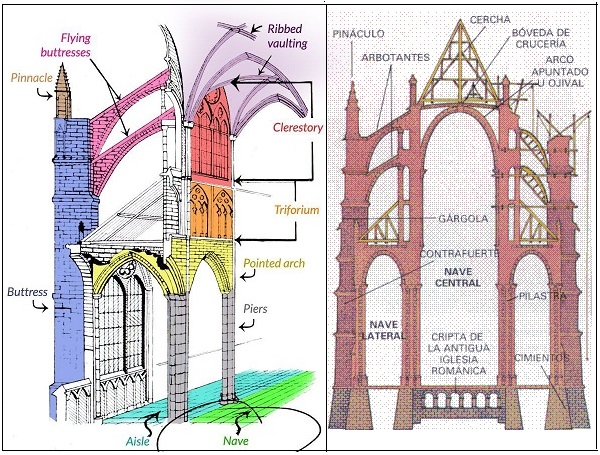
    Level on level, the structure of a gothic cathedral is arch building on arch (forgive my Spanish):

    Erwin Panofky‘s masterwork, Gothic Architecture and Scholasticism, argues for a common mental structure explaining the simultaneous occurrence of Gothic cathedral architecture and the scholastic argumentation characteristic of Peter Abelard and Thomas Aquinas..

    **

    The music of Hesse’s cathedral?

    All the insights, noble thoughts, and works of art that the human race has produced in its creative eras, all that subsequent periods of scholarly study have reduced to concepts and converted into intellectual values the Glass Bead Game player plays like the organist on an organ. And this organ has attained an almost unimaginable perfection; its manuals and pedals range over the entire intellectual cosmos; its stops are almost beyond number.

    And the game’s ultimate destination – besides the creation of an overarching synthesis uniting sciences and arts, great leaps of discovery and profound flights of imagination?

    Every transition from major to minor in a sonata, every transformation of a myth or a religious cult, every classical or artistic formulation was, I realized in that flashing moment, if seen with a truly meditative mind, nothing but a direct route into the interior of the cosmic mystery, where in the alternation between inhaling and exhaling, between heaven and earth, between Yin and Yang, holiness is forever being created.

    In the coincidence of opposites — the buttressed left side of the cathedral’s gothic arch leaning into, against and with the buttressed right side, culminating in the high vaulting that characterizes the nave — transcendence of the physical in the spiritual..

    **

    An aside:

    Okay, very quickly, one associative link that jumped out at one poster recently after the Democratic response to Trump’s resolute desk address was the similarity between Schumer and Pelosi‘s stilted appearance, standing shoulder to shoulder at a single podium [left], and — returning to our theme of gothic as in a fugue — the celebrated painting titled American Gothic [composite, right] —

    That’s a “haha!” (comedic, laughter) rather than an “aha!” (creative, excitement) or “aah!” (tragedic, tears) explosion, to return to Arthur Koestler’s notion of bisociation and its various types and expressions.

    But that’s just fun, and will quickly become dated.. that’s an aside.

    **

    A new category of linkage:

    More seriously, I’d like to suggest that one faascinating type of linkage, close kin to “this is similar to that” is the category of mistake:

  • this is, has been, or can be mistaken for that
  • My example here is the weird sonic effect that seems to have physically hurt American diplomats and other embassy employees in Cuba, and confused national security analysts —

    That headline was taken from an article dated December 12, 2018, less than a month ago at time of writing. Doctors called in to examine embassy workers were flummoxed:

    The patients complained of intense ear pain, hearing loss, headaches, dizziness and difficulty with balance, as well as increased anxiety and irritability, doctors found, but who or what caused the damage is still unknown.

    From The Atlantic:

    Various parties argued that the strange noise was the result of a sonic weapon, a microwave attack, or malfunctioning eavesdropping equipment.

    And back to ABC:

    “The possible sources and the medical findings we have here do not have a quick or easy solution,” said Dr. Carey Balaban, a professor of otolaryngology at the University of Pittsburgh School of Medicine who contributed to the study. “I wish someone could tell us that right now. I wish we’d have that.”

    Damn commie Cubans!

    The thing is, otolaryngologists and high-tech security experts were the wrong people to solve the problem. Whenentomologists listened to a recording of the sound, they recognizedd it —

    as the mating call of Anurogryllus celerinictus, the Indies short-tailed cricket.

  • the cricket’s call has been mistaken for a devious commie attack on American diplomats
  • **

    Very briefly, then, to wrap up, since the idea is to link one concept to another, I use graphs as my game boards, assigning the concepts (images, quotes, clips &c) to numbered positions (nodes) on the boards, with the lines between them (edges) representing their associative links, which can be spelled out in however much detail a given game requires:.

    top left, the standard WaterBird board; top right, a board from the Sembl game as played on iPads in the National Museum of Australia; lower left, the Doublequote board, for direct comparison of two concepts / images; lower right, the Said Symphony board, for us in “aymphonic” games.

    The idea of conceptual graphs precedes Margaret Masterman by centuries:

    Left, the Sephirotic Tree of classical Kabbalah; middle: Oronce Fine’s diagram of the elements and humors; right: a medieval Trinitarian diagram

    And as a grace note — my two now ancient pages on Masterman, Boole and that Trinitarian diagram are still a quiet delight for scholars of conceptual graphs and the like. Masterman really was an unsung genius, and her curious and vastlky erudite paper Theism as a Scientific Hypothesis proves it..

    I wonder when AlphaZero will be playing a game like this:

  • HipBone, What sacred games shall we have to invent

  • Switch to our mobile site