OTB Radio
Friday, April 9th, 2010
Dr. James Joyner, Dave Schuler and Col. Pat Lang discuss the Apache video, COIN, ROE, war in an information age, Thomas P.M. Barnett’s Sys Admin-Leviathan split and Hamid Karzai at OTB Radio. A good discussion.
Dr. James Joyner, Dave Schuler and Col. Pat Lang discuss the Apache video, COIN, ROE, war in an information age, Thomas P.M. Barnett’s Sys Admin-Leviathan split and Hamid Karzai at OTB Radio. A good discussion.
Dr. Tom Barnett had an excellent WPR column on the cognitive value that blogging has had for him:
The New Rules: Strategic Thinking in 10,000 Blog Posts or Less
In the last half-decade, blogs have gone from a quirky personal sideline activity to a mainstream, almost de rigeur professional activity — following the previous trajectory of Web sites and, before them, e-mail itself. To many, this democratization of the flow of information is a distinct blessing, to others it is the epitome of data deluge. As someone who has now posted blog entries every day for six years and recently passed the 10,000-unit mark (fulfilling Malcolm Gladwell’s quota for expert practice), I wanted to take stock of what this has meant to me as a writer and thinker
….Old-timer that I am at 47 years of age, I still read many of these sources via paper subscriptions, but that habit is slipping with each passing year and each new technology. In fact, what originally attracted me to online posting was
the ease it offered in terms of maintaining the resulting database, compared to the hassle of physically clipping and filing MSM articles of interest, as I did during my pre-blogging days. With the blog, I can now attach my first-impression analysis to the formal citation, with both hot-linked to the full article and stored in a content management system — the blog — that I can instantly access and search from anywhere in the world.
In this sense, generating and maintaining the blog magnificently expanded my professional “RAM,” or random-access memory storage capacity. Without that upgrade, I simply couldn’t write or think at the level I do today, nor could I cover as much of the world or so many domains. Without that reach, I couldn’t be much of an expert on globalization, which in turn would seriously curtail my ambitions as a grand strategist — because nowadays, strategic thinking requires a whole lot more breadth than merely mastering the security realm. To be credible and sustainable in this complex age, grand strategy requires a stunning breadth of vision when judged by historical standards. So as far as this one-armed paperhanger is concerned — no blog, no grand strategist.
And I have to tell you, just making that admission in 2010 stuns me. But without the blog’s organizing and storage capabilities, I’d be reduced to a parody of “A Beautiful Mind”: tacking news clippings on walls and feverishly drawing lines between them, desperately seeking patterns but constantly falling behind the data tsunami. The blog thus prevents the early onset of what I call “strategic Alzheimer’s,” which is what happens when a strategist’s growing inability to process today’s vast complexity provokes a sad retreat into the past and an overdue reliance of history-is-repeating-itself arguments. But if a strategist no longer “gets it,” it’s because they’ve stopped trying to “see it.” The blogging “lens” corrects their vision’s lack of acuity.
But my blog is also my daily workspace, and I share it with strangers — for free, mind you — because I want to pass on this largely lost skill set of strategic thinking to others. I especially hope to reach the next generation of grand strategists, who would otherwise have to rely primarily on op-ed columnists’ flavor-of-the-news-cycle habits, with new “Manhattan Projects” proposed and “Marshall Plans” demanded every other month. Consider it a one-to-many offer of virtual internship.
Read the whole column here.
I really enjoyed this one because Tom was expounding on how a social media platform – this case, his blog – altered the psychological flow and conceptual reach of his professional work. It is now standard for author/thought leader types to have a blog that relates in some way to their books or speaking gigs. Some ghost it out to their PR firm or shut off the comments or have an almost static web page with little or no personal investment or thought.
IMHO those who keep the blog as an interactive medium with their readers as Tom does, tend to be more intellectually interesting and productive figures – they “grow” and play with ideas in the scrutiny of the public eye and accept the reader’s pushback along with the accolades which makes the exchanges are very stimulating – “infocrack”, as it were. Participation in well moderated, high quality forums like the Small Wars Council have a similar effect and are good places to “test drive” your new ideas – provided you have a thick skin and a healthy ego that can stand up to constructive criticism.
Personally, I wish I had more time for blogging – I learn a great deal from the readers who take the time to contact me across various Web 2.0 sites, send me links, ask questions, challenge my assertions, suggest new books or correct my errors. While the volume of feedback from ZP readers and other bloggers is sometimes more than I can manage as a one-man band, your contributions are always appreciated.
In a burst of raw self-interest – and also a little love for my blogfriends – these books make nifty gifts for any war nerd or deep thinker on your Christmas list:
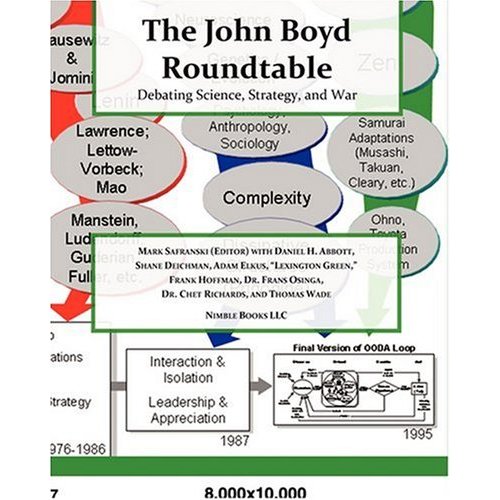
The John Boyd Roundtable: Debating Science, Strategy, and War


Threats in the Age of Obama
Great Powers: America and the World After Bush
Brave New War: The Next Stage of Terrorism and the End of Globalization
Science, Strategy and War: The Strategic Theory of John Boyd



The Genius of the Beast: A Radical Re-Vision of Capitalism
Intelligence and How to Get It: Why Schools and Cultures Count
Inside Cyber Warfare: Mapping the Cyber Underworld
This Is for the Mara Salvatrucha: Inside the MS-13, America’s Most Violent Gang
Full Disclosure:
In copmpliance with new Federal regulations of dubious Constitutional merit, I hearby declare ZP does not accept money for publishing reviews or any paid advertising. Courtesy review copies were extended to me by authors or publishers acting on behalf of Sam Logan, Tom Barnett and Jeff Carr. I edited the first book in this post and was a contributing author to the second one. All of the books, with the exception of Cyber Warfare have been the subject of prior reviews or posts at ZP.
Professor Richard Pipes, the Harvard University political scientist, is a seminal figure among sovietologists, historians and scholars of Soviet Studies. I highly recommend his trilogy, Russia under the Old Regime


 way eminent historians and political scientists handle the same topic). Dr. Pipes has written an op-ed for WSJ.com and it was reviewed by his former student, Dr. Thomas P.M. Barnett.
First the Pipes op-ed, then Tom’s assessment and then my comments:
“Pride and Power: Russia is caught between continents and haunted by its past,”
One unfortunate consequence of the obsession with “great power” status is that it leads Russians to neglect the internal conditions in their country. And here there is much to be done. To begin with: the economy. The Russian aggression against Georgia has cost it dearly in terms of capital flight. Due to the decline in the global prices of energy, which constitute around 70% of Russian exports, exports in the first half of 2009 have fallen by 47%. The stock market, which suffered a disastrous decline in 2008, has recovered, and the ruble has held steady, but the hard currency reserves are melting and the future does not look promising: The latest statistics indicate that Russia’s GDP this year will fall by 7%. It is this that has prompted President Dmitry Medvedev recently to demand that Russia carry out a major restructuring of her economy and end her heavy reliance on energy exports. “Russia needs to move forward,” he told a gathering of parliamentary party leaders, “and this movement so far does not exist. We are marking time and this was clearly demonstrated by the crisis… as soon as the crisis occurred, we collapsed. And we collapsed more than many other countries.”
….Today’s Russians are disoriented: they do not quite know who they are and where they belong. They are not European: This is attested to by Russian citizens who, when asked. “Do you feel European?” by a majority of 56% to 12% respond “practically never.” Since they are clearly not Asian either, they find themselves in a psychological limbo, isolated from the rest of the world and uncertain what model to adopt for themselves. They try to make up for this confusion with tough talk and tough actions. For this reason, it is incumbent on the Western powers patiently to convince Russians that they belong to the West and should adopt Western institutions and values: democracy, multi-party system, rule of law, freedom of speech and press, respect for private property. This will be a painful process, especially if the Russian government refuses to cooperate. But, in the long run, it is the only way to curb Russia’s aggressiveness and integrate her into the global community.
Read the rest here.
Now, Tom on Pipes:
Pipes the Elder on Biden comments: so impolite because they are so true
The biggest issue, like with China, is official corruption. The second is the pervasive depoliticization of the populace:
they’ve never really had any experience picking their own leaders over the past 1,000 years. That fend-for-yourself mentality pervades the political system and its foreign policy. All citizens want from the state is order, and what they miss most about the Soviet past was that it preserved Russia’s contiguous empire beyond that of any in Europe or Asia.
Russians have no idea who they are today: they don’t feel either European or Asian. Eventually, they’ll come to some conclusion about what sitting between those civilizations means in terms of identity.
So patience and care is required.
Very nice piece by Pipes.
Read the rest here.
Russia has had repeated bouts of historical, “geographic schizophrenia”: the long Tatar Yoke, the age-old conflict between Petrine westernization and Orthodox slavophilism, the iron Soviet dictatorship, especially Stalin’s democidal rule. Russia has neither joined the West nor considered itself to be fully Asiatic. Instead, the Russians inherited a “Third Rome” complex from Byzantium that has helped keep them isolated from their own best opportunities as a great power. Fringe groups of ideologues promoting nutty “neo-Eurasianism” in Russia play upon this historical legacy.
To the extent that the cold-blooded Vladimir Putin and the Siloviki clan have made their nation into “Russia, Inc.” – a gas and energy monopoly in the tattered rags of a nation- state, the long term trend will be accepting globalization and integration, regardless of any deep cultural angst and Ivan Q. Public Great Russian nationalist-chauvinism along the way.
ADDENDUM:
“The Western View of Russia” by George Friedman
I have a mixed opinion on STRATFOR’s analytical products but Friedman is playing to his strengths here in a piece that is measured and thoughtful. Hat tip to Lexington Green.
Forget Me Not. Obama’s Russian “Reset” Risks Alienating Eastern European Allies by Mike Wussow
Adds some regional context to Friedman’s post .
Cybersecurity expert and blogfriend Gunnar Peterson of 1 Raindrop snagged a multi-part interview with grand strategist and blogfriend Dr. Thomas P.M. Barnett, author of Great Powers
GP: ….It seems that the emerging middle class is the main factor that separates the developing countries’ past and future, they always had some very rich people and many very poor people, but now depending on how you measure it,
India’s middle class is 200 million people. What trends should we watch as the global middle class emerges? What milestones will mark key events along the progression?
TB: The one of greatest interest is when per capita income gets in the range of $5,000 per year. Somewhere between $5,000 and $10,000 is where you see previously authoritarian, single-party-dominated states move into the process of increasingly pluralism, typically started when a reformist faction breaks off from, and begins to challenge, the dominant party.Obviously, India is already blessed in that regard, so China is the one to watch there. Until China reaches such a level of development, all talk about authoritarian capitalism being superior to democratic capitalism is historically premature. Authoritarian regimes do well with extensive growth (simply adding in more resources) but then tap out when it comes to shifting into innovation-based, intensive growth….
Tom Barnett Interview Part 2 »
TB:….At initial glance, China’s route has higher risks concerning its political system (all those unruly and increasingly assertive urban laborers can go all Marxist on Beijing’s allegedly “communist” ruling party), but India has higher risks
concerning its economic trajectory (you point about scaling out badly). It’s just easier to imagine-for me at least-China having to change politically than India somehow avoiding industrialization and the social tumult/reformatting it will cause the country’s rural life. China’s got a lot of that already under its belt (although its rural impoverished population remains vast, there are plenty of opportunities for village employment or migration to the cities), and its government seems willing to do whatever it takes to encourage and accommodate the migration from rural areas to cities. But India moving far more tepidly in this direction, the result being that, what rural-to-urban migration does occur, often results in rather scary urbanization scenarios (more slumdog than millionaire).
GP: Many security writers and thinkers are obsessed with threats, they throw a dart a connected systems, extrapolate worse case scenario and everything goes “boom!”; your work is different, it accounts for system perturbation from threats but has more focus on the system resiliency to deal with events over the long haul. I find this system thinking lacking in many of your peers, and have never understood how worst case threat extrapolation can automatically lead to a parasite that takes over its host. Can you explain why its different to think of security in terms of resiliency rather than simply threats? What insights fall out of this distinction?
TB: Worst-case thinking obviously has its uses in the national security realm. I just think we got into very odd, extreme tendencies during the Cold War, when the threat of nuclear conflict distorted our thinking unduly. We’re just beginning to see thinkers and analysts and strategists emerge from a post-Cold War educational environment, like my nephew Brendan who’s studying Russian and International Relations (as I once did) at my alma mater, Wisconsin. The problem is, the field of international relations, as Brendan will attest, is still obsessed with game theory and all sorts of artificial schools and still tends to be way too insular (economics still needs to embraced far more, not in some antiseptic academic sense but more in a keen understanding of how international business works). But the key thing is, Brendan and others of his generation won’t be held to the extreme fears that my generation was, despite the constant hyping of the threat of nuclear proliferation, so they’re forced to cast their nets wider and that’s a good thing.
Tom is pointing to the “higher level of play” that leaders need to operate at if their foreign policies and national security strategies are to be based upon sound assumptions ( I would also throw in accounting for greater systemic instability or probability of Black Swan system perturbations)
An old saw is that amateurs study tactics while professionals study logistics. Strategists study geoeconomics because the structural economic shifts within and between countries and regions are not only predictive of where strife is likely to occur or never materialize but they set the framework or parameters on how effectively states are able to exercise “hard” forms of power. Interdependence wrought by globalization multiplies your leverage but it also constrains it’s uses.
For a great power, it’s a very short step in statecraft these days between “zen master” or as a “pitiful, helpless, giant”.

Zenpundit is a blog dedicated to exploring the intersections of foreign policy, history, military theory, national security,strategic thinking, futurism, cognition and a number of other esoteric pursuits.
Customized Web Site & Blog Design

