zenpundit.com » myth

Archive for the ‘myth’ Category

The imagery of religion and war

Friday, September 9th, 2011

[ by Charles Cameron — graphical analysis, selling bibles to teenage boys, tge Mass in time of war ]

.

Following on from my post on the work of Al Farrow, and leading towards a series of posts on ritual and ceremonial, I’d like to show you two very different images at the overlap of war and religion.

The first shows two different covers of the books of Joshua, Judges, Ruth, I & II Samuel, I & II Kings, Ezra and Nehemiah, as featured in a “biblezine” edition of the New Century Version of the Bible pitched at teenage testosterone.
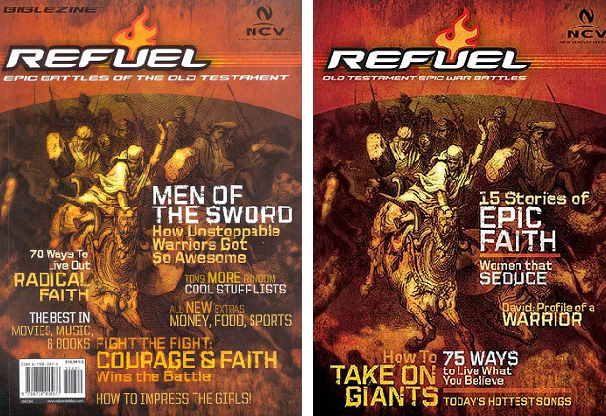
double.png

Each of will have our own sense of whether that’s fun, stupid,  Biblical, unBiblical, enticing, disgusting or simply uninteresting — but whatever your aesthetic and/or belief-based response, there’s a powerful lesson there in the choice of subtitles:

how unstoppable warriors got so awesome…
courage and faith wins the battle…
how to impress the girls!
how to take on giants!
women that seduce…
tons more random cool stuff lists…

I’m not a fan of this kind of thing myself, but I picked up a copy when I saw one at the thrift the other day — the one with Men of the Sword on the cover — and as someone who has done a fair amount of copy-editing in my day, was surprised to see “courage and faith wins the battle” (sic) had slipped past the editorial eyes at Nelson Books

The New Testament in the same series is a bit better — the cover still features “dynamic stories of daring men” –but the, ahem, romantic element has been toned down a bit, with the catch phrase “class act: how to attract godly girls” replacing the Old Testament’s “how to impress the girls”.

* * *

Okay, I’m not as young as I once was, and maybe I’ve been mean enough at the expense of these people who want to market the Bible as though it was an invitation to warfare washed down with sex.

The other image I found recently comes a great deal closer to my own taste, and will serve as an excellent introduction to the idea of religious ceremonial as an oasis of peace in time of war:
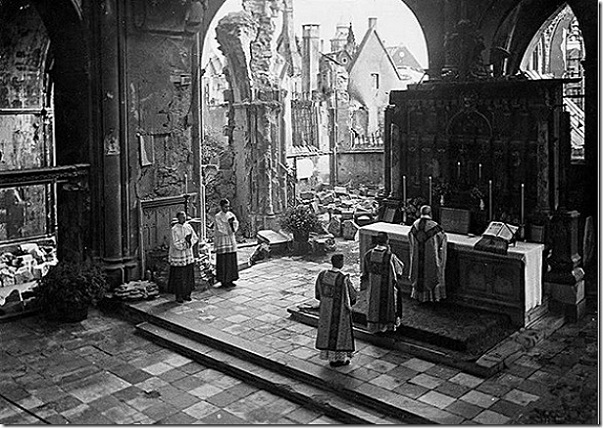
missa_thumb3.jpg

Again, I suppose there may be some who will find the idea of religious ritual boring and irrelevant rather than beautiful — but it is its capacity to move us at a deep level — even (and perhaps particularly) when high tides of  circumstance and emotion are breaking over us — that I wish to focus on and, to the extent that it is possible, explore and explain in  some upcoming posts.

In my view, it was this kind of beauty, verging on the austere and the timeless, rather than the snazzy and faddish “impress the girls — draw in the kids” kind, that Pope Benedict XVI had in mind when he said:

Like the rest of Christian Revelation, the liturgy is inherently linked to beauty: it is veritatis splendor. The liturgy is a radiant expression of the paschal mystery, in which Christ draws us to himself and calls us to communion. As Saint Bonaventure would say, in Jesus we contemplate beauty and splendor at their source.

* * *

I am not a Catholic, though my sympathies run in that direction, and my examples of ceremonial will not be drawn only from Catholic or Christian sources — part of what i want to explore is the universal quality of ritual as a powerful source of motivation and inspiration, while another aspect has to do with the interweaving of military, religious and state symbols, but the point I would most like to make in each case is the profound impact that such symbols and rituals can have on the receptive heart.

I hope to touch on a wide range of ritual expressions, from the Requiem for a departed princely Habsburg to the Lakota sweat lodge, and from to the fire-walking ceremonial of the Mt Takei monks of Japan to the Spanish bull-fight, with a close look at the ritual surrounding coronation in my own British tradition.

For those who would like to peer deeper into these matters, I would suggest these four books:

Victor Turner, The Ritual Process
Geoffrey Wainwright, Eucharist and Eschatology
William Cavanaugh, Torture and Eucharist
Josepha Zulaika, Basque Violence: Metaphor and sacrament

The first explains “how ritual works” from an anthropological point of view, the second deals with the purposeful interweaving, accomplished within ritual, of time with the timeless, the third with the way in which sacramental transcendence is the very antithesis of torture, and the fourth with the impact of a sacramental sensibility within terrorism.

Each one is a masterpiece of intelligence and profound feeling.

One thing leads to an unexpected other

Saturday, August 13th, 2011

[ by Charles Cameron — complex situations, unexpected consequences, analysts’ need for semi-random knowledges ]
.

azelin-tweet.gif

Suppose you’re a Japanese journalist given a news report to write about a tourist who may have contracted an obscure disease on a visit to Zaire. The job seems straightforward enough, you expect your Japanese readers to be sympathetic to the plight of your Japanese tourist subject, you don’t exactly expect your readers to include one Shoko Asahara, guru of Aum Shinrikyo…

But he’s there in the penumbra, reading… as this report from the Center for Counterproliferation Research of the NDU testifies:

In 1992, Aum sent a team of 40 people to Zaire to acquire Ebola. Led by Asahara himself, the team included doctors and nurses. During an outbreak of Ebola in Zaire, a Japanese tourist visiting that country may have contracted the hemorrhagic fever. This report, which received considerable publicity in Japan, apparently inspired Asahara to mount the expedition to Zaire in October 1992. Ostensibly, this trip was intended as a humanitarian mission, called the “African Salvation Tour.” It is not known if Aum actually obtained Ebola cultures. A Japanese magazine quoted a former member of the group, “We were cultivating Ebola, but it needed to be studied more. It can’t be used practically yet.”

One things leads to an unexpected other.

*

Here’s a positive example, one that I heard on the radio yesterday, and nothing to do with terrorism — except perhaps at the cellular level:

You know, the Scottish surgeon George Beatson was walking through the highlands in England, and he heard some shepherds saying, oh, you know, when we remove the ovaries of cows and goats, the pattern — or the breasts of these animals changes; the pattern of milk production changes.

So, Beatson began to wonder, well, what is the — this was a time when no one knew about estrogen. So, Beatson began to wonder, what is the connection between ovaries and breasts? And he said, well, if ovaries are connected to breasts, then maybe they’re connected to breast cancer.

And he took out the ovaries of three or four women with breast cancer and had these spontaneous, had these, not spontaneous, but amazing remissions. And it was — this is the basis for tamoxifen, the drug that actually blocks estrogen, and thereby affects breast cancer.

I mean, who would have thought that walking through and talking to a shepherd in Scotland would affect a billion-dollar drug, which is very, very powerful against breast cancer today?

One thing leads to an unexpected other.  Listen.

*

Back to terror — and what jihadists notice, think about and discuss:

They follow the news.

If the stock-market takes a dive, the folks on the forums know about it — and crow about it.  Because, as bin Laden said, AQ’s policy is one of “bleeding America to the point of bankruptcy, Allah willing, and nothing is too great for Allah.” Inspire magazine calls it “the strategy of a thousand cuts” and claims the “aim is to bleed the enemy to death”.  Daveed Gartenstein-Ross‘ book, Bin Laden’s Legacy, is abundantly clear on that point.

So yes, they follow the news.  So they know about the riots in the UK.

There was an interesting short flurry of tweets on Twitter a couple of days ago, when Will McCants, who monitors such things and runs the Jihadica blog, noted: “Lots of pictures of #londonriots being posted to Ansar jihadi forum” and followed up by quoting a couple of forum comments: “God is burning the ground beneath the feet of the Crusaders” and “We are witnessing this aggressor nation quaking inside and out….collapsing and suffering defeat by the permission of God”.

Jason Burke of the Guardian picked up on McCants’ post and noted, “so now Islamic militants exploiting #londonriots” – and Aaron Zelin of Jihadology chimed in with the tweet I quoted at the top of this post.

The conversation continued for a bit, but it’s Aaron’s comment that I want to focus on, because it makes explicit the kind of seamless weave of knowledge that I’ve been thinking about lately — which makes cross-disciplinary awareness both so necessary and so feasible at this time.  Let’s call it Zelin’s law:

every event and issue will be exploited by every group and ideology on the net.

Here’s my corollary: one thing leads to an unexpected other.

*

So what?

So we need a supersaturated solution of knowledges where decisions are made.

So our analysts need to be speckled specialists — experts with a sufficiently wide and random assortment of additional odd knowledges to be able to frame and reframe and reframe, to shake off any group frame and suggest half a dozen plausible alternatives, to doubt each one of them in turn, to turn to the right people who are themselves specialists in those other framings, to ask, to listen, to hear…

So we also need a supersaturated solution of ignorances — admitted, and inquiring.

*

Here’s Herbert E Meyer on the non-bureaucratic qualities of first-rate analysts:

In normal circumstances people like this would never be willing to take government jobs. Moreover, any agency that hired them would soon be driven nuts by their energy, their drive, their seemingly off-the-wall ideas, their sometimes bizarre work habits, even their tempers.

Sometimes bizarre, eh?  “Embrace the maverick,” Deputy Director for Intelligence Jami Miscik advised.

And by extension, embrace the unexpected — learn to expect it.

Is there a literature of the unexpected? Read it! And I don’t just mean read Nicholas Nassim Taleb‘s Black Swan — I mean, keep tabs on the undertows, read the opposition, read the factional fights within the opposition, read the underclass and upperclass, the radical and the pacific and the merely eccentric and the totally off the wall.  Know that some people believe there is a reptile in Queen Elizabeth II‘s head — and I don’t mean people who hold some variant on Paul MacLean‘s triune brain theory!  Read the ancients as well as the moderns.

Note especially the places where two fields or perspectives or framings overlap — they’re the places where experts can most easily see that each others’ approaches have value.  Cultivate binocular vision — and I mean, vision.

And do all this with a fair amount of randomness, with curiosity.

I happen to study religion, for instance, and splatter myself with other things — epidemiology, for instance, and complexity, and lit crit, and medieval music and plenty more besides — just enough to give a vaguely Jackson Pollock look to my interest in religion.

And Aum Shinrikyo’s attempt to gather samples of the Ebola virus isn’t an epidemiology story, isn’t a new religious movements story — it’s at the intersection, it’s both.

*

How many fields of knowledge can you gossip in for a minute or three? That’s a question with profound implications in terms of networked interactions and collective understanding.

How many languages can you frame your questions in?

UBL and Fisk: a quick note on something that caught me eye

Sunday, August 7th, 2011

[ by Charles Cameron — taqiyya, diplomacy, or theology? ]

.

I understand that Robert Fisk is viewed differently by different segments of the public, and hope we won’t get entangled in that discussion here – because I want to quote a story he tells, with an eye for two or three significant details.

The first detail, which you’ll find right at the end of the story, has to do with a leader’s standing when he must “withdraw” in front of his men – in other words, it’s a matter of honor and shame, and Fisk clearly feels that’s a motif of significance in his tale, though we might miss it if we weren’t specifically looking for it…

Here then is the story as Fisk tells it:

19 March 1997. There was a sudden scratching of voices outside the tent, thin and urgent like the soundtrack of an old movie. Then the flap snapped up and Bin Laden walked in, dressed in a turban and green robes. I stood up, half bent under the canvas, and we shook hands, both of us forced by the tarpaulin that touched our heads to greet each other like Ottoman pashas, bowed and looking up into the other’s face. Again, he looked tired, and I had noticed a slight limp when he walked into the tent. His beard was greyer, his face thinner than I remembered it. Yet he was all smiles, almost jovial, placing the rifle which he had carried into the tent on the mattress to his left, insisting on more tea for his guest. For several seconds he looked at the ground. Then he looked at me with an even bigger smile, beneficent and, I thought at once, very disturbing.

“Mr Robert,” he began, and he looked around at the other men in combat jackets and soft brown hats who had crowded into the tent. “Mr Robert, one of our brothers had a dream. He dreamed that you came to us one day on a horse, that you had a beard and that you were a spiritual person. You wore a robe like us. This means you are a true Muslim.” This was terrifying. It was one of the most fearful moments of my life. I understood Bin Laden’s meaning a split second in front of each of his words. Dream. Horse. Beard. Spiritual. Robe. Muslim. The other men in the tent were all nodding and looking at me, some smiling, others silently at the Englishman who had appeared in the dream of the “brother”. I was appalled. It was both a trap and an invitation, and the most dangerous moment to be among the most dangerous men in the world. I could not reject the “dream” lest I suggest Bin Laden was lying. Yet I could not accept its meaning without myself lying, without suggesting that what was clearly intended of me – that I should accept this “dream” as a prophecy and a divine instruction – might be fulfilled. For this man to trust me, a foreigner, to come to them without prejudice, that was one thing. But to imagine that I would join them in their struggle, that I would become one with them, was beyond any possibility. The coven was waiting for a reply.

Was I imagining this? Could this not be just an elaborate, rhetorical way of expressing traditional respect towards a visitor? Was this not merely the attempt of a Muslim to gain an adherent to the faith? Was Bin Laden really trying – let us be frank – to recruit me? I feared he was. And I immediately understood what this might mean. A Westerner, a white man from England, a journalist on a respectable newspaper – not a British convert to Islam of Arab or Asian origin – would be a catch indeed. He would go unsuspected, he could become a government official, join an army, even – as I would contemplate just over four years later – learn to fly an airliner. I had to get out of this, quickly, and I was trying to find an intellectual escape tunnel, working so hard in digging it that my brain was on fire.

“Sheikh Osama,” I began, even before I had decided on my next words. “Sheikh Osama, I am not a Muslim.” There was silence in the tent. “I am a journalist.” No one could dispute that. “And the job of a journalist is to tell the truth.” No one would want to dispute that. “And that is what I intend to do in my life – to tell the truth.” Bin Laden was watching me like a hawk. And he understood. I was declining the offer. In front of his men, it was now Bin Laden’s turn to withdraw, to cover his retreat gracefully. “If you tell the truth, that means you are a good Muslim,” he said. The men in the tent in their combat jackets and beards all nodded at this sagacity. Bin Laden smiled. I was saved.

I’m interested in the honor / shame angle because I have just been reading my friend Richard Landes‘ paper Edward Said and the Culture of Honour and Shame: Orientalism and Our Misperceptions of the Arab-Israeli Conflict and his blog post Game Theory and Social Emotions… I may not always agree with Richard, but he certainly sets me thinking…

The second point of interest here — which I’ve noted before — is the emphasis in the minds of bin Laden and his followers on the prophetic nature of dreams.

It is the third that is, if Fisk is accurate in his recall here, the most interesting – that bin Laden would utter the words “If you tell the truth, that means you are a good Muslim.” Fisk is not threatening him, so this is not an occasion for taqiyya as I understand it – perhaps it is an occasion, as Fisk himself suggests, for diplomacy.

But how does that remark sound as theology in the mode of Ibn Abd al-Wahhab?

Book Review: The Profession by Steven Pressfield

Monday, July 25th, 2011

The Profession by Steven Pressfield

We should begin this review with “Full Disclosure“:

I just finished reading The Profession by Steven Pressfield, which I enjoyed a great deal. Steve sent me an earlier draft doc of the book and I consider Steve a friend. Furthermore, in an extremely gracious gesture, Steve granted me (or at least zenpundit.com) the novelist’s equivalent to a walk-on cameo appearance in his book. Therefore, if you the reader believe that I cannot review this book objectively…well….you are right. It’s not possible 🙂 . Here are some other reviews by Shlok Vaidya, Greyhawk of Mudville Gazette and Kirkus if you want greater impartiality.

Nor am I going to delve into the mechanics of the plot structure and action sequence in The Profession. For one, I think too much of the story in a review of a work of fiction spoils the enjoyment for the group of readers who would be most interested. And you can get the blow by blow elsewhere.

Instead, I would like to draw your attention to how Pressfield has written this novel differently. And why that matters.

There is plenty of action in The Profession and the book really moves. It is violent, but not at a Blood Meridian level of cruelty and the murky political intrigue that surrounds the hero, the mercenary’s mercenary and “pure warrior” Gilbert “Gent” Gentilhomme, is a nice counterpoint to physical combat and technical military details. Many people will enjoy the novel on this level and The Profession would make for an exciting action film. Or perhaps a series of films along the lines of The Bourne Identity or those Tom Clancy movies with Harrison Ford. All well and good. But that is not why The Profession is worth reading – that’s merely why it is fun to read.
What surprised me initially about The Profession was how unlike Killing Rommel it was. Killing Rommel also had war and adventure, but it was a deep study in the character development of Chap, the protagonist, who had enough of a textural, cultural, authenticity as a young gentry class British officer of the WWII period as to make Killing Rommel seem semi-biographical. As a reader, I didn’t much care if Chap and his men succeeded in killing Rommel, only that I would be able to continue to see the story unfold from Chap’s perspective. Many artists believe characters and character interaction are the most important element in a story, from Saul Bellow to Quentin Tarantino. Their stories are captivating even though their narratives are not always particularly logical or centered on a grand conflict.

The Profession is not like that at all. In my view, Pressfield turned his creative energies, his knowledge for military affairs and his formidible ear for history away from character development and toward theme. This difference may or may not explain his own reports of difficulty in wrestling with this novel.

Reaching back to the lessons learned from late Republican Rome, Thucydides, Xenophon and seasoning it liberally with Machiavelli, Pressfield’s 2032 near-future is also jarringly allegorical with America of 2012. Like Rome of the 1st century BC or Athens after it’s defeat in the Peloponnesian War, America in The Profession is strategically paralyzed, politically polarized and teetering on the precipice of decay and decline. These historical inspirations have been mashed up with a dystopian 4GW world, filled with mercenary PMCs like Force Insertion and The Legion, terrorists, drones, tribes, criminal corporations and and a devious and cowardly global financial elite. A future more evenly distributed from the present.

The antagonist against whom the plot is structured is not the story’s nominal villain terrorist, but Gent’s Homeric father-figure, former Lieutenant General James Salter, USMC,  “the crawling man” who was martyred, disgraced, exiled and redeemed as the new master of Force Insertion’s Mideast deployed “armatures” (combined arms divisions) and the book’s geopolitical apex predator, who boasted:

” I was obeying a more ancient law” 

This marks a drastic shift in Pressfield’s use of characters from people existing in themselves with humanistic nuances to their use as philosophical archetypes to better express the theme, more like the technique of Fyodor Dostoyevskii, Victor Hugo or Ayn Rand.

The interplay between the kinetic Gent and the increasingly totemic Salter elucidates a theme that is creating tectonic political shifts in America and the world; a theme which is expressed explicitly to Gent at one point by the ex-Secretary of State, Juan-Estebaun Echevarria. The ex-Secretary plays Cicero to Salter’s Caesar, but Gent is ultimately cast in the role of a very different Roman by the manipulative Salter. Pressfield, in honing the various characters, including AD, Maggie Cole, El-Masri and others, is also drawing on Alcibiades, Critias, Livy, Homer, Robert Graves, Joseph Conrad and the pattern of mythic epics. Salter is at once a pagan chieftain and a philosopher-king, a civilized Kurtz or a barbaric John Galt, who after continuous dissembling, in a brutally honest speech, gives his followers, his enemies, Gent and even himself, no opportunity to morally evade what he has become or his reasons for what he proposes to do. A speech that resonates with the negative trends we see today.

The Profession is a cautionary tale outfitted in kevlar.

2083 Graphics — a first look

Sunday, July 24th, 2011

[ by Charles Cameron — index of graphics, first 800 or so pages of the “2083 European Declaration of Independence”, with some analysis ]

.

A great deal of work needs to be done on the 2083 European Declaration of Independence, and I thought a useful place to start would be a catalog of images.

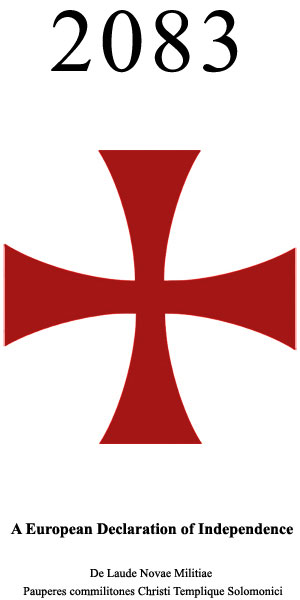
The document opens with a graphical title:

000-2083-cross-tp.jpg — title page —

That’s probably the largest single graphic in the entire work, and it puts the work squarely in the context of the Knights Templar — with e Templar cross and the full name of the order, “Pauperes commilitones Christi Templique Solomonic” or Poor Fellow-Soldiers of Christ and of the Temple of Solomon.  The Templars were a Western Christian chivalric order strongly associated with the Crusades — and the topic more recently of much historical, occult and fictional speculation.

The date 2083 is a date SFE (in the Science Fictional Era) as was 1984 before it — but it was almost certainly chosen for its echo of the 1683 Battle of Vienna, which is commonly taken to represent the turning back of the Ottomans by the Habsburgs, and thus the victory of Christendom over Islam.  Two maps show the Umayyad Conquests:

umayyad-conquests-p-228.jpg — p 228 —

and the Second Islamic Wave, turned back in Spain and at the gates of Vienna:

243-1683-second-islamic-wave-p-243.jpg — p 243 —

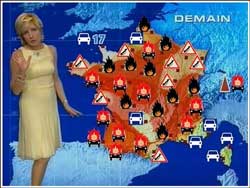
These can fruitfully be contrasted with a map of “tomorrow”:

demain-p-487.jpg — p 487 —

it being the author’s contention that France will be the first European country to fall to Islamic dhimmitude.  I suspect much the same is implied in this version of the French tricolore:

flag-face-p-781.jpg — p 781 —

There are some pointed attacks on leftist intellectuals:

033-academic-reform-p-33.jpg — p 33 —

and on media perceived as left-leaning, notably the BBC:

bbc-flag-w-crescent-p-384.jpg  — p 384

— that’s the Saudi flag mashed up with the BBC logo and star and crescent — and:

804-bbc-02-p-804.jpg  — p 804 —

giving both “ancient” and “modern” variants on the theme…

There are some strange items which I’ll drop in here for a breath of fresh air…

free-pluto-equal-gravity-for-all-planets-p-381.jpg  — p 381 —

which appears to be a commentary on the respective attractions of Venus and Mars, since it’s situated in a commentary on Feminism…

this really is a strangely mythic document… and…

global-warming-voidka-p-657.jpg

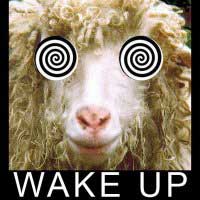
with its reference to “mind control agents” — and those whose minds have been controlled are clearly sheep:

wake-up-p-803.jpg — p 803 —

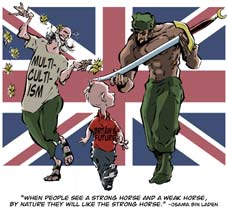
which may be the right moment to mention that the British, too, come in for a measure of contempt, via a quotation from none other than Osama bin Laden:

when-people-see-a-strong-horse-p-707.jpg  — p 707 —

“When people see a strong horse and a weak horse, by nature they will like the strong horse”.  Perhaps its unsurprising that the author is something of an admirer of bin Laden’s means, if not his ends.

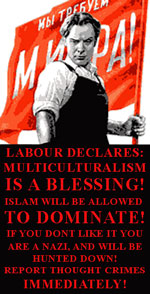
Of course, that’s largely the fault of the Labour party:

labour-declares-multiculturalism-is-a-blessing-p-373.jpg

But that’s probably enough for one post — in my next, I’ll consider how weak we are, what the jihadist strategy against us is, and how the new Templars hope to turn the tide

against:

worst-threats-to-mankind-p-674.jpg — p 674 —

the worst threats to mankind.


Switch to our mobile site