zenpundit.com » pakistan

Archive for the ‘pakistan’ Category

Pew II: Prevalence of belief in the Jinn

Monday, August 13th, 2012

[ by Charles Cameron — Corbin on Queen Bilqis, Qur’an and hadith regarding jinn, Pew statistics on belief in jinn — with some earlier Natsec implications & a non-serious suggestion from contemporary physics ]
.

La Jinn the Mystical Genie of the Lamp
from the Yu-Gi-Oh card game

.

I’ve been “fond” of the jinn (djenoun) since first encountering them in the brilliant short stories of Paul Bowles, and notably his A Hundred Camels in the Courtyard.

But that’s a literary fondness, neither science nor belief-based on my part. In my view, that’s only right and proper, since djenoun belong in the realm of imagination — or better said, the Imaginal, as Henry Corbin terms it — see note 16, p, 326. of his Creative Imagination in the Sufism of Ibn ‘Arabi, where he speaks of the Sheikh’s Bilqis Queen of Saba in his poetry as a being “born from a jinn and a woman” — it’s a fascinating passage, connecting Bilqis with Jesus in terms of the (unorthodox) angelology that Corbin envisioned uniting the Abrahamic faiths at a visionary level.

**

Here are two of the mentions of jinn in the Qur’an:

And the Jinn race We had created before from the fire of a scorching wind. [Sura 15, 27]

Say: It has been revealed to me that a company of Jinns listened (to the Qur’an). They say ‘We have really heard a wonderful Recital! It gives guidance to the Right and we have believed therein: We shall not join (in worship) any (gods) with our Lord. And exalted is the Majesty of our Lord: He has taken neither a wife nor a son.’ [Sura 72, 1-3]

And here is a tale of the Prophet and a jinn, as narrated by the Companion Malik ibn Anas:

The Prophet said to the jinni: “This is the stride of a jinni, as well as the tone of his voice!” The jinni replied: “My name is Hamah ibn Laqqis ibn Iblis.” The Prophet said: “Only two generations seperate you from him [Iblis].” He replied: “True.” The Prophet asked: “How long have you lived?” The jinni replied: “Almost all of time. I was a small boy when Abel was killed. I believed in Noah and repented at his hands after I stubbornly refused to submit to his call, until he wept and wept. I am indeed a repentant — God keep me from being among the ignorant! I met the prophet Hud and believed in his call. I met Abraham, and I was with him when he was thrown in the fire. I was with Joseph, too, when his brothers hurled him into the well—I preceded him to its bottom. I met the prophet Shu’ayb, and Moses and Jesus the son of Mary, who told me: ‘If you meet Muhammad, tell him Jesus salutes thee!’ Now I’ve delivered his message to you, and I believe in you.” The Prophet said: “What is your desire, 0 Hamah?” He said: “Moses taught me the Torah, Jesus the Gospels, can you teach me the Qur’an?” So the Prophet taught him the Qur’an.

The Tasneem Project

**

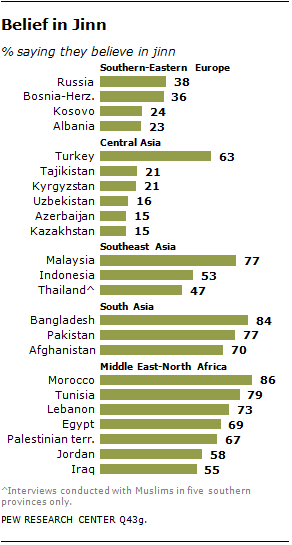
Literal vs metaphorical, let alone imaginal belief is not something the interviewers who conducted the Pew poll had the leisure to distinguish — but for the record, here are their findings as to the Muslim belief in jinns:

According to the Quran, God created jinn as well as angels and humans. Belief in jinn is relatively widespread – in 13 of 23 countries where the question was asked, more than half of Muslims believe in these supernatural beings.

In the South Asian countries surveyed, at least seven-in-ten Muslims affirm that jinn exist, including 84% in Bangladesh. In Southeast Asia, a similar proportion of Malaysian Muslims (77%) believe in jinn, while fewer in Indonesia (53%) and Thailand (47%) share this belief.

Across the Middle Eastern and North African nations surveyed, belief in jinn ranges from 86% in Morocco to 55% in Iraq.

Overall, Muslims in Central Asia and across Southern and Eastern Europe (Russia and the Balkans) are least likely to say that jinn are real. In Central Asia, Turkey is the only country where a majority (63%) of Muslims believe in jinn. Elsewhere in Central Asia, about a fifth or fewer Muslims accept the existence of jinn. In Southern and Eastern Europe, fewer than four-in-ten in any country surveyed believe in these supernatural beings.

In general, Muslims who pray several times a day are more likely to believe in jinn. For example, in Russia, 62% of those who pray more than once a day say that jinn exist, compared with 24% of those who pray less often. A similar gap also appears in Lebanon (+25 percentage points), Malaysia (+24) and Afghanistan (+21).

The survey also asked if respondents had ever seen jinn. In 21 of the 23 countries where the question was asked, fewer than one-in-ten report having seen jinn, while the proportion is 12% in Bangladesh and 10% in Lebanon.
**

Two markers concerning National Security concerns regarding Pakistan, nuclear weapons and those who believe (literally, energetically) in jinns — from the early 2000s, but dating back by implication to the era of Zia ul-Haq:

Just after the September 2001 terrorist attacks in the U.S., Pakistan’s intelligence service detained two retired nuclear scientists who had met with senior members of al Qaeda, including Mr. bin Laden, during charity work in Afghanistan. One, Sultan Bashiruddin Mahmood, was a former director at the Pakistan Atomic Energy Commission and a controversial Islamic scholar who had postulated that energy could be harnessed from fiery spirits called djinns.

WSJ, Inside Pakistan’s Drive To Guard Its A-Bombs

But as a subscriber to a brand of what is known to practitioners as “Islamic science,” which holds that the Koran is a fount of scientific knowledge, Mr. Bashiruddin Mahmood has published papers concerning djinni, which are described in the Koran as beings made of fire. He has proposed that these entities could be tapped to solve the energy crisis, and he has written on how to understand the mechanics of life after death.

NY Times, Pakistani Atomic Expert, Arrested Last Week, Had Strong Pro-Taliban Views

— together with a Pakistani critique:

If a scientist is European or Hindu he will be restricted in his vision by reason. A Muslim scientist has unlimited scope; he will relate his science to miracles, mostly performed by himself. Sultan Bashiruddin, our top enrichment expert, believed he could draw electricity from a captured jinn. (For Pakistan’s needs just one jinn would suffice.)

Khaled Ahmed, Scientists, our kind

There are times when beliefs have, or might just have, consequences.

**

Jinn are significant not only for their own sakes, so to speak, but also for their etymological implications. To quote again from the Tasneem Project:

One saying of the Prophet (aws) mentions that, “God divided the jinn and the humans into ten parts. One part makes up the human race, and the other nine parts is made up of the jinn.” The invisible is everywhere. The Arabic language itself bears witness to how the invisible realm insinuates itself on everyday life. In Arabic, each time the two letters jeem and nun occur together, as in jinn, they convey the meaning of invisible or hidden. Thus, paradise is jannah because paradise is hidden from the human sight; janin is the foetus in the womb; the expression ajannahu al-layl means the night covered him.

The jinn, like paradise itself, are among the hidden secrets…

**

And how large is the universe, that it might encompass the angels and jinn? Hugh Everett III quite brilliantly argued for what has come to be known as the “many worlds” hypothesis in quantum measurement while still a grad student:

Hugh Everett III was a student in his mid-twenties in 1957 when he presented his revolutionary formulation of quantum mechanics in his PhD thesis. Everett himself called his theory variously; pure wave mechanics, the relative-state formulation of quantum mechanics, and the theory of the universal wave function. His theory, however, came to be popularly known as the many-worlds interpretation, because it predicts that everything that might happen, does in fact happen. As the physicist Bryce DeWitt later described it, Everett’s theory predicts that our universe is composed of countless parallel universes that are each constantly splitting into yet further copies, and in the process, creating copies of each observer, each of which subsequently observes a different quantum universe and splits into further copies.

While a science fiction fan might embrace such a theory simply by dint of how cool it would be if something like that were true, one might naturally wonder what good scientific reason one might have for believing that our universe is in fact composed of countless parallel splitting universes.

**

The whole article from which that quote was taken, The Quantum Measurement Problem and the Everett Interpretation, is indeed worth reading. But whereas physicists and (most) science fiction writers might confine their “many worlds” to physical, “materialist” universes, students of the imaginal are under no such restriction, as the same Tasneem Project article suggests:

The Muslim universe has always been made up of multiple worlds – the Qur’an itself refers to “universes” in the plural, in its open chapter al-fatihah. According to prophetic tradition, the cosmos consists of 18000 universes. …

So the jinn when summoned might come — somewhat unexpectedly — from one of Everett’s more hidden “many worlds”, perhaps?
Techno-Mahdi?

Saturday, August 4th, 2012

[ by Charles Cameron — of no practical importance, yet curious indeed, Mahdism, Pakistani history, shamanism, magic, the Kwakiutl / Tlingit, religion ]
.

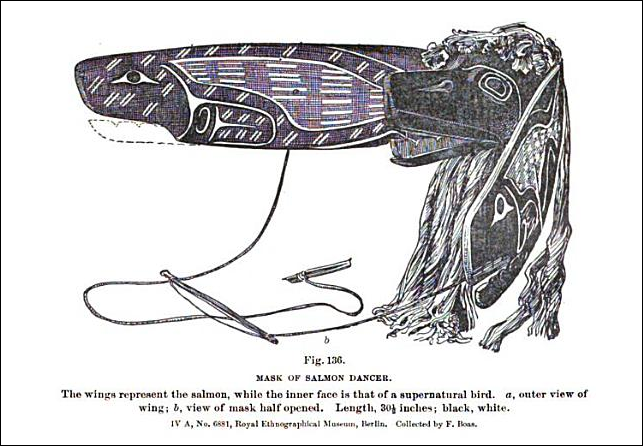
Kwakiutl Salmon Dancer's mask

.

I really don’t have much to say about this, but I’d like to note it as one more instance of Mahdism cropping up in unlikely places. And a h/t to Scott McWilliams @macengr for pointing me to the story. I can’t entirely vouch for its accuracy since I don’t have easy access to 1970s Pakistani newspapers, but I’ve seen allusions to the same story dating back a couple of years

When the Pakistani army and bureaucratic establishment realized that Mujib-ur-Rehman’s Awami League and Zulfiqar Ali Bhutto’s PPP were attracting people—with no other party able to draw even 5000 to its rallies—they imported Zohra Fona, a woman from Indonesia, pregnant with Imam Mehdi. She had visited several Islamic countries, it was propagated, where rulers had offered prayers in her Imamat [i.e. she led the prayers even if a woman is not supposed to do that].

Many Muslim intellectuals and scholars claimed through their writings and lectures that the time for Imam Mehdi’s appearance had arrived. A new Islamic world was about to emerge. During this period the Islamic parties, including Jamat-e-Islami, perpetrated violence. Members started attacking liberal and progressive professors, doctors, writers, journalists as well as their houses. They also burned many libraries and collections of books.

Zohra Fona claimed that the child in her womb recited Azaan [call for prayers] and could lead the prayers. Ulema like Maulana Okarvi and Ehtesham Ul Haque went to see Zohra Fona and listened to Azan with ears close to lady’s womb. Prayer events were arranged for her in open places as well as in the larger mosques, and the Ulema [religious scholars] were praying behind her. She would stretch her legs towards Kaaba [Mecca], directing her womb toward the pulpit. Suddenly Azaan would start coming from her womb or from another private part. The Ulema were so shameless that they were offering prayers while focusing their eyes on her private parts.

Back then the left was very organized so it was difficult to explain this farce. Finally the Pakistan Medical Association and doctors at Jinnah Hospital, Karachi decided to unearth the drama. Several lady gynecologists were asked to help; they knew that this kind of thing could not happen. But Zohra Fona was very clever. Whenever doctors were pursuing her to take a medical examination she avoided with help from the Pakistani security forces. But one day, when she was unable to escape, the doctors of Jinnah hospital, Karachi conducted an examination. The doctors recovered a small tape recorder from her womb.

Does the bit about the tape-recorder in the womb sound a bit far-fetched? Here’s another version, this one from The [International] News:

Zohra Fona, a blessed Indonesian woman, arrived in Pakistan just ahead its first general elections. She was said to be expecting a child who would be Imam Mehdi. She had visited several Islamic countries where, and it was propagated, that rulers had offered prayers in her imamat. Many ulema began to claim that the time for Imam Mehdi’s coming had arrived.

Zohra Fona claimed that the child recited Azaan. Reputed ulema like Maulana Okarvi and Ehteshamul Haque met Zohra Fona and listened to the Azaan with ears close to the lady’s stomach. She began to draw huge crowds to mosques and parks where she led prayers. Our reputed ulema would join the prayers.

Woe betide this country! Some leftist and agnostics at Karachi’s Jinnah Hospital decided to put the legend to scientific test. It was revealed that the holy woman was not even pregnant with an Azan-reciting messiah but had a recording device tied to her body. She immediately left for Indonesia once the farce was exposed.

That sounds more plausible.

**

A word of caution here.

Just as theater and film sometimes deploy “deux ex machina” interventions to immerse their audiences more deeply into their created micro-worlds, so have shamanic performances.

I’ve written about this before in an email to a religious scholars’ list, and in these days when even self-plagiarism is disdained, I am going to repeat here what I wrote then, with very minor changes:

It’s my recollection that [Tlingit / Kwakiutl winter ceremonials] were both entertainment for the long winter nights and “schooling” for the young, and I have a vivid recall of reading somewhere a shaman’s admission to an anthro of the exact nature of the dramatic means by which the shaman’s capacity to defeat death was demonstrated.

I read this in the early eighties, but searching on the web I’ve found something that comes close — Clellan Stearns Ford’s record of Charles James Nowell’s memories in _Smoke from their fires: the life of a Kwakiutl chief_. Around p 120, there are two stories, the first about a girl who “turned the wrong way” during a dance, the second about a girl who is put in a box and burned. In both cases, the nature of the trickery is described but in the version I read all those years ago, the two stories were one — the girl who was put in a box in the fire pit and “burned to death” escapes through a false bottom to the box along a tunnel into the adjoining room, and her voice then issues as if from her ashes, via a kelp tube that goes from the tunnel to the adjoining room where she’s now standing.

She describes her descent into the sea realm, where she is chastened and eventually granted a boon to return to the tribe. A canoe sets out to fetch her, but by the time the audience sees it set out, she’s already secured by rope to the far side of the boat, and at a suitable distance is hauled aboard and brought back to shore, alive.

A child seeing this would be mightily predisposed to believing the shaman had healing powers, and by the time the ruse was revealed, that underpinning of faith is already in place.

In the Nowell version, even the adults, who “know” the deception involved, are deceived: “The fire burned and the box burned, and she was still singing inside, and then the box go up in flames, and they can see her burning there in her blue blanket, and all her relatives just cry and cry. Although they know it is not real, it looks so real they can’t help it. It was all a trick. There was a hole under the box with a tunnel leading out of the house, and the woman went out of the box and put a seal in her place wrapped in a blue blanket, and then someone sang into the fire through a kelp tube, her song. Oh, it looked real!”

The Winter ceremonials of the Pacific Northwestern tribes are by turns opera, history, religion and “general education” to the children of the tribe, and “continuing education” to their elders…

Do we have anything to equal them?

Bearing such things in mind, we may want to consider trickery — a quality of the trickster gods, after all, in many mythologies — a not entirely illegitimate activity for a religious performer…

Query: COIN Manual Conference Feedback

Wednesday, May 16th, 2012


Was the COIN  Manual conference at Fort Leavenworth last week a success or a failure?

I have heard backchannel that the focus of the rewrite of FM 3-24 was going to be on “tactics” and but that a “light footprint option” had to be included to appease policy makers. Some good suggestions were made at SWJ by Colonel Robert C. Jones, but not much has been said yet online that I have seen. USACAC bloseriously could use some updating on a more frequent basis.

I’m curious where they went with this. Opinions and comments solicited.

Book Review: The Hunt for KSM

Monday, May 14th, 2012

The Hunt for KSM: Inside the Pursuit and Takedown of the Real 9/11 Mastermind by Terry McDermott and Josh Meyer 

I received a review copy of The Hunt for KSM from  Hachette Book Group and was pleased to see that the authors, Terry McDermott and Josh Meyer, are investigative journalists, one of whom, Meyer, has extensive experience reporting on terrorism, while McDermott is also the author of the 9-11 highjackers book, Perfect Soldiers. So, I was looking forward to reading this book. My observations:

  • In the matter of style, McDermott and Meyer have opted to craft a novel-like narrative of their research, which makes The Hunt for KSM a genuine page-turner. While counterterrorism wonks used to a steady diet of white papers may become impatient with the format, they already know a great deal about operational methods of Islamist terror groups and the general public, who are apt to be engaged by the story, do not. While enjoying the yarn about Khalid Sheikh Mohammed, the villain behind 9-11 and his downfall, the general reader picks up a great deal of important information.
  • McDermott and Meyer deserve kudos for their fair and balanced handling of Pakistan – and I say this as a severe critic of the Pakistanis. While pulling no punches about the perfidy of Pakistan’s elite, the ties of the ISI and their religious extremist parties to terrorist groups including al Qaida, they give credit where credit is due to Pakistanis who made the difference in assisting the United States and it’s investigators in tracking down KSM and his AQ associates . “Colonel Tariq” of the ISI, in particular stands out as a courageous and sympathetic figure.
  • Khalid Sheikh Mohammed emerges in the story as a master adversary, part Bond villain, part sinister clown, who confounded the efforts of the FBI and the CIA for years with his prodigious ability to organize and orchestrate geographically diverse terrorist networks, fundraising, logistical support, bombings and murder like a one-man KGB while remaining as elusive as a ghost. His abilities, daring, good fortune and defiant resilience in captivity are impressive enough in McDermott and Meyer’s telling that they unfortunately tend to overshadow the fact that KSM is an enthusiastic mass-murderer. A facet that comes out to it’s true ghastly extent only in their description of KSM personally beheading kidnapped reporter Daniel Pearl.
  • The bureaucratic bungling and stubborn infighting of the FBI and CIA, with assistance from the DoD and Bush administration on particularly stupid decisions related to the interrogation and reliance upon torture while excluding AQ experts and experienced KSM case investigators from talking to KSM, makes for a profoundly depressing read. It contrasts poorly with the dedication and sacrifice demonstrated by law enforcement agents Frank Pellegrino, Matt Besheer, Jennifer Keenan and those who aided them.

The Hunt for KSM closes with Khalid Sheikh Mohammed as he is at the present time, on trial at Guantanamo Bay, a story with a climax but not yet an epilogue.

Well written, concise yet dramatic, The Hunt for KSM is warmly recommended.

Request for help regarding a hadith

Tuesday, March 13th, 2012

[ by Charles Cameron — no extremism in religion, did Muhammad say that? ]
.

1.

Illustrated above is the banner of the Khudi blog from Pakistan, offering a hadith in support of its vision, which it describes as follows:

As a movement Khudi stands against all forms of extremism, including those that use religion to justify a certain agenda. But simply saying ‘no’ to extremism isn’t good enough – it’s essential to challenge and undermine the arguments used by extremists and to refute the religious justifications they put forward.

However, challenging extremism in this way doesn’t mean that Khudi is eligible to comment on religious matters or issue fatwas about the length of the beard or the hijaab. At Khudi we believe religious beliefs are a personal matter that each individual may take guidance on from their respective religious authorities. Thus, our volunteers and friends belong to a variety of faiths and sects and span the religious spectrum, from conservative to liberal. The important thing is that we stand firmly by the principle of respecting each other’s difference.

2.

I’m intersted in Khudi, not least because it seems to be a brainchild of Maajid Nawaz, one of the ex-jihadists who founded the Qulliam Foundation in London:

Quilliam is the world’s first counter-extremism think tank set up to address the unique challenges of citizenship, identity and belonging in a globalised world. Quilliam stands for religious freedom, equality, human rights and democracy.

Khudi appears to be Quilliam’s Pakistan equivalent, more or less.

3.

Here’s the deal. The Khudi blog website header illustrated above cites Bukhari 9.582 as saying:

Beware of extremism in religion, for extremism destroyed those who went before you.

I would like to be able to point to that hadith with confidence in my own writings, and I’d be happy to give appropriate attribution to the Khudi blog. but first I need help in clearing up some questions I have about it.

Specifically, when I went to verify the hadith for scholarly accuracy before quoting it — not being a reader of Arabic, and thus being dependent on what resources in English I can muster — I found to my surprise that the
hadith-search function for MulsimOnline gave the following result for Bukhari 9.582:

Narrated Ibn `Abbas:

(regarding the Verse):– ‘Neither say your prayer aloud, nor say it in a low tone.’ (17.110) This Verse was revealed while Allah’s Apostle was hiding himself in Mecca, and when he raised his voice while reciting the Qur’an, the pagans would hear him and abuse the Qur’an and its Revealer and to the one who brought it. So Allah said:– ‘Neither say your prayer aloud, nor say it in a low tone.’ (17.110) That is, ‘Do not say your prayer so loudly that the pagans can hear you, nor say it in such a low tone that your companions do not hear you.’ But seek a middle course between those (extremes), i.e., let your companions hear, but do not relate the Qur’an loudly, so that they may learn it from you.

“Not too soft, not too loud” bears a kind of family resemblance to “nothing in excess” — but it’s not the same thing, and I rather doubt that the words in Bukhari rendered by one translator as “Neither say your prayer aloud, nor say it in a low tone” would be rendered by another as “Beware of extremism in religion” — and I don’t see anything there that would correspond with the phrase “for extremism destroyed those who went before you”.

4.

Okay, all this set me digging a little further, and I next found a hadith reported at the ProphetEducation site, which reads as follows:

On the authority of Ibn Abbas (May Allah be pleased with him):

“Very early in the morning on the day of ‘Aqabah, the messenger of Allah (blessings and peace of Allah be upon him) while riding on his camel said to me: ‘pick some pebbles for me’. I then picked seven hurling pebbles for him. While dusting them of his hands he said: thou shall not cast except with such pebbles. Then he said: O mankind! Beware of extremism in religion for those before you were destroyed as a result of extremism in religion”

Related by Ibn Majah, Hadith no.(3029).

5.

So.

Did the folks putting the Khudi site together just get the hadith citation wrong — or is there more here than meets my eye? I would very much appreciate any help in explaining what at present seems to me a somewhat confusing picture.

If the hadith is authentic and can be found as stated in Sahih Bukhari, the pre-eminent source for hadith, and can be referenced from the English translation of Bukhari on the USC site, that would itself be a help. If so, it would also be of interest to know what kind of hermeneutic AQ deploys to get around it.

And if it is always found in the original sources, Bukhari or otherwise, in association with the comments about small “hurling pebbles” — why, that raises yet other questions.

6.

TIA — in this case meaning thanks in advance, not transient ischemic attack!


Switch to our mobile site

