zenpundit.com » Afghanistan

Archive for the ‘Afghanistan’ Category

Change: a poem from The Poetry of the Taliban

Tuesday, May 8th, 2012

[ by Charles Cameron — poetry in time of war, symbolism / semiotics of blood and martyrdom, analogies with Jefferson and St Augustine, sacramental nature of reality ]
.
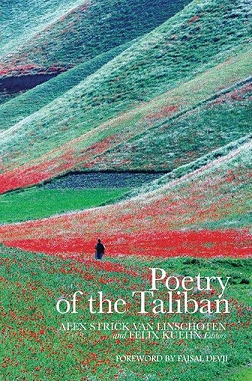
Felix Kuehn and Alex Strick van Linschoten’s book The Poetry of the Taliban (Hurst, Columbia UP) contains a remarkable poem composed in the 1990s by one Bismillah Sahar:
.

Change

The spring of change needs blood to rain down,
It requires the irrigation of the gardens with blood.
Valuing the blood of the people of the past
Requires the price of human blood.
Each drop of it has become a Nile of the dawn’s blood;
The Pharaohs want to fill the Nile with blood

Sitting here in California seven thousand miles and many cultures distant and more than a decade later, the phrase “spring of change” has an interesting ring to it – but it was likely not the not-yet-deposed Mubarak that Sahar was thinking of when he penned his lyric about the Pharaoh, but “the Oppressor” — whomever that might be. The imagery of the Pharaoh is a common enough trope, in fact, used for instance by the Taliban to describe President GW Bush in their magazine Al-Sumud [ link is to preview, relevant chapter of Master Narratives of islamist Extremism.

And while it is true that, as Asim Qureshi notes, “poetry links the ancient past with the modern day”, neither the trope itself nor the reference to the plight of the Jews in Egypt is exclusive to Afghanistan in specific or Islam in general. Indeed, Martin Luther King explicitly views himself as what theology would term a “type” of Moses when he says:

We’ve got some difficult days ahead. But it doesn’t matter with me now. Because I’ve been to the mountaintop. And I don’t mind. Like anybody, I would like to live a long life. Longevity has its place. But I’m not concerned about that now. I just want to do God’s will. And He’s allowed me to go up to the mountain. And I’ve looked over. And I’ve seen the promised land. I may not get there with you. But I want you to know tonight, that we, as a people will get to the promised land. And I’m happy, tonight. I’m not worried about anything. I’m not fearing any man. Mine eyes have seen the glory of the coming of the Lord.

These sacramental bleedings of the past into the present as in a palimpsest are native to the imagination and powerful in their poetic impact, as MLK’s life, final speech and death eloquently testify.

But there is a second layer of sacramental reality at work in the poem, and it lies in the repeated mention of blood. – the transition between past an present itself being presented in terms of blood spilled in the lines:

Valuing the blood of the people of the past
Requires the price of human blood.

The past requires a price from the present, then, and that price is paid in blood.

*

The poem is six lines long, and there is not a line of it that does not contain the word blood. Again:

The spring of change needs blood to rain down,
It requires the irrigation of the gardens with blood.
Valuing the blood of the people of the past
Requires the price of human blood.
Each drop of it has become a Nile of the dawn’s blood;
The Pharaohs want to fill the Nile with blood.

*

Zeus “poured bloody drops earthwards, honoring his own son, whom Patroklos was soon to destroy in fertile Troy far from his homeland”, Homer writes in the Iliad, 16.459, and the associations of rain with tears, and of spilled blood with spilled life, are ancient and pervasive.

Blood lust, blood sacrifice – the word blood is as powerful as any in the human vocabulary, so much less abstract that birth or death yet richly associated with both, while the sight or thought of blood stirs us at some archaic level of primal imagination. And what of the “irrigation of the gardens with blood”?

The gardens, first, are paradise. Next, they are paradise on earth, perhaps in one’s own village. I have written before of my memories of:

one small white-walled mosque way out on a dry stretch of road between Herat and Kandahar and its small, lush, green garden, all these years later: whatever it was to the inhabitants of that small village, to me it was “oasis” and “paradise” in perfect miniature, and it remains so in memory.

The rivers of Islam’s paradise flow with water, milk, honey and wines: so what place has blood there?

One answer would be found in the hadith, “Know that paradise is under the shade of swords”.

In his book The Shade of Swords: Jihad and the Conflict Between Islam and Christianity, named after the hadith in question, the noted journalist MJ Akbar writes:

The only reason why a person could ever want to leave paradise for this earth would be to get martyred again. Death was only a welcome release; there was no possible deed in this life that could equal jihad in reward after death. The Prophet urged Muslims to seek Firdaus, the best and brightest part of paradise, just below Allah’s throne. Allah had reserved one hundred grades of paradise only for the martyrs. The blood of the wounded would smell like musk on the day of resurrection; and nothing could interfere with Allah’s reward.

The blood of the wounded would smell like musk…

For more on musk, blood, martyrdom and the “odor of sanctity”, see my Of war and miracle: the poetics, spirituality and narratives of jihad.

And so blood is linked to paradise by martyrdom.

*

The spring of change “requires the irrigation of the gardens with blood” the poet tells us, much as Thomas Jefferson told William Stephens Smith in a letter of November 13, 1787:

The tree of liberty must be refreshed from time to time with the blood of patriots and tyrants. It is it’s natural manure.

But hold on, the same trope is found in St. Augustine‘s City of God, xx.7:

Through virtue of these testimonies, and notwithstanding the opposition and terror of so many cruel persecutions, the resurrection and immortality of the flesh, first in Christ, and subsequently in all in the new world, was believed, was intrepidly proclaimed, and was sown over the whole world, to be fertilized richly with the blood of the martyrs.

And the imagery continues, in the West, into our own day. When Pope Benedict XVI visited Mexico earlier this year, he was treading on “land that was wet with the blood of martyrs” according to Mgr. Fidel Hernández Lara, Episcopal Vicar of the Mexican Archdiocese of León.

*

The very earliest Christian accounts of martyrdom, indeed, have a distinctly sacramental flavor, as one sees by juxtaposing Ignatius of Antioch (quoted by Carolyn Forche in Susan Bergman, ed., Martyrs):

I am God’s wheat ground fine by the lion’s teeth to become purest bread for Christ

with Tertullian (Apologeticum in the translation by Lewis Carroll‘s father):

The blood of the Christians is their harvest seed

*

Joseba Zulaika subtitles his book Basque Violence — which Leah Farrall kindly pointed me to — with the words “Metaphor and Sacrament”.

Sacrament is a key word for me, obviously, and for the sake of those disinclined to religion, may I point to Gregory Bateson‘s comment in the first paragraph of the Introduction to his Mind and Nature:

Even grown-up persons with children of their own cannot give a reasonable account of concepts such as entropy, sacrament, syntax, number, quantity, pattern, linear relation, name, class, relevance, energy, redundancy, force, probability, parts, whole, information, tautology, homology, mass (either Newtonian or Christian), explanation, description, rule of dimensions, logical type, metaphor, topology, and so on. What are butterflies? What are starfish? What are beauty and ugliness?

The concept of “sacrament” occupies a place of honor second only to “entropy” in Bateson’s listing.

I am not arguing the pros and cons of publishing these poems, although I side firmly with the publisher on this. Nor am I attempting to assess the poetic value of the one poem I have quoted and examined. What I am trying to do is to give that poem the kind of reading I would want to give to any poem that interested me — one that seeks out its resonances in both local and world cultures as far as my wits can manage, showing, if possible, what power it gains from archetype, authority and form… If the poem were from the South English Legendary, for instance — which expresses similar sentiments — I’d have no hesitation calling its worldview “sacramental”.

But this is a poem from Afghanistan and Islam, not from medieval Christian England, so I should perhaps explain that in my view, any perspective which views the world as a series of legible “signs from God” — ayat, in the Arabic of the Qur’an — is a sacramental view, under the definition of sacrament that calls it “an outward and visible sign of an inward and spiritual grace”.

Blood is such a sign — of life, of its value, of its continuity by descent, and of its redemptive power even in death.

It is in sensing this semiotic / sacramental quality to Islam that we begin to grasp what translations such as these can point us to, but not directly reveal.

*****

Further reading:

From today’s NYT: Why Afghan Women Risk Death to Write Poetry
Poetry reading in Afghan culture: Reading Poetry In Kandahar
Afghan poetics: Poetry: Why it Matters to Afghans? Understanding Afghan Culture [.pdf], NPS, 2009
Talib poetry as propaganda: Johnson & Waheed, Analyzing Taliban taranas (chants): an effective Afghan propaganda artifact, Small Wars & Insurgencies, 2011
And finally, Afghans Build Peace, One Stanza at a Time
History Will Judge Only if We Ask the Right Questions

Wednesday, April 18th, 2012

Thomas Ricks of CNAS recently had a historically-minded post at his Best Defense blog at Foreign Policy.com:

What Tom would like to read in a history of the American war in Afghanistan 

I think I’ve mentioned that I can’t find a good operational history of the Afghan war so far that covers it from 2001 to the present. (I actually recently sat on the floor of a military library and basically went through everything in its stacks about Afghanistan that I hadn’t yet read.)

Here are some of the questions I would like to see answered:

–What was American force posture each year of the war? How and why did it change?

–Likewise, how did strategy change? What was the goal after al Qaeda was more or less pushed in Pakistan in 2001-02?

–Were some of the top American commanders more effective than others? Why?

–We did we have 10 of those top commanders in 10 years? That doesn’t make sense to me. 

–What was the effect of the war in Iraq on the conduct of the war in Afghanistan?

–What was the significance of the Pech Valley battles? Were they key or just an interesting sidelight?

–More broadly, what is the history of the fight in the east? How has it gone? What the most significant points in the campaign there?

–Likewise, why did we focus on the Helmand Valley so much? Wouldn’t it have been better to focus on Kandahar and then cutting off and isolating Oruzgan and troublesome parts of the Helmand area?

–When did we stop having troops on the ground in Pakistan? (I know we had them back in late 2001.) Speaking of that, why didn’t we use them as a blocking force when hundreds of al Qaeda fighters, including Osama bin Laden, were escaping into Pakistan in December 2001?

–Speaking of Pakistan, did it really turn against the American presence in Afghanistan in 2005? Why then? Did its rulers conclude that we were fatally distracted by Iraq, or was it some other reason? How did the Pakistani switch affect the war? Violence began to spike in late 2005, if I recall correctly — how direct was the connection?

–How does the war in the north fit into this?

–Why has Herat, the biggest city in the west, been so quiet? I am surprised because one would think that tensions between the U.S. and Iran would be reflected at least somewhat in the state of security in western Afghanistan? Is it not because Ismail Khan is such a stud, and has managed to maintain good relations with both the Revolutionary Guard and the CIA? That’s quite a feat. 

Ricks of course, is a prize winning journalist and author of best selling books on the war in Iraq, including Fiasco and he blogs primarily about military affairs, of which Ricks has a long professional interest and much experience.  Ricks today is a think tanker, which means his hat has changed from reporter to part analyst, part advocate of policy. That’s fine, my interest here are in his questions or rather in how Ricks has approached the subject.

First, while there probably ought to be a good “operational history” written about the Afghan War – there’s a boatload of dissertations waiting to be born – I think that in terms of history, this is the wrong level at which to begin asking questions. Too much like starting a story in the middle and recounting the action without the context of the plot, it skews the reader’s perception away from motivation and causation.

I am not knocking Tom Ricks. Some of his queries are important – “What was the effect of the war in Iraq on the conduct of the war in Afghanistan?”  – rises to the strategic level due to it’s impact and the light it sheds on national security decision making during the Bush II administration, which I suspect, will not look noble when it is revealed in detail because it almost never is, unless you are standing beside Abraham Lincoln as he signs the Emancipation Proclamation.  Stress, confusion, anger and human frailty are on display. If you don’t believe me, delve into primary sources for the Cuban Missile crisis sometime.  Or the transcripts of LBJ and NIxon. Exercise of power in the moment is uncertain and raw.

But most of the questions asked by Ricks were “operational” – interesting, somewhat important, but not fundamental. To understand the history of our times, different questions will have to be asked in regard to the Afghan War. Here are mine for the far off day when documents are declassified:

What was the evolution of the threat assessment posed by Islamist fundamentalism to American national security by the IC from the Iranian revolution in 1979 to September 11, 2001?  Who dissented from the consensus? What political objections or pressures shaped threat assessment?

What did American intelligence, military and political officials during the Clinton, Bush II and Obama administrations know of the relationship between the ISI and al Qaida and when did they know it?

What did American intelligence, military and political officials during the Clinton, Bush II and Obama administrations know of the relationship between Saudi intelligence, the House of Saud and al Qaida and when did they know it?

What did American intelligence, military and political officials during the Clinton, Bush II and Obama administrations know of the relationship between the Taliban and al Qaida and when did they know it?

In the aftermath of 9-11, how did Saudi leverage over global oil markets effect American strategic decision making?

In the aftermath of 9-11, how did Pakistani nuclear weapons effect American strategic decision making?

In the aftermath of 9-11, how did the “Iraq problem”  effect American strategic decision making?

In the aftermath of 9-11, how did nuclear terrorism threat assessments effect American strategic decision making?  Did intelligence reports correlate with or justify the policy steps taken?

Who made the call on tolerating Pakistani sanctuaries for al Qaida and the Taliban and why?

Was there a net assessment of the economic effects of a protracted war in Afghanistan or Iraq made and presented to the POTUS? If not, why not?

Why was a ten year war prosecuted with a peacetime military and a formal declaration of war eschewed?

How did the ideological convictions of political appointees in the Clinton, Bush II and Obama impact the collection and analysis of intelligence and execution of war policy?

Who made the call for tolerating – actually financially subsidizing – active Pakistani support for the Taliban’s insurgency against ISAF and the Government of Afghanistan and why?

What counterintelligence and counterterrorism threat assessments were made regarding domestic Muslim populations in the United States and Europe and how did these impact strategic decisions or policy?

What intelligence briefs or other influences caused the incoming Obama administration to radically shift positions on War on Terror policy taken during the 2008 campaign to harmonize with those of the Bush II administration?

What discussions took place at the NSC level regarding the establishment of a surveillance state in the “Homeland”, their effect on our political system and did any predate September 11, 2001 ?

What were the origins of the Bush administration’s  judicial no-man’s land policy regarding “illegal combatants” and “indefinite detention”, the recourse to torture but de facto prohibition on speedy war crimes trials or capital punishment?

The answers may be a bitter harvest.

Pondering Transition Ops with Quesopaper

Monday, April 16th, 2012

One of the nice things about this blog is that periodically, smart folks will send me their unpublished material for feedback and private commentary. This comes in a wide variety of formats – manuscripts, articles, book chapters, powerpoint, sometimes an entire book or novel! It is flattering and almost always informative, so I try to help where I can or at least point the sender in the direction of someone more appropriate.

Recently, I was given a peek at a very intriguing paper on “Transition Operations” by Dr Rich Ledet, LTC Jeff Stewart and Mr. Pete Turner, who blogs occasionally at quesopaper.  Pete has spent a good chunk of the past ten years in a variety of positions and capacities in Iraq and Afghanistan, where he currently is with American troops in a remote rural district and it was he who passed their draft to me. They have taken a fresh look at the subject.

While I can’t give away their “secret sauce” in detail,  I particularly liked the fact that while the  focus and advice for executing transition operations is aimed at field grade officers and their civilian agency counterparts, their vision is in sync with the ideal of having policy-strategy-operations and tactics as a seamless “whole-of-government” garment. If only we could get our politicians to think in these terms, half the battle would be over.

Their paper is now headed to a professional journal; when it is published ( as I think it will be), I will definitely be linking to it here and hopefully, that will be soon.

My reason for my bringing this up – I have the permission of the authors to do so – is that the trio have put their finger on the major doctrinal problem faced by the United States military in Afghanistan – “transition operations” being a politically charged topic, laden as it is with implied foreign policy decision making by heavyweight policy makers, is treated in very scanty fashion by FM 3-24. Compared to other aspects of COIN, very little guidance is given to the the commander of the battalion or brigade in the effort to coordinate “turnover” of responsibilities and missions to their Afghan Army, police and government allies.

This at a time when the “readiness” of Afghan units and officials to accept these burdens in the midst of a war with the Taliban is questionable, variable, controversial at home and politically extremely sensitive in Afghanistan.

And at a point where, ten years after September 11, the US State Department is no more able in terms of personnel and vision or sufficiently funded by Congress, to step up their game and take the lead role in Afghanistan from the Pentagon than it was on September 10, 2001.  SECSTATEs Condi Rice and Hillary Clinton deserve great praise for making State do more with less, but State needs wholesale reform to fit the needs of the 21st century and the money and budgetary flexibility to split foreign policy tasks more equitably with the Defense Department.

State is not going to be playing a major role on the ground in our transition out of Afghanistan, which makes guidance to our majors and colonels – and in turn to their company and platoon leaders stationed there-  all the more important.

Of Robert Bales and Dennis Weichel

Saturday, March 31st, 2012

[ by Charles Cameron — one shooting spree (or two?) — one act of self-sacrifice ]
.

The question is: who gets top billing — Specialist Dennis Welch Weichel (upper image above), who saved the life of a young Afghan girl boy, Zaiullah, throwing her him out of the path of an oncoming MWRAP, at the cost of his own life — or Staff Sergeant Robert Bales (lower image), who is alleged to have killed a dozen or more Afghans, men, women and children, in a shooting spree (or two)?

El Snarkistani gives us one answer at It’s Always Sunny in Kabul:

I do know that Good Morning America has already spent quite a bit of airtime on the Bales’ case, from his financial past, to his injuries, to more unfounded speculation about his mental health. Over several days.

Weichel? 34. Seconds.

*

Here’s a pop-psych rough cut on why that might be:

Media studies show that bad news far outweighs good news by as much as seventeen negative news reports for every one good news report. Why? The answer may lie in the work of evolutionary psychologists and neuroscientists. Humans seek out news of dramatic, negative events. These experts say that our brains evolved in a hunter-gatherer environment where anything novel or dramatic had to be attended to immediately for survival. So while we no longer defend ourselves against saber-toothed tigers, our brains have not caught up.

*

Look, I’m afraid I cannot judge SSG Bales, though my heart goes out to his victims, their families, his comrades, their families, and him and his family. That whole incident leaves me sad.

And I cannot judge SPC Welch Weichel, either. I can and do admire him, and am grateful to him — and my heart goes out to his family, his comrades, the young girl boy whose life he saved, and her his family and friends.

In both men I see the human condition under pressure — its breaking points and possibilities.

*

You can read El Snarkistani’s piece, The Madness of SPC Weichel in full for more of the possibilities…

More “night watch” than “guardian angels” perhaps?

Thursday, March 29th, 2012

[ by Charles Cameronguardian angels, really? — or a surface use of in-depth terminology? ]
.

.
Just two days ago I posted Quantity and Quality: angelic hosts at Badr and / or Armageddon, and noted in a comment that “the Counterinsurgency Manual, FM 3-24 makes no mention of angels” — whereas “Brigadier Malik’s Qur’anic Concept of War does.

1.

Has someone in ISAF been reading ZP? Two days later, we have this AP report:

U.S. military commanders in Afghanistan have assigned “guardian angels” — troops that watch over their comrades even as they sleep — and have ordered a series of other increased security measures to protect troops against possible attacks by rogue Afghans.

A bit further down, we read:

According to the senior military official, the so-called guardian angels provide an extra layer of security, watching over the troops as they sleep, exercise or go about other daily activities.

Allen noted that the Afghans also have taken some similar steps to provide guards for their own forces.

2.

Just for the record, that’s not quite what I had in mind.

Specifically — and only half-joking — it’s an instance of what Sri Krishna Prem termed “the degradation of spiritual concepts” in his Yoga of the Bhagavat Gita (original Penguin edition, p. xxv. if my notes are to be believed):

There is a law, which may be termed the law of the degradation of spiritual concepts, by which terms originally used by Seers to express levels of supernormal spiritual experience become in the hands of later and purely scholastic exponents terms for elements in purely normal mental life.

Or as TS Eliot puts it in Burnt Norton: V (in Four Quartets):

Words strain,
Crack and sometimes break, under the burden,
Under the tension, slip, slide, perish,
Decay with imprecision, will not stay in place,
Will not stay still.

3.

Where does the idea of a guardian angel come from — and what did it mean before it meant some poor sod who’s on night watch?

4.

Anyway.

Best night watch ever? Rembrandt‘s, in the Rijksmuseum in Amsterdam:

The brilliant Peter Greenaway has made two quirky films [link to Amazon boxed set] about the painting. Wikipedia describes them well enough that I’ll simply use their phrasing:

The Night Watch is the subject of a 2007 film by director Peter Greenaway called Nightwatching, in which the film posits a conspiracy within the musketeer regiment of Frans Banning Cocq and Willem van Ruytenburch, and suggests that Rembrandt may have immortalized a conspiracy theory using subtle allegory in his group portrait of the regiment, subverting what was to have been a highly prestigious commission for both painter and subject. His 2008 film Rembrandt’s J’Accuse is a sequel or follow-on, and covers the same idea, using extremely detailed analysis of the compositional elements in the painting…

I was certainly richly educated and entertained by both films — and am a great admirer of his The Draughtsman’s Contract — but not quite convinced.

________________________________________________________________________________________

h/t @peterjmunson.


Switch to our mobile site

