zenpundit.com » Afghanistan

Archive for the ‘Afghanistan’ Category

Lieven on Pakistan

Wednesday, June 15th, 2011

Noted foreign policy commentator and academic Anatol Lieven has a new book on Pakistan, and holds forth at length here on the always excellent Conversations With History.

For my part, diplomatic relations with Pakistan amount to our stage managing their elite’s LIC war against us, Afghanistan and India at what our elite perceive as a tolerable level of affront , deceit and violence. And we are doing it as expensively as possible.

The US Army War College National Security Seminar 2011

Sunday, June 12th, 2011

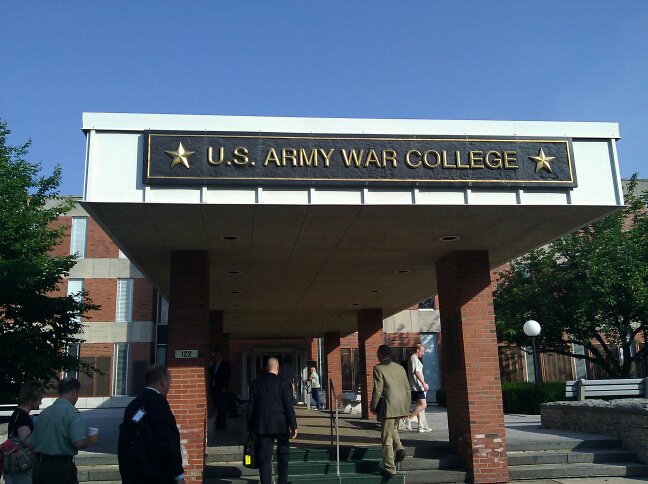
warcollege.jpg

As noted previously, I was fortunate to attend the National Security Seminar at the the US Army War College this year and wanted to relay my impressions while they were still fresh.

First, in terms of reception and cordiality, I have rarely experienced such an extensive and personal outreach as was demonstrated by the War College staff, faculty, administration and students. Every new member had a “sponsor” – a student, usually a colonel or Navy captain, who acted as a liason and personal guide from the time their plane touched down until the moment they returned to the airport. My sponsor, the former commander of the WolfhoundsColonel Richard “Flip” Wilson, whom I consider a friend, really extended himself on my behalf, making me feel welcome and a full member of Seminar Group 20. Most of the students have multiple tours of duty in Iraq and Afghanistan under their belt and many can report the same for the first Gulf War, Panama, Bosnia or Kosovo.

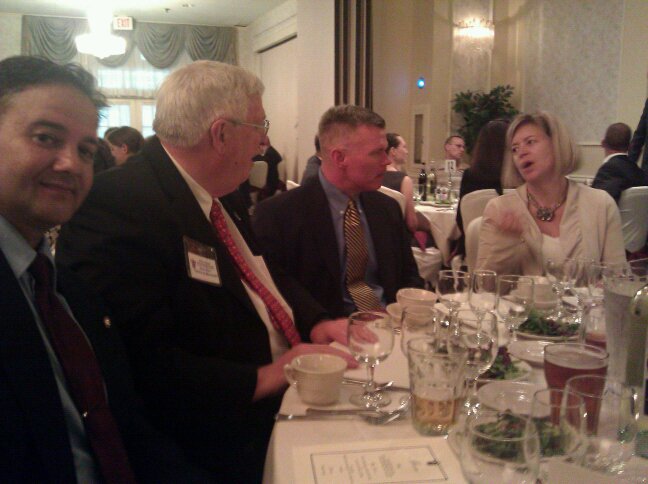
The War College, the Commandant and the Seminar Group all hosted receptions and dinners designed to get students and civilian new members to mix and further discuss issues raised in the seminar sessions or lectures. At these events I had the opportunity to meet and talk to the leadership of the Army War College including the Commandant Major General Gregg Martin, the Deputy Commandant for International Affairs, Ambassador Carol Van Voorst, the Executive Director of the Army Heritage Foundation, Mike Perry, the Director of SSI, Dr. Douglas Lovelace,  the Chief of Staff and numerous faculty and seminar members. The New Members such as myself were exceedingly well fed at these events as I suspect the Army was attempting to prove that it really does march on it’s stomach.


warparty.jpg

warparty2.jpg

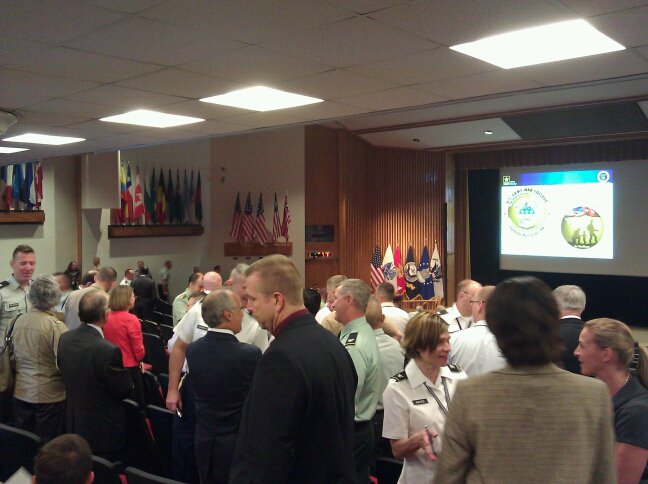
The serious business of the National Security Seminar was divided into two segments, the talks given by distinguished speakers to the entire class of 2011 and the New Members and the Seminar Group sessions of approximately twenty students, New Members, academics and foreign visitors. We received a brief on the war in Afghanistan from the ISAF Chief of Staff, who was standing in last minute for General Petraeus who was called to meet with senior adminstration officials; and a very interesting concluding talk by Foreign Affairs Editor Gideon Rose, author of How Wars End, which covered issues of strategy, grand strategy and the disconnect with policy.

warseminar.jpg

  The National Security Seminar is run strictly on a non-attribution basis, in order to encourage candor and frank exchange of views, which handicaps my ability to discuss specifics here. I can say that my views on Pakistan ( which I compared to “North Vietnam” ) riled more than a few people – Pakistan is the only country in the world given 2 exchange student slots at the Army War College at the request of the most senior leadership of the US Army – and several students and faculty members took the time, outside of seminar sessions, to make certain I heard countervailing POV regarding Pakistan’s value as an ally. Other topics included, but were not limited to:

Defense budget cuts and force structure
Narco-cartels in Mexico: Insurgency or No?
Civil-Military Relations
Repeal of DADT
AfPak War
al Qaida and GWOT/US Strategy
COIN
Critical thinking and Leadership
Logistics
Libya and NATO
AWC Strategy Curriculum/Program
What the US public expects from their military
China as a peer competitor
Effects of ten years of war on officer corps/military
Illegal combatants and international law
PTSD
Battle of Gettysburg and Grand Strategy
Cyberwar
Differences in Armed Services strategy, command climate, discipline, leadership
The Arab Spring
US Global leadership and Economics
Interagency Operational jointness

Most of the discussion took place in the seminar groups, with Q&A periods in the mass sessions with featured speakers. I came away deeply impressed with the seriousness and insights as practitioners that AWC students brought to the table. The AWC strategic studies program seeks to broaden students who are assumed to arrive with tactical expertise and prepare them for higher command that carries operational, strategic and even policy responsibilities (at least in terms of interpreting and executing within policy guidelines). Many students were articulating ideas associated with Thomas P.M. Barnett, the “mission order” and “commander’s intent” style of leadership or Clausewitzian strategic premises during debates and discussion.

The National Security Seminar Week was for me, an enlightening and exceptionally enjoyable experience, one I would highly recommend to readers who may have such opportunities in future years.

Rapturous times, neh?

Saturday, May 21st, 2011

[ By Charles Cameron — apocalyptic movements, best readings, budget shortfalls, lack of support for scholarship in crucial natsec areas — and with a h/t to Dan from Madison at ChicagoBoyz for the video that triggered this post ]
.
.
What with rapture parties breaking out all over, billboards in Dubai proclaiming The End and thousands of Hmong tribespeople in Vietnam among the believers, this whole sorry business of Harold Camping‘s latest end times prediction is catching plenty of attention. I thought it might be helpful to recommend some of the more interesting and knowledgeable commentary on Camping’s failed prophecy.

*

First, three friends and colleagues of mine from the Center for Millennial Studies at Boston University, about which I will have a further paragraph later:

Richard Landes of BU has a text interview here, and a TV interview here. His forthcoming book, Heaven on Earth, is a monumental [554 pp.] treatment of millenarian movements ranging “from ancient Egypt to modern-day UFO cults and global Jihad” with a focus on “ten widely different case studies, none of which come from Judaism or Christianity” — and “shows that many events typically regarded as secular–including the French Revolution, Marxism, Bolshevism, Nazism-not only contain key millennialist elements, but follow the apocalyptic curve of enthusiastic launch, disappointment and (often catastrophic) re-entry into ‘normal time'”.

Stephen O’Leary of USC wrote up the Harold Camping prediction a couple of days ago on the WSJ “Speakeasy” blog. He’s the rhetorician and communications scholar who co-wrote the first article on religion on the internet, and his specialty as it applies to apocalyptic thinking is doubly relevant: the timing of the end — and the timing of the announcement of the end. His book, Arguing the Apocalypse, is the classic treatment.

Damian Thompson of the Daily Telegraph is a wicked and witty blogger on all things Catholic and much else beside — the normally staid Church Times (UK) once called him a “blood-crazed ferret” and he wears the quote with pride on his blog, where you can also find his comments on Camping. Damian’s book, Waiting for Antichrist, is a masterful treatment of one “expecting” church in London, and has a lot to tell us about the distance between the orthodoxies of its clergy and the various levels of enthusiasm and eclectic beliefs of their congregants.

Three experts, three highly recommended books.

*

Two quick notes for those whose motto is “follow the money” (I prefer “cherchez la femme” myself, but chacun a son gout):

The LA Times has a piece that examines the “worldwide $100-million campaign of caravans and billboards, financed by the sale and swap of TV and radio stations” behind Camping’s more recent prediction (the 1994 version was less widely known).

Well worth reading.

And for those who suspect the man of living “high on the hog” — this quote from the same piece might cause you to rethink the possibility that the man’s sincere (one can be misguided with one’s integrity intact, I’d suggest):

Though his organization has large financial holdings, he drives a 1993 Camry and lives in a modest house.

*

Now back to the Center for Millennial Studies.

While it existed, it was quite simply the world center of apocalyptic, messianic and millenarian studies. CMS conferences brought together a wide range of scholars of different eras and areas, who could together begin to fathom the commonalities and differences — anthropological, theological, psychological, political, local, global, historical, and contemporary — of movements such as the Essenes, the Falun Gong, the Quakers, Nazism, the Muenster Anabaptists, al-Qaida, the Taiping Rebellion, Branch Davidians, the Y2K scare, classic Marxism, Aum Shinrikyo and Heaven’s Gate.

And then the year 2000 came and went, and those who hadn’t followed the work of the CMS and its associates thought it’s all over, no more millennial expectation, we’ve entered the new millennium with barely a hiccup.

Well, guess what. It was at the CMS that David Cook presented early insights from his definitive work on contemporary millennial movements in Islam — and now we have millennial stirrings both on the Shia side (President Ahmadinejad et al) and among the Sunni (AQ theorist Abu Mus’ab Al-Suri devotes the last hundred pages of his treatise on jihad to “signs of the end times”)…

Apocalyptic expectation continues. But Richard Landes’ and Stephen O’Leary’s fine project, the CMS, is no longer with us to bring scholars together to discuss what remains one of the key topics of our times. When Richard’s book comes out, buy it and read it — and see if you don’t see what I mean.

Or read Jean-Pierre Filiu‘s Apocalypse in Islam.  Please. Or Tim Furnish‘s recent paper.

*

And while it may not see Judgment Day or the beginning of the end of the world as predicted, what this week has seen is the end of funding of Fulbright scholarships for doctoral dissertation research abroad.  But then as Abu Muqawama points out:

hey, it’s probably safe to cut funding for these languages. It’s hard to see Iran, Afghanistan, Pakistan or anywhere in the Arabic-speaking world causing issues in terms of U.S. national security interests anytime soon.

Right?

So the CMS isn’t the only significant scholarly venue we’ve lost to terminal lack of vision.
The DARPA arts

Friday, April 29th, 2011

[ by Charles Cameron ]

.

Blog-friend Cameron Schaefer has a piece up at Small Wars Journal today in which he quotes Boyd (writing that his approach “incorporated science, but more closely approximated the often chaotic, creative impulses of art”) and Mahan (“art, out of materials which it finds about, creates new forms in endless variety”), and concludes:

Approaching strategy in an indirect fashion, as more of an art than science may make some uneasy, specifically those who find safe haven in the concreteness of checklists and formulas. Yet, the nature of strategy reflects the nature of the world. It is infinitely complex, it is always changing and it is filled with humans that often do irrational things. Literature (see Charles Hill) and psychology have as much of a place at the strategy table as military history… as do mathematics, physics, political science and technology. So, when asking, “what must one study to be a great strategist?” the answer seems to be, “everything else.”

Okay, so that (and Hill‘s work, which Zen reviewed recently) gives us the significance of the arts in strategic thinking which, one hopes, is practiced before going in to battle, and may indeed give one second thoughts about it…

*

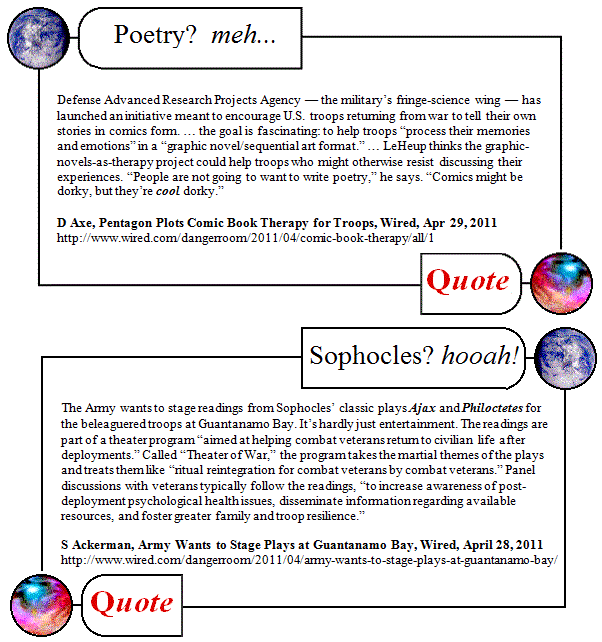
Literature and the arts are also important after battle, though – and the US Military and DARPA have clearly been thinking about that side of things:

quodarpa-arts1.gif

Sources: ComicsPlays

Poetry? meh… Sophocles? Chlanna nan con thigibh a so’s gheibh sibh feoil!

*

Lionel Tiger and Robin Fox in The Imperial Animal characterize modern health care as the “bureaucratization of mercy” and propose that for comparison, we set it beside:

the Greek ideal of the hospital as the place with the best food, the finest furnishings and paintings, and the most skilled musicians and comedians.

The greatest healing center in ancient Greece was the Asclepion at Epidavros / Epidaurus, which housed an amphitheater that could seat more than ten thousand people for dramatic and musical performances without amplification.

At Epidavros, patients would be healed by watching those same dramas of Sophocles to which the US Army is now turning for therapeutic relief in Guantanamo — for as Tiger and Fox (what a pair of names) go on to argue:

It is not the healthy, but the sick who most vitally needed such agreeable and re-creative stimuli; and the resources the community had were most beneficially and sanely used in helping them ease their personal disarray and feel encouraged by this display of their community’s careful concern.

*

It’s also interesting to note that the graphic novel Silver Shields mentioned in Axe‘s piece as a precursor to DARPA’s “Online Graphic Novel/Sequential Art Authoring Tools for Therapeutic Storytelling” project is “set during the ancient Greek invasion of Afghanistan more than two millenniums ago” as a metaphor for America’s current situation…

And Taking Names!

Friday, April 22nd, 2011

Ya Mullen Huzzah!  

About  goddamn  time ….


Switch to our mobile site