zenpundit.com » Religion

Archive for the ‘Religion’ Category

US Foreign Policy, Egypt and the Muslim Brotherhood

Wednesday, January 30th, 2013
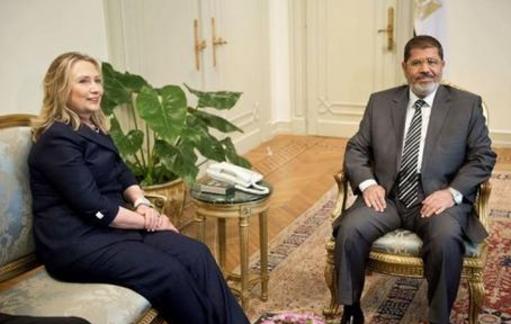
The Obama administration, though they would not characterize it as such nor have much desire to acknowledge it at all, have attempted  a strategic detente with the “moderate” elements of political Islam.

This policy has not been entirely consistent; Syria, for example, is a quagmire the administration has wisely refrained from wading directly into despite the best efforts of R2P advocates to drag us there.  But more importantly, under President Obama the US supported the broad-based Arab Spring popular revolt against US ally, dictator Hosni Mubarak, and pushed the subsequent ascendancy of the Muslim Brotherhood in Egypt and the Libyan revolution against the entirely mad Colonel Gaddafi. These appear to be geopolitical “moves” upon which the Obama administration hopes to build.

I would like to emphasize that there is one legitimate and valid strategic pro to this sub rosa policy; namely, if everything went well, it would provide the United States with powerful triangulation against revolutionary, apocalyptic, radical Islamism as expressed by al Qaida and various Salafi extremist movements. There are reasons, rooted in takfirism, strategy and the politics of lunacy that our terrorist enemies frequently hate and revile the Brotherhood as traitors, apostates or whatever. Isolating the most actively dangerous and violent revolutionary enemies from a large mass of potential allies is, at least, a good strategic goal.

It is also my view, that this “outreach” is as politically sensitive  to the Obama administration as was the China Opening was to Nixon and about which they have been equally opaque and misleading for fear of a domestic backlash. The weird, foot-dragging, dissembling, embittered, kabuki drama inside the Beltway about public statements and intelligence on whether Benghazi was caused by obscure crackpot Islamophobic film makers or a well-orchestrated terrorist attack  is in my view due to a major foreign policy strategy never having been framed in public for what it is. I’m sure people will differ strongly with me on this (which is fine), but I would characterize detente with Islamists as a strategic shift on par with the “Pivot to Asia”.

The downside here is that first, things are not likely to come out well at all, as unfinished revolutions tend to give birth to monsters; and secondly, any detente with “moderate” political Islam is an uncertain gamble based on certain exceptionally optimistic conceptions of not only what the Brotherhood might do, but about it’s very nature.

While the removal of Arab dictators resonated with American values , it was questionable realpolitik while the administration’s de facto support of  Egypt’s Muslim Brotherhood faction over poorly organized secular liberal modernists was an act of realpolitik that required a compromise of the democratic values so recently invoked to justify abandoning Mubarak. This was cynical diplomatic flexibility worthy of Talleyrand.

Unfortunately, the most democratic thing – perhaps the only thing – about Mr. Morsi and his Brotherhood supporters was his election.

The Egyptian people who are subjected now to thuggery from both Morsi’s Islamist stormtroopers and from the security forces of the Egyptian military are less sanguine than are the Brotherhood’s cheerleaders inside the administration. The Egyptian people, in fact, seem to be in revolt against domination by the Muslim Brotherhood’s shadow government.

The first question to ask in assessing if the Obama administration policy here is wise would be “What is the nature of the Muslim Brotherhood?” Americans love to personalize foreign policy, but if  Morsi were to be toppled or die, the Brotherhood will remain what it currently is, the best organized political force in Egypt and one widely influential throughout the Arab world and the West itself.

I am not an expert on the Muslim Brotherhood, nor am I an Arabist by education. Most of us aren’t – a group that I fear includes most of the Obama administration officials involved in shaping this policy. Almost fifty years after King Faisal determined to export Wahhabism, more than thirty years since Khomeini’s Revolution and more than ten years since 9/11 the USG still has less in-house expertise related to Islam than it did about the Soviet Union and Communism a decade after the Berlin Blockade.

Perhaps we all should begin learning more?

Here is an analysis from FPRI; it is extremely critical but it touches on organizational aspects of the Muslim Brotherhood that I have not seen elsewhere (hat tip to David Ronfeldt). Feel free to suggest others, both for and against. The Brotherhood is a very large group with a long history that includes violence , terrorism and subversion on one hand and peacefully representing expressions of pious, middle-class, social conservatism in other places and times:

Lecture Transcript: What Every American Should Know about Egypt’s Muslim Brotherhood, Delivered by Eric Trager 

….Two years ago when I was doing my dissertation fieldwork in Cairo, I sought out interviews with leaders from the Muslim Brotherhood, and I was referred to a man named Muhammad Morsi, now the President of Egypt. At the time, President Mubarak was ill and had gone off to Europe for operations amid a lot of mystery surrounding his health. I asked Muhammad Morsi whether the Muslim Brotherhood would run a presidential candidate if Mubarak died tomorrow. Here is what he said:

[From an audio file played by Trager]

Eric Trager: You don’t see the Muslim Brotherhood nominating a presidential candidate [if Mubarak dies tomorrow]?

Muhammad Morsi: No… because society is not ready… Our society is not ready yet to really defend its worth. We want a society to carry on its responsibilities, and we are part of this society. Another thing, if we are rushing things, then I don’t think that leads to a real stable position.

When he made that statement, I don’t think he was lying, and I don’t think he was being coy. I think that he didn’t expect that he would be faced with this reality in a mere six months. He did not expect that Mubarak would step down six months later and, to be completely honest with you, neither did I. My dissertation was entitled “Egypt: Durable Authoritarianism”—until the revolution.

What did Morsi mean when he said that the Brotherhood was trying to build a society? Let me give you some background on the Muslim Brotherhood. It was founded in 1928 by Hassan al-Banna, who was a schoolteacher in Ismailia. The Muslim Brotherhood’s goal was then—and remains now—to establish an Islamic state in Egypt. The way it pursues this goal is by trying to Islamize Egyptian society. Through social services, education, and the mosque, it sought to make Egyptians more religious and more Islamic as a grassroots strategy for building an Islamic state. That’s very, very different from a strategy that says, “We’re going to run for president, run for the Parliament, and use that power to transform society.” Rather, the Brotherhood says, in effect, “We’re going to Islamize society to build towards power.” It was a long-term strategy; it took them 84 years before they ran for and won the presidency. So Morsi told me in 2010 that the Muslim Brotherhood was not going to run for the presidency because it was not done Islamizing Egyptian society….

Read the rest here.
They are being sincere, even if they are not being accurate

Saturday, January 12th, 2013

[ by Charles Cameron — disentangling religion / politics braids in Pakistan and elsewhere ]
.

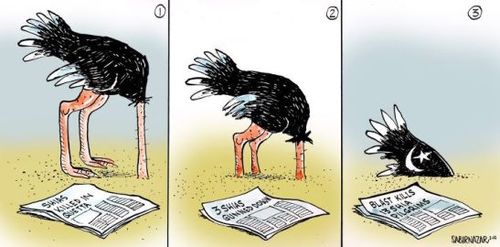
image credit: Pakistani cartoonist and artist Sabir Nazar

.

Blog-friend Omar Ali writes:

The state will make a genuine effort to stop this madness. Shias are still not seen as outsiders by most educated Pakistani Sunnis. When middle class Pakistanis say “this cannot be the work of a Muslim” they are being sincere, even if they are not being accurate.

The “madness” he’s discussing is the extensive killing of Shia Muslims by Sunni Muslims in Pakistan, and I’d recommend both his own article on 3 Quarks Daily and Bahukutumbi Raman‘s on Raman’s strategic analysis as offering detailed background for a topic I addressed from a different angle in Ashura: the Passion of Husayn.

**

It’s Dr. Ali’s final sentence in the quote above that interests me, though, as you’ve probably deduced already from the title of this post:

When middle class Pakistanis say “this cannot be the work of a Muslim” they are being sincere, even if they are not being accurate.

I haven’t quite known how to say this succinctly before, but I think Dr Ali hits a whole array of nails on the head.

Religions are mostly preached to whoever listens — and those who listen can be a pretty diverse lot, particularly across continents and centuries. The upshot is that religions generally wind up being interpreted in a variety of ways to suit the wide variety of human temperaments and situations.

Et voilà! Members of a religion who see it as a force for peace will tend to say of those who dismay them by using it as a cover for violence, “this cannot be the work of a member of my faith” — and they are being sincere, their understanding of their own religion is as peaceable as they say it is.

They are being sincere — even if they are not being accurate, and their religion as a “big tent” across cultures, classes, continents and centuries, also includes sincere people whose views are radically and violently opposed to theirs.

**

If Walt Whitman can say it, you’d better believe it can be said of religions with a billion or more adherents:

Do I contradict myself? Very well, then I contradict myself, I am large, I contain multitudes.

Battling bus ads revisited

Saturday, January 12th, 2013

[ by Charles Cameron — today’s “shout it from the rooftops” is “advertise it on the bus” — the wars of sound-bite religion, plus special extra, the perils of dehumanization ]
.


.

I am pretty sure that when Sojourners puts up an ad saying Love your Muslim neighbors” (above, right) it’s a religiously motivated act with political implications, but not quite so sure when Pamela Geller puts up an ad that’s certainly anti-Hamas and likely anti-Muslim (below), whether to consider it religiously or politically motivated: the two things aren’t always easily untangled.

*

But hey, at least in Portland according to this AP article, the Pamela Geller ads were posted in response to this one, which I’d tend to characterize as politically motivated, with a plausible religious undercurrent:

**

Of course, there are other maps.. including this one, from American Trial Attorneys in Defense of Israel:

**

Okay, I’ve been on about ads as a medium for religious dispute for a while now [1, 2], and frankly I don’t know why we need seminaries in Oxford, Qom or Dharamsala if all you need to know about a religion can be found on the side of a bus…

But it does get confusing, eh?

For instance, when Mona Eltahawy defaces one of Pamela Geller’s ads, is she erasing freedom of speech, or hate speech — or freedom of hate speech?

**

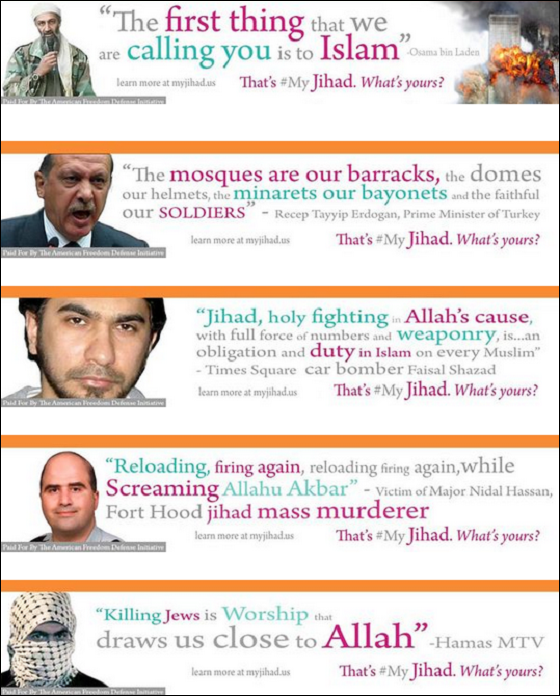
Look, here are a series of ads that CAIR has just put out, using the term “jihad” in a way that’s both a legitimate meaning of the term within Islam and compatible with western democratic ideals:

**

And here are Pamela Geller’s reworkings of the same series of ads, using the term “jihad” in a way that’s both a legitimate meaning of the term within Islam and entirely incompatible with western democratic ideals.

The thing is, there’s an enormous spectrum of beliefs and nuances of belief within Islam, and even within Salafism…

And buses and subway ads aren’t the go-to places to understand that spectrum.

**

But they’re worth watching to get a sense of how the public is being swayed.

Ironic, isn’t it, that as the New York Times reports, Erika Menendez told the cops:

I pushed a Muslim off the train tracks because I hate Hindus and Muslims ever since 2001 when they put down the twin towers.

Hindu, Muslim, Sikh..

**

For what it’s worth, Sojourners could have posted an ad that said, Love your enemies rather than Love your neighbor — both are equally biblical:

Ye have heard that it hath been said, Thou shalt love thy neighbour, and hate thine enemy. But I say unto you, Love your enemies, bless them that curse you, do good to them that hate you, and pray for them which despitefully use you, and persecute you.

Matthew 5. 43-44

But then, that’s a bit long for an advertisement, isn’t it?

**

Somewhere between Christ‘s command “Love your enemy” and Sun Tzu‘s “Know your enemy” we can surely find a place for “Honor your enemy” — and that, it turns out, may be of considerable importance. Describing the work of Lt. Col. Dave Grossman, Lin, Mehlman and Abney write in their Greenwall Foundation report, Enhanced Warfighters: Risk, Ethics, and Policy:

Grossman has interviewed many US veterans of the Vietnam War. Not all of his subjects, however, were those with lingering psychological trauma. Grossman found that some of the men he interviewed had never truly achieved emotional distance from their former foes, and seemed to be the better for it. These men expressed admiration for Vietnamese culture. Some had even married Vietnamese women. They appeared to be leading happy and productive post-war lives. In contrast, those who persisted in viewing the Vietnamese as “less than animals” were unable to leave the war behind them.

That, more generally, may be key to understanding why demonizing Islam and Muslims is such a bad idea. In Grossman’s own words:

It can be easy to unleash this genie of racial and ethnic hatred in order to facilitate killing in time of war. It can be more difficult to keep the cork in the bottle and completely restrain it. Once it is out, and the war is over, the genie is not easily put back in the bottle. Such hatred lingers over the decades, even centuries, as can be seen today in Lebanon and what was once Yugoslavia.

Steven Pinker on Analogy

Thursday, December 6th, 2012

[ by Charles Cameron — importance of analogy as an under-developed cognitive skill ]
.

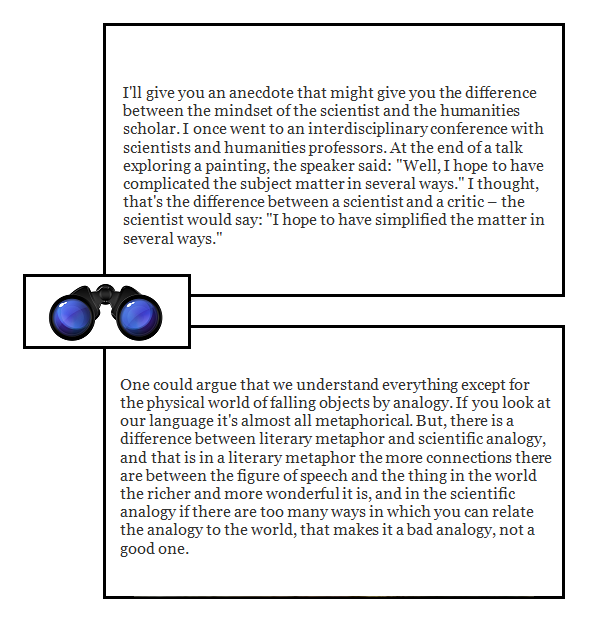
There was a interview with five prominent “science writers” in the Guardian a few days back, titled Science writing: how do you make complex issues accessible and readable? and one of the writers, Steven Pinker, makes two highly interesting observations:

**

There are a couple of things going on here that I’d like to note. One is that without intending to do so specifically, he is in essence formulating a view about a possible, central difference between scientific and religious thinking, since what he says about the humanities in general applies with great specificity to religion and the arts: in both religion and art, the expansive nature of “symbolism” is a key to the experience.

And that in turn prompts me to suggest that perhaps both the arts and religion are geared towards provoking, evoking or invoking an experience — whereas the sciences are geared towards obtaining an understanding.

I’ll have to think about that, and come to some sort of understanding of my own — perhaps expressed via symbolic means.

**

My second point of interest is that there’s an analogy to be made between Pinker’s two remarks: each of them has a form I could portray thus in terms of cause :: effect

science : humanities :: simplicity : complexity

Nobody present — the interviewer, Pinker himself, and four other very bright science writers — picked up on the close correspondence between those two statements at the time. And I find that very interesting.

I find it very interesting because the six of them were more interested in seeing what they could say (of what they already thought) than in saying what they could see (in light of the ongoing, immediate conversation).

I think we all tend to do that — which is why David Bohm‘s approach to dialogue is so important: if brings us to speak more into the moment as it surrounds us, not quite so much from the past as it has informed us.

**

Then there’s the interesting fact that Pinker’s sense of the difference between modes of thought in the humanities and the sciences as expressed in the top quote translates so directly to the difference between uses of analogy in the second — and his fairly emphatic statement:

one could argue that we understand everything except for the physical world of falling objects by analogy.

Analogy is the central device in our mental toolkit, and yet we know far more about trains of logic than we do about analogical leaps. We know so little, in fact, that distinguishing between “literary metaphor” and “scientific analogy” (both of which are based in the recognition of resemblance) on the basis of one looking for multiple, rich connectivity and the other for a single tight connection is something noteworthy enough for Pinker to bother to point it out. It is indeed a provocative and perhaps essential insight. But it is also pretty basic — dividing a field up into significant chunks, the way anthropology got divided into “cultural”, “archaeological”, “linguistic” and “physical anthropology”…

It’s time we learned to understand and use analogic with the same rigor we’ve applied to learning and using logic — and Sembl is just the tool for this.

**

Experience wants to be rich: factual understanding wants to be clear.

OMG! — Fisher to Churchill, 1917

Thursday, November 29th, 2012

[ by Charles Cameron — for your general amusement ]
.

Is OMG something to write after your name on your official correspondence — one of the orders of British knighthood, perhaps?

**

**

Hat-tip: Smithsonian, via Jeff Gates.


Switch to our mobile site