zenpundit.com » India

Archive for the ‘India’ Category

Duel in slow time

Friday, April 1st, 2011

[ by Charles Cameron ]


In slomo –

as in the slow rotating
backseat of a hurtling flipping car –

at that most divine of speeds at which
concentration arrives and
all is revealed –

as when Krishna himself bears
each arrow loosed from his
left-handed archer Arjuna’s drawn bow
to some fine warrior’s

doom

we see: all contest is
cooperation,
each edged duel, a true duet…

Honor killings

Monday, March 7th, 2011

[ by Charles Cameron — cross-posted from ChicagoBoyz ]

*

I had occasion today to give myself a quick refresher course on honor killings, one form of which is already present in the Torah as of Leviticus 21.9:

And the daughter of any priest, if she profane herself by playing the whore, she profaneth her father: she shall be burnt with fire.

and found myself once again noting that there is a substantial swathe of regions of the world where honor killings are found, and that where it is found (including in immigrant communities from those parts of the world) the practice is not confined to any one religious group.

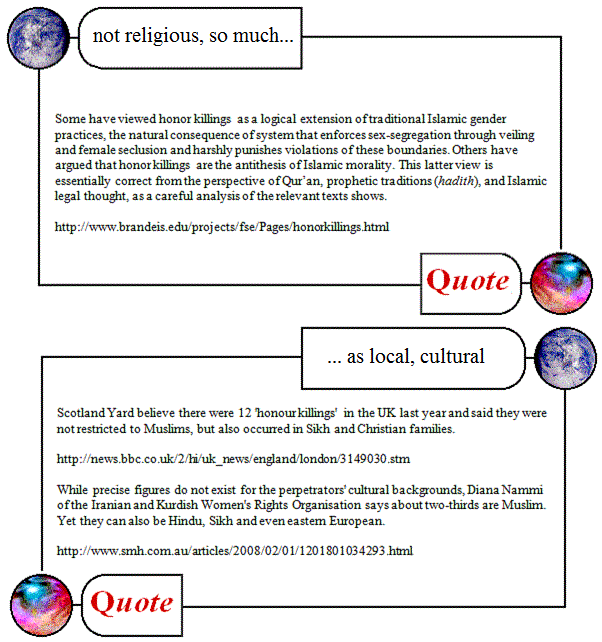
Hence this DoubleQuote:

I think it is appropriate to consider honor killing a form of religious violence when the claim is made by those who do the killing that they are acting in the name of their religion — but that it is also important to distinguish such acts committed in a cultural context in which they are practiced across religions from acts that are the exclusive province of one religious tradition.

There are examples of honor killings which are performed in the name of Islam, and/or advocated by Islamic scholars — and the same could no doubt be said of other religious traditions — but honor killing as a genre is fundamentally more cultural than religious.

Sources: Brandeis studyBBCSydney Morning Herald

The analytic point:

From my point of view as an analyst, it is important to note and compare both religious and cultural drivers — neither avoiding mention of the one out of “correctness” — nor overlooking the other for lack of comparative data.

A brief fugue on the graphics of coexistence

Saturday, December 4th, 2010

by Charles Cameron
[ cross-posted from ChicagoBoyz ]

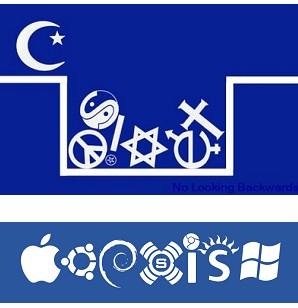
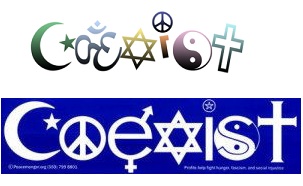
A great many people will have seen (or designed) some variant of the “coexist” bumper-sticker / tee-shirt design:

Coexist

— the first of which can be found on acsapple‘s photobucket — and hey, the “aum” sign for “oe” is a brilliant bit of graphic substitution! – while I nabbed the second here.

What with a thousand flowers blooming, the importance of preserving memetic variations, peaceful coexistence and all, it’s only natural that some will have different takes on the matter —

coexist variants

— the first of these comes from the blog of a gun-toting political refugee from the People’s Progressive Republic of Massachusetts, while the second is a tee-shirt design by Matt Lussier, and you can get your tee-shirt here

*

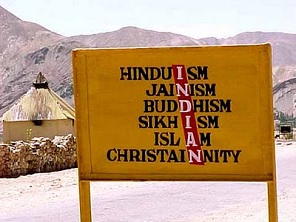
As for myself, I have fond memories of India, and was accordingly heartened to see this on an Indian Muslim site

india calling-religious unity

which is what set me thinking about “coexistence” graphics in the first place.

*

Did I ever tell you about the sign I saw over a shop in Delhi, advertising the sale of mythelated spirits?

I frequently feel just a tad mythelated myself.

Guest Post: Of Weaponry and Flags

Sunday, October 24th, 2010

 Charles Cameron is the regular guest-blogger at Zenpundit, and has also posted at Small Wars Journal, All Things Counterterrorism, for the Chicago Boyz Afghanistan 2050 roundtable and elsewhere.  Charles read Theology at Christ Church, Oxford, under AE Harvey, and was at one time a Principal Researcher with Boston University’s Center for Millennial Studies and the Senior Analyst with the Arlington Institute:

Originally posted at Chicago Boyz.com

Of Weaponry and Flags

by Charles Cameron
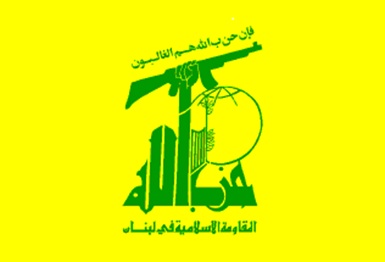
Hezbollah Flag Use

A day or two ago, Abu Muqawama asked whether the Hizballah flag showed an AK-47, and in general what flags carried what weapons as emblems.

As it happens, I’d just been viewing a pro-jihadist United States of Islam video and made the following screen-capture as an illustration of my continuing concern about the “black flags of Khorasan” and the issue of whether AQ and or its franchises and or portions of the Taliban consider themselves to be fighting the apocalyptic war of the end of time.
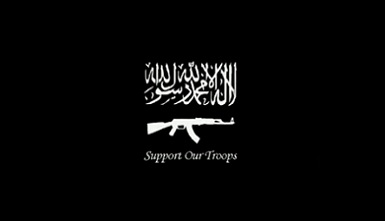
Black Flag Support out Troops Sm

Note also that the filmmaker’s ironic borrowing of the phrase “Support Our Troops” to urge support of the troops of the Mahdi will not be lost on some viewers.

This screen-capture, from the United States of Islam video, in turn reminded reminded me of the Saudi flag, which likewise carries the shahada or Muslim profession of faith and a weapon – a sword.
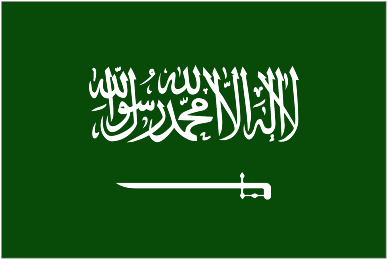
Saudi flag

According to a note on an earlier version of the World Flag Database:

The script in the centre of the flag is the Islamic creed, “There is no God but Allah, and Mohammed is the Prophet of Allah”. The flag is therefore considered sacred and special protocol rules apply: the flag does not dip in salute, nor is it ever flown at half-mast. Note that the creed always reads properly from right to left, with the sword hilt to the right, so the reverse of the flag is not a mirror image of the obverse. When making the flag, the creed must be reproduced precisely, including the accent marks. The use of the flag on any commercial item (especially clothing) is not recommended as it might be considered inappropriate, or even insulting.

The Shahada is the central testament of faith of Islam, as is the Shema Yisroel of Judaism and the Credo of Christianity, and I respect it as such – and likewise the Saudi flag., on which it is displayed.

*

Flags, however, are potent symbols, and the graphical power of the “black flags of Khorasan” motif should not, in my view, be underestimated. The particular video that I took that screen-capture from makes use of “mix” flags of its own devising:
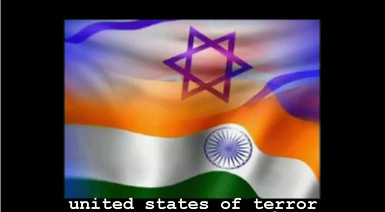
Flag01

– merging the American and Indian flags – or the flags of India and Israel –
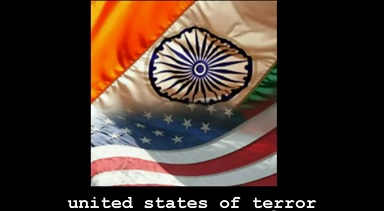
Flag02

to create an imagery of the “United States of Terror” to juxtapose against their own black flags as the “United States of Islam” – giving us Huntington’s “Clash of Civilizations” in visceral graphic form.

And that conjunction of India with Israel bears thinking about, too… not only in terms of military aid between the two nations, but also of the symbolic juxtaposition of the Al-Aqsa Mosque and Jerusalem with the Babri Masjid and Ayodhya…

Indeed, the Indian flag itself also deserves consideration in our context.
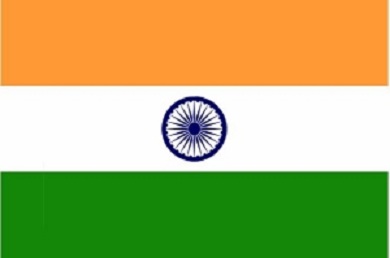
indian-flag

Originally, Mahatma Gandhi had hoped that it would feature the charka or spinning wheel which he had made famous. As an informative article on the subject from The Hindu puts it:

For Gandhiji, the charka represented not a mere hand-spinning device that could provide employment and income to the poor, but much more. “The message of the spinning-wheel is much wider than its circumference. Its message is one of simplicity, service of mankind, living so as not to hurt others, creating an indissoluble bond between the rich and the poor, capital and labour, the prince and the peasant.” (Young India, September 17, 1925). “Above all, charka is a symbol of non-violence” (Collected Works of Mahatma Gandhi, Vol. 71, first edition, p.234).Gandhiji was, therefore, all the more sad when a correspondent from Hyderabad brought to his notice, on the eve of Independence, K. M. Munshi’s indictment in his broadcast speech that the wheel in the new flag represented the Sudarshana Chakra (discus of Lord Vishnu), a symbol of violence! But Gandhiji consoled himself that “under no circumstances, can the Asoka Chakra become a symbol of violence as Emperor Asoka was a Buddhist and a votary of non-violence” (Harijan Sevak, August 17, 1947).

So there’s another weapon-flag connection – albeit one where non-violence seems to triumph over violence.

*

But let me get back to the yellow Hizbollah flag with which we started, and quickly note the resemblance (which I don’t claim to be the first to note, but cannot presently find my source for) between its portrayal of a rifle raised in a victorious fist, and this poster from the Irgun:
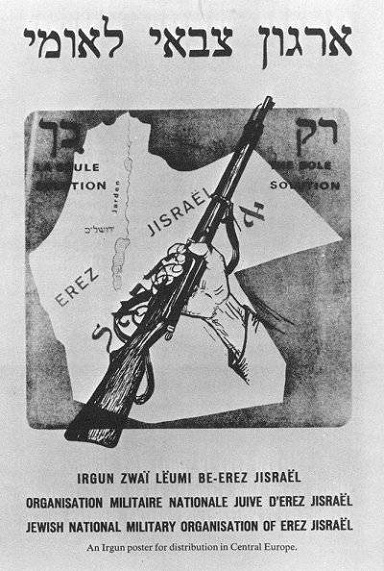
Irgun poster

And that’s enough about weaponry and flags for now, I think.

I hope to follow this post up shortly with a more detailed account of the United States of Islam video mentioned above, and its many and curious references and resonances.
Pundita on Pakistan

Thursday, June 24th, 2010

Miss P. bangs pots and pans, shoots off fireworks, uses her knee to pound a bass drum while blowing a vuvuzela in an effort to draw attention to the Elephant in the policy room no one wishes to address.

It won’t work until a Pakistani-sponsored terrorist pulls off an act of catastrophic terrorism inside the United States and kills a large number of elite Americans in Manhattan or the Beltway. After that point, we’ll get serious and these views will become conventional wisdom.

I just hope the terrorists don’t succeed in Arizona or Kansas – the story will only make page 2, then and policy will stay the course:

Why General Stanley McChrystal is going straight to hell

On or about August 30, 2009, Secretary of Defense Robert Gates received a detailed assessment of the military situation in Afghanistan that included a request for additional U.S. troops. The report was from General Stanley A. McChrystal, Commander, Nato’s International Security Assistance Force (ISAF) and Commander, U.S. Forces Afghanistan. But as noted on the first page the assessment was a joint effort representing input from ISAF staff and the component commands.On the matter of Pakistan the report noted:

Afghanistan’s insurgency is clearly supported from Pakistan. Senior leaders of the major Afghan insurgent groups are based in Pakistan, are linked with al Qaeda and other violent extremist groups, and are reportedly aided by some elements of Pakistan’s lSI.

A year earlier McChrystal’s predecessor, General David D. McKiernan, delivered a franker assessment of the same situation. He stated flatly that he was certain there was a “level of ISI complicity” in the militant areas of Pakistan and within organizations like the Taliban.McKiernan’s observation came on the heels of a secret visit by a top CIA official to Islamabad; the visit was to directly confront Pakistan’s most senior officials with new data about ties between the ISI and militants operating in Pakistan tribal areas.It seems the CIA met with the same stonewalling Britain’s government encountered in 2006 when they brought virtually the same charges to Pakistan because their next move echoed the one taken by Britain’s Ministry of Defense: the CIA leaked news of the trip to a major press outlet — in their case, The New York Times.These naive attempts to embarrass a government comprised of terror-masters, dope dealers and professional beggars skilled at wheedling billions in aid out of the West came to nothing, beyond the ISI’s decision to outsource more of their oversight of terrorist attacks on NATO troops to front agencies such as the SSG.

David Petraeus might study Kashmir if he doesn’t want to repeat Stanley McChrystal’s mistakes in Afghanistan

On Monday the RAND Corporation published a paper titled Counterinsurgency in Pakistan by Seth G. Jones and C. Christine Fair. I don’t agree with most of the authors’ recommendations. However, I think the section of the paper titled Pakistan’s Use of Proxy War, which goes into some detail about Pakistan’s Operation Gibraltar in Kashmir, will be instructive in light of Pakistani-sponsored actions against ISAF and the Afghans who resist Taliban rule.The section begins on page 6, chapter two. Although I don’t provide the footnotes I’ve kept the footnote numbering for ready reference. (The paper can be downloaded for free in PDF at the RAND website. A summary in PDF is also available):

Pakistan’s Use of Proxy WarfareMost accounts assume that Pakistan first engaged in using militants as a foreign policy tool during the anti-Soviet jihad in Afghanistan. Pakistan, the United States, Saudi Arabia, and others supported seven major mujahideen groups operating in Afghanistan.”The Mujahedeen could achieve nothing without financial support,” acknowledged Brigadier Mohammad Yousaf, who headed the Directorate for Inter-services Intelligence’s (ISI’s) Afghan bureau from 1983 to 1987, and was responsible for the supply, training, and operation planning of the mujahideen. “Almost half of this money originated from the U.S. taxpayer, with the remainder coming from the Saudi Arabian government or rich Arab individuals.”3

In many standard accounts, Pakistan redeployed these battle-hardened operatives to Kashmir in 1990 when the Soviets formally withdrew from Afghanistan. In fact, Pakistan has relied on nonstate actors to prosecute its foreign policy objectives in Kashmir since its independence in 1947. In that year, the state mobilized lashkars (tribal forces) to seize Kashmir while the Maharaja of Jammu and Kashmir, Hari Singh, debated whether to join India or Pakistan….

ADDENDUM:

Good things come in threes. A third post by Pundita – The last American helicopter out of Kabul

… Pakistan is presenting itself as the new viable partner for Afghanistan to President Hamid Karzai, who has soured on the Americans. Pakistani officials say they can deliver the network of Sirajuddin Haqqani, an ally of Al Qaeda who runs a major part of the insurgency in Afghanistan, into a power-sharing arrangement.In addition, Afghan officials say, the Pakistanis are pushing various other proxies, with General Kayani personally offering to broker a deal with the Taliban leadership.

Washington has watched with some nervousness as General Kayani and Pakistan’s spy chief, Lt. Gen. Ahmad Shuja Pasha, shuttle between Islamabad and Kabul, telling Mr. Karzai that they agree with his assessment that the United States cannot win in Afghanistan, and that a postwar Afghanistan should incorporate the Haqqani network, a longtime Pakistani asset. …

Despite General McChrystal’s 11 visits to General Kayani in Islamabad in the past year, the Pakistanis have not been altogether forthcoming on details of the conversations in the last two months, making the Pakistani moves even more worrisome for the United States, said an American official involved in the administration’s Afghanistan and Pakistan deliberations.

“They know this creates a bigger breach between us and Karzai,” the American official said.

The best American general to replace McChrystal is not Petraeus but rather Curtis LeMay.


Switch to our mobile site