Who says Apple and Microsoft can’t work together? They certainly do, at least when it involves the ingenuity of their users, the more inventive of whom use technologies from both companies (and others).
Here’s a neat example, “a just-for-fun experiment from the guys at Laan Labs” where they whip up a neat Augmented Reality recipe: take one iPad, one Kinect, and stir.
Some technical detail from the Brothers Laan, the engineers who did the work:
We used the String Augmented Reality SDK to display real-time 3d video+audio recorded from the Kinect. Libfreenect from http://openkinect.org/ project was used for recording the data coming from the Kinect. A textured mesh was created from the calibrated depth+rgb data for each frame and played back in real-time. A simple depth cutoff allowed us isolate the person in the video from the walls and other objects. Using the String SDK, we projected it back onto a printed image marker in the real world.” – source, Laan Labs blog.
The outgoing commander of US and NATO forces in Afghanistan says the focus of the war will shift in coming months from Taliban strongholds in the south to the eastern border with Pakistan where insurgents closest to al-Qaeda and other militants hold sway.
With a new job pending as the CIA director, General David Petraeus said on Monday that by the northern autumn, more special forces, intelligence, surveillance, air power will be concentrated in areas along Afghanistan’s rugged eastern border with Pakistan….
….Senators pressed McRaven on the impact that the planned U.S. troop withdrawal from Afghanistan would have on special operations troops, asking whether Afghan elite forces would be able to step in.
McRaven said that right now U.S. forces need to continue to monitor and guide many of the Afghan special forces, but some units are highly trained and are increasingly taking on a larger role.
While the number of special operations forces has doubled to about 61,000 over the past nine years, the total of those deployed overseas has quadrupled. There are at least 7,000 special operators in Afghanistan and about 3,000 in Iraq. Those numbers can vary as units move in and out of the war zone, and often the totals don’t include the most elite of the commandos – special mission units such as Army Delta Force and Navy SEALs that may go in and out more quietly and quickly.
….In Afghanistan, special operations forces serve a number of roles. Not only do they mount an aggressive counterterrorism campaign across the country, but they also form teams to train or mentor Afghan forces. In one example, McRaven said that over the past 12 months, the task force he commanded conducted about 2,000 operations, roughly 88 percent of which were at night….
Supply and demand is an economic principle with universal application.
Mass in an AVF is very, very expensive (so is, incidentally, choosing grandiose political objectives to be achieved by military means). The shift that is happening in Afghanistan, partly by fiscal necessity, is going to become our default defense paradigm for at least the 2010’s. Highly mobile, extremely fast, networked, partially covert, backed by lethal high-tech firepower.
As a rule, I think recreating a modernized OSS-like community in all but name is a good idea that will pay dividends in terms of tactical and strategic flexibility. I fully expect the bureaucratic gravitational pull and sheer utility in fighting the murky, mutable, Islamist enemy to eventually draw in cyber elements of various agencies, elite law enforcement, DOJ, DARPA, Treasury and State Department personnel in to the mix, albeit sparingly. Such an interdependent and collaborative military and intelligence community is optimized as a striking force against our most immediate or proximate security threats – though definitely not all of our security threats (those who wish to disband all our armored units or unilaterally give up nuclear weapons can stop fantasizing now).
However, there are some caveats that need to be considered, in my view.
First, supply and demand applies here as well. There’s a high practical barrier to growing the size of our special forces, which are presently badly overstressed. The commonly cited figure for growth is 3-5 % annually, if we want something better in our special forces than the highly conditioned thugs that the Soviets used to roll out in large numbers in their SPETSNAZdivisions. That’s not much and it represents the max that is probably possible without returning to conscription, which theoretically would give the US military the pick of the litter of entire age cohorts, but in reality much less. You have to be highly motivated to become a Navy SEAL or want to jump out of a perfectly good Army helicopter. Unwilling conscripts won’t fit the bill. Right now we are “stretching” our special forces by mixing them with high quality regulars; a hidden cost to this practice is that most of these folk are essentially “officer material” and drawing out the most capable personnel systemically weakens the regular units of their natural leaders. The tip of this shadowy spear is always going to be small and difficult to replace and not something suited for waging total war (shades of Byzantium).
Secondly, normal use of this kind of force requires a political climate that keeps the antiwar and anti-American factions of the Left marginalized because many operations in the blurry realm between war, terrorism, crime and covert ops will legally require presidential findings to be reported to Congressional oversight committees. If the US Congress had the political composition of the 1980’s, with Vietnam era anti-war types being extremely vocal, especially in the House, much of what we are doing and have done in Afghanistan, Pakistan or Yemen would not be politically possible, including the raid that killed Osama bin Laden. It would require a considerable electoral turn, but friction in the form of modern day Boland amendments, special prosecutors, Church–Pike hearings and gratuitous leaks will make use of these forces impractical and highly risky for any president. Or for the military and intelligence personnel themselves who might face ex post facto prosecution due to the agitation of zealous leftist partisans in Congress and the media.
Thirdly, an emphasis on a special forces dominant force structure may have the unintended consequence of causing the executive branch civilian officials to move even further away from strategic thinking and incline them more toward reactive, tactical, retaliation. Misuse of special forces is the American historical norm. Special forces are so well suited for “emergency use” that they are frequently employed for every “priority” mission except those that are intended to have a strategic effect, even when a regular military unit of combat infantry is more than adequate for the task at hand (Or for that matter, using non-military options!) The mental focus and threat awareness starts to unconsciously migrate to those problems such a force structure is well-suited to solve and away from those that they are not. Unfortunately, those other security threats might ultimately be a lot more important in the long run to American interests.
America is headed into the Light Footprint Era, ready or not.
John recently gave me a preview of this ideain a much more specific context:
….Here are some of the economic reforms that turned the horde of Genghis Khan into a steamroller than flattened most of the world’s kingdoms/empires.* He:
Delayed gratification. He banned the sacking of the enemy’s camp/city until all of the fleeing soldiers, baggage, etc. were rounded up. This radically increased the loot accumulated and ensured it could be shared among all of the participants (he confliscated the wealth of those men that cheated by looting early).
Systematically shared the loot based on contribution and merit. He disregarded title or status and systematically rewarded loot to everyone in the horde that earned it (the traditional approach was to let a few take it all — sound familiar?). Of course, that fairness pissed off the nobility since they were used to backroom dealing and hereditary rights. However, the benefits of this system, were far greater than the costs. To wit: He cemented the loyalty of the men and was able to attract thousands to his banner for every noble lost.
Protected those that make sacrifices. For men killed in the campaign, he paid their share of loot to their widows/orphans posthumously.
*of course, the first unsaid lesson is: attack the places with the most loot.
“I have not lived so long, Spartans, without having had the experience of many wars, and I see among you of the same age as myself, who will not fall into the common misfortune of longing for war from inexperience or from a belief in it’s advantage and safety”
One thing on which most commentators, academics and former officials seem to agree is that the United States government has a difficult time planning and executing strategy. Furthermore, that since 1991 we have been without a consensus as to America’sgrandstrategy, which would guide our crafting of policy and strategy. This failing bridges partisan divisions and departmental bureaucracies; there are many career officials, political appointees and even a few politicians, who can explain the nuances of the Afghan War, or the Libyan intervention, the depreciatory tailspin of the US Dollar or America’s Russia policy – but none who would venture to say how these relate to one another, still less to a common vision.
Sadly, they do not, in fact, relate to one another – at least not, as far as I can discern, intentionally.
Few American policies or even military operations (!) in one country can be said to have been conceived even within a coherent and logically consistent regional strategy and it is not just common, but normal, to have DIME agencies working at completely contradictory purposes in the same area of operations. The interagency process, to the extent that it exists, is fundamentally broken and incapable of interagency operational jointness; and the institutional coordinating mechanism for any “whole of government” effort, the National Security Council, has become too consumed with crisis management. A mismatched prioritization of resources which leaves little time for the kind of long range planning and strategic thinking that allows nations to seize the initiative instead of reacting to events.
It would be a useful corrective for the better conception and execution of US policy, for the President and the Congress to create a special board for grand strategy that could give presidents and key officials frank assessments and confidential guidance to help weave their policy ideas into a durable and overarching national strategy. One that might last beyond a few days’ headlines in The New York Times.
The President of the United States, of course has a number of bodies that could, should but do not always provide strategic advice. There’s the Defense Policy Advisory Board, an Intelligence Advisory Board, the National Intelligence Council, the State Department’sPolicy Planning Staff, theOffice of Net Assessment and not least, the NSC itself and the Joint Chiefs of Staff, whose Chairman, by act of Congress, is the military advisor to the President and Secretary of Defense. While strategic thinking does percolate from these entities, many have very specific mandates or, conversely, wide ranging briefs on matters other than strategy. Some operate many levels below the Oval Office, are filled with superannuated politicians or have personnel who, while intellectually brilliant, are excessively political and untrained in matters of strategy. The Joint Chiefs, the professionals of strategy, are highly cognizant of the Constitutional deference they are required to give to civilian officials and are very leery of overstepping their bounds into the more political realms of policy and grand strategy.
What the President could use is a high level group just focused on getting strategy right – or making sure we have one at all.
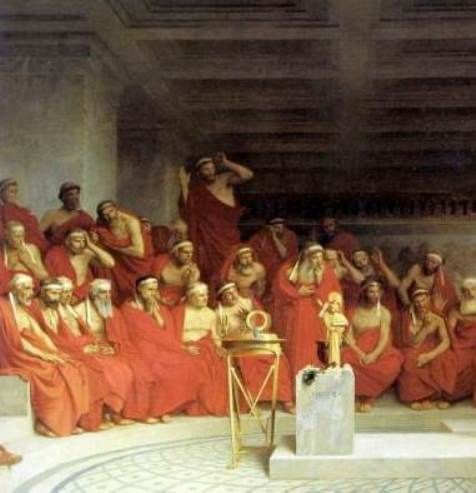
I’m envisioning a relatively small group composed of a core of pure strategists leavened with the most strategically oriented of our elder statesmen, flag officers, spooks and thinkers from cognate fields. A grand strategy board would be most active at the start of an administration and help in the crafting of the national strategy documents and return periodically when requested to give advice. Like the Spartan Gerousia, most of the members ( but not all) would be older and freer of the restraint of institutional imperatives and career ambitions. Like the Anglo-American joint chiefs and international conferences of WWII and the immediate postwar era, they would keep their eye on the panoramic view.
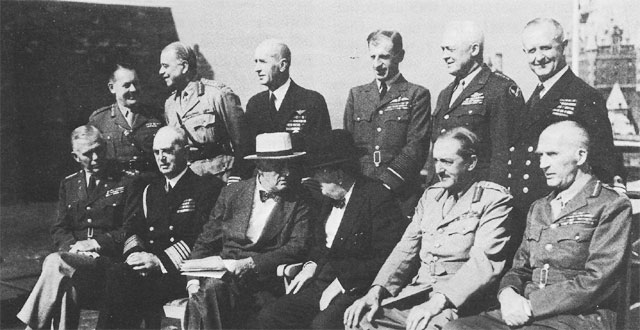
The Octagon Conference – FDR, Churchill and the Combined Chiefs of Staff
Here’s my grand strategy board in a hypothetical perfect world, unlike the one that prevails inside the beltway. I’m sure people will quibble with particular names or will suggest others. I freely admit, for example, that I do not have the best grasp of who our leading intellectual powerhouses are in the Navy, Air Force or the closed world of intelligence analysis and this impairs my ability to put together the list. Nevertheless, I’m trying anyway:
Let’s start with a group of acclaimed and eminent strategic thinkers who have demonstrated over a long tenure, their ability to consider matters of war, peace and statecraft as well as the nuances of strategic theory:
Thomas Schelling -Chairman
Andrew Marshall
Edward Luttwak
Colin Gray
Joseph Nye
Next, some senior statesmen:
Henry Kissinger
George Schultz
Zbigniew Brzezinski Madeleine Albright
General officers and one colonel with a demonstrated talent for challenging conventional assumptions:
Lieutenant General Paul van Riper
General James Mattis
General Jack Keane
Colonel John Warden
Two economists:
Alan Greenspan
Nouriel Roubini
Two scientists:
Freeman Dyson E.O. Wilson
Mixed group of strategists, historians, practitioners and theorists:
David Kilcullen
John Robb
John Negroponte Barry Posen
Antulio Echevarria Chet Richards
Micheal Vlahos
Thomas P.M. Barnett
Stephen Biddle
Robert Conquest
Duane Clairridge
Jack Matlock
Martin van Creveld
Visionaries and Contrarians:
Nicholas Nassim Taleb William Gibson
Ray Kurzweill
Andrew Bacevich
What are the problems with my grand strategy board (aside from having zero chance of coming into being)?
For one, it is probably way too large. In my efforts to balance expertise in strategy with varied thinking it grew bigger than what is manageable in real life, if the group is to be productive.
Secondly, it is an exceedingly white, male and conservative leaning list – though to some extent that reflects the criteria of experience, the field of strategy itself and the nature of American politics. Barbara Ehrenreich, for example, is definitely bright but her politics are fundamentally opposed to effectively maximizing American power in the world or the use of military force – thus making her of little use except as a voice of dissent.
Another limitation of this exercise is the idiosyncratic eclecticism of my approach – this was a blog post written over a few days in my spare time and not a methodical inquiry into who in American life would verifiably be the “best qualified” to help construct a grand strategy. There are “insiders” who command great respect within the national security, defense and intelligence communities who are unknown to the general public, or even this corner of the blogosphere, who would be enormously helpful to such a board. Finally, a grand strategy board would not be a panacea; it would be subject to all the inertial pressures that over time would reduce it’s ability to effect change, just as the Policy Planning Staff and the NSC have been “neutered” over decades by the forces of the status quo.
That said, the above group or one reasonably comparable to it could, for a time, markedly improve the construction of strategy , assuming American leaders are willing to enlist such advice, put aside short term political considerations and pursue long term strategic goals.
Whom would you nominate to a grand strategy board?
My students watched this and reacted by defining themselves as those who were creative mostly through social collaboration but a decided minority required solitude and an environmental filter to think clearly and creatively – not a catalyst of a series of social-intellectual stimuli. For them, the cognitive load generated by the environment amounted to an overload, a distracting white noise that short-circuited the emergence of good ideas.
This suggests to me that there are multiple and very different neuronal pathways to creativity in the brain and a person’s predisposition in their executive function, say for example the classic “ADHD” kid at the back of the class, may have different requirements to be creative than a peer without that characteristic. It also means that creativity may be subject to improvement if we can cultivate proficiency in several “styles” of creative thinking.
Zenpundit is a blog dedicated to exploring the intersections of foreign policy, history, military theory, national security,strategic thinking, futurism, cognition and a number of other esoteric pursuits.