zenpundit.com » Tactics

Archive for the ‘Tactics’ Category

RESTREPO on Television this Monday

Monday, November 29th, 2010

An important announcement from my colleague, Lexington Green:

Lexington Green – (1) RESTREPO Monday, 11/29/10 at 9PM ET/PT; (2) Maj.Gen. Scales on Small Unit Dominance

This is the television premier of this extraordinarily film. I wrote about seeing this film here.

Restrepo chronicles the deployment of a platoon of U.S. soldiers in Afghanistan’s Korengal Valley. The movie focuses on a remote 15-man outpost, Restrepo, named after a platoon medic who was killed in action. It was considered one of the most dangerous postings in the U.S. military. This is an entirely experiential film: The cameras never leave the valley; there are no interviews with generals or diplomats. The only goal is to make viewers feel as if they have just been through a 94-minute deployment. This is war, full stop. The conclusions are up to you.

I highly recommend this film to all of our readers.

An information page for Restrepo is here, including video.

RESTREPO, an award winning documentary, was based on (or more precisely, closely related to) the book WAR by Sebastian Junger, which told the story of the war against the Taliban in the Korengal Valley, waged by the soldiers of the 2nd Platoon of Battle Company.

I previously reviewed WAR here and the movie RESTREPO here.

More Books!

Friday, November 26th, 2010

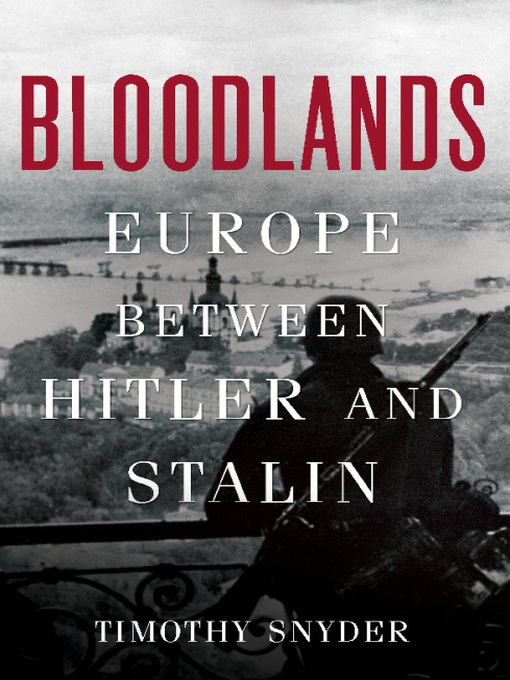
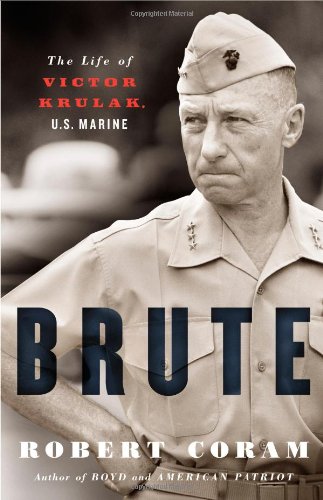
Just picked up a few new reads…..


Brute: The Life of Victor Krulak, U.S. Marine by Robert Coram

Bloodlands: Europe Between Hitler and Stalin by Timothy Snyder

Robert Coram, whom I had the pleasure of meeting at Boyd ’07, has a new biography of the legendary military visionary and Marine Lt. General Victor “Brute” Krulak, reviewed here by Max Boot and here by Tony Perry (Hat tip to Dr. Chet Richards). Having thumbed a few pages, Krulak appears a complicated man – gifted, dauntless and extremely driven but also possessed of a mean streak, edging at times toward petty cruelty.

Bloodlands I intend to read in a “Hitler-Stalin/Nazi-Soviet Comparison” series along with Richard Overy’s The Dictators: Hitler’s Germany, Stalin’s Russia, Robert Gellately’s Lenin, Stalin, and Hitler: The Age of Social Catastrophe , Richard J. Evans’ The Third Reich at War and Alan Bullock’s classic dual biography Hitler and Stalin: Parallel Lives.  I’d also recommend, for those with the stomach for historiographic commentary, Robert Conquest’s Reflections on a Ravaged Century and John Lukac’s The Hitler of History

CURRENTLY READING:

Human Face of War by Jim Storr

After reading approxmately a third of The Human Face of War by  Dr. Jim Storr, a retired Lt. Colonel, King’s Regiment and an instructor at the UK Defence Academy, I will say that if you are going to read only one book on modern military thought this year, it should be The Human Face of War. It’s that good.

Aside from a reflexive hostility toward John Boyd’s OODA Loop ( though not, strangely enough, toward the substantive epistemology advocated by Boyd that the diagram represented), Storr’s tome is an epistle of intellectual clarity on military theory that deserves to be widely read.

ADDENDUM:

NDU Press recommends, and I concur, this review of The Human Face of War by Col. Colonel Clinton J. Ancker III. Ancker, like Storr, is an expert on military doctrine, so it is a well-informed review by a professional peer.

Blood and Rage by Burleigh

Tuesday, November 16th, 2010

After an extended hiatus, Summer Series 2010: Reviewing the Books! re-starts……

Blood and Rage: A Cultural History of Terrorism by Michael Burleigh

British historian Michael Burleigh brings the same kind of unsparingly brutal prose to the history of terrorism that he previously delivered on National Socialism in his acclaimed, The Third Reich: A New History. There is a wealth of detail about terrorists, their casual atrocities and the warped morality that terrorists habitually employ to rationalize their crimes; a nihilistic mentalite shared with their intellectual groupies in universities and political law firms that will shock and inform the reader. The scattered nature of the case studies that comprise modern terrorism though, makes Blood and Rage more of a kaleidescope than microscope.

Burleigh set out to chronicle a comprehensive examination of the evolution of terrorism in the last two centuries. There are Feinians and radicalized Russian Narodniks, murderous FLN Algerians and their pied noir OAS blood enemies, Irgun gunmen and Black September, ETA, IRA and Baader-Meinhoff gangsters consorting with Palestinian radicals and Herbert Marcuse. Burleigh dissects the psychopathology of ultraviolent degenerates like Hugh “Lenny” Murphy, Abu Musab al-Zarqawi and Andreas Baader. Terrorists, statistically speaking, are generally not madmen in a clinical sense, but Burleigh records a noteworthy exception regarding Germany’s Baader-Meinhoff Gang:

….With their numbers by now reduced to about a dozen people, the group was desperate for new recruits. Salvation came from an unlikely quarter. The mad. A radical psychiatrist at Heidelberg University, influenced by the anti-psychiatry of R.D. Laing and the anti-institutionalisation theories of Franco Basaglia, had formed a socialist collective among the mainly student clientele he was treating for various mental disturbances common to that age cohort including depression, paranoia and mild schizophrenia. In early 1971 Baader and Ensslin visited Heidelberg where they met some of the radicalized patients. In the following years, about twelve of the latter, including Gerhard Muller, Siegfried Hausner, Sieglinde Hofmann, Lutz Taufner and others became the second generation of RAF terrorists, initially under the slogan “Crazies to Arms”.

Blood and Rage makes for a grim read, with the recurring pattern of terrorism and counterterrorist response erupting to demoralize societies until the terrorists in question are either dead, imprisoned or mellowed by paunchy middle-age and political irrelevance as the times pass their maniacal political passions by. Only in a few instances, notably South Africa and Northern Ireland are political settlements a more feasible option than methodical police and intelligence work followed by tough-minded prosecution and a steely societal rejection of grandiose moral claims of terrorists and their fellow-travelling left-wing lawyer-advocates. Burleigh also makes clear his disdain for militarized CT and multiculturalist enablement alike.

The weakness of Blood and Rage, unlike some of Burleigh’s other works, is a lack of a strong analytical theme, focus or grand theory to explain and unite the relentless and gory march of geographically diverse case studies in terrorism, though an intelligent reader should be able to discern patterns present well enough for themselves. Given Burleigh’s stature as a scholar, one can envision him having taken the ball further down field for a deeper level of analysis of terrorism as a societal phenomena. Burleigh would probably reply that such is not the proper job of a historian, which while true enough, still leaves me wishing he had.

As a popular history, Blood and Rage makes a page turner out of rancorous destruction.

Infinity Journal

Monday, November 15th, 2010

Military consultant and ardent Clausewitzian, Wilf Owen contacted me today to alert me to the launch of Infinity Journal, “a peer-review electronic journalzine dedicated to the study and discussion of strategy “:

Infinity Journal views strategy as the use of any or all instruments of power to secure political objectives. IJ is concerned mainly – though not exclusively – with the use of force. Strategy must both pursue policy objectives and be viable via tactics. Beyond that there are no sacred cows within the pages of the Infinity Journal.

Critically, and beyond doubt, is the fact that the practice and application of strategy has life and death outcomes for people living in the world today. The fate of nations and peoples still rests in the realm of strategy and as such, it is a vitally important area of study.

Infinity Journal aims to make the discussion of strategy accessible to the widest possible audience, because today strategy is widely misunderstood not only by the layman but also by students, senior soldiers and politicians. Therefore, we aim to keep rigid language and complexity to minimum and comprehensible language and simplicity to a maximum. 

Wilf has an impressive line-up of current and future issue contributors including TX Hammes, Martin van Creveld, John Mackinlay, Colin Gray and many other strategists, soldiers, academics and “students of war” who share a deep interest in strategy. 

An excerpt, from Col. TX Hammes in the current issue of Infinity Journal, available online (registration is free!):

Assumptions – A Fatal Oversight

….In short, in every plan there will be key factors that are unknown to the planners. For instance, we can’t know for certain how a population will react to a U.S. invasion or how much of the international development assistance promised at a conference will actually be delivered. However, to continue planning, the planners must make an educated guess – an assumption – about such key unknowns. While some may see this as a bureaucratic process of little value, recent events show assumptions are central to all planning. For instance, General Tommy Franks assumed the Iraqi government would remain in place after we removed Saddam. Thus Iraqis would deal with the problems of getting their nation back on its feet after the war. And because they would, the United States could invade with a much smaller force than that recommended by the previous CentCom Commander, General Anthony Zinni. In contrast, Zinni assumed the government would collapse and he would need large number of U.S. forces (380,000) to provide security and services.[v] This single, unexamined assumption dramatically altered the war plan.

Check it out.

Al-Awlaki has a Phineas moment

Wednesday, November 10th, 2010

Posted by Charles Cameron

Here’s a meme worth noting when it crops up in the advocacy of religious violence:

You don’t need permission from a religious authority…

1

This particular idea came up in the video of Anwar al-Awlaki that was released yesterday, Nov. 8th.

Flashpoint Partners translated the comment in question, “do not consult anyone in killing the Americans. Fighting Satan does not require a jurisprudence. It does not require consulting. It does not need a prayer for the cause. They are the party of Satan … It is the battle between truth and falsehood.”

The AFP translation of the key phrase here reads, “Killing the devil does not need any fatwa (legal ruling).”

2

My interest was piqued because of the correspondence between this comment from al-Awlaki, and the case of Phineas in the biblical Book of Numbers, chapter 25.

Phineas is “the son of Eleazar, the son of Aaron the priest” – but when he recognizes that the Lord would be infuriated by the interracial and interreligious copulation of Zimri, “a prince of a chief house” in Israel, with Cozbi, the daughter of the “head over a people, and of a chief house in Midian”, he does not go to the priest his grandfather seeking permission to kill them – he knows it is his Lord’s wish that they should die, and so he takes the responsibility for his action entirely upon himself, and kills them.

3

As I shall recount in greater detail in two future posts on the topic of Phineas, it is the fact that Phineas acts without first requesting permission that pleases his Lord so much that He grants to Phineas and his seed “the covenant of an everlasting priesthood”.

It is precisely this acting without requesting permission that is emphasized in modern Christian Identity writings on the topic of “Phineas Priests”:

So a Phinehas priest is a MAN who acts on personal initiative to execute Yah’s judgment on violations of Yah’s laws which are adversely affecting His people.

And according to Ehud Sprinzak, the eminent scholar of modern Jewish terrorism, it was reading the “Balak portion” of the book of Numbers, in which the story of Phineas is recounted, that convinced Yigal Amir that he could legitimately assassinate Yitzhak Rabin without first obtaining rabbinic approval (which would have put the rabbi who granted him permission at risk).

4

So. We have one more piece of the puzzle by which a mind with its own interpretation of God’s will can come to the conclusion that some specific act or acts of violence – accurately termed “terrorism” by others – are not only divinely sanctioned, and indeed mandatory, but can be undertaken without the requirement of prior verification from an appropriate religious authority.

And in this case — the religious authority, such as it is, of Sheikh al-Awlaki proposes this.

5

Aaron Zelin‘s post on the Qur’anic text invoked by al-Awlaki’s title and the commentaries on that verse by ibn Kathir and others, is well worth your time, if you have not already seen it.


Switch to our mobile site