zenpundit.com » primary loyalties

Archive for the ‘primary loyalties’ Category

More Thoughts on Mexico

Tuesday, April 6th, 2010

From John Robb:

JOURNAL: Mexico’s Mercado of Violence Heats Up

Open source warfare often combines market-based functions to accelerate its innovation rates and expand its operations beyond the primary players.  These markets, or bazaars (as I called them) are very efficient.  For example: the price of violence plummets as the number of entrants increases and the capacity for violence improves as the market’s participants specialize and hone their skills.  

Usually, the military/law enforcement response to the surge in the sophistication and quantity of violence is to assume some outside source of training or support rather than something that is the natural byproduct of rapid marketplace development.  

So, it’s no surprise with the growing availability of the street/prison gangs (Barrio Azteca and the Artistic Assassins) as sources of cheap, violent labor the marketplace is heating up. Note the excellent quotes below from a WaPo article on the growth of the market for contract killings

From Joseph Fouche at The Committee of Public Safety:

Containing Mexico

….Mexico, showing more concern for its sovereignty than their northern neighbor, has launched a brave if thus far futile attempt to win control of its territory from large and powerful narco-traffickers. Large parts of Mexico are in disorder and large parts of Mexico threaten to descend into chaos. The Mexican Army has been brought in to take over from Mexico’s corrupt local and federal police. The well-armed and well-equippednarcotraficantes have counterattacked against the police and even the Mexican Army. The government is riddled with gang informants and corrupt officials. An already uninspiring government has pulled off the unique trick of becoming even more uninspiring.

In the long run, I believe the Mexican state will win. Colombia was in a similar pickle ten years ago but eventually found enough institutional resilience to fight back and win control of most of its territory. But the road back is long and, in the meantime, Mexico’s troubles will inevitably leak north, involving and corrupting American law enforcement even more than it already is, drawing entrepreneurs on both sides of the border to profit from America and Mexico’s shared misery, and applying negative pressures on Mexican residents in the United States to cooperate with the narcotraficantes¿O plata o plomo? (silver or lead?) the Colombian drug gangs used to ask their victims. Profit or death, a choice will be put to many Mexican Americans in the years ahead, or as Mexico’s own Porfirio Diaz put it, ¿Pan o palo? (bread or a beating?). Illegal immigration, perhaps deliberately induced by Mexican drug gangs in an ironic echo of the strategy of  Mexico’s incumbent elites, will destabilize American local governments and drain their resources. Violence in Mexican communities in America will increase and inevitably spill over to non-Mexicans. Political correctness and diplomatic niceties will paralyze American responses.

The historical significance of the War in Iraq will be revealed: COIN on American streets. Containment, if it can be described as such, will occur house by house, block by block, city by city, state by state. The traditional American response to crisis, the inspired muddle, will produce more corruption of American institutions and society, already weakened by the last round of containment….

The Health Care Bill’s Effect on the Next Election

Monday, March 22nd, 2010

2010.jpg

I don’t know what the ultimate effects of the Health Care Bill will be because….well….no one has actually read this far reaching, highly partisan, Democratic legislation. I’m not sure even the Congressional leaders can state categorically what they just voted on. Support and opposition was largely faith-based.

I can say that the 2010 election is going to be brutal.

Cameron on Conflicts of Commands, Part III. – A Guest Post Series

Tuesday, March 16th, 2010

Charles Cameron, my regular guest blogger, is the former Senior Analyst with The Arlington Institute and Principal Researcher with the Center for Millennial Studies at Boston University. He specializes in forensic theology, with a deep interest in millennial, eschatological and apocalyptic religious sects of all stripes.  Here is part III. of a three part series by Charles, entitled “CONFLICT OF COMMANDS”.

Conflict of Commands III: Two pre-Hasan documents

by Charles Cameron

In my research on the topic of “conflict of commands” I ran across two documents from October and November of 2001 which make for interesting reading in the wake of Major Hasan’s slide presentation and the Fort Hood shooting.

The first is a MEMRI post, and hence both copyrighted and readily available on the web. It s titled Terror in America (23) Muslim Soldiers in the U.S. Armed Forces in Afghanistan: To Fight or Not to Fight? and dated November 7, 2001, and the intro paragraph reads as follows:

As soon as the U.S. geared up for the war against the Taliban regime in Afghanistan, Muslim military personnel in the American armed forces began to deal with the question of the religious permissibility of their participation in battle. Army Chaplain Capt. Abd Al-Rasheed Muhammad, the Imam of Walter Reed Army Medical Center in Washington, D.C. sent an inquiry on the matter to the North American Fiqh (Islamic Jurisprudence) Council, which in turn referred the matter to clerics in the Arab world. The clerics issued a Fatwa permitting Muslim soldiers to take part in the fighting if there was no alternative, and the council delivered the ruling to Capt. Muhammad. But on October 30, the editor of the Arabic London daily Al-Sharq Al-Awsat reported that the clerics who signed this Fatwa had changed their minds and abrogated their previous Fatwa with a new one prohibiting participation of Muslim soldiers in the war in Afghanistan.

The rest you can read on the MEMRI site.

The second document was actually posted a little earlier on the State Department site, although it is no longer available there. Dated 16 October 2001 and titled U.S. Islamic Leaders Issue Fatwa on U.S. Muslim Soldiers Fighting Terrorists, as far as I can determine, it is currently only present (outside of archive.org) on the Department’s Jakarta site.

Interestingly enough, this document also includes a quote from another person whose name has been much in the news in connection with Islamism: Chaplain Yee — the Chinese-American US Army Chaplain who ministered to the Muslim inmates at Guantanamo Bay, was charged in 2003 with sedition, espionage and other crimes, and held in a Navy brig until all charges against him were dropped. Yee is quoted as saying back in 2001 that “Muslims on his base have come to him with worries about being ordered to fight Muslims overseas”.

I think this document is worth reposting in full, and would simply note my surprise that neither this official State Department statement nor the MEMRI document appears to have formed part of any discussion of the Fort Hood incident in open source materials that I have seen. I hope the IC is doing better in this regard — but if these materials have been overlooked by the relevant classified inquiries too, I wonder whether this might not be yet another result of the sort of thing Gregory Treverton comments on in his 2009 paper “Bridging the Divide between Scientific and Intelligence Analysis” from the Center for Asymmetric Threat Studies, Swedish National Defense College:

Analysts do not have the freedom to explore issues by pursuing them down the rabbit hole, so to speak. There is a hard andfast process in place that determines what they look at, when, and in some cases, to what end.

*U.S. Islamic Leaders Issue Fatwa on U.S. Muslim Soldiers Fighting Terrorists:

*

U.S. Muslim soldiers need to defend their country and combat terrorism
By Phillip Kurata
Washington File Staff Writer
16 October 2001

Washington — Two prominent Islamic scholars in the United States have issued a fatwa, or legal opinion, on the importance of American Muslims serving in the U.S. military to defend their country and combat terrorism.

“All Muslims ought to be united against all those who terrorize the innocents, and those who permit the killing of non-combatants without a justifiable reason. The Muslim soldier must perform his duty in this fight despite the feeling of uneasiness of ‘fighting without discriminating.’ His intention must be to fight for enjoining of the truth and defeating falsehood. It’s to prevent aggression on the innocents, or to apprehend the perpetrators and bring them to justice,” the fatwa reads.

It was written by Taha Jabir Al-Alawani, President of the Fiqh Council of North America and President of the Graduate School of Islamic and Social Sciences, and Sheikh Muhammad Al-Hanooti, a member of the fiqh council. The two Islamic scholars issued their legal opinion in response to a query submitted by Chaplain Abdul-Rashid Muhammad, the most senior Muslim chaplain in the U.S. military, who sought guidance on the permissibility of U.S. Muslim servicemen to participate in the war effort in Afghanistan and other Muslim countries.

“Muslims are part of the American society. Anyone who feels he’s fighting in a just war must fight,” Al-Alawani said.

“We abide by every law of this country except those laws that are contradictory to Islamic law,” said Sheikh Al-Hanooti. The sheikh added that U.S. Muslim military personnel may refuse to fight on the grounds of conscientious objection.

“If any Muslim serving in the U.S. Armed Forces has a conscientious objection to combat and believes that it is against Islamic principles to fight in any war, then that individual has the right to stand by his or her concience,” Al-Hanooti said. “They realize, of course, that they may be administratively separated from the military as a result of their choice.”

Muhammad, who is stationed at the Walter Reed military hospital in Washington, says there is no conflict between being a loyal soldier and a loyal Muslim. He is helping some Muslim American servicemen deal with their qualms about fighting terrorists who claim to represent Islam.

“It is time now for us to not only wake up, but speak up,” Muhammad said in a recent interview. “The prophet said when we see evil action we are compelled to change it with our hand, challenge it with our tongue or at least hate it in our heart.”

Muhammad, an African American who was raised as a Baptist, became the first Muslim chaplain in the U.S. military in 1993. Until then, all the 3,150 U.S. military chaplains were either Jews or Christians. In 1996, a second Muslim chaplain was commissioned by the Navy. Since then the number of Muslim chaplains in the U.S. military has grown to 14.

Qaseem Uqdah, a Marine Corps veteran who is executive director of the American Muslim Armed Forces and Veteran Affairs Council, said the Muslim military chaplains include Muslims who were born into the faith in Asia, Africa and the Middle East and Muslim converts, who include several African Americans, an Anglo-American and a Chinese American. Uqdah’s group has been selected by the U.S. military to recommend people as Muslim chaplain candidates.

U.S. military officials say a shortage of candidates with the required education limits the number of Muslim military chaplains. Three Muslim chaplains are currently being trained at the Hartford Seminary in Connecticut.

The newest Muslim chaplain is James Yee, a Chinese American and a graduate of the West Point military academy, who was born into a Lutheran family. He became interested in Islam while a student and later spent four years studying Arabic and Islam in Damascus, Syria. Currently he serves with the 29th Signal Battalion at Fort Lewis, Washington.

Chaplain Yee said that Muslims on his base have come to him with worries about being ordered to fight Muslims overseas.

“An act of terrorism, the taking of innocent civilian lives is prohibited by Islam, and whoever has done this needs to be brought to justice, whether he is Muslim or not,” Chaplain Yee said.
Review: Senator’s Son by Larson

Monday, March 15th, 2010

larson.jpg

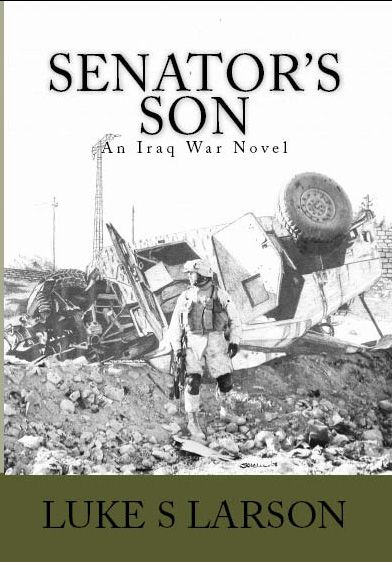
Senator’s Son: An Iraq War Novel by Luke S. Larson

Fiction is not a genre that I usually review here, or get an opportunity to read often, but I received a courtesy review copy of a book Senator’s Son, by Iraq war vet, Marine officer and new novelist Luke Larson and was curious. The Iraq War and the War on Terror have produced a fine array of thoughtful books by veterans, war reporters and military thinkers like FiascoOne Bullet Away  and The Strongest Tribe, all of which were non-fiction memoirs, journalistic histories and quasi-policy books. By virtue of writing Senator’s Son as a novel, Larson was taking a different path in explaining his war.

There are two books at once in Senator’s Son. The first, is of course, a story, with characters and a plot and rising action, action, tragedy and theme – all the usual aspects of literature which I am not especially practiced at evaluating here. The second part is a contextual explanation of COIN by an author who lived the Iraq War. To his credit, Larson contacted me personally to request a “No bulls**t review”, so I will give the man what he asked for.

As an explanation of COIN, I think the book is a must read for anyone unfamiliar with the subject and the nuanced complexities that COIN entails. The gritty, unforgiving, human suffering and moments of triumph of soldiers waging “pop-centric” COIN that gets lost in powerpoint slides, in the dry abstractions of journal articles and blogospheric arguments far removed from the ground is present in ample measure in Senator’s Son. Many times, I paused in a passage and thought, “hmmm….I did not consider that”. Or “This is what the soldiers bear up under without complaint”. More people need to read that and digest what we ask of our men and women in Iraq and Afghanistan.

Senator’s Son also lays out, fairly methodically, how COIN theory may have been interpreted and debated by soldiers outside the wire, including cameo appearances or mention of real life COIN leaders woven into the story. The characters Bama, Cash, Rogue, Isaac, Gonzo the Iraqi and more, resist and adapt, struggling with their environment, unseen enemies and the political pressures of higher authorities, registering both frustration and progress in executing the mission of Golf Company. There’s even diagrams. If Senator’s Son is not on official COIN reading lists, it should be.

As a pure novel, judged on literary standards, Senator’s Son reflects its’ status as a “first novel” of a talented author whose vision of the craft is emerging. Larson excels at creating scenarios, staccato vignettes for the characters to act ( Larson may also have a future as a screenwriter – his book naturally flows in the mind like a movie). There’s always a believable, environmental, “texture” present that exceeds that of short story and science fiction writers, yet as a novelist, Larson leaves enough to the reader’s imagination so that the story moves at a dramatic pace.

Characterization in Senator’s Son is uneven. It takes a while for the individual personalities of the characters to shine beyond their common “Marine-ness” and we get only the briefest glimpse of the malign nature of the enemy, and that secondhand through the eyes of an Iraqi character. That probably is an accurate representative of the experience of most US soldiers and Marines in Iraq who are not interrogators; furthermore, having the antagonist that the characters struggle against be the total environment is perfectly legitimate. It would have been interesting for me to have seen how Larson would develop and utilize a figure who was the focus of evil; however that task would be fairly incompatible with getting an effective message across regarding COIN, success of which does not hinge on the defeat of super-villains or the resolution of black-white moral absolutes but is complexity written in shades of gray.

Finally, as an avid reader, I found Senator’s Son to be a page-turner. Several times, I looked at the clock while reading for what seemed to me a short time, noted it was 1:30 am and was regretful that I had to put it on my bedstand ( I always finished the chapter first though 🙂 ) only to repeat the process the following night.  Strongly recommended.

ADDENDUM – OTHER REVIEWS of SENATOR’S SON by:

Thomas P.M. Barnett 

Shrinkwrapped 

Shane Deichman

Cameron on Conflicts of Commands, Part II. – A Guest Post Series

Friday, March 12th, 2010

Charles Cameron, my regular guest blogger, is the former Senior Analyst with The Arlington Institute and Principal Researcher with the Center for Millennial Studies at Boston University. He specializes in forensic theology, with a deep interest in millennial, eschatological and apocalyptic religious sects of all stripes.  Here is part II. of a three part series by Charles, entitled “CONFLICT OF COMMANDS”.

PREFACE: 

I would like to state quite categorically that I am not in the business of making “moral equivalences” here. I have culled these quotes from a wide variety of sources – from friend and foe alike, moderate and extremist, local and far-flung. The fact that I juxtapose a variety of quotations in which the issue of divided lines of command comes up in no way means that I equate the principled opposition to state brutality of one quotation with the wilder reaches of conspiracist rhetoric in another. Part I has further details and provides my context. Please note too that as an appendix, I have attached two quotes that only indirectly address the issue of conflict of commands – a white supremacist quote, immediately followed by a principled quote about militia movement members “disgust at the genocidal fantasies in white supremacist discourse” – because I believe it is important to be aware just how far the rhetoric of hatred can go, and just how firmly it can be rebutted.        – Charles Cameron

Conflict of Commands II: Quotations

by Charles Cameron

Principle IV, Principles of International Law Recognized in the Charter of the Nüremberg Tribunal and in the Judgment of the Tribunal, 1950.

The fact that a person acted pursuant to order of his Government or of a superior does not relieve him from responsibility under international law, provided a moral choice was in fact possible to him.

*

No man can serve two masters: for either he will hate the one, and love the other; or else he will hold to the one, and despise the other…

Jesus Christ, in the Gospel according to Matthew, 6.24

*

Archbishop Romero to the Salvadoran military, March 24, 1980:

No soldier is obliged to obey an order that is contrary to the will of God. Now it is time that you recover your consciences and that you first obey your conscience rather than an order to sin.

Carolyn Forche, “Oscar Romero” in Susan Bergman, ed., Martyrs.

*

And we call on every soldier working in the crusader armies and puppet governments to repent to Allah and follow the example of the heroic Mujahid brother Nidal Hassan, to stand up and to kill all the crusaders by all means available to him supporting the religion of Allah and to make the word of Allah most supreme on earth.

Operation by the Mujahid brother Omar Al-Farooq the Nigerian, AQAP statement, 26 December 2009

*

Oath-Keepers’ Declaration of Orders We Will NOT Obey:

Recognizing that we each swore an oath to support and defend the Constitution against all enemies, foreign and domestic, and affirming that we are guardians of the Republic, of the principles in our Declaration of Independence, and of the rights of our people, we affirm and declare the following:

1. We will NOT obey any order to disarm the American people.

*

US Special Forces have conducted multiple raids into Pakistani territory, local daily The Nation reported today in a front-page article that was basically just quoting an earlier Guardian story. 

One previous US raid that occurred in 2008 was already known about. And when it happened, there was serious concern as to whether such actions by the Americans might lead to the breakdown of the Pakistani army. One respected London-based Pakistan academic said if American troops kept crossing into Pakistani territory he could envisage a situation where Pakistani commanders would lose control over soldiers who would want to fight the incursions.

Londonstani, blogging on CNAS’ Abu Muqawama

*

SINCE its meeting on 28th Shvat 5765, the Sanhedrin has deliberated the initiative of the Prime Minister of Israel, the decisions of the government, and legislation enacted by the Knesset regarding the plan known as “The Disengagement,” henceforth referred to in this document as “the uprooting.”

This plan involves the uprooting of Jewish communities in the Gaza strip and northern Samaria, the forced expulsion of Jews from their homes, and the willful transfer of these lands to a foreign power. Following an intensive study which took place regarding the halachic (authentic Jewish law) questions that arise from the government’s decision, the Sanhedrin hereby brings its conclusions and decisions to the public’s attention. [ … ]

7. Any Jew – including a soldier or policeman – who supports the uprooting, whether directly or indirectly, whether by voting in its favor, or by giving council, or by supplying vehicles or materials, and obviously, anyone who actively participates in the uprooting… by so doing, transgresses a large number of Torah commandments.

*

Members of all branches of the United States Military will soon be facing a most critical decision. A report emerged that Obama is using the deployment of additional troops to Afghanistan to cover for the movement of some 200,000 troops, presently on duty in countries other than Iraq and Afghanistan, to USNORTHCOM to prepare for the “expected outbreak of Civil War within the United States before the end of winter.”

LewRockwell.com

*

Rabbis and teachers from Hesder yeshivas, which offer Torah studies alongside military service, released a letter to students in which they reiterated their assertion that soldiers must refuse orders if they are commanded to evacuate settlements, arguing that Torah law is above the Israel Defense Forces. … “Unfortunately, the IDF has been used for purposes unrelated to Israel’s defense and directly opposed to God’s wishes for quite some time,” the rabbis wrote in the letter. “This situation faces IDF soldiers with a contradiction between Jewish commandments and commanders’ orders.”

Chaim Levinson, “Hesder yeshiva rabbis: Torah law is above IDF”, Ha’aretz, Deecember 18, 2009.

*

AL-JAZEERA: How can you agree with what Nidal did as he betrayed his American nation?”

AL-AWLAKI : More important than that is that he did not betray his religion. Working in the American Army to kill Muslim is a betrayal to Islam. American today is Yesterday’s pharaoh; it is an enemy to Islam. A Muslim is not allowed to work in the American Army unless he intends to walk the steps of our Brother Nidal. Loyalty in Islam is to Allah, His messenger and the believers, and not to a handful of soil they call “nation.” The American Muslim’s loyalty is to the Muslim Nation and not to America, and brother Nidal is a proof on that through [executing] his blessed operation, so may Allah reward him with the best of the rewards for that.

Al-Jazeera Interview with Anwar al-Awlaki regarding Maj. Hasan, December 23, 2009

*

You must understand that the desire of the nation isn’t meaningful for someone who believes in the creator.

Rabbi Ariel Bareli, quoted in Christian Science Monitor

(more…)


Switch to our mobile site

