zenpundit.com » peace

Archive for the ‘peace’ Category

Two TED Talks: Stavridis and van Uhm

Thursday, July 26th, 2012

[ by Charles Cameron — talking across the military / civilian divide ]
.

Adm. Stavridis' rheostat

.

I thought these two TED talks — one given in Amsterdam by Gen. Petrus J.M. “Peter” van Uhm, current Chief of the Netherlands Defence Staff, the other by Adm. James Stavridis, current Commander, U.S. European Command (USEUCOM) and NATO’s Supreme Allied Commander Europe (SACEUR) — were interesting in terms of the speaker-audience combination in each case, and the topics the two speakers chose to present.

**

First, Adm. Stavridis, speaking to A Navy Admiral’s thoughts on global security:

I’m particularly intrigued by the sub vs raft image, and by the admiral’s hard and soft power rheostat (image above) — I hope we’ll get to discuss that image.

**

Then Gen. van Uhm, speaking to Why I chose a gun:

**

Stavridis is the guy who says:

We are excellent at launching Tomahawk missiles … we need to get better at launching ideas.

and told his audience at National Defense University convocation:

in the end, 21st-century security is about brain on-brain warfare.

**

There’s some interesting bridge-building going on here — from military speakers to civilian audiences. I welcome your comments.

Review: Poetry of the Taliban

Friday, July 20th, 2012

[ by Charles Cameron — poetry, humanity, dehumanizing, enmity and amity, image and likeness ]
.

I wrote this review-essay for Books & Culture: A Christian Review — the book review site associated with Christianity Today — where it was published earlier today. I am grateful to my old friend John Wilson for permission to cross-post it here.

I posted a reading of a single poem from the same anthology here on ZP in May: Change: a poem from The Poetry of the Taliban

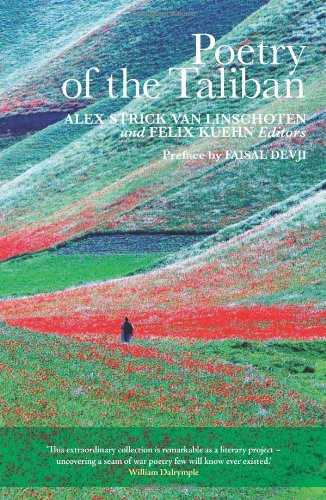
Poetry of the Taliban (Columbia/Hurst)

Columbia University Press, 2012
176 pp., $24.50Buy Now


CHARLES CAMERON

Poetry of the Taliban

Regarding the image and likeness.

Which heart’s voice is this that directly enters into my heart?
Which brute’s ears are these that are deaf to this?
Which sigh of the defenceless is shaking God’s domain?

The poet is Dr. Faizullah Saqib, and the poem is taken from an anthology of poetry written by the Taliban, our enemies. Could it not have been written when an earlier generation of mujaheddin, resisting the Soviet occupation, were our friends? What is this thing, enmity?

Poetry is not simply another weapon the Taliban have decided to use for wartime purposes. Poetry is integral to Afghan culture, and while there are “official” Taliban poems, the flourishing “unofficial” poetry of the Taliban is the place where their Afghan love of poetry takes flight, and the varied aspects of war have been woven into it in much the same way that helicopters have been woven into Afghan carpets: as part of the pattern. There’s an interesting quote on the Textile Museum of Canada website, in fact, relating to Afghan war rugs: “On their rugs flowers turned into cluster bombs, birds turned into airplanes.”

War changes us, war changes everything. Most significantly, I’d suggest, war changes the nature of those we label enemies. We do this anti-sacramental thing, we de-humanize them. As Samiullah Khalid Sahak writes in a poem in this volume,

They don’t accept us as humans,
They don’t accept us as animals either.
And, as they would say,
Humans have two dimensions.
Humanity and animality,
We are out of both of them today.

We are not animals,
I say this with certainty.
But,
Humanity has been forgotten by us,
And I don’t know when it will come back.
May Allah give it to us,
and decorate us with this jewellery,
the jewellery of humanity,
For now it’s only in our imagination.

War tends to do this; it strips people of their humanity—and the stripping tends to boomerang. As Archbishop Desmond Tutu put it,

when we dehumanize someone, whether you like it or not, in that process you are dehumanized. A person is a person through other persons. If we want to enhance our personhood, one of the best ways of doing it is enhancing the personhood of the other.

I said we “do this anti-sacramental thing, we de-humanize’ those we identify as the enemy. And there are really two significant points here, one to do with dehumanizing the other and its impact on us, while the other has to do with the sacramental—with humanizing and loving the other.

Brigadier General S. L. A Marshall, later the official historian of the European theater in World War II for the US Army, found by asking soldiers in the field that “out of an average of one hundred men along the line of fire only fifteen men … would take any part with the weapons.” As a Guardianarticle put it much later,

Marshall’s astonishing contention, debated vigorously ever since, was that about 75% of second world war combat troops were unable to fire their weapons on the enemy. Guns were discharged, but they would be deliberately aimed over the heads of the enemy. The vast majority of soldiers couldn’t actually kill. And, in the midst of combat, they became de facto conscientious objectors.

Marshall’s conclusion, contained in his 1947 book Men Against Fire, was that:

It is therefore reasonable to believe that the average and healthy individual—the man who can endure the mental and physical stress of combat—still has such an inner and usually unrealized resistance towards killing a fellow man that he will not of his own volition take life if it is possible to turn away from that responsibility.

And the result of this?

Lt. Col. Dave Grossman, a former Ranger who has taught psychology at West Point, wrote in 2007, “Since World War II, a new era has quietly dawned in modern warfare: an era of psychological warfare, conducted not upon the enemy, but upon one’s own troops.” That too is a sort of boomerang effect: we now find ourselves needing not only to dehumanize the enemy, but to desensitize (and how different is that?) ourselves.

Grossman, whose book On Killing: The Psychological Cost of Learning to Kill in War is another major contribution to our understanding here, goes on to describe the “triad of methods used to enable men to overcome their innate resistance to killing” as including “desensitization, classical and operant conditioning, and denial defense mechanisms”:

During the Vietnam era millions of American adolescents were conditioned to engage in an act against which they had a powerful resistance. This conditioning is a necessary part of allowing a soldier to succeed and survive in the environment where society has placed him. If we accept that we need an army, then we must accept that it has to be as capable of surviving as we can make it.

But if society prepares a soldier to overcome his resistance to killing and places him in an environment in which he will kill, then that society has an obligation to deal forthrightly, intelligently, and morally with the psychological repercussions upon the soldier and the society. Largely through an ignorance of the processes and implications involved, this did not happen for Vietnam veterans—a mistake we risk making again as the war in Iraq becomes increasingly deadly and unpopular.

And what’s the basis for this? Sebastian Junger hung out for the better part of a year with troops in one of the most heavily contested parts of Afghanistan’s Korengal Valley, describing what he saw there in the bookWar and the film Restrepo, which he directed. Junger commented not so long ago in the Washington Post:

I can’t imagine that there was a time in human history when enemy dead were not desecrated. Achilles dragged Hector around the walls of Troy from the back of a chariot because he was so enraged by Hector’s killing of his best friend. Three millennia later, Somali fighters dragged a U.S. soldier through the streets of Mogadishu after shooting down a Black Hawk helicopter and killing 17 other Americans …. Clearly, the impulse to desecrate the enemy comes from a very dark and primal place in the human psyche. Once in a while, those impulses are going to break through.

And:

They are very clear about the fact that society trains them to kill, orders them to kill and then balks at anything that suggests they have dehumanized the enemy they have killed.

But of course they have dehumanized the enemy—otherwise they would have to face the enormous guilt and anguish of killing other human beings …. It doesn’t work …, but it gets them through the moment; it gets them through the rest of the patrol.

People who fight wars find it easier to kill people they have dehumanized. Perhaps, as Junger suggests, it makes it easier to handle, for a while, the burden of having killed. But then comes the post-traumatic stress, the label “PTSD,” the rising tide of military suicides.

It’s almost easier for me to go to the sacramental side.

All terror is sacramental, Joseba Zulaika suggests in Terror and Taboo: The Follies, Fables, and Faces of Terrorism—an “outward and visible sign of an inward and spiritual grace,” as evidenced by the stories of miracles recounted by bin Laden’s mentor Abdullah Azzam in his book, The Signs of the Merciful in the Jihad of Afghanistan.

It is with sacramental eyes, then, that we must understand and oppose terror, as William Cavanaugh in Torture and Eucharist suggests we should the “disappearances” and torture under the Pinochet regime in Chile. The issue, again, is that of personhood, of humanity, of the image and likeness.

Of which the poets Samiullah Khalid Sahak and Faizullah Saqib speak.

Sun Tzu in The Art of War advises us to know our enemy. Christ goes further, and instructs us to love. He instructs us in loving:

But I say unto you, Love your enemies, bless them that curse you, do good to them that hate you, and pray for them which despitefully use you, and persecute you.

Somehow, we are to understand a new relationship of enmity with amity.

Perhaps the poetry of the Taliban can show us something of our enemy’s humanity, brutal and angelic by turns, as is that humanity with which we ourselves contend:

Like those who have been killed by the infidels,
I counted my heart as one of the martyrs.
It might have been the wine of your memory
that made my heart drunk five times.
The more I kept the secret of my love,
This simple ghazal spoke more of my secrets.
—Khairkhwa

Charles Cameron is a writer, teacher, and game designer.

Numbers by the numbers: two

Thursday, July 12th, 2012

[ by Charles Cameron — numbers as analytic categories, two, the duel and the duet ]
.

Charles Darwin once said of his fellow species biologists:

Those who make many species are the “splitters,” and those who make few are the “lumpers”.

**

The diagram above represents a card-game I’ve played on occasion in my mind, asking myself the question: what is the opposite of one?

Two is the usual answer — and it’s interesting, you can get there from one two ways: by adding, or by dividing.

**

The human mind very often thinks in binaries, we talk about us and them, friend and foe, the Allies and the Axis Powers, and even an eye for an eye and a tooth for a tooth – our ideas of warfare, contest and justice alike are predicated on the number two.

As I said in my intro post, one is a single data point, perhaps an anomaly: two is a duel or a duet, an opposition or a trend.

So we don’t always have to think of us and them — we could also think about me and mine, you and yours, two heads are better than one…

And what if you can “turn” your enemy? Then the duel turns into a duet.

**

The duel is all about two competing, contending, fighting, agonizing to see who shall be the one. It is arguably the most basic form of combat, the simplest, and possibly the most profound. It can be close to symmetric — “they were perfectly matched” — or the very essence of asymmetric — David and Goliath.

The duet is about two collaborating, counterpointing, harmonizing — seeing how, together, they are one…

War-fighting and music-making, war and peace, regiment and free form, the march and the dance…

*****

I am eager to know what sorts of insights you can derive from or find echoed in this series of posts.

The best war game is a library of windows

Tuesday, July 3rd, 2012

[ by Charles Cameron — Escher, Borges, simulating the future, wargames, A Pattern Language, Sembl ]
.

MC Escher, Relativity

.
Ridiculous phrase, a library of windows. Unless you think, as I do, of books as windows onto different worlds, in which case it makes a whole lot of sense, and a decent library has more windows onto more profoundly different worlds than any physical room — and here we are getting into the territory of Jorge Luis Borges (links to Library of Babel) and Maurits Escher (image above).

And let me just state for the record that Godel Escher Bach could just as well have been Escher Carroll Borges, and that a comparison between the logics of Escher and Borges is one of the desiderata of our times.

That’s a Sembl move.

**

Let’s expand the concept of window to include the sort of inter-worldview glimpse that Haaretz describes today here:

Last week, in a small beit midrash (study hall) named after Rabbi Meir Kahane in Jerusalem’s Shmuel Hanavi neighborhood, an emergency meeting was convened to discuss instigating freedom of religion and worship on the Temple Mount. It was a closed meeting attended by representatives of the Temple Institute, HaTenu’ah LeChinun HaMikdash (the Movement to Rebuild the Holy Temple) and the Temple Mount Faithful, as well as two representatives of Women for the Mikdash, and others. The activists met to try to understand how they could overcome the authorities, who they believe are plotting against them, and return to the Temple Mount. At this meeting, Haaretz was offered a rare behind-the-scenes glimpse of the most ardent activists in the battle to Judaize the Temple Mount.

**

Here’s the meat of the post, as yet uncooked. Back in 2005, but brought to my attention today by Rex Brynen at Paxsims, is this piece from Strategy Page:

After eight years of effort, and spending over $300 million, the U.S. Army has officially received its new wargame (WARSIM) for training battalion, brigade, division, and as big as you want to get, commanders, and their staffs. Now even the most elaborate commercial wargame would not get $300 million for development, and eight years to create the system. But wargames for professional soldiers have different requirements, and a troublesome Department of Defense bureaucracy to deal with. First, the requirements. Commercial wargames shield the player from all the boring stuff (support functions, especially logistics.) But professional wargames must deal with these support activities, because in a real war, these are the things commanders spend most of their time tending too. …

WARSIM covers a lot of complex activities that a commander must deal with to achieve battlefield success. Besides logistics, there’s intelligence. Trying to figure out what the enemy is up to is, next to logistics, the commanders most time consuming chore.

— which in turn was referenced by Michael Peck writing in a Kotaku piece today titled Why It’s So Hard to Make a Game Out of the 21st Century:

Let’s build a game. Let’s make it a strategy game. We will realistically simulate global politics in the 2030s. Perhaps a sort of Civ or Supreme Ruler 2020-type system.

Where shall we start? How about something easy, like choosing the nations in the game? It’s simple enough to consult an atlas. We’ll start with Britain…but wait! Scotland is on the brink of declaring independence from the United Kingdom. Should Britain be a single power, or should England and Scotland be depicted as a separate nation? What about Belgium splitting into Flemish and Walloon states? And these are old, established European nations. How will states like Syria and Nigeria look in two decades? It was only a bit over 20 years ago that the Soviet Union appeared to be a unshakeable superpower that controlled Eastern Europe and Central Asia.

**

Let’s cook that meat, let’s make a meal of it.

Peck’s piece goes into many other ways in which predictive gaming isn’t terribly productive.

But it left me asking the question, what would I do with a game-sized budget, if my aim was to push military and intelligence towards greater insight.

And my answer would be to embed information in walls. In corridors…

To build windows at sparse and irregular intervals into the internal corridors that connect any given office in the Pentagon or three-letter agency — or my local preference (hush, I know it’s the Glorious Fourth tomorrow) MI-5 and -6 — through which analysts and decision makers can glimpse snippets of information.

Which can then fall into the deep well of memory.

It is deep within that well of half-forgotten knowledge, ST Coleridge tells us, that the “hooks-and-eyes of memory” link one thought with another to build a creative third.

**

A wall, then. I would build a wall embedded with facts and fancies, maps and illustrations, graphs and stats, film clips and news clips, anecdotes and quotes — even, perhaps, tiny alcoves here and there with books free for the taking, music CDs, DVDs of movies, old, new, celebrated, strange…

And I would be constantly shifting and rearranging the “views” from my windows, so that what was seen yesterday would not be what would be seen tomorrow — yet with a powerful index of words, topics, themes, memes, image contents, names of actors, newscasters, authors and so forth, so that what was once seem and dimly recalled could be recaptured.

**

The concept here is pretty much the exact opposite of having a huge black poster proclaiming Creativity Matters!

Don’t get me wrong, creativity does matter (get that poster and others here), but it “works in mysterious ways its wonders to perform” — and the way to entice it is to see things out of the corner of the eye…

The windows I’m looking for, therefore, offer glimpses you wouldn’t necessarily notice if you were deep in thought or conversation, and conversely, wouldn’t see twice and grow so familiarized to that they’d become irrelevant by repetition. They’d be glimpsed in passing, their esthetic would be that of Christopher Alexander’s Zen View, pattern 134 in his brilliant work — the closest we have to a Western I ChingPattern Language:

The idea, then, is to seed the memory with half-conscious concepts, patterns, facts and images, carefully selected and randomly presented — so that those hooks and eyes have the maximum chance of connecting some scrap of curious information with a pressing problem.

Which is how creativity tends to work.

**

That way each corridor becomes a game-board — but it is in the analyst’s focused mind that the game is played and won.

What you’d get, in effect, would be community-wide, ongoing free-form gameplay in complete alignment with the web-based game we’re currently developing at Sembl. Games of this genre will also have powerful application in conflict resolution.

And peace.

One bead for a rosary

Friday, June 22nd, 2012

[ by Charles Cameron — one bead from NASA for the glass bead game as rosary ]
.


photo credit: Norman Kuring, NASA’s Goddard Space Flight Center
.

Consider her sacred, treat her with care.


Switch to our mobile site