zenpundit.com » Taliban

Archive for the ‘Taliban’ Category

Review: Poetry of the Taliban

Friday, July 20th, 2012

[ by Charles Cameron — poetry, humanity, dehumanizing, enmity and amity, image and likeness ]
.

I wrote this review-essay for Books & Culture: A Christian Review — the book review site associated with Christianity Today — where it was published earlier today. I am grateful to my old friend John Wilson for permission to cross-post it here.

I posted a reading of a single poem from the same anthology here on ZP in May: Change: a poem from The Poetry of the Taliban

Poetry of the Taliban (Columbia/Hurst)

Columbia University Press, 2012
176 pp., $24.50Buy Now


CHARLES CAMERON

Poetry of the Taliban

Regarding the image and likeness.

Which heart’s voice is this that directly enters into my heart?
Which brute’s ears are these that are deaf to this?
Which sigh of the defenceless is shaking God’s domain?

The poet is Dr. Faizullah Saqib, and the poem is taken from an anthology of poetry written by the Taliban, our enemies. Could it not have been written when an earlier generation of mujaheddin, resisting the Soviet occupation, were our friends? What is this thing, enmity?

Poetry is not simply another weapon the Taliban have decided to use for wartime purposes. Poetry is integral to Afghan culture, and while there are “official” Taliban poems, the flourishing “unofficial” poetry of the Taliban is the place where their Afghan love of poetry takes flight, and the varied aspects of war have been woven into it in much the same way that helicopters have been woven into Afghan carpets: as part of the pattern. There’s an interesting quote on the Textile Museum of Canada website, in fact, relating to Afghan war rugs: “On their rugs flowers turned into cluster bombs, birds turned into airplanes.”

War changes us, war changes everything. Most significantly, I’d suggest, war changes the nature of those we label enemies. We do this anti-sacramental thing, we de-humanize them. As Samiullah Khalid Sahak writes in a poem in this volume,

They don’t accept us as humans,
They don’t accept us as animals either.
And, as they would say,
Humans have two dimensions.
Humanity and animality,
We are out of both of them today.

We are not animals,
I say this with certainty.
But,
Humanity has been forgotten by us,
And I don’t know when it will come back.
May Allah give it to us,
and decorate us with this jewellery,
the jewellery of humanity,
For now it’s only in our imagination.

War tends to do this; it strips people of their humanity—and the stripping tends to boomerang. As Archbishop Desmond Tutu put it,

when we dehumanize someone, whether you like it or not, in that process you are dehumanized. A person is a person through other persons. If we want to enhance our personhood, one of the best ways of doing it is enhancing the personhood of the other.

I said we “do this anti-sacramental thing, we de-humanize’ those we identify as the enemy. And there are really two significant points here, one to do with dehumanizing the other and its impact on us, while the other has to do with the sacramental—with humanizing and loving the other.

Brigadier General S. L. A Marshall, later the official historian of the European theater in World War II for the US Army, found by asking soldiers in the field that “out of an average of one hundred men along the line of fire only fifteen men … would take any part with the weapons.” As a Guardianarticle put it much later,

Marshall’s astonishing contention, debated vigorously ever since, was that about 75% of second world war combat troops were unable to fire their weapons on the enemy. Guns were discharged, but they would be deliberately aimed over the heads of the enemy. The vast majority of soldiers couldn’t actually kill. And, in the midst of combat, they became de facto conscientious objectors.

Marshall’s conclusion, contained in his 1947 book Men Against Fire, was that:

It is therefore reasonable to believe that the average and healthy individual—the man who can endure the mental and physical stress of combat—still has such an inner and usually unrealized resistance towards killing a fellow man that he will not of his own volition take life if it is possible to turn away from that responsibility.

And the result of this?

Lt. Col. Dave Grossman, a former Ranger who has taught psychology at West Point, wrote in 2007, “Since World War II, a new era has quietly dawned in modern warfare: an era of psychological warfare, conducted not upon the enemy, but upon one’s own troops.” That too is a sort of boomerang effect: we now find ourselves needing not only to dehumanize the enemy, but to desensitize (and how different is that?) ourselves.

Grossman, whose book On Killing: The Psychological Cost of Learning to Kill in War is another major contribution to our understanding here, goes on to describe the “triad of methods used to enable men to overcome their innate resistance to killing” as including “desensitization, classical and operant conditioning, and denial defense mechanisms”:

During the Vietnam era millions of American adolescents were conditioned to engage in an act against which they had a powerful resistance. This conditioning is a necessary part of allowing a soldier to succeed and survive in the environment where society has placed him. If we accept that we need an army, then we must accept that it has to be as capable of surviving as we can make it.

But if society prepares a soldier to overcome his resistance to killing and places him in an environment in which he will kill, then that society has an obligation to deal forthrightly, intelligently, and morally with the psychological repercussions upon the soldier and the society. Largely through an ignorance of the processes and implications involved, this did not happen for Vietnam veterans—a mistake we risk making again as the war in Iraq becomes increasingly deadly and unpopular.

And what’s the basis for this? Sebastian Junger hung out for the better part of a year with troops in one of the most heavily contested parts of Afghanistan’s Korengal Valley, describing what he saw there in the bookWar and the film Restrepo, which he directed. Junger commented not so long ago in the Washington Post:

I can’t imagine that there was a time in human history when enemy dead were not desecrated. Achilles dragged Hector around the walls of Troy from the back of a chariot because he was so enraged by Hector’s killing of his best friend. Three millennia later, Somali fighters dragged a U.S. soldier through the streets of Mogadishu after shooting down a Black Hawk helicopter and killing 17 other Americans …. Clearly, the impulse to desecrate the enemy comes from a very dark and primal place in the human psyche. Once in a while, those impulses are going to break through.

And:

They are very clear about the fact that society trains them to kill, orders them to kill and then balks at anything that suggests they have dehumanized the enemy they have killed.

But of course they have dehumanized the enemy—otherwise they would have to face the enormous guilt and anguish of killing other human beings …. It doesn’t work …, but it gets them through the moment; it gets them through the rest of the patrol.

People who fight wars find it easier to kill people they have dehumanized. Perhaps, as Junger suggests, it makes it easier to handle, for a while, the burden of having killed. But then comes the post-traumatic stress, the label “PTSD,” the rising tide of military suicides.

It’s almost easier for me to go to the sacramental side.

All terror is sacramental, Joseba Zulaika suggests in Terror and Taboo: The Follies, Fables, and Faces of Terrorism—an “outward and visible sign of an inward and spiritual grace,” as evidenced by the stories of miracles recounted by bin Laden’s mentor Abdullah Azzam in his book, The Signs of the Merciful in the Jihad of Afghanistan.

It is with sacramental eyes, then, that we must understand and oppose terror, as William Cavanaugh in Torture and Eucharist suggests we should the “disappearances” and torture under the Pinochet regime in Chile. The issue, again, is that of personhood, of humanity, of the image and likeness.

Of which the poets Samiullah Khalid Sahak and Faizullah Saqib speak.

Sun Tzu in The Art of War advises us to know our enemy. Christ goes further, and instructs us to love. He instructs us in loving:

But I say unto you, Love your enemies, bless them that curse you, do good to them that hate you, and pray for them which despitefully use you, and persecute you.

Somehow, we are to understand a new relationship of enmity with amity.

Perhaps the poetry of the Taliban can show us something of our enemy’s humanity, brutal and angelic by turns, as is that humanity with which we ourselves contend:

Like those who have been killed by the infidels,
I counted my heart as one of the martyrs.
It might have been the wine of your memory
that made my heart drunk five times.
The more I kept the secret of my love,
This simple ghazal spoke more of my secrets.
—Khairkhwa

Charles Cameron is a writer, teacher, and game designer.

William Lind on the Taliban’s Operational Art

Friday, June 29th, 2012

Adam Elkus directed my attention today on Twitter to a new piece by William S. Lind, “the Father of 4th Generation Warfare” at The American Conservative:

Unfriendly Fire 

….The Soviet army focused its best talent on operational art. But in Afghanistan, it failed, just as we have failed. Like the Soviets, we can take and hold any piece of Afghan ground. And doing so brings us, like the Soviets, not one step closer to strategic victory. The Taliban, by contrast, have found an elegant way to connect strategy and tactics in decentralized modern warfare.

What passes for NATO’s strategy is to train sufficient Afghan forces to hold off the Taliban once we pull out. The Taliban’s response has been to have men in Afghan uniform— many of whom actually are Afghan government soldiers or police—turn their guns on their NATO advisers. That is a fatal blow against our strategy because it makes the training mission impossible. Behold operational art in Fourth Generation war.

According to a May 16 article by Matthew Rosenberg in the New York Times, 22 NATO soldiers have been killed so far this year by men in Afghan uniforms, compared to 35 in all of last year. The report went on to describe one incident in detail—detail NATO is anxious to suppress. There were three Afghan attackers, two of whom were Afghan army soldiers. Two Americans were killed. The battle—and it was a battle, not just a drive-by shooting—lasted almost an hour.

What is operationally meaningful was less the incident than its aftermath. The trust that existed between American soldiers and the Afghans they were supposed to train was shattered. Immediately after the episode, the Times reported, the Americans instituted new security procedures that alienated their native allies, and while some of these measure were later withdrawn,

Afghan soldiers still complain of being kept at a distance by the Americans, figuratively and literally. The Americans, for instance, have put up towering concrete barriers to separate their small, plywood command center from the outpost’s Afghan encampment.

Also still in place is a rule imposed by the Afghan Army after the attack requiring most of its soldiers to lock up their weapons when on base. The Afghan commanding officer keeps the keys….

Lind has lost none of his skill for zeroing in on which buttons to push that would most annoy the political generals among the brass.

However, I think Lind errs in ascribing too much credit to the Taliban here. A much simpler explanation is that the usually illiterate ANA soldier is a product of the same xenophobic cultural and religious environment that created the Taliban, the Haqqanis, vicious Islamist goons like Gulbuddin Hekmatyar or the Afghan tribesmen who slaughtered the retreating garrison of Lord Elphinstone in 1841.

While the Taliban have infiltrators, it remains that many of the “Green on Blue” killings are just as easily explained by personal grievances, zealous religious bigotry, indiscipline, mistreatment by American advisers or Afghan superiors and sudden jihad syndrome. While it is impolitic to emphasize it, Afghan betrayal and murder of foreign allies (generally seen as “occupiers”) is something of a longstanding historical pattern. The Taliban capitalize on it politically but they are not responsible for all of it.

A footnote to a benchmark in boundless cyberspace

Saturday, June 23rd, 2012

[ by Charles Cameron — Taliban use of social media with side ramble on the cognition of similars, parallels and opposites ]
.


.

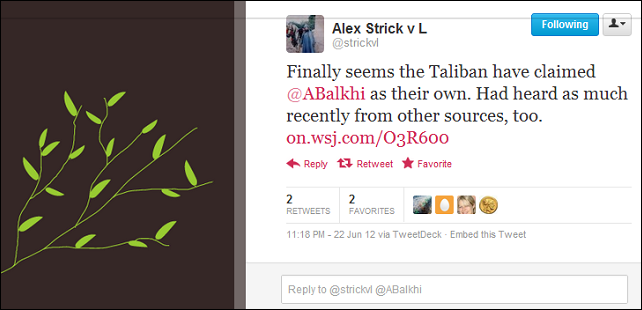
It’s not like it’s a big deal or anything, it’s just a footnote, a detail — but God is in the details, the devil is in the details. And it looks as though a certain Twitter account does belong to the Taliban after all.

Some back-story:

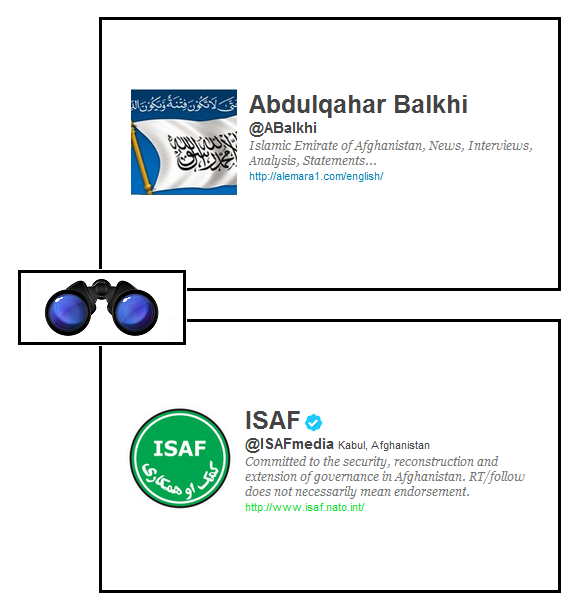
A while back, on my way to make other points, I posted this:

I wasn’t the first or last to make the connection between A Balkhi and the Taliban, nor to note the Twitter-exchanges between Balkhi and the ISAF press office — but I happened to have this habit of juxtaposing similars and opposites, and had developed the “Specs” format used here, with the little binoculars inset, to suggest the idea of seeing parallel or opposite things in parallel or opposition — a sort of mental equivalent of stereoscopic vision or stereophonic sound — in the hope that something about the comparison and contrast would add a depth dimension to understanding.

As a footnote to a footnote to a footnote, I think the Necker Cube can add an interesting aspect to this business of stereoscopic thinking:

When two things are so much the same and so utterly different that, as with a Necker Cube (or the positive and negative of a photo rapidly alternating) the mind flashes rapidly from one view to its exact and opposite other, a metacognitive insight arises about what I can only term the two in one in twoness experienced.

File that under number theory, koans.

But that’s about metacognition, let’s get back to the Taliban on Twitter.

Towards the end of last year, Alex Strick van Linschoten posted his doubts about A Balkhi:

No. Just no. The account @abalkhi appears to have nothing to do with the Taliban (see below). I’d also be interested to see the evidence for the statement that ‘Taliban spokesmen also frequently spar with Nato press officers’. I have not seen a single instance of this. Every other story on these accounts repeats this claim. And it’s presumably quite an important distinction: an official spokesman (we might assume it is a man) engaged in verbal attacks on the official ISAF account is a different thing from some fanboy in his bedroom doing the same thing.

Today, Alex (I hope that’s the appropriate way to name him) reversed himself with the tweet featured at the top of this post.

The pool of people to whom it matters whether A Balkhi is an official Talibvan site or a fan site is probably quite small, and by now they will all surely have either read the Wall Street Journal, seen Alex’s tweet, or arrived at whatever conclusion in the matter their own intelligence sources have suggested to them.

In the enormity of cyberspace, then, this whole post of mine is just a footnote to a footnote.

Alex’s piece from which I quoted above, on the other hand, is a true footnote: it provides us with a decent summary of Twitter-feeds associated with the Taliban, helpfully annotated.

Let’s call it a benchmark — and while this business about A Balkhi may be just a detail, benchmarks are go-tos, and I hope Alex will update his.

Query: COIN Manual Conference Feedback

Wednesday, May 16th, 2012


Was the COIN  Manual conference at Fort Leavenworth last week a success or a failure?

I have heard backchannel that the focus of the rewrite of FM 3-24 was going to be on “tactics” and but that a “light footprint option” had to be included to appease policy makers. Some good suggestions were made at SWJ by Colonel Robert C. Jones, but not much has been said yet online that I have seen. USACAC bloseriously could use some updating on a more frequent basis.

I’m curious where they went with this. Opinions and comments solicited.

Book Review: The Hunt for KSM

Monday, May 14th, 2012

The Hunt for KSM: Inside the Pursuit and Takedown of the Real 9/11 Mastermind by Terry McDermott and Josh Meyer 

I received a review copy of The Hunt for KSM from  Hachette Book Group and was pleased to see that the authors, Terry McDermott and Josh Meyer, are investigative journalists, one of whom, Meyer, has extensive experience reporting on terrorism, while McDermott is also the author of the 9-11 highjackers book, Perfect Soldiers. So, I was looking forward to reading this book. My observations:

  • In the matter of style, McDermott and Meyer have opted to craft a novel-like narrative of their research, which makes The Hunt for KSM a genuine page-turner. While counterterrorism wonks used to a steady diet of white papers may become impatient with the format, they already know a great deal about operational methods of Islamist terror groups and the general public, who are apt to be engaged by the story, do not. While enjoying the yarn about Khalid Sheikh Mohammed, the villain behind 9-11 and his downfall, the general reader picks up a great deal of important information.
  • McDermott and Meyer deserve kudos for their fair and balanced handling of Pakistan – and I say this as a severe critic of the Pakistanis. While pulling no punches about the perfidy of Pakistan’s elite, the ties of the ISI and their religious extremist parties to terrorist groups including al Qaida, they give credit where credit is due to Pakistanis who made the difference in assisting the United States and it’s investigators in tracking down KSM and his AQ associates . “Colonel Tariq” of the ISI, in particular stands out as a courageous and sympathetic figure.
  • Khalid Sheikh Mohammed emerges in the story as a master adversary, part Bond villain, part sinister clown, who confounded the efforts of the FBI and the CIA for years with his prodigious ability to organize and orchestrate geographically diverse terrorist networks, fundraising, logistical support, bombings and murder like a one-man KGB while remaining as elusive as a ghost. His abilities, daring, good fortune and defiant resilience in captivity are impressive enough in McDermott and Meyer’s telling that they unfortunately tend to overshadow the fact that KSM is an enthusiastic mass-murderer. A facet that comes out to it’s true ghastly extent only in their description of KSM personally beheading kidnapped reporter Daniel Pearl.
  • The bureaucratic bungling and stubborn infighting of the FBI and CIA, with assistance from the DoD and Bush administration on particularly stupid decisions related to the interrogation and reliance upon torture while excluding AQ experts and experienced KSM case investigators from talking to KSM, makes for a profoundly depressing read. It contrasts poorly with the dedication and sacrifice demonstrated by law enforcement agents Frank Pellegrino, Matt Besheer, Jennifer Keenan and those who aided them.

The Hunt for KSM closes with Khalid Sheikh Mohammed as he is at the present time, on trial at Guantanamo Bay, a story with a climax but not yet an epilogue.

Well written, concise yet dramatic, The Hunt for KSM is warmly recommended.


Switch to our mobile site