zenpundit.com » ideas

Archive for the ‘ideas’ Category

Guest Post: Cheryl Rofer – I Hope the Government Doesn’t Listen to Nathan Myhrvold

Monday, September 23rd, 2013

Cheryl Rofer, scientist, WMD expert and founder of Nuclear Diner.com and long-time friend of ZP blog, will be cross-posting here today regarding the report “Strategic Terrorism: A Call to Action” by Microsoft billionaire, venture capitalist, theoretical mathematician and cookbook author, Dr. Nathan Myhrvold

I Hope The Government Doesn’t Listen to Nathan Myhrvold

by Cheryl Rofer

Shane Harris at Foreign Policy tells us that Nathan Myhrvold, fresh off introducing the world to liquid nitrogen and other expensive innovations for cookery, is now going to straighten out the US government on terrorism. He has produced a thirty-three page paper that he is shopping around Washington to help the government get things right.

Except that Myhrvold does not understand the definition of a threat: intent + capability. And he gets a lot of things wrong.

He has a lot to say about what he calls, and barely defines, “strategic terrorism.” This is apparently intended to be parallel to the strategic nuclear threats of the Cold War. But during the Cold War, both the United States and Russia had nuclear weapons aimed at each other. They still do. The terrorists that Myhrvold discusses do not have weapons that can kill millions of Americans, which seems to be central to “strategic terrorism.” It’s not even clear that they have intent, but, for the sake of argument, let’s assume they do. That is only half a threat.

Could they get that capability? Myhrvold is convinced they can, but he offers little in the way of evidence, and some of that is incorrect. Further, he confuses possibility with actuality throughout the paper, slipping easily from might to could to can.

Let’s get the biggest factual error out of the way first. On page 5, Myhrvold says:

The collapse of the Soviet Union has also greatly aided the dispersal of nuclear knowledge and potentially even complete weapons.

Note that potentially. again on page 10:

Today, tremendously lethal technology is available on the cheap. Anyone—even a stateless group—can have the deadliest weapons on earth. Several trends led to this inflection point. One is nuclear proliferation, which in recent years reached a tipping point at which access to nuclear weapons became impossible to control or limit in any absolute way. The collapse of the Soviet Union scattered ex-Soviet weapons across many poorly governed and policed states, and from there, the weapons may spread further into the hands of terrorists. At the same time, the set of ragtag countries that have developed homegrown nuclear devices is large and growing. The entrance to the nuclear-weapons club, once limited to a small number of sophisticated and stable countries, is now far more open.

Myhrvold is simply wrong that “The collapse of the Soviet Union scattered ex-Soviet weapons across many poorly governed and policed states.” He may have heard that when the Soviet Union split into fifteen separate states in December 1991, four of them had nuclear weapons: Russia, Ukraine, Kazakhstan, and Belarus. This was a consequence of Soviet basing policy and the rapidity with which the Soviet Union fell apart. Kazakhstan decided it didn’t want to be a nuclear power and sent its missiles back to Russia. It took a bit more persuasion to convince Belarus and Ukraine, but they sent theirs back too. Twenty-two years after the breakup, there is no evidence that any Soviet nuclear weapons are outside Russia.

And the “large and growing” number of “ragtag countries” that “have developed homegrown nuclear devices”? Well, let’s count them. Outside the five nuclear weapons countries enumerated in the Nuclear Nonproliferation Treaty, India, Israel, and Pakistan that are known to have significant numbers of nuclear weapons. North Korea has tested three nuclear devices; whether they have weaponized any is not known. And, despite Iran’s insistence that it is not developing nuclear weapons, some people believe that is the case. That’s all I can think of. Nine is not a large number, nor is it growing particularly rapidly. I’ll leave it to Myhrvold to tell us which of those countries are “ragtag.”

So his assumption that nuclear weapons are easily available to terrorist organizations fails. I’m not as closely acquainted with the issues of biological weapons, but if Myhrvold’s arguments there are equivalent to the ones on nuclear weapons, I’m not worried. Likewise, he cites only one example, Aum Shinrikyo, for the terrorist use of chemical weapons, but there have been no incidents since. And he uses his expansionary sense of capability: If they had been able to disperse the sarin more effectively, more people would have died. But they didn’t; these weapons are difficult to make effective, and small groups, even with expertise, have shown themselves not up to the capability of states.

It’s worth going back to that paragraph from page ten to examine Myhrvold’s rhetorical methods, which persist throughout the paper. The first two sentences are sensational assertions with no specific content. And it is an inflection point – everything has changed! This is a common trope for computer guys, and the rest of us are on to it. Again, no specifics. Then the “facts,” which turn out to be wrong and unsupported. And then the sensational conclusion that the first two sentences told us we would come to.

He provides a number of old chestnuts, again with no support. Many of them have been shown to be doubtful.

  • Terrorists have no home address; therefore retaliation and deterrence are difficult or impossible.
  • “If a nation-state really wants to hurt the United states, why risk reprisal? Why not inflict damage by giving encouragement, resources, and direction to a group such as al Qaeda?”
  • “The quickest path to power for a ruthless and ambitious 21st-century man in many parts of the world is now to lead a stateless terror group.”
  • “The bully pulpit afforded by modern communications has allowed what once would have been isolated fringe groups to knit together into formidable adversaries against the most powerful nations on earth.”

He conflates all terror groups with al-Qaeda and almost asserts that their single goal is to build a caliphate. I say “almost” because throughout the paper, he implies or states pseudo-conclusions loosely connected to earlier statements, not quite willing to own his implications. However, since he includes them, one might assume that they represent his thinking. This method of presentation, however, leaves him ample room to say “I didn’t say that.”

He defines (or, in his loose way, almost defines) tactical and strategic terrorism, presumably attempting a parallel with tactical and strategic nuclear weapons. Tactical terrorism – the shooting up of shopping malls and bombing of marathons – can be handled by normal means of law enforcement. Strategic terrorism – which seems to mean actions that can kill millions of Americans – needs Myhrvold’s advice.

The parallel, however, doesn’t work, because strategic nuclear weapons exist, but the capability for a terrorist group to kill millions of Americans doesn’t and isn’t likely to for some time, if ever.

But let’s consider Myhrvold’s advice. It is to centralize and highly fund (ah, now we see why he’s getting an audience in Washington) an organization with a single executive to prevent strategic terrorism.

Business knows best, he says, and this is how business does it. But, whatever the virtues, this has been tried before. Any number of politicians and lobbyists have advocated a special agency with an executive focused like a laser on their preferred goals. Sometimes the agency is formed. It would be helpful if Myhrvold would list the successful examples.

The government is doing many of the things that Myhrvold advocates; he seems not to have researched what is being done and what is not. And some of his (almost) suggestions are scary: we must reconsider whether the dangers from the Bill of Rights outweigh the benefits. Not even that explicitly, his goals of preventing strategic terrorism imply a great deal of surveillance, probably a lot more than the NSA is now being accused of.

Harris says that Myhrvold is talking to people in federal agencies concerned with terrorism, although Myhrvold is shy about saying whom. There are always a few people in federal agencies who are impressed by a Big Name with Big Money. Perhaps they just wanted him to sign their copy of his cookbook. And perhaps some see an opportunity to use Myhrvold’s recommendations to enhance their agency’s budget or reach.

But it’s the sameold sameold: be very afraid, the terrorists are coming to get you! The country seems to be moving past that after twelve long years.
Ronfeldt’s In-Depth Review of America 3.0

Monday, September 23rd, 2013


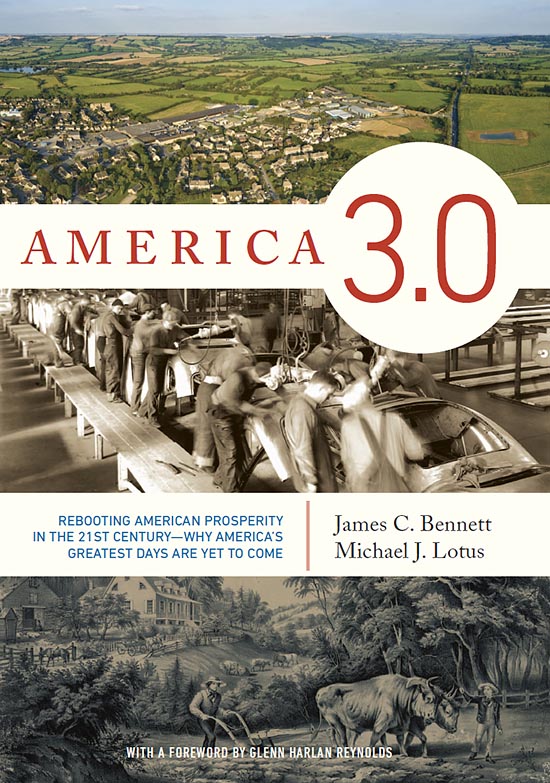
 David Ronfeldt, RAND strategist and theorist has done a deep two-part  review of America 3.0 over at his Visions from Two Theories blog. Ronfeldt has been spending the last few years developing his TIMN analytic framework (Tribes, Institutions [hierarchical], Markets and Networks) which you can get a taste from here  and here or a full reading with this RAND paper.

David regards the familial structure thesis put forward by James Bennett and Michael Lotus in America 3.0 as “captivating”  and “compelling” for  “illuminating the importance of the nuclear family for America’s evolution in ways that, in my view, help validate and reinforce TIMN”. Both reviews are detailed and should be read in their entirety, but I will have some excerpts below:

America 3.0 illuminates significance of nuclear families — in line with TIMN (Part 1 of 2) 

….Bennett and Lotus show at length (Chapter 2, pp. 29-45) that the nuclear family explains a lot about our distinctive culture and society:

“It has caused Americans to have a uniquely strong concept of each person as an individual self, with an identity that is not bound by family or tribal or social ties. … Our distinctive type [of] American nuclear family has made us what we are.” (p. 29)And “what we are” as a result is individualistic, liberty-loving, nonegalitarian (without being inegalitarian), competitive, enterprising, mobile, and voluntaristic. In addition, Americans tend to have middle-class values, an instrumental view of government, and a preference for suburban lifestyles. 

As the authors carefully note, these are generally positive traits, but they have both bright and dark sides, noticeable for example in the ways they make America a “high-risk, high-return culture” (p. 38) — much to the bane of some individuals. The traits also interact in interesting ways, such that Americans tend to be loners as individuals and families, but also joiners “who form an incomprehensibly dense network of voluntary associations” — much to the benefit of civil society (p. 39). 

In sum, the American-style nuclear family is the major cause of “American exceptionalism” — the basis of our freedom and prosperity, our “amazing powers of assimilation” (p. 53), and our unique institutions:

“It was the deepest basis for the development of freedom and prosperity in England, and then in America. Further, the underlying Anglo-American family type was the foundation for all of the institutions, laws, and cultural practices that gave rise to our freedom and prosperity over the centuries.” (p. 52)The authors go on to show this for America 1.0 and 2.0 in detail. They also reiterate that Americans have long taken the nuclear family for granted. Yet, very different marriage and family practices are the norm in most societies around the world. And the difference is profoundly significant for the kinds of cultural, social, economic, and political evolution that ensue. Indeed, the pull of the nuclear model in the American context is so strong that it has a liberating effect on immigrants who come from societies that are organized around extended families and clans (p. 55) — an important point, since America is a land of immigrants from all over, not just from Anglo-Saxon nuclear-family cultures.

….As for foreign policy, the authors commend “an emerging phenomenon we call “Network Commonwealth,” which is an alignment of nations … who share common ties that may include language, culture and common legal systems.” (p. 260) Above all, they’d like to see the “Anglosphere” take shape. And as the world coalesces into various “global networks of affinity” engaged in shifting coalitions (p. 265), America 3.0 would cease emphasizing democracy-promotion abroad, and “reorient its national strategy to a primary emphasis on maintaining the freedom of the global commons of air, sea, and space.” (p. 263) [UPDATE: For more about the Network Commonwealth and Anglosphere concepts, see Bennett’s 2007 paper here.]

Read the whole thing here.

America 3.0 illuminates significance of nuclear families — in line with TIMN (Part 2 of 2)  

….Overlaps with TIMN themes and propositions

Part 1 discussed America 3.0’s key overlap with TIMN: the prevalence and significance of the nuclear family in the American case. This leads to questions about family matters elsewhere. Furthermore, it should be pointed out that there is more to TIMN’s tribal form than the nature of the family. I also spotted several additional thematic overlaps between America 3.0 and TIMN, and I want to highlight those as well. Thus, in outline form, this post addresses:

  • Seeking a fuller understanding of family matters beyond the American case.
  • Gaining a fuller understanding of the tribal/T form.
  • Anticipating the rise of the network/+N form.
  • Recognizing that every form has bright and dark sides.
  • Recognizing the importance of separation among the forms/realms.
  • Recognizing that balance among them is important too.
  • Cautioning against the exportability of the American model.

After these points, the post ends by summarily noting that America 3.0 is more triformist than quadriformist in conception — but a worthy kind of triformist plus, well worth reading.

My discussion emphasizes the T and +N forms. Bennett and Lotus also have lots to say about +I and +M matters — government and business — and I’ll squeeze in a few remarks along the way. But this post mostly skips +I and +M matters. For I’m more interested in how America 3.0 focuses on T (quite sharply) and +N (too diffusely). 

By the way, America 3.0 contains lots of interesting observations that I do not discuss — e.g., that treating land as a commodity was a feature of nuclear-family society (p. 105), and so was creating trusts (p. 112). Readers are advised to harvest the book’s contents for themselves.

….Caution about the exportability of the American model: TIMN sharpens — at least it is supposed to sharpen — our understanding that how societies work depends on how they use four cardinal forms of organization. This simplification leaves room for great complexity, for it is open to great variation in how those forms may be applied in particular societies. Analysts, strategists, and policymakers should be careful about assuming that what works in one society can be made to work in another. 

….In retrospect it seems I pulled my punch there. I left out what might/should have come next: TIMN-based counsel to be wary about assuming that the American model, especially its liberal democracy, can be exported into dramatically different cultures. I recall thinking that at the time; but I was also trying to shape a study of just the tribal form, without getting into more sweeping matters. So I must have pulled that punch, and I can’t find anywhere else I used it. Even so, my view of TIMN is that it does indeed caution against presuming that the American model is exportable, or that foreign societies can be forced into becoming liberal democracies of their own design.

Meanwhile, America 3.0 clearly insists that Americans should be wary of trying to export the American model of democracy. Since so much about the American model depends on the nature of the nuclear family, policies that work well in the United States may not work well in other societies with different cultures — and vice-versa. Accordingly, the authors warn,

“American politicians are likely to be wrong when they tell us that we can successfully export democracy, or make other countries look and act more like the United States.” (p. 24)

“A foreign-policy based primarily on “democracy-promotion” and “nation-building” is one that will fail more times than not, … .” (p. 254)TIMN is not a framework about foreign policy. But as a framework about social evolution, it may have foreign-policy implications that overlap with those of America 3.0. In my nascent view (notably herehere, and here), the two winningest systems of the last half-century or so are liberal democracy and patrimonial corporatism. The former is prominent among the more-advanced societies, the latter among the less-developed (e.g., see here). As Bennett and Lotus point out, liberal democracy is most suitable where nuclear families hold sway. And as I’ve pointed out, patrimonial corporatism is more attractive in societies where clannish tribalism holds sway. 

Read the rest here.

This discussion about America 3.0 and TIMN seems particularly appropriate in light of the need to process, digest and distill the lessons of more than a decade of COIN and counter-terrorism warfare in Iraq, Afghanistan, Pakistan, Yemen and – increasingly- Africa. One of the more difficult aspects of COIN operations has been for American military and diplomatic to decipher the layered relationships and interplay of family honor, tribe, political institution, emerging market and networks in a nation shattered by dictatorship and war like Iraq or to import modern institutions and  a democratic political system in Afghanistan where they had never existed.

Many of these aspects were opaque and were understood only through hard-won experience (frequently lost with new unit rotation) or still remain elusive to Americans even after ten years of fighting among alien cultures which were also permeated by the sectarian nuances and conflicts of Islam. A religion to which relatively few Americans adhere or know sufficiently about, yet is a critical psychological driver for many of our adversaries as well as our allies.

Arguably, the eye-opening response of people to America 3.0 indicates we do not even understand ourselves, much less others

Octavian Manea interviews T.X. Hammes

Saturday, September 7th, 2013

[by Mark Safranski, a.k.a. “zen“]

Octavian Manea and SWJ are on something of a roll lately. Colonel T.X. Hammes (ret.) PhD is the respected author of the excellent The Sling and the Stone. If you have never read it, you should.

The Fallacies of Big Expeditionary Counterinsurgency: Interview with T.X. Hammes

SWJ: How different is Mao’s people’s war compared with what you call 4GW (Fourth Generation Warfare)? Is 4GW an updated, evolved form of people’s wars? In the end, isn’t 4GW focused on people and minds, on influencing people and minds?

TX: Mao is a little bit different because (in China) it was a domestic insurgency and focused on wearing down the nationalists and changing the minds of the warlords who supported them. In the case of 4GW, the focus is overseas. People you can’t reach with force, you must reach with the message. 4GW is an evolved form of insurgency. It is also important to note that Maoism is a type of insurgency that essentially fits a hierarchical society, not a tribal one. It always ends with a conventional campaign to destroy the government’s army as the final step in overthrowing the government. You can’t run a Maoist insurgency in the mountains of Afghanistan, the society won’t tolerate that kind of structure.  Nor can you do it in Iraq. 4GW covers both because its objective is not the military defeat.  4GW does not focus on the destruction of the enemy’s armed forces, but on changing the minds of the enemy’s political decision makers. 4GW directly attacks the will of enemy decision makers.  Once the outside power has been ejected, the conflict can continue until resolution. 

SWJ: Tell us about the center of gravity in a 4GW.

TX: The center of gravity in a 4GW is the will of the policymakers of the other side. 4GW war uses all available networks – political, economic, social and military – to convince the enemy’s political decision makers that their strategic goals are either unachievable or too costly for the perceived benefit. 4GW is not necessarily targeted at the people.  If the war is small enough, it can run on for years like El Salvador.  In that case, the US commitment was small enough there was no major political cost to US decision makers to continue supporting the El Salvadorian government.

When you look at the counterinsurgent side, I am more and more convinced that as a foreign power you can only do indirect counterinsurgency. You can advise and assist.  But keep it small – the host nation has to make it work. We, the United States, have done this successfully a number of times. Admittedly, we have not created the perfect nations that the nation-builders want, but that wasn’t the goal. The goal was to achieve US strategic goals. And we achieved our strategic goals in the Philippines, El Salvador, Columbia and Thailand. In a 4GW, the insurgent is not trying to win over the people as a whole. But the counterinsurgent must do so. In a tribal society, you can do what Kilcullen refers to as wholesale COIN – if you persuade the tribal chief everybody flips. In a more democratic society, you have to convince the people. It is more of a retail operation. It is critical to understand the society you are in and tailor your counterinsurgency and insurgency accordingly. 

I would add, in the 4GW theme of reasoning with the “moral level of war”, that a foreign power supporting a host nation government with FID that faces an insurgency, can probably get away with “punitive raiding”  of the non-state actors from time to time, particularly in rapid response to some heinous action committed by rebels. A heavy in-country footprint though will change the political calculus for the population – it is too easy to look lie occupiers and stringpullers. Foreign troops are rarely welcome guests for long.

Read the rest here.

Creativity and Ennui

Friday, August 16th, 2013

[Mark Safranski a.k.a. “zen“]

Creativity is a subject that has  interested me, going back to the days long, long ago when I was an art student. Creativity is only mildly correlated with IQ, but like “intelligence”, the deeper you delve into the study of  creativity and creative thinking the more “creativity” looks like a multifaceted, multidimensional and diverse set of capacities, habits and circumstances than it does a single, universal, characteristic or ability.

Creativity has been studied from a neuroscientific, psychological, evolutionary,  behavioral, economic and social perspective but what of creativity”s opposite?  What about Ennui?

From a cognitive perspective, the two may be flip sides of the same coin, note the correlation between highly   creative  people and incidence of depression. It may also be a sign of overuse of certain brain functions, like adrenal exhaustion from an excess of physical and mental stress over a long period of time. Creativity, being in “the flow” is intoxicating but it usually involves peak exertion which accumulates weariness. Exemplary performance in one area can also come at the expense of penalties in another area.

Or perhaps ennui is the natural, cyclical ebb and flow between generative conceptual fertility and barrenness, the brain preparing itself for the next creative “surge” to come?

When are you creative and when are you not?

Is Grand Strategy Democratic?

Friday, August 9th, 2013

[by Mark Safranski – a.k.a. “zen“]

Grand strategy in 1941

A very interesting article at Small Wars Journal by Captain Sean F.X. Barrett, USMC on the state of contemporary grand strategy. Definitely worth the time to read the whole thing:, but I am only going to make meandering comments on a few sections:

The Democratization of Grand Strategy 

Calls for a formalized strategic planning process and grand strategy have been mounting for years.  However, those sounding these calls erroneously remember a past that rarely if ever existed and overestimate the importance of a formalized process and a final product.  Most disconcertingly, they assume that government is necessarily the only supplier of grand strategy, while ignoring that those in government are not incentivized to actually produce it.  In fact, the proliferation of communications technology, which provides the means for accessing a wealth of open source intelligence and for disseminating ideas, and the plethora of academics, analysts, and other intellectuals outside of official government communities provide a more effective, democratic, and transparent substitute to the (oftentimes imagined) Project Solariums of the past.  The environment in which these intellectuals operate nurtures “real devils,” who vigorously propose policy and strategy alternatives in which they truly believe and have a stake in seeing implemented, resulting in a de facto strategic planning process, whose merits far exceed those of a de jure one. 

I think the call for a formal process, or at least an institutionalized forum for “doing grand strategy”, derives from both the lack of incentives correctly noted by Barrett and the frequently piss-poor and astrategic performance of American statesmen after the Soviet collapse. That the resulting criticism, proposals, counter-proposals, debates and domestic politics in drag relating to grand strategy are an alternative, open-source and more effective mechanism than formal planning is an intriguing idea.

Certainly, if a statesman or senior policy adviser have not done hard thinking about geopolitics and grand strategy while in the political wilderness then they won’t do it at all. Once in office, there simply is no time even if the inclination is present. Richard Nixon, who thought very seriously on these matters, as POTUS was militant about having Haldeman carve out undisturbed time for him to continue doing so in a secret “hideaway” office in the EOB. This was highly unusual and difficult even for Nixon to maintain – most presidents and senior officials faced with 18 hour days, 6-7 days a week, simply want to unwind in their off hours, see their loved ones or sleep.

….Furthermore, when formalized strategic planning processes and grand strategy have actually existed, their importance has largely been exaggerated.  For example, Richard Immerman debunks some of the myths surrounding Project Solarium, which is often referenced today as a model for grand strategy.  In referencing the intelligence that was ostensibly utilized during Project Solarium to guide the formation of grand strategy, he argues that, even though President Eisenhower—whose highest priority was to exploit the full resources of government to formulate a more effective and sustainable national strategy—was welcoming of CIA input, this input had minimal impact on President Eisenhower’s policies or grand strategy.[viii]  After such a long time serving in the Army, President Eisenhower had already developed highly formed beliefs about national security, and while intelligence has been perceived as playing a critical role by confirming his beliefs, a lack of confirmation would not have significantly impacted or altered his decisions.[ix]  Furthermore, Immerman claims that he has “never been able to locate a scintilla of evidence collected by the CIA and other agencies that changed Eisenhower’s [mind].”[x]   

While Barrett is correct that in discerning grand strategy in historical eras it is often reified and exaggerated retrospectively -that is because grand strategy, much like strategy itself, has a deeply iterative character. In facing the Soviet challenge,  Project Solarium both responded to and built upon a solid foundation laid by the post-warwise menNSC-68, Containment policy, the Marshall Plan, the National Security Act, the creation of the CIA , NSC, NATO, the Department of Defense, the Truman Doctrine, the X Article, the Long  Telegram, Bretton Woods and stretching back to WWII, the geopolitical vision of The Atlantic Charter, Potsdam and FDR’s Four Freedoms. Project Solarium was not ex nihilo but an effort to improve, shape, refine and surpass what the Eisenhower administration had inherited from it’s Democratic predecessors.

Barrett is also on target when he identifies a strong ideological-political predisposition in formulation of grand strategy. Eisenhower had not only operational/experential preferences but a worldview that he brought with him into the White House and his Secretary of State, John Foster Dulles, had even stronger convictions that, especially in regard to his fierce and almost Calvinistic anti-communism, sometimes render him a caricature today. We have to be careful though in parsing public statements and private assessments. Dulles, despite his hardline reputation, was a sophisticated and highly influential figure in American foreign policy as the senior GOP adviser through most of the 1940’s. Despite talk of “rollback”, neither Dulles nor Eisenhower had any appetite for leaping into Hungary militarily to support the anti-Soviet revolt or supporting the Franco-British-Israeli debacle in the Suez. Still less attractive was the prospect of military intervention in faraway Laos. Grand strategic ideas were applied with realism and prudence by the Eisenhower administration.

….It should come as no surprise that three of the first four members of the 2014 QDR’s “independent” panel are those that self-selected into the DOD and conformed and performed so well as to achieve flag officer rank, including retired Marine Corps Gen. James E. Cartwright, former vice chairman of the Joint Chiefs of Staff; retired Air Force Gen. Gregory S. Martin, former commander of Air Force Materiel Command; and retired Army Lt. Gen. Michael D. Maples, former Defense Intelligence Agency director.[xx]  The fourth member, Michele Flournoy, former Undersecretary of Defense for Policy, has been deemed politically palatable enough by both Congress and the Obama Administration, and one must assume the DOD well, since nominations are not made, and consent by Congress not given, without DOD’s at least tacit approval.  That we insist on calling this panel independent should be disconcerting enough in itself.  The first four members were selected by the Senate Armed Services Committee, Defense Secretary Chuck Hagel will appoint the Chairman and Vice Chairman of the panel, and the other panel appointees will be made by the chair and ranking member of the House Armed Services Committee.  This situation is not entirely dissimilar to China under the Ming emperors, wherein the emperors’ concern for stability, obedience, and conformism overlapped with the bureaucracy and their strong aversion to changing the status quo.  The imperial literary examination system of Imperial China helped breed this mutually beneficial conformism, and its effects prove quite relevant in this regard.  While the examination preserved the cultural unity and political stability of China, it also impeded originality and experimentation.[xxi]

Yes.

Arguably, the period of Ming-Q’ing decline may have been superior in the sense that the Confucian classics and the exams upon which they were based that were the gateway to the mandarinate were at least, an objective and respected yardstick, however ossified and ritualized. All we have by contrast are partisan politics, bureaucratic culture and the increasingly oligarchic client-patron networks within the Beltway and Manhattan..

….President Eisenhower commissioned Project Solarium in part to devise a strategy for coping with a lack of knowledge about the Soviets’ intentions and capabilities.  Today, however, more and more strategic intelligence is publicly available.  For example, the National Intelligence Council’s[xxiii] new Global Trends series is unclassified.  We now arguably suffer not from too little information, but from too much. This has increasingly democratized the arena of grand strategy and enabled more and more even amateur analysts to help process the wealth of information in the public domain and formulate it into alternative visions for the future.  One might argue that what these different entities focus on is simply policy or at best strategies for individual instruments of national power.  However, even individual policy or strategy analyses might instead be seen as reflections of the overarching principles that they support (and that are often enumerated in the mission statements of many of these think tanks, institutes, and analysis centers), which as Sinnreich contends, are what in fact help form the basis of an enduring grand strategy

Sort of. There are two other ways to look at this picture.

First, that we have an insufficient consensus bordering on ideological schism within the elite as to what America is and is supposed to become that executing  foreign policy, much less enunciating a grand strategy, cannot get beyond the lowest common denominators between left and right and bureaucratic autopilot. This in turn causes the cacophony of voices on grand strategy. I partially subscribe to this view.

Secondly, that our elite, whatever their divisions over political passions or personalities have a consensus grand strategy ( or at least, an ethos) for generational and class aggrandizement at the expense of the rest of us and American national interest in a way that the former 20th century governing class called the Eastern Establishment would have neither imagined nor tolerated. The resulting ferment of “bottom-up” grand strategy is a result of increasing divergence of interests between rulers and the ruled and an erosion of the former’s legitimacy as a result of their self-aggrandizing game-rigging , abandonment of the ethic of leadership as stewardship for “ubi est mea” and a deficit of competence that contrasts with their enormously inflated collective sense of self-importance.

I partially subscribe to this one as well.


Switch to our mobile site

