zenpundit.com » ideas

Archive for the ‘ideas’ Category

Strategy and Perception, Part II.

Monday, March 26th, 2012

To continue, my last post was inspired by analysis by Jason Fritz at Inskspots and I would like to continue to use excerpts from his post as a foil to ruminate about strategy:

Delicate strategic balancing: perception’s role in formulating strategy

….We have a whole suite of problems with our strategy in Afghanistan, foremost of which are a failure to state specific and achievable ends as well as a misalignment of ways and means to achieve the pitifully-described desired ends we have written down. But if our strategic success now depends upon selling to the Afghans that we mean well and that they are now more skeptical than not of us, well we have a very, very serious problem. Balancing the Say-Do equation is an imperative. However, if public perception is that mistakes and crimes committed by individual U.S. service members is indicative of U.S. policy or strategy, then public communications begins to drive strategy instead of the other way around.

Incidentally, I agree completely with Jason’s emphasis that we do not have the fundamentals right on strategy and Afghanistan. To an extent, worrying about “Perception” when you do not have Ends, Ways and Means in sync is akin to fretting about the paint job and waxing of your automobile while the battery is dead, the engine is shot and your car is up on blocks with the tires stolen. Nevertheless, perception will always be at least a contingent factor in strategy, affecting the friction of your diplomatic and theater environment, the attitude of the home front and the political will of elite decision makers.

The classic example of perception having a strategic impact is the Tet Offensive and the effect it had on America’s Eastern Establishment political elite and the Johnson administration directing the war in Vietnam. While Tet was a debacle militarily for the southern Communist cadres that composed the Viet Cong, the offensive struck the American political center of gravity hard. SECDEF McNamara resigned, the antiwar movement was energized and Tet indirectly contributed to the primary results in New Hampshire that caused President Lyndon Johnson to withdraw from the race for president in 1968 and subsequently order a halt to bombing North Vietnam. The mighty Democratic Party, which had dominated American politics since 1933, was riven by an ideological civil war that played out in the streets of Chicago.  Had Hanoi been prepared to seek a negotiated settlement, Johnson likely would have given away the store (a TVA on the Mekong!) to secure peace.

….Public communications and information operations to influence perceptions are ways, but the U.S. keeps falling into the trap of making perceptions ends in themselves. If our ends, ways, and means were better formed and aligned, I suspect that the “Do” side of the equation would be solid enough to negate the affects of mistakes. But this is not the situation in Afghanistan where continued programs of questionable efficacy, strategic drift with regard to ends (compare this and this for instance), andcontinued support for an illegitimate and ineffectual government abound. If ways and means are not succeeding (to what ends?!?) or are the wrong ways and means entirely then your strategy rests in total upon Afghan perception that you’re making a difference instead of in part, which amplifies individual disasters such as we’ve seen of late. While it is unlikely that the United States will change course at this juncture, we need to start paying attention to this phenomenon now and avoid it in the future so we can avoid codifying perceptions as ends and put influencing them back where they belong: as ways. A successful strategy would go a long way to restoring this balance. Once again, maybe in the next war.

I think Jason has put his finger on another problem altogether here. His description of “perception” in that paragraph is one of political perception of a foreign audience of our actions as they constitute an ongoing, apparently unending process to which there is no conclusion in the sense of a defined End, just an arbitrary time limit (to which we are only kinda, sorta, maybe sticking to).  Actually “audience” is not even the right word, as the Afghans are interested participants and actors as well as onlookers who happen to be on the weaker side of an asymmetric dynamic. Weak does not equate to “powerless”, and as we have stupidly set very high strategic goals that require the voluntary consent, adoption and cooperation of the Afghan people to reach, withholding of consent, passive or active resistance or armed insurgency are Afghan bargaining alternatives to abject submission to our wishes. As occupation in the form of unending process looks a lot like foreign domination of Afghanistan by infidels and their corrupt and predatory collaborators, it is not surprising that the Afghans of all stripes are bargaining hard after ten long years.

American civilian leaders running the Afghan war are politicians and lawyers, for whom unending process (like for example, the Federal budget) rather than results is familiar and comfortable and for whom irrevocable choice making is anathema. Crafting a usefully effective military strategy is difficult if one of the unspoken, sub rosa, goals is to “keep all options open as long as possible” which precludes commitment to and vigorous pursuit of a prioritized, specific End to the exclusion of others in as short a time as possible.

This perspective, while perhaps a career advantage for a politician, is over the long haul ruinous for a country in a statesman, as the net result becomes burning money and soldier’s lives to garner nothing but more time in which to avoid making a final decision, hoping to be rescued by chance (Once in a blue moon in warfare, a Tsarina dies or an Armada sinks and changes fortunes, but most nations losing a war ultimately go down to defeat).

A defined and concrete End, by contrast, yields a different perceptual effect because uncertainty for soldiers and onlookers alike is reduced. Foreigners can calculate their own interests and costs with accuracy and decide if opposition, neutrality or alliance will be to their advantage. Now it may be that a desired strategic End is so provocative that it is best kept secret until a sudden victory can be presented to the world as fait accompli, but that is still a very different thing from elevating process of Ways and Means over distant, ambiguously unrealistic and vaguely defined Ends. Loving policy process and tactical excellence above strategic results when employing military force gets you a very long and likely unsuccessful war.

However, somebody else said it much better than I can  2500 years ago….

….When you engage in actual fighting, if victory is long in coming, then men’s weapons will grow dull and their ardor will be damped. If you lay siege to a town, you will exhaust your strength
Again, if the campaign is protracted, the resources of the State will not be equal to the strain
Now, when your weapons are dulled, your ardor damped, your strength exhausted and your treasure spent, other chieftains will spring up to take advantage of your extremity. Then no man, however wise, will be able to avert the consequences that must ensue.
Sun Tzu

A Cure for Dystopianism

Sunday, March 25th, 2012

Or, at least a palliative.  Civilizational progress past and future.

Nancy Fouts and the heart of the matter

Thursday, March 22nd, 2012

[ by Charles Cameron — Nancy Fouts, sculpture, juxtaposition, essence of creativity, pocket universes, Arthur Koestler, Mark Turner ]
.

Nancy Fouts is an American artist based in London. I ran across her work a while ago thanks to Michael Weaver on Google+, and was immediately struck by the intensity of her images, each one of which seemed like a landmark from a larger geography, more precisely focused and dense with meaning than our own world usually appears to be.

First impression:

.
The first image I saw was of a snail on the straight edge of a razor blade (above, left) — an image out of the script of Apocalypse Now to be sure, but presented by Fouts in sharp detail and unadorned by any other context, visually, direct from eye to mind and heart.

This may be the image many people first see of her work — very, very striking, exquisite, terrifying if you allow it to be so, and yet as clear and simple, almost, as a single drop of water on a leaf.

Singer and song:

.
But it was this next image that conquered me:

The juxtaposition is impeccable: sewing machine, record on turntable – and the overlap between the two, the link, the vesica piscis between them, is the needle.

The music of Bach, Handel, and Vivaldi — particularly on harpsichord — has been disparagingly called “sewing-machine music”. If that phrase gave rise to this marvelous image, perhaps the slight can be forgiven.

The sewing-machine? It’s a Singer. And in what must surely be an ironic, gender-influenced choice coming to us from an artist so assured and exacting — the music that the needle draws from the groove of the record is, as you can tell from the record label, the music of His Master’s Voice.

Philosophical aside:

.
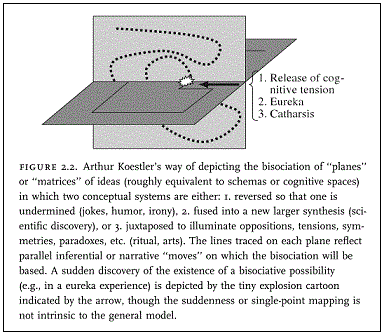
I have pointed before to this diagram from Mark Turner‘s The artful mind: cognitive science and the riddle of human creativity, based on those in Arthur Koestler‘s The Act of Creation (eg those on pp 35 and 37):

koestler-model.gif

It shows the essence of the creative act — the “release of cognitive tension” that occurs when some form of analogy, similitude, overlap allows the mind to join conceptual clusters from two fields in a “creative leap”.

Nancy Fouts’ work doesn’t merely make use of such twinned field overlaps, it makes twinned fields with overlap the defining quality of her works.

She is aiming right at the heart of the creative process. And it shows.

Moving further afield:

.
In that earlier post of mine, I talked about Ada, Countess of Lovelace, and noted that her analogy between Charles Babbage‘s Analytical Engine and Jacquard‘s mechanical loom, famously expressed by her thus:

The Analytical Engine … weaves algebraic patterns, just as the Jacquard-loom weaves flowers and leaves.

was precisely the creative leap that led to the us of punched card systems in computation from Babbage to Watson…

I could give other examples. The Taniyama-Shimura conjecture which formed the basis of Andrew Wiles‘ proof of Fermat‘s Last Theorem, bridges two previously distinct branches of mathematics precisely by showing that for every elliptic curve, there is a related modular form

And no, I don’t understand the mathematics. But I understand the concept of twinned fields, and the power of their overlap.

Some favorite tropes:

.
Back, then, to Nancy Fouts:

One thing that interests me about her work is that she has a few simple “essences” that she returns to time and again: in this case, bees, forms that resemble honeycombs, and by implication, honey.

In my own work, making similar connections between what we might paradoxically call “kindred ideas in unrelated fields” — I might set Nancy’s honeybees across from the verse from the Upanishads [Brihadaranyaka, fifth Brahmana, 14] which says:

This Self is the honey of all beings, and all beings are the honey of this Self.

Another of Nancy’s tropes connects nature and music…

The piercing:

.
And thimbles, those miniature emblems of armor and protection, are another recurring theme:

Let’s take a look at that last image, of the thimble transpierced by a needle.

I believe it has a history — again, accessible via an associative leap. Here are three images of the “wounded healer” motif, two of them specifically images of the Inuit shaman who has harpooned himself — a motif which the anthropologist and zen roshi Joan Halifax writes “captures the essence of the shaman’s submission to a higher order of knowing”:

Armor, the defenses we have in place to protect our selves, and vulnerability, the ability to to allow our selves to be wounded, so that the “self” which is “the honey of all beings” may shine through us. The paradox of Selflessness and Self.

Koan and sacrament:

.
Among wounded healers, we might count the crucified Christ, his side pierced by the spear of a Roman soldier — and here I might suggest that Fouts contrasts (image below, left) the self-sacrifice at the heart of Christianity with the pugilistic approaches of some proponents of his message:

And the image of Christ (right) balancing on a high wire?

Again I’m reminded of the language of shamanism. The anthropologist Barbara Myerhoff studied the religious beliefs and practices of the Huichol or Wixaritari of the Mexican Sierra Madre Occidental, with Ramon Medina Silva, a mara’akame or shaman of the tribe.

In her book, Peyote Hunt: The Sacred Journey of the Huichol Indians, she describes a feat of balance that Ramon performed, which appeared to serve a “sacramental” function for his people – providing them with what Cranmer‘s Book of Common Prayer calls “an outward and visible sign of an inward and spiritual grace”:

One afternoon Ramon led us to a steep barranca, cut by a rapid waterfall cascading perhaps a thousand feet over jagged, slippery rocks. At the edge of the fall Ramon removed his sandals and told us that this was a special place for shamans. We watched in astonishment as he proceeded to leap across the waterfall, from rock to rock, pausing frequently, his body bent forward, his arms spread out, his head thrown back, entirely birdlike, poised motionlessly on one foot. He disappeared, reemerged, leaped about, and finally achieved the other side. We outsiders were terrified and puzzled but none of the Huichols seemed at all worried. The wife of one of the older Huichol men indicated that her husband had started to become a mara’akame but had failed because he lacked balance.

It’s easy to read the description — but by no means as easy to keep one’s balance — something that Fouts’ image perhaps suggests more vividly than words easily can.

Richard de Mille describes the mara’akame‘s function in Huichol society as to “cross the great chasm separating the ordinary world from the otherworld beyond,” and suggests that Medina Silva’s feat of acrobatics on the barranca that day is to be understood as offering “a concrete demonstration in this world standing for spiritual balance in that world.”

Myerhoff herself was never entirely sure whether Medina Silva was “rehearsing his equilibrium,” or giving it “public ceremonial expression” that afternoon: it is clear, however, that for the Huichols, such feats of balance possess a resonance and meaning that extends beyond the “merely” physical.

Bringing the viewer into the picture

.
I may of course be projecting some of my own ideas onto Nancy Fouts’ work — and indeed, perhaps that’s the point.

She has some pretty fierce observations to make concerning matters religious — Christian, Buddhist and other — and I’ll leave those who are interested to make their own discoveries on her website. I don’t doubt there are places where her sympathies and my own overlap, and others where we differ.

Fouts speaks a direct and visceral language of images — and her juxtapositions, carefully chosen and choreographed as they are, provoke us to feel and think.

Thank you, Nancy.

No need to reach for the gun, fellas — but that’s art.

_________________________________________________________________________________________

credits for images of Harpooned Shaman: Charlie Ugyuk (left); David Ruben (right).

Perception and Strategy Part I.

Tuesday, March 20th, 2012

Jason Fritz at Inkspots had a thoughtful post about Afghanistan in light of recent events and made some points regarding strategy well worth further consideration. I suggest that you read his post in full, but I will comment on excerpts of his remarks below in a short series of posts. Here’s the first:

Delicate strategic balancing: perception’s role in formulating strategy

…..That all said, incidents in Afghanistan these past few months have caused me to question the validity of strategies that hinge upon the perspectives of foreign audiences*. This is not to negate the fact that foreign perspectives affect nearly every intervention in some way – there has been plenty of writing on this and believe it to be true. I firmly believe that reminding soldiers of this fact was possibly the only redeeming value of the counterinsurgency manual. To say nothing of this excellent work. But strategies that hinge upon the perspectives of foreign populations are another matter altogether. 

I think Jason is correct to be cautious about either making perception the pivot of strategy or throwing it overboard altogether. The value of perception in strategy is likely to be relative to the “Ends” pursued and the geographic scale, situational variables and longitudinal frame with which the strategist must work. The more extreme, narrow and immediate the circumstances the more marginal the concern about perception. Being perceived favorably does not help if you are dead. Being hated for being the victor (survivor) of an existential war is an acceptable price to pay.

Most geopolitical scenarios involving force or coercion though, fall far short of Ludendorf’s total war or cases of apocalyptic genocide. Normally, (a Clausewitzian would say “always”) wars and other violent conflict consist of an actor using force to pursue an aim of policy that is more focused politically and limited than national or group survival; which means that the war or conflict occurs within and is balanced against a greater framework of diverse political and diplomatic concerns of varying importance.  What is a good rule of thumb for incorporating perception into strategy?

According to Dr. Chet Richards, the advice offered by John Boyd:

….Boyd suggested a three part approach:

  • With respect to ourselves, live up to our ideals: eliminate those flaws in our system that create mistrust and discord while emphasizing those cultural traditions, experiences, and unfolding events that build-up harmony and trust.  [That is, war is a time to fix these problems, not to delay or ignore them. As an open, democratic society, the United States should have enormous advantages in this area.]
  • With respect to adversaries, we should publicize their harsh statements and threats to highlight that our survival is always at risk; reveal mismatches between the adversary’s professed ideals and how their government actually acts; and acquaint the adversary’s population with our philosophy and way of life to show that the mismatches of their government do not accord with any social value based on either the value and dignity of the individual or on the security and well being of society as a whole.  [This is not just propaganda, but must be based on evidence that our population as well as those of the uncommitted and real/potential adversaries will find credible.]
  • With respect to the uncommitted and potential adversaries, show that we respect their culture, bear them no harm, and will reward harmony with our cause, yet, demonstrate that we will not tolerate nor support those ideas and interactions that work against our culture and fitness to cope. [A “carrot and stick” approach.  The “uncommitted” have the option to remain that way—so long as they do not aid our adversaries or break their isolation—and we hope that we can entice them to join our side. Note that we “demonstrate” the penalties for aiding the enemy, not just threaten them.]

I would observe that in public diplomacy, IO  and demonstrations of force, the United States more often than not in the past decade, pursued actions in Afghanistan and Iraq that are exactly the opposite of what Boyd recommended. We alienated potential allies, regularly ignored enemy depredations of the most hideous character, debased our core values, crippled our analysis and decision-making with political correctness and lavishly rewarded treachery against us while abandoning those who sacrificed at great risk on our behalf . We are still doing these things.

Most of our efforts and expenditures at shaping perception seem to be designed by our officials to fool only themselves.

The End and Ends

Tuesday, March 13th, 2012

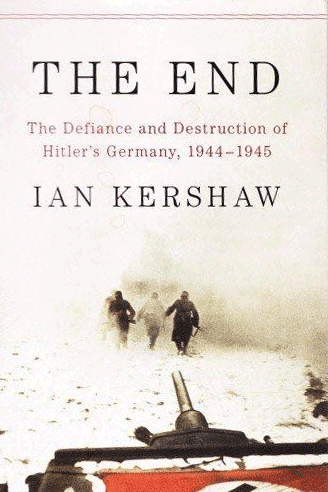
The End by Sir Ian Kershaw

I am currently reading The End, about the last year of the Third Reich and the Nazi death spiral toward Germany’s absolute destruction. It is a fascinating, mass suicidal, political dynamic that was mirrored to an even greater degree of fanaticism by Nazi Germany’s Axis partner, the Imperial Japanese. Facing the prospect of certain defeat, the Germans with very few exceptions, collectively refused every opportunity to shorten the agony or lighten the consequences of defeat and stubbornly followed their Fuhrer to the uttermost doom. It made no sense then and still does not now, seven decades later.

Adolf Hitler’s personal authority over the life and death of every soul in Germany did not end until his last breath. When surrounded by Soviet armies, trapped in his Fuhrerbunker in the ruin of Berlin, all it took for Hitler to depose his most powerful paladins, Hermann Goering and Heinrich Himmler was a word. They still commanded vast military and paramilitary security forces – Himmler had been put in charge of the Home Army as well as the SS, Gestapo and German police – but when Hitler withdrew his support and condemned them, their power crumbled. Goering, the glittering Nazi Reichsmarchal and second man in the state, was ignominiously arrested.

Even in Gotterdammerung, the Germans remained spellbound, like a man in a trance placing a noose around his own neck.

Currently, the chattering classes of the United States are uneasily working their way toward a possible war with Iran, or at least a confrontation with Teheran over their illegal nuclear weapons program (some people will object that, technically, we are not certain that Iran has a weapons program. This is true. It is also irrelevant to the diplomatic dynamic created by Iran’s nuclear activities which the regime uses to signal regularly to all observers that they could have one).  There is much debate over the rationality of Iran’s rulers and the likely consequences if Iran is permitted to become a nuclear weapons state. There is danger and risk in any potential course of action and predictions are being made, in my humble opinion, far too breezily.

In the run-up to war or negotiation, in dealing with the Iranians and making our strategic calculations, it might be useful to recall the behavior of the Germans.


Switch to our mobile site