zenpundit.com » ideas

Archive for the ‘ideas’ Category

Clausewitz vs. Sun Tzu

Monday, December 13th, 2010
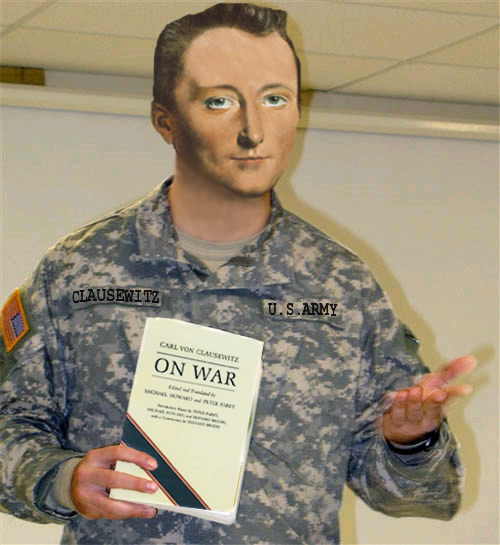
  

This article at SWJ blog has stirred a lively debate in the comments section with some very able practitioner-scholars weighing in.

….Sun Tzu?s ancient military philosophy of indirectness and gradualism runs counter-culture with much of mainstream western military strategy. Western reliance on superior technology and firepower shaped American counterinsurgency doctrine to be largely lethal in nature and enemy focused. Clausewitz instructed generations of military officers that the destruction of the enemy?s army is the primary goal in all combat1; therefore, all political-military conflict results in offensive action where attrition of the enemy force becomes a universal requirement. Clausewitzian war theory „worked? in both world wars in that the Allies did accomplish their desired goals; however critics such as Israeli strategist Shimon Naveh raise valid questions on whether Clausewitz?s fixation on offensive action and attrition warfare helped or hindered the Allied causes2. Despite Clausewitzian strategy?s seemingly illogical structure, application of his theories in the major 20th century conflicts created an enduring military school of war strategy with „On War? taking a sacred position.

In fairness to Clausewitz, this is over the top.

The US military could use more Sun Tzu; it is far more Clausewitzian in the perspective of the officer corps than it is “Sun Tzuite”, but the armed services are not the Children of Clausewitz. Not even the US Army. We’d probably be better off if the American military was more thoroughly one or the other in terms of strategic culture than the industrial age, bureaucratic, ad hoc, legacy thinking non-strategic hodgepode that currently prevails.

I do not expect that to change. American military organizational culture is driven more by appropriations than by ideas.

Some Related Links:

Sonishi.com Interview with Martin van Creveld on Sun Tzu

Sonishi.com Interview with Chet Richards on Sun Tzu and Boyd

Christopher Bassford on Sun Tzu, Jomini and Clausewitz

Colin Gray on Clausewitz and the Modern Strategic World

The Clausewitz Roundtable

Strategy of the Headless Chicken

Book Mini-Reviews to Clear a Boundless Bibliographic Backlog!

Friday, December 10th, 2010

I have too many books that I have read that I would like to review that, realistically, I will never get to post on in conventional fashion. A fair number belong with Summer Series which seems ridiculous as it is two weeks to Christmas! Therefore, brace yourselves, as I commence the first, and hopefully only, Mini-Reviews post:

Play: How It Shapes the Brain, Opens the Imagination, and Invigorates the Soul by Stuart Brown, MD

Dr. Stuart Brown, scientist and psychiatrist, has written a short tome on the nature and cognitive value of play. While there is plenty of child social development information and “pop”self-helpish type chapters, ZP readers wil gravitate to the chapters on play’s vital role in creaivity and innovation ( which are not the same thing), scientific discovery and work. Also of interest are the spectrum of “play personalities” and the “dark side of play”. Not an academic book but a reasonable read on a deceptively complex subject.

The Collapse of Complex Societies by Joseph Tainter

A superb academic book, previously featured and reviewed in the blogosphere by John Robb and Joseph Fouche, The Collapse of Complex Societies embarks upon a critical examination and partial de-bunking of theories that purport to explain the “sudden” fall of great empires, such as Rome or the vanishing of the Mayans. With caveats, Tainter settles on declining marginal returns from increasing societal investment in complexity as a rough proximate cause capable of subsuming a ” significant range of human behavior, and a number of social theories” under it’s rubric. Highly recommended.


The Bin Ladens: An Arabian Family in the American Century by Steve Coll

A biography of the Bin Laden family, this book does not come close to matching the impact or importance of Coll’s previous instant classic, Ghost Wars. There are many interesting trivialities about the divergences between the “religious and the hard Rock Cafe wings” of the Bin Laden families, and intriguing nuggets about political matters such as the 1979 takeover of the Grand Mosque and the connections between the Bin Ladens and elite figures inside the beltway but anyone looking for insight into Osama bin Laden will be disappointed. The most infamous member of Saudi Arabia’s dominant non-royal business clan is a subdued figure in this biography. Coll’s superior skills as a wordsmith and reporter manage to make the book a pleasant page turner.

The Death and Life of the Great American School System: How Testing and Choice Are Undermining Education by Diane Ravitch

Conservative education scholar and historian Diane Ravitch lays out the demise of the movement for high curricular standards in public education that she once championed and it’s transmogrification under NCLB into a punitive system that is slowly imposing an unprecedentedly narrow and dumbed down national curriculum focusing on basic math and reading skills, featuring gamed  test results, highly paid lawyer-consultant insiders and perverse incentives for public and charter schools alike. A depressing but important read.

WikiLeaks: Counterpoint at the State Department?

Wednesday, December 8th, 2010

[ by Charles Cameron ]

[ note: all links are to youtube videos ]

The pianist Glenn Gould is celebrated for his ability to bring the different and at times positively oppositional voices in a fugue by Bach to our attention, so that we follow each one separately while hearing all at the same time as a single whole. What is less known is that he liked to sit at a table in a truck stop and listen to the different conversations at the other tables and booths, mentally braiding their pale or brightly colored threads of human together into an analogous tapestry — one voice harmonizing with or conflicting against another, here a new subject introduced, there an echo of an earlier idea heard in a fresh context, with the murmurings of waitresses punctuated by the kaching! of the cash register, the hydraulic hiss of a door closing — conversation as counterpoint.

Organizations and individual alike, we all have different and at times dissonant voices, and strive to bring them to some kind of resolution. The many stakeholders debating an issue in town halls, blogs or letters to the editor, the many drives within each one of us, idealistic, hopeful, defeated, paralytic, angry, evasive, sluggish, vengeful, curious, alert, defiant, all have voices, all constitute an experience of polyphony, a “music of many voices”, in point counter point.

One of my interests is to find a way to score these many fugues, these musics of meaning.

My DoubleQuotes, then, can be considered as two-part inventions, attempts to show the multiple tracking of the mind — whether of a single individual, as in this case, or of a group, a community, a world divided – so that something of the music begins to be visible, and some of the dissonances can move towards necessary resolution.

*

QUOwikileaks

*

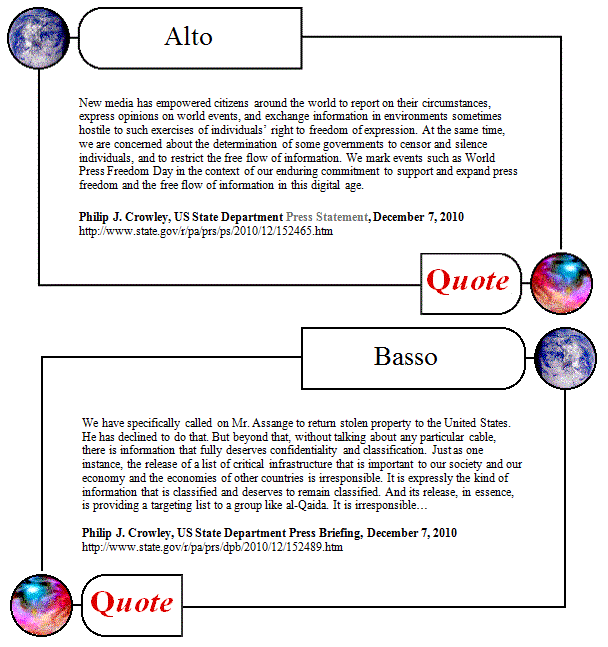
I believe there is unresolved irony between these two statements, made on the same day by Philip J Crowley, the US State Department’s Assistant Secretary, Bureau of Public Affairs – but each has its reasons, and there are arguments to be made for both transparency and opacity, diplomacy and publicity, secrets and revelations.

Between them lies the possibility I think of as a virtual music of ideas.

*

Bach published a series of two-part inventions, BWV 772–801, and wrote of them that he intended to offer them as an honest method

by which the amateurs of the keyboard – especially, however, those desirous of learning – are shown a clear way not only (1) to learn to play cleanly in two parts, but also, after further progress, (2) to handle three obligate parts correctly and well; and along with this not only to obtain good inventions (ideas) but to develop the same well; above all, however, to achieve a cantabile style in playing and at the same time acquire a strong foretaste of composition…

Later comes the Art of Fugue.

Simplification for Strategic Leverage

Sunday, December 5th, 2010

Remember this much ridiculed visual monstrosity?:

Excessively complex representations, much less the bureaucratic systems in practice, are poor vehicles for efficient communication of strategic conceptualizations to the uninformed – such as those downstream who must labor to execute such designs. Or those targeted by them for help or harm.  In addition to the difficulty in ascertaining prioritization, the unnaturally rigid complexity of the bureaucracy generally prevents an efficient focus of the system’s resources and latent power. The system gets in it’s own way while eating ever growing amounts of resources to produce less and less, leading to paralysis and collapse.

Does it have to?

Here’s an interesting, very brief take on analytical simplification from a natural scientist and network theorist Dr. Eric Berlow on how to cull simplification – and thus an advantage – out of complex systems by applying an ecological paradigm.

Cognitive simplification will be a critical strategic tool in the 21st century.

A draft of what’s on my mind lately

Sunday, December 5th, 2010

by Charles Cameron
[ cross-posted from ChicagoBoyz ]

I’ve been thinking…

*

Reports, overstatements and underestimates

There are factual reports of violence and threats of violence, which are within the proper province of journalism and intelligence gathering.

There are also overstatements of such reports, generally resulting from paranoia, hatred, recruitment, or the desire to increase sales of advertising or munitions.

And there are understatements of such reports, generally resulting from sheer ignorance or a desire to be diplomatic.

*

Religious sanctions for violence

Similarly, there are factual reports of sanctions for violence in the scriptures, hagiographies and histories of various religions.

There are also overstatements of such reports, attributing to entire religions the beliefs and or activities of a significant subsection or outlier group of that religion

And there are understatements of such reports, avoiding the attribution of violence to religious beliefs regardless of whether the religious correlation is a “cover” for other motives or a sanction powerfully affecting the actions of those who respond to it.

*

Proportional and disproportionate responses

There are actions which represent a balanced and proportional response to threats or acts of violence, whether they be made at home or abroad, by the military or law enforcement, for reasons of just war or of security.

There are actions which present an unbalanced and disproportionate heightened response to acts of violence, into which category I would place both over-reactive military responses and over-reactive domestic security measures.

And there are inactions which are no less unbalanced as responses to acts or threats of violence, as with political wool-gathering or appeasement, bureaucratic failures to implement realistic information sharing and dot-connection within the IC, or public aversion to factual news or intelligent, nuanced analysis.

*

Ideals, kumbaya and skepticism

There are honest statements of aspiration for peaceable outcomes to current and future conflicts.

There are versions of such aspirations which naively overlook the very real correlations between religious sanctions and violence.

And there are skeptical aversions to such aspirations, which no less naively overlook the very real differences which are present between the most angry, the most terrified, the most politically driven, the most financially interested and the most generous members of any and every religious and irreligious viewpoint.

*

Let’s talk…

It is useful to bear these distinctions of category in mind, and to make accurate appraisals of one’s information inputs in terms of which categories they fall under, and how much trust one should therefore place in them.

There: it was on my mind and I have said it.

This is, as my title indicates, a first draft. I hope it will spark some interesting conversations, and lead to further insight and refinement…


Switch to our mobile site